Weekend links 78

carr.jpg

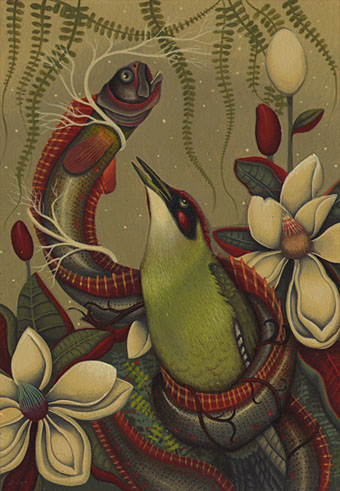
Struggle (2009) by Lindsey Carr.

• “Twilight Science is an imprint for sound, music and DVD editions initiated by artist Paul Schütze. We will progressively publish all back catalogue, new projects and collaborations. These will include works by Phantom City, NAPE, Schütze-Hopkins and others.” Related (because Paul Schütze remixed Main): Main Feed The Collapse, Neil Kulkarni talks to Robert Hampson.

• “You can’t really narrate or display this situation, you can only, endlessly, contemplate it. When the writer or director gets tired of the iterations, he tells us who the mole is.” Michael Wood on the novel, (superb) television series and recent film of Tinker, Tailor, Soldier, Spy.

• “Havin’ a dick is pretty fuckin’ awesome” says Horst, a new gay magazine limited to 1000 copies. Related (well, there’s a guy in and out of his underwear): Naked Lunch, a fashion shoot very tenuously based on David Cronenberg’s film.

“At first, I tried fighting bullies one-on-one, but they don’t fight fair; they fight two and three on one,” Bennett said. So the youths got together and “started carrying mace, knives, brass knuckles and stun guns, and if somebody messed with one of us then all of us would gang up on them.”

 “Gay black youths go from attacked to attackers” says the headline. A group of genuine Wild Boys; William Burroughs would have approved.

• Tor.com reminded me of Sally Cruikshank‘s amazing animated film Face Like a Frog (1987) which features a score and Cab Calloway-style song by Danny Elfman.

• It’s 1969, OK? Pádraig Ó Méalóid talks with Kevin O’Neill about the Swinging League of Extraordinary Gentlemen.

• In the Tumblr labyrinth this week: Fuck Yeah St Sebastian and Gender is Irrelevant.

• For when you need some motherfucking placeholder text: Samuel L Ipsum.

• “Study finds ‘magic mushrooms’ may improve personality long-term.”

Solar Megalomania: paintings by Leonora Carrington.

• It’s all fun and games until Charles Manson turns up.

Firmament II (1993) by Main | Firmament IV (1993) by Main | Reformation (1994) by Main.
A Wilde Night

bragdon.jpg

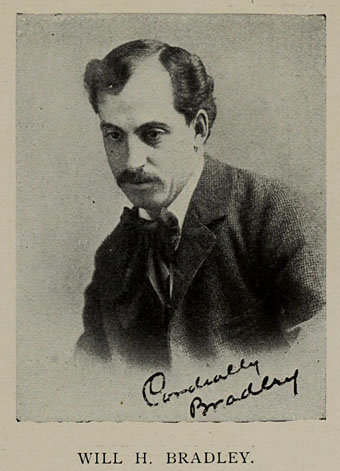
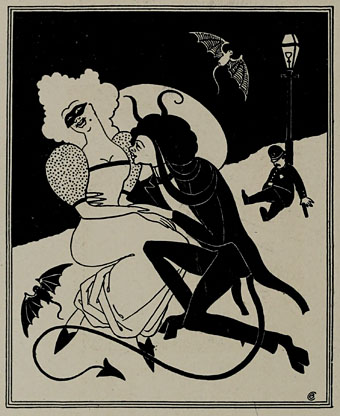
A couple more pieces from yesterday’s Posters in Miniature. The drawing above is entitled A Wilde Night and credited to Claude Fayette Bragdon (1866–1946) whose design work has appeared here before. Bragdon was an acquaintance of Will Bradley’s, and like Bradley was a man of many talents being variously employed as an architect, writer and stage designer. Bragdon and Bradley both worked together on The Chap-Book, Herbert Stone’s Chicago periodical which commenced publication in 1894, the same year as The Yellow Book, a magazine whose style and light-hearted content Stone and co. seemed keen to emulate. Bragdon’s small drawings for The Chap-Book are less Beardsley-like than Bradley’s designs which is why this very overt homage appears as a surprise.

yellowbook.jpg

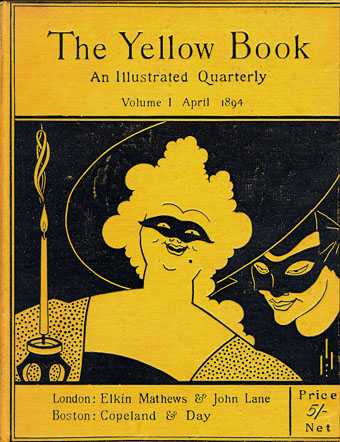
Bragdon’s picture is undated but the female figure is taken from Beardsley’s cover for the first issue of The Yellow Book which would place it in around 1894; the satyr-like male is an odd blend of bits of Beardsley’s male and female figures. Aubrey, however, would never have drawn bats like Bragdon’s, or a sleeping policeman…too gauche, my dear. As for the Wildeness, 1894 was only a year away from Oscar’s trial, a time when London was buzzing with scandalous rumours, none of which appear to have reached Chicago.

giannini.jpg

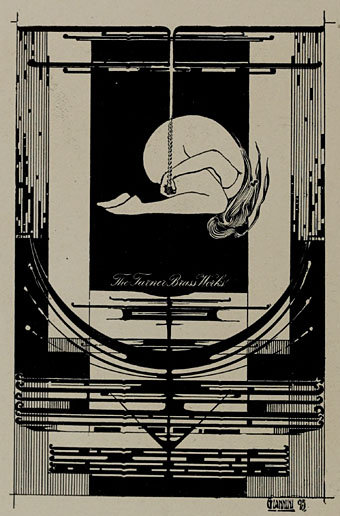
Also in Posters in Miniature is this piece by another American, Orlando Giannini (1860–1928), a glass designer and another Chicagoan who worked for a while with Frank Lloyd Wright. This design is dated 1895 and struck me with its radical appearance, so very different from the evolving Art Nouveau styles of the time. Giannini’s work as a glass designer evidently brought a different sensibility to graphic design, one which would have still looked bold and original ten years later.

Elsewhere on { feuilleton }
The Aubrey Beardsley archive
The illustrators archive
The Oscar Wilde archive

Will Bradley posters

bradley01.jpg

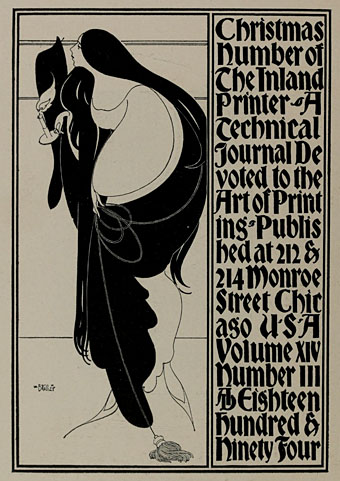
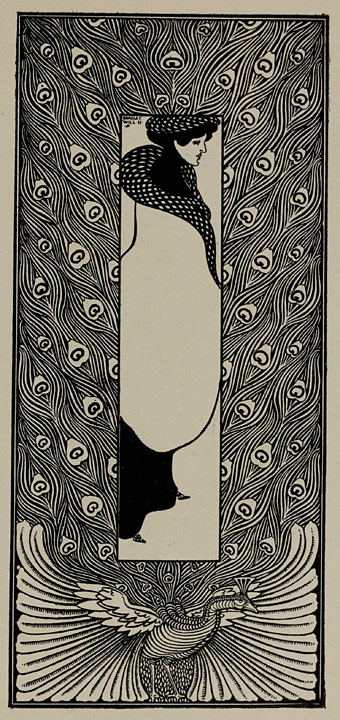
More from American illustrator and designer Will Bradley (1868–1962) from the height of his Beardsley period circa 1894–95. These are from a collection by Edward Penfield entitled Posters in Miniature (1897) in which Bradley’s work receives more attention than some of his better-known contemporaries. Half of these designs are familiar, the rest I hadn’t seen before, including the peacock piece below. Even though Bradley was trying out various Beardsley moves at this stage, his work was always a lot more versatile than the lesser imitators. More of Bradley’s designs, and work by other artists, can be found in the scanned edition of Penfield’s book at the Internet Archive.

bradley02.jpg

bradley03.jpg

Continue reading “Will Bradley posters”

Brion Gysin’s walk, 1966

gysin.jpg

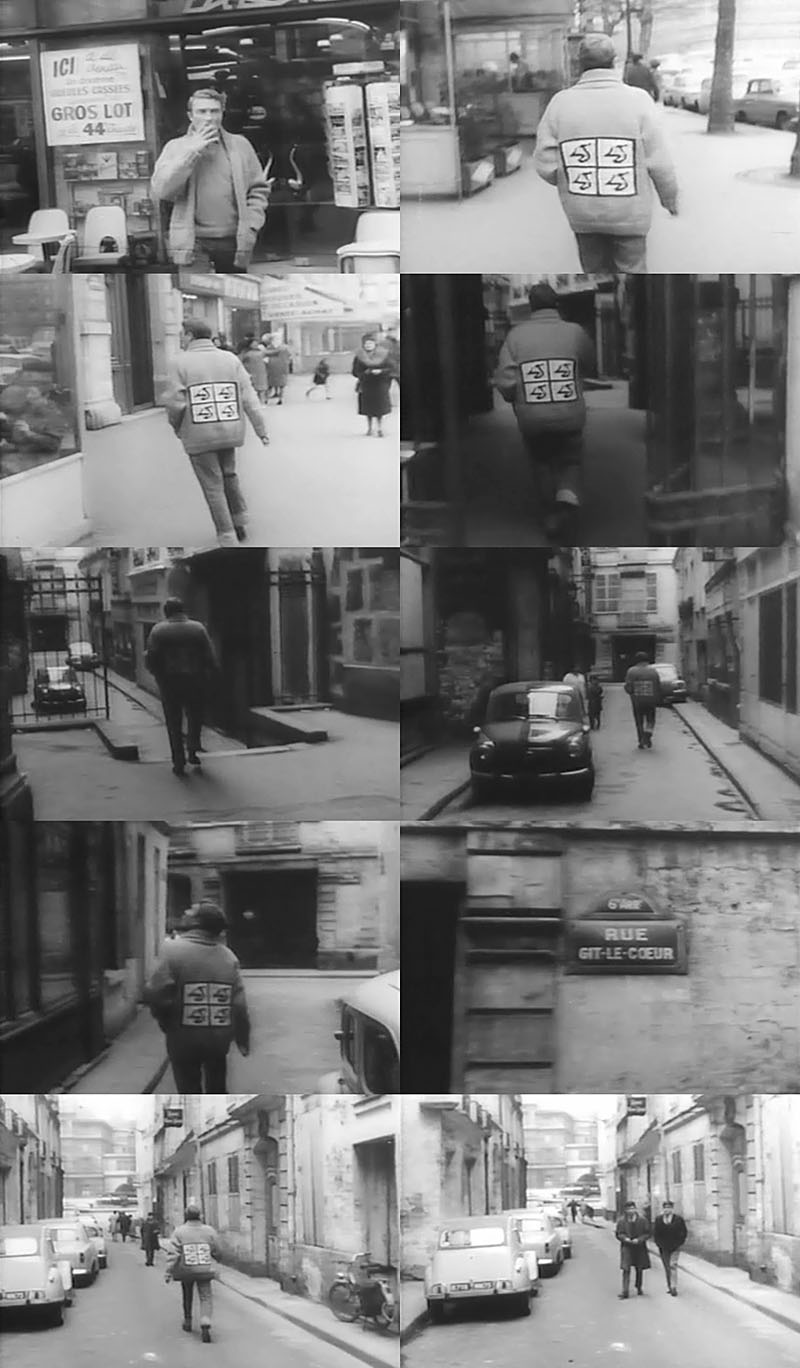
The Cut-Ups (1966).

More of the present preoccupation. Choosing Brion Gysin as a subject seems like a detour but the shots above are from Antony Balch’s 1966 film The Cut-Ups which also features William Burroughs, Ian Sommerville and someone-or-other’s cute boyfriend of the time who’s only ever credited as “Baby Zen”, a person about whom I know nothing at all.

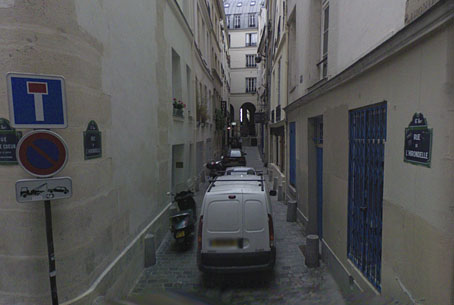
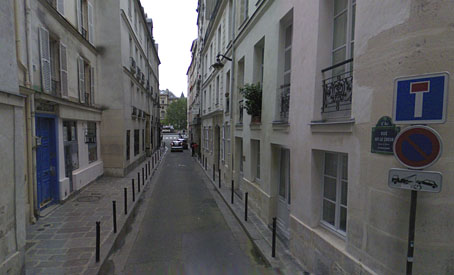
I first saw The Cut-Ups in video form projected on the screens of the Haçienda nightclub in Manchester during their Final Academy evening in 1982, an event at which Burroughs and John Giorno both gave readings. The film on that occasion was mixed with some of the other Antony Balch shorts including Towers Open Fire, and together they made a strong (and bewildering) impression. The Cut-Ups, as noted a few days ago, may have inspired some of the flash edits in Performance, although Nicolas Roeg had been cinematographer on Petulia for Richard Lester the year before, a film which uses similar Resnais-like flashbacks and flash-forwards. In Balch’s film several sequences each a foot in length are cut together at random, a process which was a lot more radical in 1966 than it looks today. The opening sequence shows Brion Gysin walking out of a shop, along a street, down an alley and into the Rue Git le Coeur where the Beat Hotel was located at no. 9, and into whose door he disappears. I visited the street the last time I was in Paris, and took a few snaps whilst there, but it wasn’t until I rewatched The Cut-Ups a couple of years later that I realised I’d made the same walk as Gysin, having inadvertently discovered the narrow passage (the Rue de L’Hirondelle) which connects Git le Coeur with the Boulevard Saint-Michel.

saintmichel1.jpg

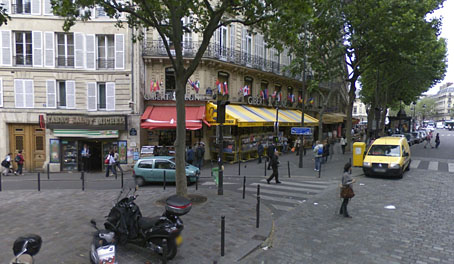
The corner of the Boulevard Saint-Michel where Gysin’s walk begins.

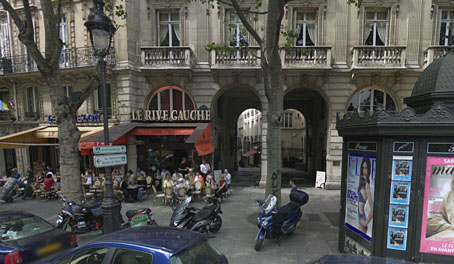
The route can be traced (after a fashion) using Google’s Street View where the photos have the usual drawbacks of being positioned high in the air and with a field-of-view which makes narrow spaces look a lot more cramped than they seem when you’re there. For those who can’t visit Paris, however, you at least get a sense of the Latin Quarter, even though the area is a lot more gentrified today than it was in 1966. The Beat Hotel, as I’ve noted before, is now the expensive Hotel du Vieux Paris whose website makes no mention of their establishment having once been cheap lodgings for depraved writers, artists and junkies. As for the Gysin film, I still wonder where he began his walk: was it at the Tabac Saint-Michel or elsewhere? You can judge for yourself at Ubuweb which has a copy of The Cut-Ups in its Burroughs film collection.

saintmichel2.jpg

Rue de L’Hirondelle from the Boulevard Saint-Michel.

saintmichel3.jpg

Rue de L’Hirondelle from Rue Git le Coeur.

saintmichel4.jpg

Rue Git le Coeur looking towards the Seine. The former Beat Hotel is down the street on the right.

Elsewhere on { feuilleton }
The William Burroughs archive

Burroughs in Paris

wsb-paris1.jpg

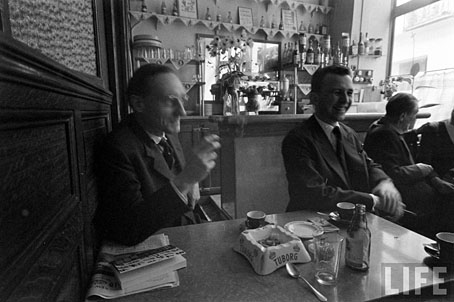
William Burroughs and Maurice Gerodias.

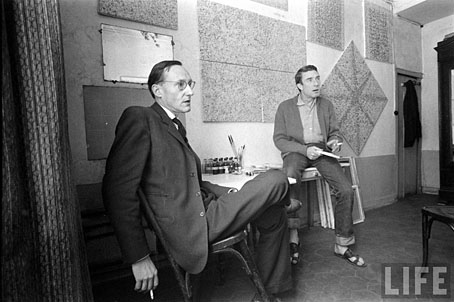
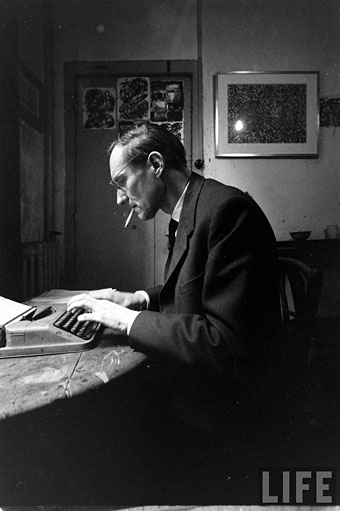
More specifically, William Burroughs photographed in 1959 for Life magazine by Loomis Dean. This was no doubt a story based around the publication of The Naked Lunch by Olympia Press: in the full set there’s shots of Burroughs with Olympia boss Maurice Gerodias, some pictures of the author signing copies of his novel (which can also be seen resting on the newspaper above), and many shots of the shabby interior of the Beat Hotel where the walls of Burroughs’ and Brion Gysin’s rooms are decorated with Gysin’s calligraphic paintings.

wsb-paris2.jpg

Burroughs and Gysin.

Over at the Time archives there’s an amusingly snotty review from 1962 of the first US publication of The Naked Lunch. The reviewer isn’t credited but they trot out details of Burroughs’ history with the implication that nasty people can’t possibly be good or worthwhile writers. In 1962 the Pulitzer Prize for Fiction was won by something called The Edge of Sadness by Edwin O’Connor. What? Who? Exactly.

wsb-paris3.jpg

Elsewhere on { feuilleton }
The William Burroughs archive