Quay Brothers: On Deciphering the Pharmacist’s Prescription for Lip-Reading Puppets

quays1.jpg

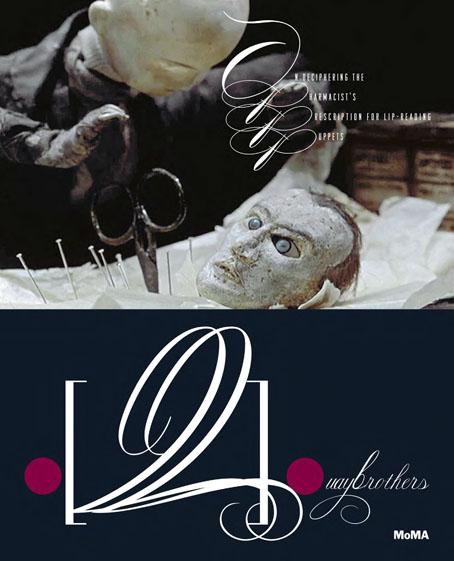
It’s not exactly the most appropriate moment to be recommending an exhibition in New York given the chaos in the city following the recent hurricane. However… Quay Brothers: On Deciphering the Pharmacist’s Prescription for Lip-Reading Puppets has been running at MoMA since August, and will continue into early 2013. A copy of the catalogue turned up this week, a slim volume of 64 pages that’s nevertheless an essential item for Quay obsessives such as myself.

quays2.jpg

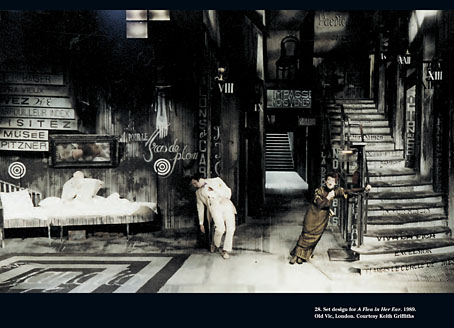
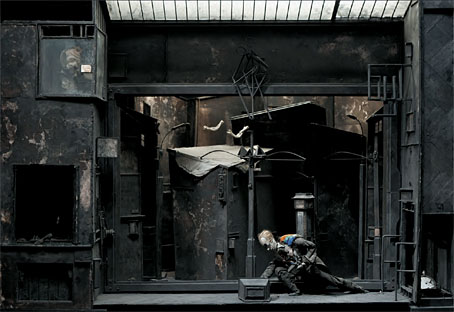
Set design for A Flea in Her Ear (1989).

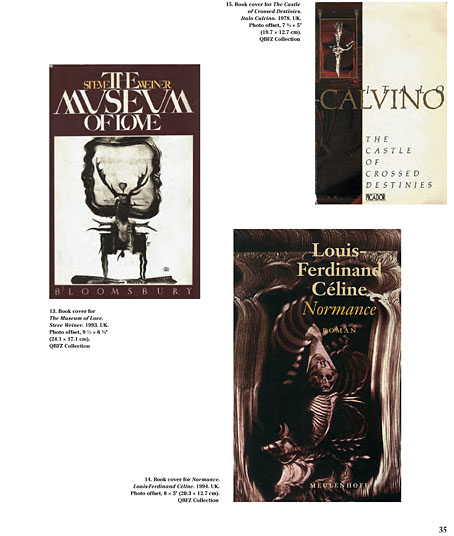
I’ve written before that while the Quays’ films are the most visible part of their oeuvre, much of their early output as artists and designers remains either obscure or unavailable. So it’s a pleasure to find a number of their early drawings, poster designs and book covers reproduced here. The catalogue also features examples of gallery installations and their designs for the stage. Ron Magliozzi, the curator, and Edwin Carels contribute essays while the Quays themselves are “interviewed” by Heinrich Holtzmüller “who was once real and now only exists under the glass of a museum vitrine in Nürnberg”. An appendix includes a thorough listing of their film works, giving me more things to chase at a later date.

quays3.jpg

In addition the Quays have also designed parts of the book, notably the title pages which feature their idiosyncratic typography. The catalogue may be purchased direct from the museum.

quays4.jpg

Grand Box, decor for Street of Crocodiles (1986).

Elsewhere on { feuilleton }
The Quay Brothers archive

Holbein’s Dance of Death

holbein01.jpg

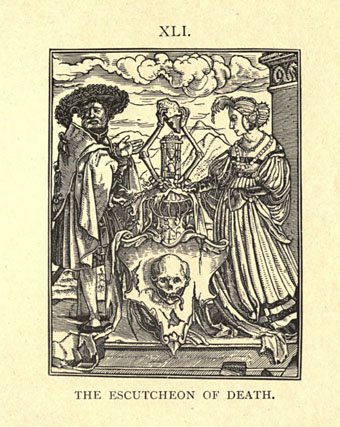
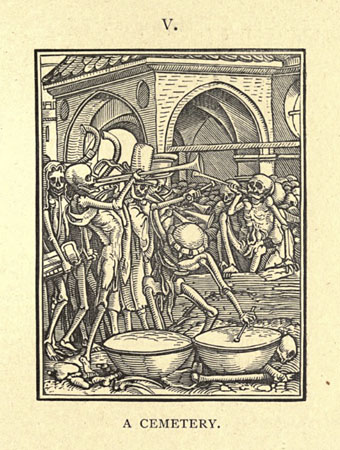
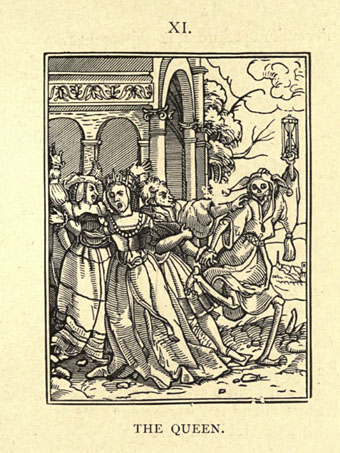
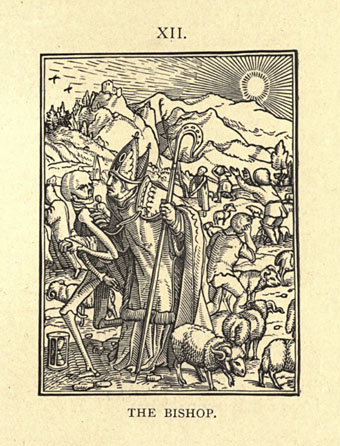
A post for Día de los Muertos. The Internet Archive has several books reprinting the Dance of Death by Hans Holbein the Younger (1497–1543). These samples are from an 1892 edition. There’s also a complete copy of the very rare original printing, Les Simulachres & Historiees Faces De La Mort, Autant Elegamme[n]t Pourtraictes, Que Artificiellement Imaginées (1538), but the reproductions aren’t as good as the later copies. Later this month the Wellcome Collection in London hosts Death: A Self-portrait, an exhibition of memento mori and related art from the Richard Harris collection. They don’t say whether Holbein will be included but I’d be surprised if he wasn’t, these images of popes, kings and paupers being hauled to the grave by grinning skeletons have been reproduced endlessly. For an example of Holbein’s astonishing painting try his portrait of Charles de Solier.

holbein02.jpg

holbein03.jpg

holbein04.jpg

Continue reading “Holbein’s Dance of Death”

A playlist for Halloween: Hauntology

ghostbox.jpg

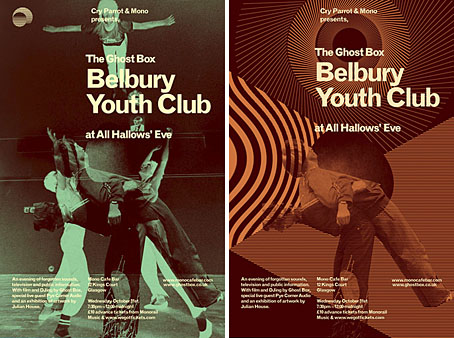
Flyers by Julian House for tonight’s Ghost Box event at Mono Cafe Bar, Glasgow.

It’s a tradition here to post some recommended listening each Halloween. This year there’s an embarrassment of riches with five listings chosen from the multitudes at Mixcloud. Hauntology is the theme, not Jacques Derrida’s spectral musings but Simon Reynolds‘ deployment of the term to define the music produced by artists on the UK’s Ghost Box label—Belbury Poly, The Focus Group, The Advisory Circle, Pye Corner Audio et al—and their allies delving into similar areas: “folklore, vintage electronics, library music and haunted television soundtracks”. I’ve been plugging the Ghost Box people for years but going by Mark Pilkington’s recent introduction to the sub-genre some still find this information to be news.

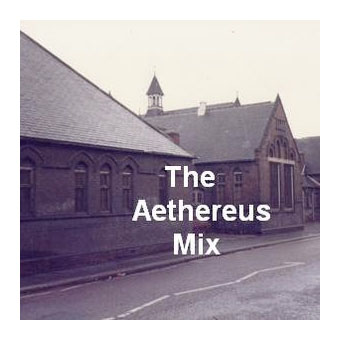
All the following mixes feature Ghost Box tracks, with the Ghost Radio mix being almost solely derived from the label’s releases. All the mixes are a year or so old apart from the Samhain Seance which was posted at the weekend. I’ve been playing these round the clock for the past couple of days, enjoying the way one playlist bleeds into another. Given the choice of only one I’d pick Samhain Seance, a great selection and very adeptly sequenced. Among the highlights there’s a lengthy extract from the occult-themed TV serial I mentioned yesterday, Children of the Stones, which had a superb vocal score by contemporary classical composer Sidney Sager. The Aethereus Mix also features Sager’s score, and opens with a warning from The Stone Tape which has even greater resonance today: “It’s in the computer!”

(Note: I corrected some of the track credits.)
mix1.jpg

The Aethereus Mix by Soulless Central Radio

The Box Of Delights by Roger Limb
Ecneuqes Rorrim by Pye Corner Audio
The Unseeing Eye by Malcolm Clarke
Cheyne Walk by Jon Brooks
Manège by Jaques Lasry
Children Of The Stones by Sidney Sager
Chocky by John Hyde
A Year And A Day by Belbury Poly
Willow’s Song by Paul Giovanni
Saturn by Neu! [What? This isn’t Neu! It’s a piece by an American artist, Neue.]
Variation 19 by Andrew Lloyd Webber
House Among The Laurels by Jon Brooks
The Ghost Of John by Kristen Lawrence
Double Trouble by John Williams
Windfall by Dead Can Dance
mix4.jpg

Fantasmagories by Timewriter

Funerailles Des Vampires by Acanthus
Hypnosis by Atrium Carceri
The Moonlawn by Belbury Poly
The Giving Of The Grape by Blood Stereo
Enferissimo by Camille Sauvage
Dream Music by Jonathan Elias
Evaparizione by Ennio Morricone
Spellbound by Creed Taylor
Sequenza Psichedelica by Piero Umiliani
Fantasm by Bernard Fevre
Funeral Organ by Fred Myrow
Uomini Al Bando by Bruno Nicolai
Lucifer Rising by Jimmy Page
Black Mass by Mort Garson
Spookies by James Calabrees
Forest Of Evil by Frank Reidy & Eric Allen
Hell House by Brian Hodgson & Delia Derbyshire
Raven’s Lament by The Haxan Cloak
Voodoo by The Natural Yoghurt Band
Lost World by Moran Russell
Falling by Delia Derbyshire
Sang Pourpre by Igor Wakhévitch
Untitled by Vladimir Ussachevsky
mix2.jpg

Ghost Radio by elevatoresque

Activate The Poacher by Moon Wiring Club
The Willows by Belbury Poly
Sundial by The Advisory Circle
The Third Eye Centre by Mount Vernon Arts Lab
Hey Let Loose Your Love by The Focus Group
Mind How You Go by The Advisory Circle
Ghost Radio by Moon Wiring Club
Owls And Flowers by Belbury Poly
Civil Defence Is Common Sense by The Advisory Circle
Inside Shoebox Garden by Moon Wiring Club
Albion Festival Report by The Focus Group
Erosion Of Time by The Advisory Circle
Opening Leaves by Moon Wiring Club
Meditation On Nothingness by Roj
Feldspar by Mount Vernon Arts Lab
Nuclear Substation by The Advisory Circle
Far Off Things by Belbury Poly
Plant Room by Mordant Music
Jam Jar Carnival by The Focus Group
Everyday Electronics by The Advisory Circle
They Are In The Room With Us Right Now by Roj
Wool Book by Moon Wiring Club
Post Apocalypse Listings by Mordant Music
From An Ancient Star by Belbury Poly
Fire, Damp And Air by The Advisory Circle
mix3.jpg

The Insomniacs Almanac by Melmoth The Wanderer

While London Sleeps by Mount Vernon Arts Lab
So Run Down by The Caretaker
Moondial (Theme) by Unknown
The Bane Tree (intro) by (Episodes From) The Field Bazaar
Sorcerer by Ataraxia
The Black Drop by Mount Vernon Arts Lab
In A Beautiful Place Out In The Country by Boards Of Canada
Of Grace And Providence (Remixed) by The Caretaker
The Voice by Brian Hodgson & Delia Derbyshire
The Wicker Man by Paul Giovanni
Children Of The Stones Theme by Sidney Sager
Legend Of Hell House by Brian Hodgson & Delia Derbyshire
mix5.jpg

Samhain Seance by The Ephemeral Man

Twins Of Evil (extract)
Forest Of Evil (Dawn) by Demdike Stare
Blackthorn Winter by Sproatly Smith
The Harmony Programme by The Focus Group
Sulphur by Cyclobe
The Power Of The Witch (extract) Rare BBC Documentary
Another Witch Is Dead by The Eccentronic Research Council
Blood On Satan’s Claw (intro)
Disorder by The Haxan Cloak
Black Blind Light by Moonstone
Denned Earth (Decay And Rebirth) by Ruhr Hunter
Children Of The Stones — Episode 3 (extract), soundtrack by Sidney Sager
Strung Like Lights At Thee Printemps by Godspeed You Black Emperor
Grim Reaper by Teen Suicide
The Globe Inn by The Future Kings Of England
Halloween 3 (ending)

Previously on { feuilleton }
A playlist for Halloween: Orchestral and electro-acoustic
A playlist for Halloween: Drones and atmospheres
A playlist for Halloween: Voodoo!
Dead on the Dancefloor
Another playlist for Halloween
The Séance at Hobs Lane
A playlist for Halloween
Ghost Box

The Stone Tape

stonetape1.jpg

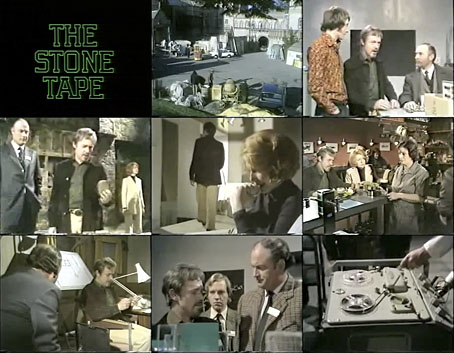
The Stone Tape has accrued a considerable cult reputation since it was first broadcast as a BBC ghost story during Christmas, 1972. I was too young to see the original transmission—I used to hear awed reports from those who remembered it—and didn’t get to see it until the BFI brought out on DVD a few years ago. That disc is now deleted, and the play is another unfortunate omission from the BFI’s Ghost Stories box set, so this seems a good opportunity to point the curious to the full-length copy that’s currently on YouTube.

stonetape3.jpg

In the past I’ve compared Nigel Kneale, the writer of The Stone Tape, to HP Lovecraft. This isn’t a comparison the often curmudgeonly Kneale might have agreed with but you can find similarities in the way both Kneale and Lovecraft (in his later fiction) created scenarios featuring scientists or technical people which grade from science fiction to outright horror. The horror can be something ancient and earthbound or, as in the case of Kneale’s Quatermass cycle, it can be extraterrestrial. Kneale’s narratives may return continually to scientific investigation but he was smart enough to avoid explaining away his mysteries. The Stone Tape is an uncanny masterpiece that often seems so bare-bones you can hardly believe the effect it’s creating compared to lavishly-budgeted yet inferior feature films. Something about Kneale’s drama works it way insidiously under the skin then lodges there. It leaves with its mysteries intact.

stonetape2.jpg

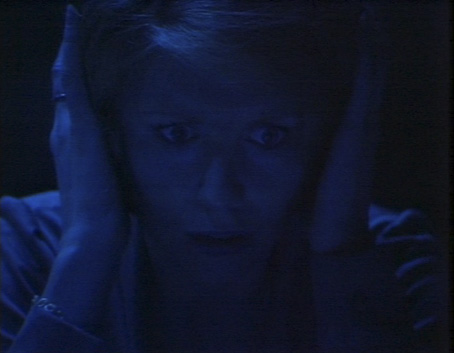
One reason Kneale’s Christmas play may have been left out of the BFI box is that it doesn’t fit the MR James model of accumulation-of-clues leading to revelation-of-spook. In Kneale’s story an industrial research and development team move into an old mansion building which turns out to be haunted. The manifestation of the ghost—usually the end point of most supernatural stories—quickly becomes an almost commonplace occurrence when the team decide to start probing its presence with their machines. Like most TV plays of the period this is done in the electronic studio but any absence of film atmosphere is compensated for by excellent writing and performances. Jane Asher plays a computer programmer and the only female professional in a group of loud and blustering men. She’s not only the person most sensitive to the spectral happenings but also proves to be the only one with the brains and tenacity to fathom the true nature of the haunting.

The conviction in the performances, Asher’s especially, and the quality and detail of Kneale’s characterisation, is what makes this production work so well. Among the other actors Michael Bryant is the stubborn team leader while Iain Cuthbertson plays the mediating foreman. Cuthbertson later had a major role in the cult TV serial Children of the Stones, and in 1979 was a memorable Karswell in an adaptation of MR James’ Casting the Runes. Also among the cast is Michael Bates who most people will know as the bellowing prison guard in A Clockwork Orange. The sound effects are by the Radiophonic Workshop’s Desmond Briscoe who also created electronic effects for The Haunting, Phase IV and The Man Who Fell to Earth. Director Peter Sasdy worked on a couple of the lesser Dracula films for Hammer but this is his finest hour-and-a-half. And if that isn’t enough priming for you I don’t know what else would suffice. I urge anyone who hasn’t seen this drama to turn off the lights and start the tape. It’s perfect Halloween viewing that grips to the very end.

Previously on { feuilleton }
Haunted: The Ferryman
Schalcken the Painter

Haunted: The Ferryman

ferryman1.jpg

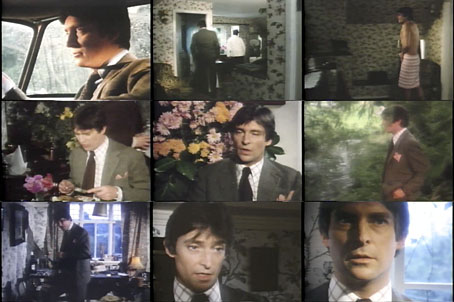
Another television ghost story from the 1970s, The Ferryman (1974) is no relation to the 2007 horror film of the same name. This 50-minute drama isn’t in the same league as Schalcken the Painter, or the other BBC ghost films, but it’s one I remembered and was surprised to find on YouTube. Haunted was a Granada production for ITV, and although it sounds like a series it seems there was only one other film in the run, Poor Girl (not on YouTube), a Turn of the Screw-like piece based on a story by Elizabeth Taylor (author not actress). The Ferryman is based on a story by Kingsley Amis, adapted by Julian Bond and directed by John Irvin, later to direct the BBC’s exceptional multi-part adaptation of Tinker, Tailor, Soldier, Spy. Interesting to see from Irvin’s credits that he also directed the now-forgotten Ghost Story (1981), a poor attempt to cram Peter Straub’s huge novel into a two-hour film.

The best thing about The Ferryman is seeing a very handsome Jeremy Brett playing novelist Sheridan Owen whose recent horror novel seems to have predicted events that he and his wife find themselves experiencing. (Ten years later Brett was back at Granada as my favourite Sherlock Holmes.) Despite some initial promise The Ferryman is less successful than you’d hope, possibly because of the weak and confused source material. With its middle class characters encountering the uncanny this could so easily have been a Robert Aickman story, and would have been far better for it. But it does serve a purpose in throwing into relief tomorrow’s post. Stay tuned.

Previously on { feuilleton }
Schalcken the Painter
“The game is afoot!”