Fišer and Liška

morgiana.jpg

Having enthused recently about Czech soundtrack composer Zdenek Liška, and about Juraj Herz’s The Cremator (1969), I can’t avoid mentioning the release this month of Liška’s soundtrack for Herz’s film which comes twinned on CD with Luboš Fišer’s equally distinctive soundtrack for Herz’s Morgiana (1972). Both films are available on DVD from Second Run. Having only discovered these works in the past month the soundtrack collection arrives at just the right moment, another excellent reissue from the UK’s Finders Keepers label who specialise in resurrecting neglected soundtracks, electronica and other obscure music. (Highlights from the electronic catalogue have included the reissue of Suzanne Ciani’s synth music from the 1970s and 80s.)

With Morgiana and The Cremator sharing a director it makes sense to present the soundtracks as a pair, but the films also share a macabre atmosphere that verges on outright weirdness. Where the character of the Cremator is obsessed with reducing human beings to ash, in Morgiana we have a sister plotting the slow death by poison of her twin in order to gain an inheritance. Fišer’s organ-inflected score is suitably dramatic, even melodramatic for the scenes where the poisoned sister is hallucinating, or we’re seeing everything from the point-of-view of the family cat. Finders Keepers’ albums are designed by Andy Votel who for this release has had the CD booklet printed with the Cremator pages running from the back to the centre so that—in the booklet at least—neither title is favoured.

Anyone curious about the Finders Keepers’ sound world can receive a taste via this mix by Andy Votel for Self-Titled Mag. It’s intended to tie-in with Cassette Store Day (that’s today) but really functions as a good sample of the record label’s obsessions. There’s some Suzanne Ciani in there, as well as a rare piece of Cristal Baschet playing from Lasry-Baschet.

Previously on { feuilleton }
Two sides of Liška
Liška’s Golem
The Cremator by Juraj Herz

Wildeana 10

wilde.jpg

Illustration from The House of Pomegranates (1914) by Jessie M. King.

Continuing an occasional series. Recent Wildean links.

• It’s a measure of a writer’s success if the characters or stories they create resonate sufficiently with future generations to be subject to new interpretations. Among Oscar Wilde’s contemporaries this has happened to Arthur Conan Doyle and Bram Stoker, both of whom Wilde knew. Increasingly it’s been happening to Wilde’s own fiction, especially in the case of Dorian Gray whose tragedy assumes the status of a modern myth. At Cannes this year, Clio Barnard premiered a contemporary retelling of Wilde’s The Selfish Giant. Bleeding Cool has some clips. The social realism is a long way from Wilde’s tale but that shows how flexible these fables can be.

• Jessie M. King’s illustrations for Wilde’s The House of Pomegranates have appeared here before but the copies posted at The Golden Age are the usual quality scans.

Rick Gekoski: “Visiting the US, I am reminded of Oscar Wilde’s tour there in 1881, which allowed him to become an orator and a celebrity.”

Paper Dolls by David Claudon based on the characters from The Importance of Being Earnest. (Thanks to Gabe for the tip.)

Elsewhere on { feuilleton }
The Oscar Wilde archive

Electronic Music Review

emr01.jpg

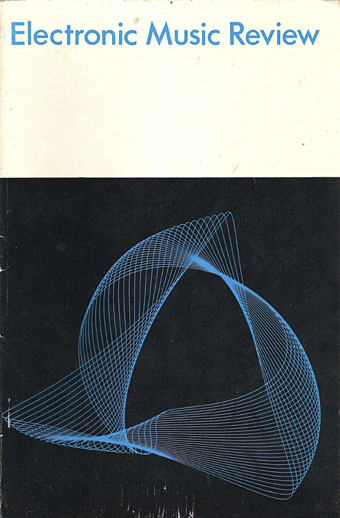
A new addition at the Ubuweb archives that’s catnip for anyone interested in the history of electronic music. Electronic Music Review was Reynold Weidenaar & Robert Moog’s short-lived journal devoted to the world of electronic music at a time when the field was rapidly growing away from the academic, “serious” side of musical composition and being taken up by the pop world.

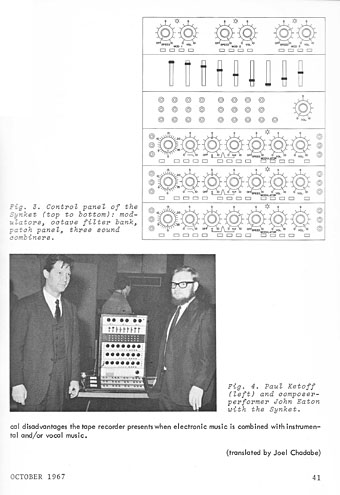
All seven issues are present, running from January 1967 to July 1968. Pages of VCF circuit diagrams aren’t so interesting unless you’re an electronic engineer but the magazines also feature unique articles from composers who are now very well known, including Luciano Berio, Frederic Rzewski, Tod Dockstader, Henri Pousseur, Alvin Lucier and Jon Appleton. Despite the many women working in the field they evidently didn’t go looking for any to write for them. Granted, Wendy Carlos is among the contributors but in the late 60s she was still using the name Walter. In the later issues, Dockstader, Carlos and others review the recent electronic music releases. It’s especially fascinating to see an early reaction to albums such as Morton Subotnik’s Silver Apples of the Moon, and the debut from The United States of America, a cult favourite of mine for many years.

emr02.jpg

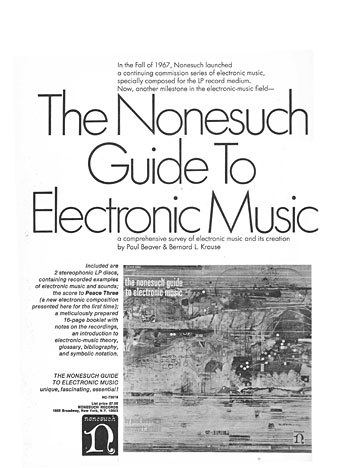
Scattered throughout the issues are ads for the latest studio gear and new album releases. One of these, The Nonesuch Guide to Electronic Music, was compiled by Paul Beaver and Bernard Krause. The latter is still recording, and happens to be interviewed in the current issue of Arthur Magazine.

emr03.jpg

emr04.jpg

Continue reading “Electronic Music Review”

Prominences

sun0.jpg

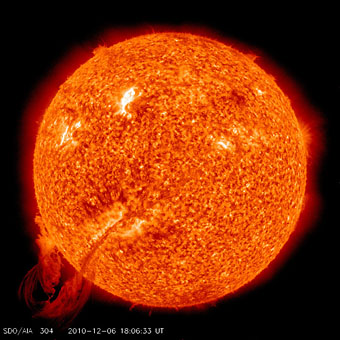
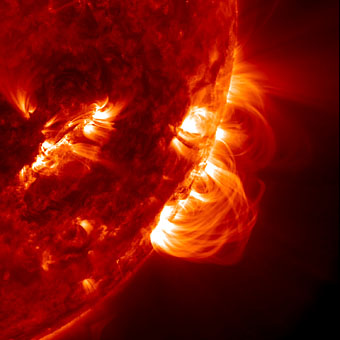
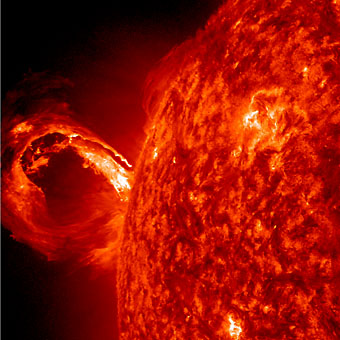
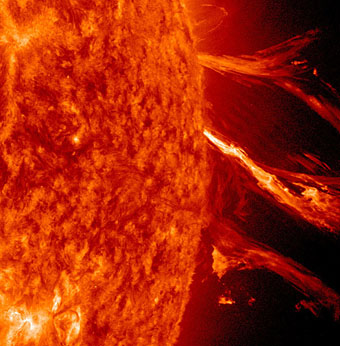
Work-related searches this week has led me to the gallery pages of NASA’s Solar Dynamics Observatory. The SDO is an observational satellite in a geostationary orbit that monitors the Sun with a variety of cameras and other imaging equipment. Some of the recent spectacular photos of solar prominences have been captured by the SDO, examples of which may be found in the project’s gallery where you can also see short movies of solar eruptions and other events. (There’s also an SDO YouTube channel. For a start try “Fiery Looping Rain on the Sun“.) I always find the Sun to be a combination of the incredible, the weird and the terrifying: many of those coronal mass ejections dwarf the Earth. Pictures such as these make you reconsider how much we take our local star for granted.

sun1.jpg

sun2.jpg

sun3.jpg

sun5.jpg

Skivvies

underwear1.jpg

Not had anything for a while deserving of the eye candy tag so here’s some gratuitous shots from a short promo video for some underwear company or other (he said disingenuously). The ad is directed by Steven Klein, and the piece as a whole doesn’t appear to have had a straight viewer in mind given the amount of shots that look like AMG beefcake or extra auditions for Fassbinder’s Querelle. And speaking of Rainer’s matelots, they’ve been in mind recently following news that the director’s Genet fantasia will be making a welcome appearance on Blu-ray later this month. The DVD format didn’t do much for those saturated colours so this is good to hear. (Underwear tip via Homotography.)

Previously on { feuilleton }
Hello, sailor
Querelle again
Sailors
Mikel Marton
Exterface