Derek Jarman In The Key Of Blue

jarman.jpg

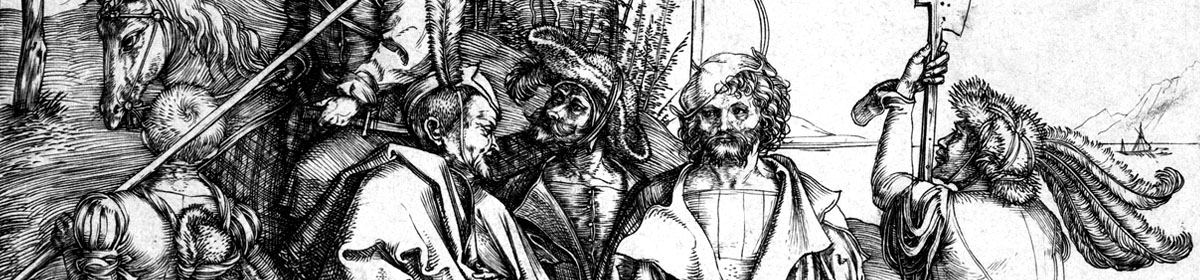
Derek Jarman died 20 years ago today. I was keeping a sketchbook at the time, something I’ve seldom bothered with before or since, and this was my reaction to the news a couple of days later, possibly drawn whilst watching one the TV documentaries which were being screened at the time.

Some current news items:
England’s alchemist, a piece by Philip Hoare
Unseen nightclub film to get London premiere
‘So Mum covered me in cooking oil. Then Dad came home’
Queer Pagan Punk, a season of films by Jarman and others, is currently running at the BFI Southbank.

Previously on { feuilleton }
The Dream Machine
Jarman (all this maddening beauty)
Sebastiane by Derek Jarman
A Journey to Avebury by Derek Jarman
Derek Jarman’s music videos
Derek Jarman’s Neutron
Mister Jarman, Mister Moore and Doctor Dee
The Tempest illustrated
In the Shadow of the Sun by Derek Jarman
Derek Jarman at the Serpentine
The Angelic Conversation
The life and work of Derek Jarman

The Dream Machine

dreamachine1.jpg

This is a 35-minute anthology film from 1986 with a very painterly, poetic (for want of a better term) quality of a kind I’ve not seen for some time in queer cinema. The reasons for this can be debated at greater length than I care to attempt, but it’s notable that a feature of the work of Derek Jarman—one of the featured directors—was an approach that was always happy to dispense with naturalism and the aping of familiar film and television narratives. In place of Jarman’s visionary approach we now have the “ordinary gay lives” of Weekend and Looking. This may satisfy those eager to see their own lives reflected on the screen but I’m usually expecting more from my cinema than another mirror held up to mundane reality. (And a very circumscribed reality, at that.)

dreamachine2.jpg

The theme of The Dream Machine is Bryon Gysin’s hallucination-inducing artwork of the same name. Brief clips by Tim Burke of Gysin sat with eyes closed in front of his flickering cylinder form the connective tissue between sections by directors Jarman, Michael Kostiff, Cerith Wyn Evans, and John Maybury. We can take these as either the dreams of those behind the camera or perhaps the visions seen by Gysin behind his eyelids. Needless to say there’s a fair amount of naked male flesh on offer, presented in a matter-of-fact manner or as the embodiments of some personal symbolism. The film can be seen here in not very flattering quality. Both Cerith Wyn Evans and John Maybury started out as assistants on Jarman’s films. Wyn Evans appears briefly in Caravaggio (1986) but is now better known as an artist, while Maybury went on to direct another excellent artist biopic, Love Is the Devil: Study for a Portrait of Francis Bacon (1998).

dreamachine3.jpg

Previously on { feuilleton }
Jarman (all this maddening beauty)
Sebastiane by Derek Jarman
A Journey to Avebury by Derek Jarman
Derek Jarman’s music videos
Derek Jarman’s Neutron
Mister Jarman, Mister Moore and Doctor Dee
The Tempest illustrated
In the Shadow of the Sun by Derek Jarman
Derek Jarman at the Serpentine
The Angelic Conversation
The life and work of Derek Jarman

Paul Schütze: Silent Surface

schutze3.jpg

Something for people living in the Thames Archipelago formerly known as London (okay, it’s not that bad but give it a couple of years…): Paul Schütze adds to the list of his polymathic accomplishments with the launch of a book, a new series of prints, and a perfume (or aroma) at Maggs Gallery. Details below. Paying attention to the aesthetics of scent only seems unusual in this context because it’s relatively rare. As Schütze insists: the eyes and ears are routinely flattered while the nose is ignored. Supermarkets exploit the power of scent; isn’t it time for artists of all varieties to follow suit?

schutze1.jpg

schutze2.jpg

Previously on { feuilleton }
Silent Engine
Schütze and Unstable at Maggs Bros
The art of scent revisited
Paul Schütze online
Perfume: the art of scent

Weekend links 199

cordal.jpg

Follow the Leader (London, 2011) by Isaac Cordal.

• “Brutalism is the decor of dystopian films, literature and comics, just as gothic is for horror.” Jonathan Meades‘ A-Z of brutalism.

Vitaly Shevchenko on the urban explorers of the ex-USSR. Related: Photos by Vitaliy Raskalov from the top of the Shanghai Tower.

Joe Banks reviews the throbbing, hissing, minatory pulses of the Black Mill Tapes 1–4 by Pye Corner Audio.

Walter Benjamin is the only one among the commentators who attempts to pin down the anonymous, evanescent quality of Walser’s characters. They come, he says, “from insanity and nowhere else. They are figures who have left madness behind them, and this is why they are marked by such a consistently heartrending, inhuman superficiality. If we were to attempt to sum up in a single phrase the delightful yet also uncanny element in them, we would have to say: they have all been healed.” Nabokov surely had something similar in mind when he said of the fickle souls who roam Nikolai Gogol’s books that here we have to do with a tribe of harmless madmen, who will not be prevented by anything in the world from plowing their own eccentric furrow.

Le Promeneur Solitaire: WG Sebald on Robert Walser

Drink The New Wine, an album by Kris Force, Anni Hogan, Jarboe, Zoe Keating and Meredith Yayanos.

• At 50 Watts: Illustrations by Fortuné Méaulle for Alphabet des Insectes by Leon Becker.

Lawrence Gordon Clark, Master of Ghostly Horror. An interview by John D’Amico.

• Chapel Perilous: Notes From The New York Occult Revival by Don Jolly.

• Mix of the week: Secret Thirteen Mix 107 by Ernestas Sadau.

• An Occult History of the Television Set by Geoff Manaugh.

• Was Ist Das? The Krautrock Album Database.

• First dérive of the year by Christina Scholz.

John Waters’ Youth Manifesto.

Gardens of Earthly Delights

Psychedelic Folkloristic

Water Music I / Here Comes The Flood / Water Music II (1979) by Robert Fripp & Peter Gabriel | After The Flood (1991) by Talk Talk | Flood (1997) by Jocelyn Pook

Conversations with Beckford

beckford.jpg

My thanks once again to Sidney Blackmore for sending me this new publication from The Beckford Society. Conversations with Beckford reprints in facsimile Cyrus Redding’s memoirs of William Beckford, a series of essays which were published in 1844 after Beckford’s death.

beckford2.jpg

Of particular interest to this folly enthusiast is a chapter entitled The Tower of the Caliph, in which Redding relates a visit to the newly-constructed Lansdown Tower which stands on Lansdown Hill outside the city of Bath. Beckford’s Tower, as it’s known today, is only half the height of the unsound structure which the fabulously wealthy Beckford built at Fonthill Abbey but it has at least survived, unlike the constructions on his old estate. The Tower and its grounds have had a chequered history since 1844 so Redding’s piece is valuable for the impression it gives of the place shortly after it was built. (The “Caliph” of the title refers to Beckford’s celebrated Gothic novel, Vathek, an Arabian Tale.) The Tower today is a museum housing some of Beckford’s art collection and furniture. Flickr has a great selection of views of the place showing how impressive the gold belvedere can be even on gloomy winter days.

Previously on { feuilleton }
The Beckford Journal
Vathek illustrated
Fonthill Abbey