Weekend links 385

picasso.jpg

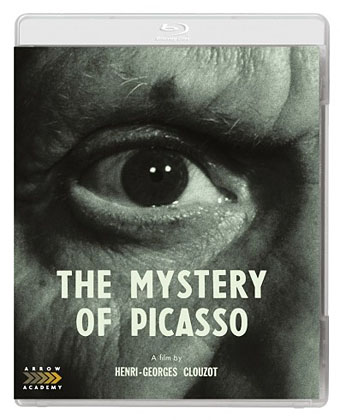
• It won’t be out until late January—and then in the UK only—but the blu-ray premiere of The Mystery of Picasso (1956) by Henri-Georges Clouzot was announced this week. The initial run of the discs (there’s also a DVD) will include a booklet containing my essay about the film, something I was very pleased and honoured to be asked to write. Clouzot’s remarkable study of Picasso drawing and painting for the camera was made immediately after his masterwork, The Wages of Fear (also newly available on UK blu-ray), and this new edition will include two short extras, one of which, A Visit to Picasso (1949) by Paul Haesaerts, is an excellent precursor/companion to the main feature. More on this subject later.

• At the Internet Archive: an almost complete run of The Twilight Zone Magazine (1981–1989). While masquerading as a TV-series spin-off, TZ under the editorship of TED Klein was an excellent periodical devoted to horror and dark fantasy. In addition to running original fiction by major authors (Stephen King was a regular), the magazine contained features about older writers such as Lovecraft and Machen along with book reviews by Thomas Disch, film reviews by Gahan Wilson, interviews and more.

• “Bram Stoker was gay,” says Tom Cardamone in a review of Something in the Blood: The Untold Story of Bram Stoker, the Man Who Wrote Dracula by David J. Skal. I’ve not read Skal’s book so can’t comment on its claims but his earlier Hollywood Gothic (about Dracula on page and screen) includes some discussion of “sexual ambiguity” in Stoker’s work.

• Mixes of the week: FACT mix 625 by Elena Colombi, Secret Thirteen Mix 235 by Rhys Fulber, and XLR8R Podcast 514 by Tommaso Cappellato.

Help, Help, The Globolinks! is a previously unreleased electronic soundtrack by Suzanne Ciani, out next week.

La Région Centrale (1971), Michael Snow’s epic of landscape gyrations in two parts, here and here.

Alexander Calder and the Optimism of Modernism: Jed Perl in Conversation with Morgan Meis.

• Illustrations by Lynd Ward for The Haunted Omnibus (1935) edited by Alexander Laing.

Daniel Dylan Wray on the gay-porn music of disco pioneer Patrick Cowley.

• It’s that man again (and his drawings): Ernst Haeckel: the art of evolution.

• At Dennis Cooper’s: Steve Erickson presents A Black Psychedelia Primer.

Bootsy Collins‘ favourite albums.

Picasso (1948) by Coleman Hawkins | Pablo Picasso (1976) by The Modern Lovers | Picasso Suite pt. 1 (1993) by David Murray Octet
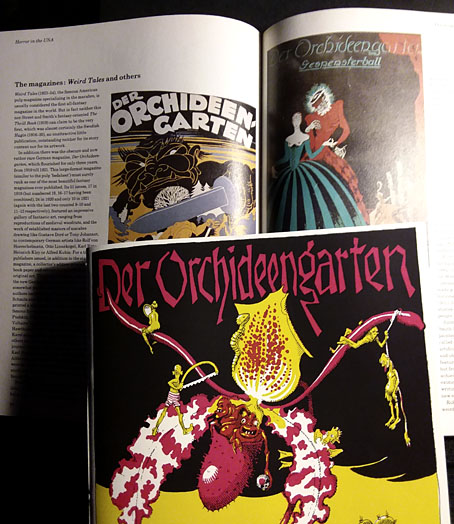
An unseasonable bloom

orchid1.jpg

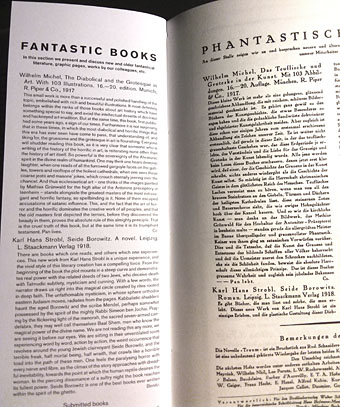
It’s a strange thing to compare the covers of Der Orchideengarten in Franz Rottensteiner’s The Fantasy Book (1978) with the facsimile of the first issue which has just been published by Zagava. For years the two covers and Rottensteiner’s laudatory description were all I knew of a magazine that nobody else seemed to write about. As with all such enigmas, this made the magazine all the more intriguing. Der Orchideengarten was short-lived, running from 1919 to 1921, and German, which no doubt did little to aid its post-war reputation. Whatever reputation it may have had was quickly eclipsed by Weird Tales and a host of other Anglophone publications some of whose creations still dominate the fantasy landscape today. One of the many services Rottensteiner’s study provided was to treat fantasy as a genre with manifestations all over the world, not only in Britain and America.

orchid2.jpg

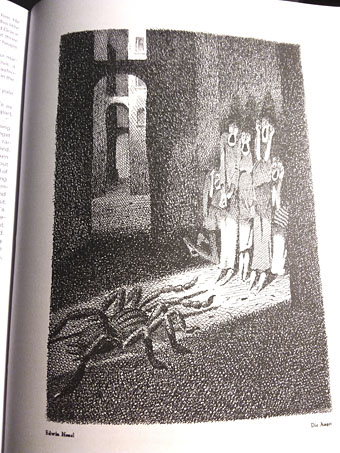
The visibility of Der Orchideengarten began to change in 2009 when Will at the now-defunct A Journey Round My Skull, having also had his curiosity piqued by Rottensteiner’s book, acquired a few copies of the magazine. I ran some of the interior illustrations here, the sight of which was genuinely revelatory since these weird and macabre drawings had been buried for 90 years. The situation changed again late last year when the entire run of the magazine was made available at the University of Heidelberg’s remarkable online archive.

What struck me in 2009—and what continues to strike me today—is the difference in tone between the illustrations, covers included, of Der Orchideengarten with its later Anglophone counterparts, especially Weird Tales. The latter presented itself very much in the pulp tradition, and many of the illustrators of the early issues were just as happy working with adventure or detective titles as they were with fantasy or horror. The German artists are less illustrational and much more grotesque, closer at times to Expressionist painting than anything you’d find in an American magazine. I continue to wonder how fantasy as a genre might have developed if it had owed less to Britain’s ghost stories and America’s adventure idioms.

orchid3.jpg

Any speculation is easier now we have this facsimile of the first issue which (as I mentioned in a weekend post) contains a translation into English by Helen Grant of the complete contents of the magazine. This has been cleverly achieved by interleaving narrower pages of translated text with the originals so the integrity of the magazine is maintained. The facsimile is a quality production with superb printing of all the illustrations and graphics. One of the ironies of our connected world is that contemporary magazines continue to be killed off while the easier accessibility of so much culture from the past makes resurrections like this one more likely.

orchid4.jpg

Whether we see more facsimile issues will no doubt depend on the success of this first number which may be ordered here. A few more page samples follow.

Continue reading “An unseasonable bloom”

Macabre mixes

lurch.jpg

Lurch approves.

It’s that time of year again but I’ve been so busy for the past few months that I haven’t had time to think about a Halloween mix, never mind piece one together. So rather than an original work I’m returning to the previous policy of recommending those by other people.

First up is a multi-set offering at No Condition Is Permanent. I did have a vague idea earlier this year to do a mix of horror-themed rock’n’roll but it’s a good job I didn’t since this collection is much more wide-ranging and original than anything I would have compiled.

bleep.jpg

For Bleep.com there’s a new mix by the very adept DJ Food who blends the Death Waltz Originals electronica catalogue with samples of an interview about nightmares, phantasms and other sinister anomalies.

eyes.jpg

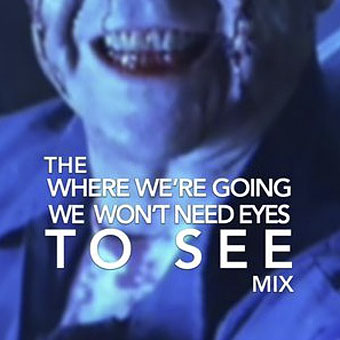
And the “Where We’re Going, We Won’t Need Eyes To See” Mix by The Curiosity Pipe covers all points in between, being “an unpleasant mix of noise, drone, metal, jazz, dark ambient, soundtracks, field recordings and electronica (with a few popular horror film snippets thrown in for good measure).”

Happy Halloween!

Previously on { feuilleton }
A mix for Halloween: Analogue Spectres
A mix for Halloween: Teatro Grottesco
A mix for Halloween: Unheimlich Manoeuvres
A mix for Halloween: Ectoplasm Forming
A playlist for Halloween: Hauntology
A playlist for Halloween: Orchestral and electro-acoustic
A playlist for Halloween: Drones and atmospheres
A playlist for Halloween: Voodoo!
Dead on the Dancefloor
Another playlist for Halloween
A playlist for Halloween

Weekend links 384

muljat.jpg

Sultans of Swing by Samantha Muljat.

• Pain & Pleasure, Indivisible: Mat Colegate talks to Stephen Thrower (Coil, Cyclobe) about the meeting between Coil and Clive Barker that would have led to Coil scoring Barker’s Hellraiser if the studio hadn’t rejected the music.

• “From Arsedestroyer to Zoogz Rift: 50 underground albums you’ve never heard of” The usual presumption—I’ve been listening to The Groundhogs since the mid-1980s—but it’s a good list.

• More magazines at the Internet Archive: an incomplete run of British science-fiction monthly Interzone; and a complete (?) run of the film magazine for horror (and gore) obsessives, Fangoria.

• “…it’s background music, is what it is. But there’s nothing wrong with that. I’m very proud of it.” John Carpenter discussing his soundtrack music and his new album, Anthology.

• Mixes of the week: Aral Mix 05 by Ellen Arkbro, Secret Thirteen Mix 234 by FOQL, and Samhain Séance Six: Triffid Witch by The Ephemeral Man.

• Dallas Killers Club: Nicholson Baker reads a stack of books about the Kennedy assassinations then draws his own conclusions.

Michael Flanagan on searching for LGB histories of Neopaganism, the paranormal and the occult in San Francisco.

• At Lounge Books: author Amelia Mangan on horror, old and new, and her favourite things.

• At Monoskop: the (almost) complete works of James Joyce in one convenient epub.

Jillian Steinhauer on Duchamp’s last riddle.

Hell Raiser (1973) by Sweet | Hell’s Bells (1989) by Rhythm Devils | Hell’s Winter (2011) by Earth

Psychotronic Video

pv1.jpg

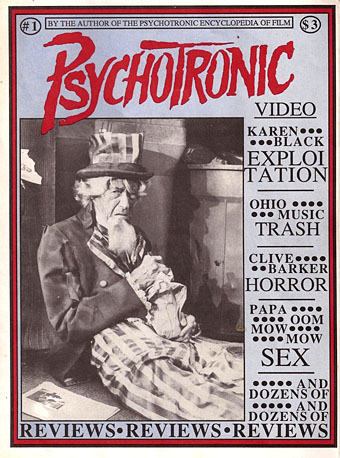
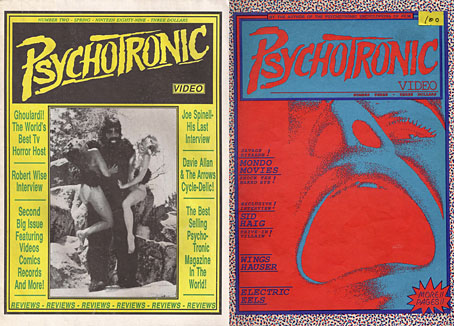
I was going to wait until the weekend to mention this but it’s too good to be lodged in a collection of links. Michael J. Weldon’s Psychotronic Encyclopedia of Film (1983) has long been one of my favourite film books, a collection of reviews by Weldon and friends written for Weldon’s NYC fanzine, Psychotronic TV. “Psychotronic” was Weldon’s umbrella label for the low-budget fare that would usually be avoided by other reviewers: “horror, exploitation, action, science fiction, and movies that used to play in drive-ins or inner city grindhouses.” A small handful of actors were considered psychotronic enough (on account of their appearing in many psychotronic films) that Weldon claimed their presence in any film made it psychotronic even if it contained no overt genre or exploitation content. So the Encyclopedia lists Fellini’s 8 1/2, for example, simply because Barbara Steele appears in it. Likewise, Casablanca is psychotronic because of Peter Lorre. As I recall, the other psychotronic actors were John Carradine (“the greatest PSYCHOTRONIC star of all time”), Vincent Price, Boris Karloff and Bela Lugosi.

pv2.jpg

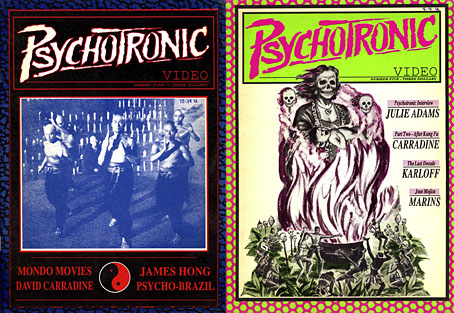
The trouble with books of film reviews is that the passage of time makes them increasingly subject to omissions, so I was delighted when Weldon launched Psychotronic Video magazine in 1989. Not only was this a continuation of the encyclopedia’s film listings it was also filled with related features: interviews with character actors, cult figures and interesting stars (Karen Black, James Coburn); a regular music column which mostly covered the kinds of bands who would watch psychotronic films; a regular obituary feature; and pages crammed with bizarre and curious graphics: film ephemera, ads from old magazines, headers by comic artist Drew Friedman, and mermaid drawings by Weldon’s girlfriend, Mia. One of my favourite features, which ran from the first issue, concerned Weldon’s obsession with The Rivingtons’ Papa Oom Mow Mow and The Trashmen’s Surfin’ Bird, an ideé fixe which had Weldon cataloguing as many cover versions or film inclusions of the songs as he could find.

pv3.jpg

Psychotronic Video ran for 41 issues until folding in 2006. I bought the first 23 or so then lapsed after the one comic shop selling it in Manchester was closed down by the IRA bombing of the city centre in 1996. Back issues are increasingly scarce (and not always cheap) so it’s good to find all 41 issues at the Internet Archive together with 10 issues of the even more scarce Psychotronic TV. The quality isn’t perfect—some of the scanned pages are subject to blurring—but I can now see what was in the rest of the magazines, and finally get to read the Timothy Carey interview in the one issue I missed, no. 6. Many of the actors interviewed with enthusiasm by Psychotronic Video have since died so the magazine is even more valuable for its insights into careers ignored by other publications.

Previously on { feuilleton }
Bikers and witches: Psychomania
The Cramps at the Haçienda