Weekend links 784

ford.jpg

An illustration by HB Ford for The Violet Fairy Book (1906), edited by Andrew Lang.

• New music: An Aesthetic – Experiments in Tape by Hawksmoor; Leylines (2025 remaster) by Aes Dana; A Fragile Geography (10th Anniversary Reissue) by Rafael Anton Irisarri.

• “Skoda Auto designers reimagine Ferat Vampire car from cult classic 1981 Czech horror film”.

• At Colossal: Chris Ware illustrates a postwoman’s day to celebrate 250 years of USPS.

Seen today, the failure of Sorcerer looks like a grim prophecy of where the film industry would be headed in the years to come. It signaled that the creative ambitions of the New Hollywood, and its indulgence of stubborn renegade auteurs, had been cast aside for a new and dispiriting blockbuster ethos. Decades later, that ethos is still with us: a Hollywood dominated by digitally smoothed, effects-encrusted moviemaking, where every backdrop looks fake (even the real ones) and action sequences carry no physical weight. It’s a wretched landscape, and Sorcerer positively towers over it. To watch the film now, from its electric opening moments through its gaspingly bleak denouement, is to encounter something more than just a magnificent ruin or an object of cultish reclamation: a thwarted masterwork that is thwarted no longer.

Justin Chang on the bleak magic of William Friedkin’s Sorcerer.

• At the BFI: The Red Shoes wallpaper by the film’s designer Hein Heckroth.

All This Violence by Caspar Brötzmann Massaker.

• RIP Lalo Schifrin and Rebekah del Rio.

• The Strange World of…Jon Spencer.

In Ultra-Violet (1983) by Cinema 90 | Violet Ray Gas (2009) by Violet | Violetta (2012) by Demdike Stare

The art of Justin Todd

todd15.jpg

I was pleased to find a copy of this book recently, a slim volume published in 1978 which isn’t especially rare but which usually sells for much more than the £2 I paid for it. Justin Todd is a British illustrator whose work was a familiar sight on book covers in the 1970s, especially when his commissions weren’t restricted to a single genre. Cover artists who work on fantasy novels are often asked to do horror covers (and vice versa), or edged towards science fiction when the material suits their style; Todd worked on fantasy, horror and the occasional SF title while also providing covers for mainstream novels, offbeat non-fiction, historical fiction and children’s stories. Fully-illustrated children’s books evidently became his main line of work in the 1980s—Alice’s Adventures in Wonderland, The Wind in the Willows, a collaboration with Angela Carter—which would have left him no time for cover commissions. I was amused to find him illustrating crank titles (previously) in the early 70s when he did the paperback cover for one of the great anti-crank books, John Sladek’s The New Apocrypha, a few years later.

todd06.jpg

The Centre of the Cyclone: An Autobiography of Inner Space (1972) by John C. Lilly.

Todd’s style is easy to recognise once you’ve seen a few examples: meticulous gouache renderings that tend to be slightly naive even when they’re depicting a wholly realistic story like Treasure Island. Gouache is a water-based paint that’s useful when you want a flat, even finish, but it doesn’t give you the depth of colour or contrast provided by oils or acrylics. Todd’s paintings embrace the limitations of the medium, with gradients and shadings that are so soft and diffused they might be taken at first for pencil drawings.

todd13.jpg

The Journey to the East (1972) by Herman Hesse.

The Magical Paintings of Justin Todd isn’t a comprehensive study of Todd’s illustration work, more a snapshot of a career in progress. In addition to 64 full-page reproductions there’s a two-page interview by editor and art director Mike Dempsey which provides valuable biographical details. I was pleased to find that many of the cover paintings were ones I hadn’t seen before, including a few Arcimboldo-like faces. Todd had a flair for this kind of visual invention, constructing faces or even whole figures out of disparate objects. I’ve had a copy of The Journey to the East for many years but until this week I don’t think I’d ever looked closely at all the tiny figures making up the central figure that strides across the landscape.

Mike Dempsey maintains a blog which includes a reminiscence of working with Justin Todd.

todd09.jpg

Stories of Five Decades (1972) by Herman Hesse.

todd02.jpg

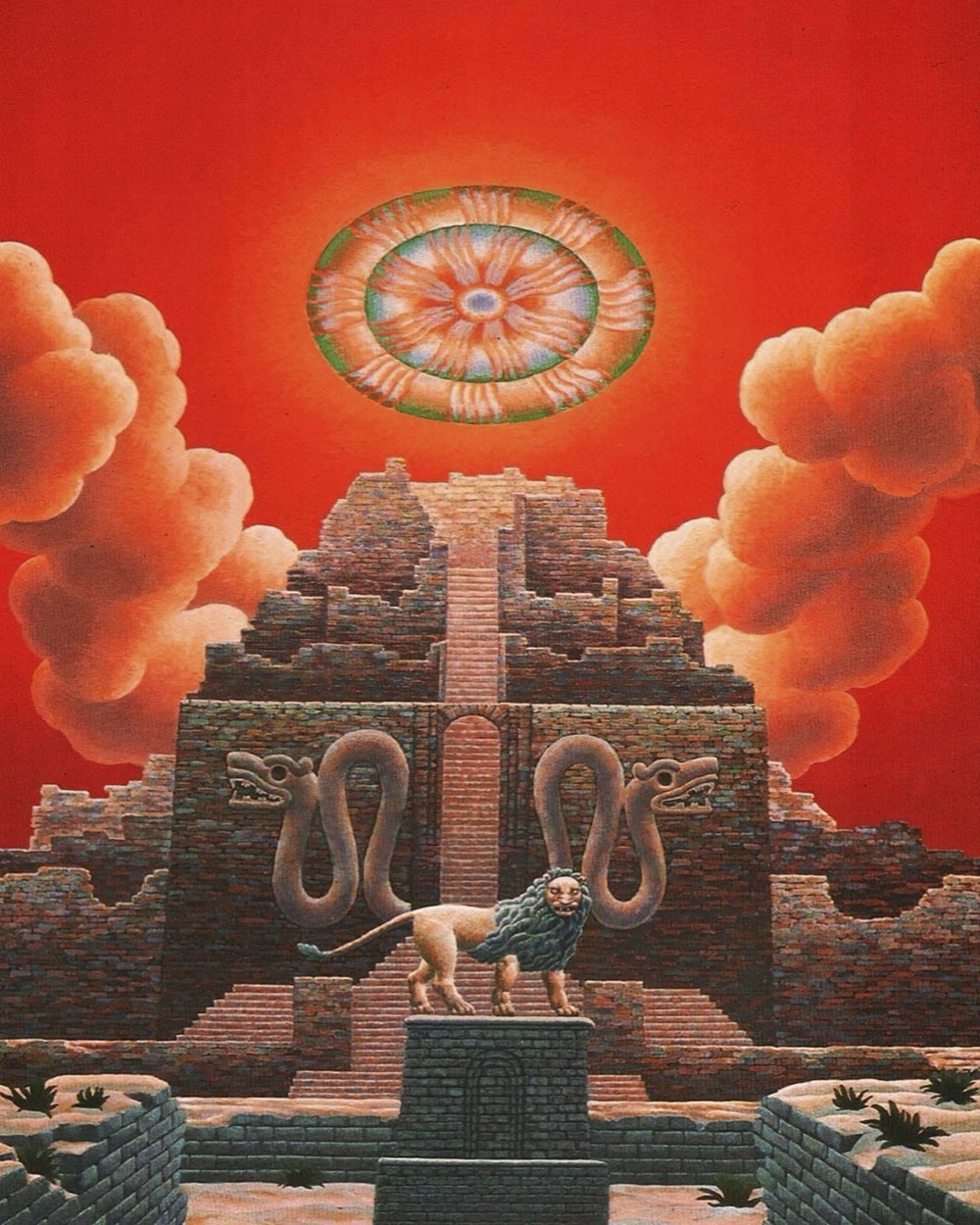
Secret Places of the Lion (1973) by George Hunt Williamson.

Continue reading “The art of Justin Todd”

Sanquirico’s theatrical settings

sanquirico01.jpg

Work-related research over the past couple of weeks has had me looking for pictures of theatres in the 19th century, especially backstage views. The latter proved harder to find than I expected although I did turn up a few useful reference images after scouring the picture libraries. Nuova raccolta di scene teatrali (1828) by Alessandro Sanquirico is an Italian book that surfaced during the searches, not something I wanted but it’s another collection of imaginary architectural views which I always like to see. Sanquirico was set designer for La Scala in Milan so most of these designs are for opera sets, although several are labelled “ballo“, a type of theatrical dance which evidently required dramatic settings. As to the designs, there’s more variety than you find among earlier generations of theatrical designers like the Bibienas, a family of artists who specialised in very detailed Baroque interiors. The Romantic era demanded tempestuous drama and greater spectacle, hence Sanquirico’s views of castles, caves, prisons, conflagrations and fanciful depictions of the ancient world. The selection that follows is only a small sample; the book has 242 plates in all.

sanquirico02.jpg

sanquirico03.jpg

sanquirico04.jpg

sanquirico05.jpg

Continue reading “Sanquirico’s theatrical settings”

Weekend links 783

robinson.jpg

An illustration by William Heath Robinson for A Midsummer Night’s Dream (1914).

• New music: How To Shoulder The Radiance Of Revelations by Dadub; Leviathan by Stephen Roddy; and Echoes Of The Hollow Earth by Cryo Chamber.

• At Sight & Sound: “Every time I look at the film, it gets better.” Steven Soderbergh on Jaws.

• At Public Domain Review: The Language of Form: Lothar Schreyer’s Kreuzigung (1920).

Leafing through the merveilleux-scientifique novels today allows for a dual rediscovery: firstly, it uncovers the previously unrecognised richness of Belle Époque scientific fiction, which did not perish with the works of Verne. The stories take in journeys to Mars, solar cataclysms, reading of auras, psychic control, weighing of souls, death rays, alien invasions, even strolls among the infinitesimally small. But exploring the genre also offers insights into the cultural history of the era, marked by a significant permeability between science and pseudo-science. Reading this work, we can learn a lot about the aspirations, fears and beliefs of early 20th-century Europe.

Fleur Hopkins-Loféron on the evolution of French science fiction after Jules Verne

• Mix of the week: A Twin Peaks mix for The Wire by Lori Eschler & Dean Hurley.

• Steven Heller’s font of the month is Kefir.

Patrick Wolf’s favourite albums.

ultrawolvesunderthefullmoon

Frou-Frou Foxes In Midsummer Fires (1990) by Cocteau Twins | Midsummer Night (2010) by The Time And Space Machine | Midsummer Boulevard (2022) by Hawksmoor

Armand Rassenfosse’s Fleurs du Mal

rassenfosse01.jpg

It’s been a while since I found another illustrated edition of Baudelaire’s poems but there are still more of them out there. This surprises me a little considering the nature of Baudelaire’s writing, you can’t imagine Anglophone fin-de-siècle publishers lavishing such attention on poems which are morbid and erotic to this degree. Beresford Egan illustrated an edition of Les Fleurs du Mal but this was published in 1929 by which time Continental decadence was regarded in a more favourable light.

rassenfosse02.jpg

Armand Rassenfosse (1862–1934) was a Belgian artist whose 1899 edition of Baudelaire is what the French would call the artist’s chef d’oeuvre, a limited reprint of Les Fleurs du Mal illustrated with colour etchings on nearly every page. Rassenfosse’s approach is much more Symbolist in tone than the near pornography of Manuel Orazi, presenting a succession of idealised figures (naked women for the most part) in nebulous spaces. I was hoping he might have produced more in this style but his other work tends to be poster design and painted studies of female dancers in various states of undress.

rassenfosse03.jpg

rassenfosse04.jpg

rassenfosse05.jpg

Continue reading “Armand Rassenfosse’s Fleurs du Mal”