JG Ballard, 1930–2009

crystal_world.jpg

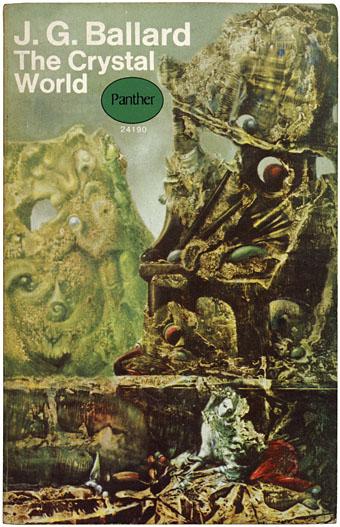
Panther Books paperback edition, 1968; cover painting: The Eye of Silence by Max Ernst.

If I can’t remember when I first encountered JG Ballard’s work, it’s not because I was reading him at a very early age, more that a childhood enthusiasm for science fiction made his books as omnipresent in my early life as any other writer on the sf, fantasy and horror shelves. I know that when I started to read the New Wave sf writers his work immediately stood out, not only for its originality but also for the numerous references to Surrealist painting which litter his early fiction, references which meant a great deal to this Surrealism-obsessed youth. Ballard was a lifelong and unrepentant enthusiast for the Surrealists, with repaintings by Brigid Marlin of two lost Paul Delvaux pictures prominent in one of his rooms (often featured in photo portraits). I always admired the way he never felt the need to apologise for Salvador Dalí’s excesses, unlike the majority of art critics who dismiss Dalí after he went to America. The paintings of Dalí, Delvaux, Tanguy and Max Ernst became stage sets which Ballard could populate with his affectless characters.

Once I’d encountered the New Worlds writers—Ballard, Michael Moorcock, M John Harrison, Brian Aldiss and company—and their American counterparts, especially Harlan Ellison, Samuel Delany and Norman Spinrad, there was no returning to the meagre thrills of hard sf with its techno-nerdery and bad writing. Ballard and Moorcock were the gateway drug to William Burroughs, Jorge Luis Borges and countless others, and I thought enough of his work in 1984 to attempt a series of unsuccessful illustrations based on The Atrocity Exhibition. It’s been an axiom during the twenty years I’ve worked at Savoy Books that Ballard, Moorcock and Harrison were (to borrow a phrase from Julian Cope) the Crucial Three of British letters, not Rushdie, Amis and McEwan. One of the books I designed for Savoy, The Exploits of Engelbrecht by Maurice Richardson, was a Ballard and Moorcock favourite, and included appreciations of Richardson by both writers. I wish Ballard could have seen the new (and still delayed) edition of Engelbrecht but he got a copy of the earlier book. Sometimes once in a lifetime is more than enough.

Ballardian.com
Pages of obits and MM comment at Moorock’s Miscellany
Ballard interview by V Vale at Arthur with an special intro by Moorcock
Jeff VanderMeer at Omnivoracious
Guardian | Times | Independent | Telegraph

Previously on { feuilleton }
Ballard in Barcelona
1st Ballardian Festival of Home Movies
Revenant volumes: Bob Haberfield, New Worlds and others
JG Ballard book covers

The art of Philip Shadbolt

shadbolt.jpg

Lila.

I’d intended to feature Philip Shadbolt’s paintings earlier but his site was offline last time I looked. The hiatus was a temporary one which means that the beautiful men, beatific gods and kaleidoscopic mandalas of his Earth and Spirit galleries are available for viewing again. One of these paintings is very aptly used as the cover art of Thom Ayres’ Arcanta CD, Book of Mirrors, Thom being better known to some of us as our witty and incorrigible host at Planet Fabulon. For more Shadboltiana, see the interior design at myhotel, Brighton.

Elsewhere on { feuilleton }
The gay artists archive

Previously on { feuilleton }
The art of Sadao Hasegawa, 1945–1999
The art of Matthew Stradling

Fred Tomaselli at White Cube

tomaselli.jpg

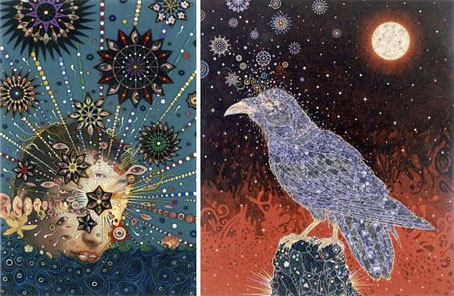
left: Summer Swell (2007); right: Big Raven (2008).

I like Fred Tomaselli’s hyper-detailed psychotropic paintings a great deal. Londoners can see an exhibition of new work at the Mason’s Yard branch of White Cube until 16 May, 2009.

Tomaselli’s new work is a departure from his earlier, more direct use of pills, hemp leaves or ornithological references. The birds are painted with greater freedom, with each flame-like brushstroke animating the feathers as if an aura were radiating from the wild creature. Big Raven is inspired by the American Gothic tradition and the poetry of Edgar Allan Poe, while Detail, with its dramatisation of the relationship between predator and prey, is a timely homage to Darwin’s Origin of the Species. The single, hypnotic gaze of Eye celebrates Tomaselli’s understanding of visual reciprocity – as if the bird were returning the artist’s affectionate stare. This reoccurs in the galaxies of multiple eyes found in his photograms, or monstrous apparitions created in direct response to front-page articles from the New York Times, through to the talismanic eye that emerges from the sea in Summer Swell, as if it were drowning in its own visual abundance.

Previously on { feuilleton }
The art of Fred Tomaselli

False perspective

hogarth.jpg

Satire on False Perspective by William Hogarth (1753).

Whoever makes a Design without the knowledge of Perspective will be liable to such absurdities as are shewn in this Frontispiece.

More eye-deceiving art for All Fools’ Day. Everyone knows MC Escher‘s pictures which continually played with the rules of perspective. Hogarth’s satire is less well-known and may even be the first of its kind. I haven’t seen any examples earlier than this.

A few contemporary equivalents follow, all of which can be found at Impossible World, a site devoted to visual disjunction.

Continue reading “False perspective”