The Gate to the Mind’s Eye

tgttme1.jpg

Turn a 6 on its head and you’ll see a number 9. Do the same with the psychedelic culture of the 1960s and you get the 1990s when psychedelia emerged again, after a fashion, in a profusion of new drugs (plus the same old ones), “ambient” music (a lot of which was never very ambient at all), and, of course, computer graphics. The resemblance of the overlit, weightless world of early computer graphics to the vivid inner landscapes of psychedelic hallucination prompted people like Timothy Leary to declare computers to be their new drug of choice, while also inspiring the resurrection of the kind of visual tripping aid that would have been considered dead and buried in the very un-psychedelic 1980s. (There were a few musical exceptions in that decade—the Paisley Underground, the Dukes of Stratosphear albums, Around The World In A Day by Prince & The Revolution—but all these were counter to the dominant trends of the time.)

tgttme2.jpg

CD-ROMS were the hippest vehicle for far-out visuals in the mid-90s. Brian Eno was vocal in his criticism of the limitations of the point-and-click CD-ROM format but he still provided music for a thing called Headcandy in 1994, one of a series of “video kaleidoscopes” with 3-D visuals created by Chris Juul and Doug Jipson. Not so overtly druggy was a series of VHS tapes and laserdiscs released throughout the 1990s by Odyssey Productions, all of which had the words “Mind’s Eye” in their titles: The Mind’s Eye: A Computer Animation Odyssey (1990), Beyond the Mind’s Eye (1992), The Gate to the Mind’s Eye (1994) and Odyssey Into The Mind’s Eye (1996). Where Headcandy and its relations created far-out visuals using original data encoded on a CD-ROM, the Mind’s Eye laserdiscs wowed the viewer by stitching together the latest examples of CGI from a variety of sources—showreels, TV ads, music videos and so on—giving you an hour of coloured balls bouncing across crystal mountains, pulsating blobs of mercury, shiny objects zooming through corridors and vortices, together with the clumsy figure animation that’s a consistent feature of early computer graphics. Each instalment was provided with a soundtrack by a different musician, so each release is really a long music video in itself, rather like The Orb’s Adventures Beyond The Ultraworld (Patterns & Textures) (1992), a 50-minute collage of rave footage, dolphins, spacewalking astronauts and cheap video effects soundtracked by live music from The Orb.

tgttme3.jpg

The Gate to the Mind’s Eye is highlighted here mainly for its having a soundtrack by Thomas Dolby that I hadn’t heard before. Other instalments feature original music by Jan Hammer (which may be okay), and Kerry Livgren from Kansas (which promises to be as unpalatable as Giorgio Moroder’s misconceived mauling of Fritz Lang’s Metropolis). The Gate to the Mind’s Eye doesn’t feature the best of Dolby’s music, it should be said, which may explain why the soundtrack CD has only been reissued once since 1994, while the visual material looks like a combination of music video and computer game. But there’s a lot of this stuff around today, especially at the Internet Archive which now has a laserdisc section containing several uploads from Odyssey Productions and its affiliate, Miramar Productions. Closer to the psychedelic ideal is a series of discs from Japan with the uninventive name of Video Drug. The Internet Archive has five discs from this series. I might have been happy to watch these in the 1990s when late-night TV in the UK was either dull or non-existent but today I’m more taken with outmoded things like Electric Light Voyage aka Ascent 1, a video release from 1979 which featured analogue video effects of a type you don’t find at all in the digital world.

Elsewhere on { feuilleton }
The abstract cinema archive

Previously on { feuilleton }
Kusama’s Self-Obliteration, a film by Jud Yalkut
Science Friction by Stan VanDerBeek

Trip texts revisited

trip1.jpg

An update to a post from several years ago about the handful of significant books that appear in Roger Corman’s The Trip (1967). The earlier post was prompted by a DVD viewing; this update has been prompted by a re-viewing via blu-ray which yielded screen-grabs showing more detail. As I’ve no doubt said before, one of the pleasures of home viewing is being able to scrutinise film frames in this manner, something that was previously only possible if you were a writer with access to a cinema print.

trip2.jpg

Corman’s film is probably the only feature from American International Pictures that contains any kind of extraneous intellectual reference. The AIP ethic was always “shoot it fast and cheap”, a production rule that had no time for winking to the hip contingent of the audience with books, of all things. Leave that stuff to the French. The Trip was still shot fast and cheap but Corman had been stretching himself increasingly while making his cycle of Poe films, especially with The Masque of the Red Death which had a longer production schedule, a British cast and crew, and a symbolic finale that sets it apart from its rivals at Hammer and other studios. The Trip is as far-out as Corman gets, the cut-up shots of Peter Fonda stumbling in delirium around Sunset Boulevard wouldn’t be out of place in any underground film of the period.

trip3.jpg

The surprising thing about the books that appear in the scene where Fonda’s character, Paul, drops his acid is that they’re perfectly appropriate items of set decoration but only two of them—the unmissable copy of Allen Ginsberg’s Howl, and David Solomon’s LSD: The Consciousness-Expanding Drug—would have been discernible to an audience. The latter inclusion is probably more to do with the three magic letters being so prominent on its cover than anything else, although it is the kind of book you’d find in a house owned by lysergic voyagers. The blu-ray detail now reveals more of the book hiding behind it although this one has eluded my attempts to search for a match: “The [something]….”? I thought it might be The Prophet by Kahlil Gibran but none of the editions prior to 1967 resemble the cover.

trip4.jpg

trip5.jpg

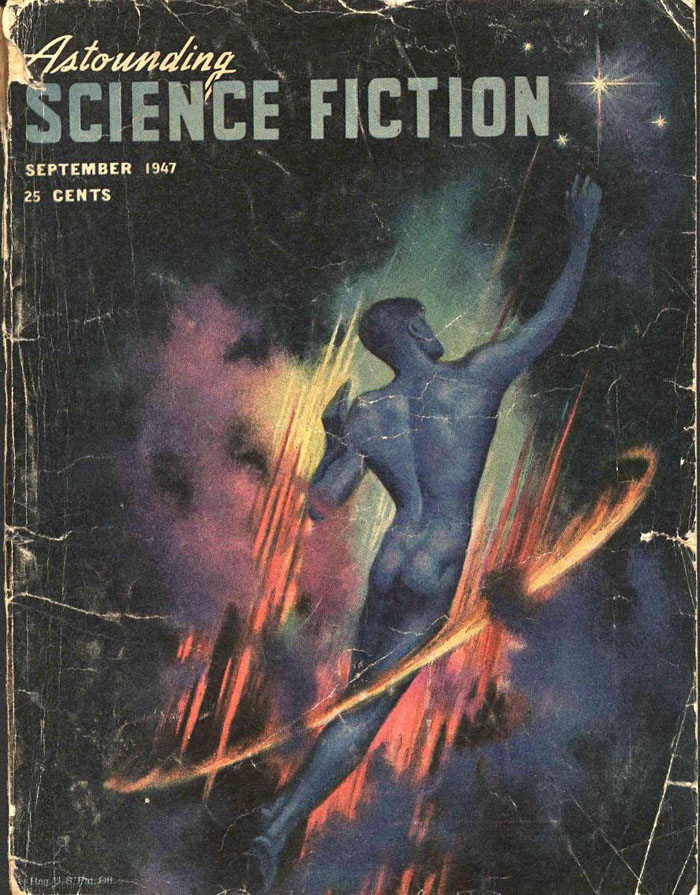
The main discovery this time round was finding a match for the book hidden by Howl, a title that I now confidently declare to be the 1962 Avon edition of Stranger in a Strange Land by Robert A. Heinlein. (The reds and blues of the cover art are more discernible in a full-frame shot.) When watching the DVD I thought those words might be “Hugo Award Winner” but couldn’t make out an author’s name, and “Award Winner” was a guess. The book might also have been written by someone named Hugo… Heinlein’s novel was a hippy favourite in the 1960s, one of several books together with The Prophet, Richard Brautigan’s novels and poetry, Herman Hesse’s Steppenwolf, etc, that were popular with turned-on readers. The irony of the author of Starship Troopers being mooned over by the love ‘n’ peace crowd wasn’t lost on the younger generation of SF authors but their criticisms didn’t travel outside genre circles. Heinlein could evade opprobrium for being one of the signatories of an ad in Galaxy for June, 1968, supporting the war in Vietnam because hippies en masse weren’t reading SF magazines.

heinlein.jpg

As noted in the earlier post, the book behind the Heinlein is a 1960 edition of The Tibetan Book of the Dead, which I was only able to identify because I own a copy of the same edition. Behind this there lurks another title whose identity is now going to nag at me. The cover decoration means it will be easy to find if it ever turns up somewhere. But will I remember it when it does? We’ll see.

Previously on { feuilleton }
Alice’s Adventures in the Horse Hospital
LSD-25 by The Gamblers
More trip texts
Trip texts
Acid albums
Acid covers
Lyrical Substance Deliberated
The Art of Tripping, a documentary by Storm Thorgerson
Enter the Void
In the Land of Retinal Delights
Haschisch Hallucinations by HE Gowers
The art of LSD
Hep cats

Weekend links 568

gekko.jpg

Dragon Rising to the Heavens (1897) by Ogata Gekko.

• “Electronic music of the past is often portrayed in a dreamy, magical light—a hazy historical landscape filled with misty, otherworldly sounds. But while the music of a bygone era may seem ineffable, it is not inaccessible.” Geeta Dayal reviews Reminded by the Instruments: David Tudor’s Music by You Nakai.

• Modular Therapy: Mute Records boss Daniel Miller and former snooker champ turned kraut-psych powerhouse Steve Davis discuss their love of modular synthesisers, ill-fated Jools Holland collaborations, commandeering Elton John’s ARP 2600 and more.

• “Some contemporary art is a little bit like an intellectual game…I’m not a big fan of this kind of stuff, because I’m a musician.” Ryoji Ikeda presents: point of no return.

One of the tunnels that Turrell has completed is 854 feet long. When the moon passes overhead, its light streams down the tunnel, refracting through a six-foot-diameter lens and projecting an image of the moon onto an eight-foot-high disk of white marble below. The work is built to align most perfectly during the Major Lunar Standstill every 18.61 years. The next occurrence will be in April 2025. To calculate the alignment, Turrell worked closely with astronomers and astrophysicists. Because the universe is expanding, he must account for imperceptible changes in the geometry of the galaxy. He has designed the tunnel, like other features of the crater, to be most precise in about 2,000 years. Turrell’s friends sometimes joke that’s also when he’ll finish the project.

Wil S. Hylton on an exclusive visit to James Turrell’s astronomical art complex at Roden Crater, Arizona. Related: 147 Orbiting 1 Through 6 for 5, Music for Roden Crater by Paul Schütze (with free download of an excerpt from the 5-hour piece)

• New music: The Black Mill Tapes, Volume 5 by Pye Corner Audio, and Interreferences by Richard Chartier.

• At Spoon & Tamago: Dense pencil drawings of retro-future worlds by Yota Tsukino.

“‘I’m bursting with fiction’: Alan Moore announces five-volume fantasy epic”.

• At Dennis Cooper’s: Lindsay Anderson Day.

Beverly Glenn-Copeland’s favourite music.

Volcano Diving (1989) by David Van Tieghem | Crater Scar (1994) by Main | Eye Of The Volcano (2006) by Stereolab

Universal Horror

universal1.jpg

A couple of Halloweens ago I worked my way through a blu-ray box of the horror films made by Universal Studios in the 1930s and 40s. It was a fun and instructive experience: fun because I’d not watched many of the films properly for a long time; instructive for reaffirming my dislike of Tod Browning’s Dracula, a film so inert and lacking in cinematic drama it may as well be a series of still pictures. Browning’s film is further diminished when you have the opportunity to watch James Whale’s Frankenstein films immediately after it. The collection also allowed me to compare the BFI release of Universal’s silent version of The Phantom of the Opera, where Lon Chaney is an unforgettable Phantom, with the 1943 remake, a film I didn’t recall having seen before. The only positive things about the remake are the always worthwhile Claude Rains, even if he is wasted in the Phantom role, and seeing the massive Paris Opera House set from the silent version being reused.

universal2.jpg

The differences between the Universal adaptations of Dracula and Frankenstein are noted in Kevin Brownlow’s 90-minute documentary which is an extra on the Frankenstein disc. Brownlow’s film, which was originally made for TV in 1998, charts the evolution of Universal’s horror films from their roots in silent cinema and German Expressionism up to the 1940s when the cycle deteriorated into sequelitis and self-mockery via Abbott and Costello. “Universal” here may be taken as referring to all of Hollywood’s early horror films. Rather than waste time on the studio’s increasingly inferior sequels, rival productions from other studios are briefly discussed: Dr Jekyll and Mr Hyde (Paramount), The Island of Lost Souls (Paramount), King Kong (RKO), and Mystery of the Wax Museum (Warner Brothers). In doing this Universal Horror follows the template that Brownlow established with fellow film historian David Gill in 1980 when they produced Hollywood for Thames TV, a 13-part series about the birth of American cinema which I rate as the best documentary series about film ever made. (Gill died in 1997 so Universal Horror is dedicated to his memory.) Hollywood interviewed as many people as possible connected with the production of the first silent films, following the format of the landmark The World at War (1973) series which related the events of the Second World War in 26 hour-long episodes. The World at War was narrated by Laurence Olivier; for Hollywood Brownlow & Gill had James Mason, not only an equivalent voice of authority but also a man with a great enthusiasm for silent cinema. Subsequent Brownlow & Gill documentaries had Lindsay Anderson as narrator, another silents enthusiast with a similar gravitas in his narrative delivery. The narrator of Universal Horror, Kenneth Branagh, isn’t bad as such but whatever his qualities as an actor, his voice alone is a poor match for these heavyweights. He does at least seem to have controlled the sporadic squeaks which mar his delivery in an earlier Brownlow & Gill series, Cinema Europe: The Other Hollywood (1995).

universal3.jpg

Universal Horror and Cinema Europe both fall short when compared to Hollywood by being made too late. By the 1990s most of the men connected with the early years of European cinema had died, and so had many of the actors who made the Universal films. It’s left to a handful of survivors, most of whom are women, to remember the days of their youth: Nina Foch (The Return of the Vampire), Gloria Stuart (The Invisible Man), Fay Wray (who must have spent most of her later years repeating stories about King Kong but here also discusses her role in Mystery of the Wax Museum), Lupita Tovar (the Spanish-language Dracula), Turhan Bey (The Mummy’s Tomb), Rose Hobart (Dr Jekyll and Mr Hyde), and Curt Siodmak (The Wolf Man). Additional commentary is provided by the daughters of significant figures: Sara Karloff, Carla Laemmle (who has a cameo in Dracula) and Arianne Ulmer whose father, Edgar G. Ulmer, directed The Black Cat for Universal, a much better film than the 1943 Phantom of the Opera, and one which should have been in the box set instead. Lastly, there’s some outsider commentary by Ray Bradbury (who also appeared in Brownlow’s next documentary, Lon Chaney: A Thousand Faces), Gavin Lambert, James Karen, Forrest J. Ackerman, Curtis Harrington, James Curtis (author of James Whale: A New World of Gods and Monsters), and David J. Skal (author of Hollywood Gothic, The Monster Show, etc). Given the breadth of the subject—two decades of film history—this should have been a series like Cinema Europe, but horror on the page or on the screen remains the most abject of the genres, continually marginalised, complained about, ignored, censored, banned. Ninety minutes of documentary time is often as good as it gets, especially with Kevin Brownlow producing.

Universal Horror at the time of writing is available for viewing at the Internet Archive, waiting for Universal’s legal goons to put a stake through its heart. Someone has also uploaded the whole of Brownlow & Gill’s Hollywood series which is gratifying to see. The latter is scattered around YouTube in varying quality so it’s good to have a range of options. It’s essential viewing wherever you see it.

Previously on { feuilleton }
Illustrating Dracula
Illustrating Frankenstein
Psychotronic Video
Dracula and I by Christopher Lee
Nightmare: The Birth of Horror
Rex Ingram’s The Magician
The Mask of Fu Manchu

Pynchon and Varo

varo.jpg

Bordando el Manto Terrestre (Embroidering the Earth’s Mantle) (1961) by Remedios Varo.

Re-reading The Crying of Lot 49 by Thomas Pynchon, this passage near the end of the first chapter stood out:

In Mexico City they somehow wandered into an exhibition of paintings by the beautiful Spanish exile Remedios Varo: in the central painting of a triptych, titled “Bordando el Manto Terrestre,” were a number of frail girls with heart-shaped faces, huge eyes, spun-gold hair, prisoners in the top room of a circular tower, embroidering a kind of tapestry which spilled out the slit windows and into a void, seeking hopelessly to fill the void: for all the other buildings and creatures, all the waves, ships and forests of the earth were contained in this tapestry, and the tapestry was the world. Oedipa, perverse, had stood in front of the painting and cried. No one had noticed; she wore dark green bubble shades. For a moment she’d wondered if the seal around her sockets were tight enough to allow the tears simply to go on and fill up the entire lens space and never dry. She could carry the sadness of the moment with her that way forever, see the world refracted through those tears, those specific tears, as if indices as yet unfound varied in important ways from cry to cry.

My earlier reading was in the mid-1990s, remote enough to have forgotten that Remedios Varo is mentioned twice (there’s another brief reference later on) in a novel otherwise unconcerned with painting. I didn’t remember much at all of the narrative, come to that, apart from the long description of a Jacobean revenge play, and all the post horn business. (And by coincidence—or is it? etc—I was amused to encounter a description of James Clerk Maxwell’s famous demon of entropy only a few days after reading this.) I did know who Varo was but at the time had only seen a couple of her paintings. She turns up in the better books on Surrealist art—one of mine has her filed under “Remedios”—but she didn’t have the connections or the longevity of her friend Leonora Carrington so any mention tended to be brief. In the 1990s it wasn’t possible to easily find a picture of a painting like Bordando el Manto Terrestre unless you worked in a major library or collected exhibition catalogues. Many complaints may be levelled against the internet but I never tire of having instant access to the entire history of art, so of course I had to stop reading for a moment to look for a copy of the picture. If I hadn’t done so I wouldn’t have discovered this lengthy discussion by Bill Brown of both novel and painting, and of the connections between the two. The Crying of Lot 49 is a slight work by Pynchon standards, one that the author disparages in his introduction to Slow Learner. In the same introduction he mentions Surrealism being an important factor in his literary evolution although he doesn’t name any specific influences. Pynchon’s Surrealism is like Varo’s, not the poetry of haphazard collisions but a thing of stylised figures in a world where hidden meanings may be present but also reluctant to reveal themselves. No wonder he liked the painting.

Previously on { feuilleton }
Remedios Varo’s recipe for erotic dreams
Thomas Pynchon – A Journey into the Mind of [P.]