New music and design

cds.jpg

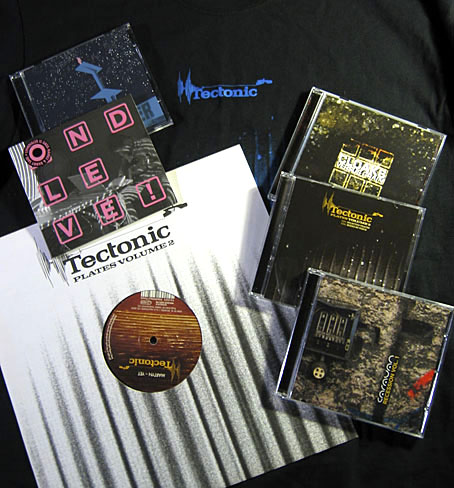
A visit to Baked Goods distribution this week brought me a haul of new releases, all items I’ve either designed or overseen the production of. Among the new CD designs I’ve already mentioned the Tectonic Plates compilation, a really excellent collection of dubstep singles with a bonus disc of mixes by Pinch. Related to Tectonic’s Bristol underground is a compilation of singles from the Caravan label mixed by DJ October. I’ve put together the labels for Caravan’s vinyl over the past year and assisted with the layout of this, their first CD. The other new design (which I’ve yet to add to the site) is a collection of live improvisations by Mojo-tipped Liondialer (influences: Supersilent, Talk Talk, Ornette Coleman, Tony Conrad, Stars of the Lid, Jandek, Loren Connors, Ben Frost, Shearwater…), aka Greg Haines and Danny Saul. This is another release on the White Box label and was recorded, edited and sequenced by my good friend Gav whose knowledge of music esoterica has been drawn upon for previous posts here.

Also new: a clutch of recent vinyl (I really need to add a vinyl section to my pages), a Tectonic promo T-shirt (!), and two releases which I helped guide through the production process, Cloaks Versus Grain and The Sleeper by The Leisure Society, the latter being a very well-received release which was nominated earlier this year for an Ivor Novello award.

Meanwhile, there’s more book work turning up but I’ll talk about that when I’ve had a chance to further update the site.

Previously on { feuilleton }
Plates: Volume 2

The Metamorphoses of Don José

velasquez1.jpg

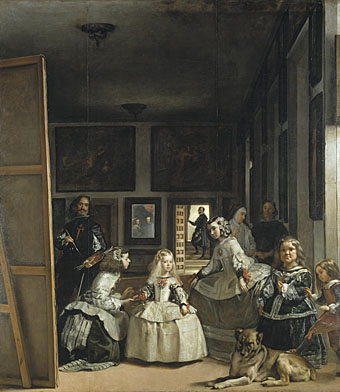
Las Meninas (1656) by Diego Velázquez.

The sight of one of Picasso’s many versions of Las Meninas (The Maids of Honour) by Velázquez earlier this week prompts this post. An endlessly fascinating painting whose influence runs through three hundred years of art history. That influence isn’t so surprising if you consider this as a painter’s painting; it certainly never seems to figure in the canon of favourite works among the wider public. But artists are beguiled by the games it plays with our ways of seeing: a self-portrait of the artist painting a subject (the royal couple) standing where the viewer would be, with the couple seen in reflection in the mirror on the back wall. We are the watchers and the watched. Wikimedia Commons has a decently large copy of the painting.
velasquez2.jpg

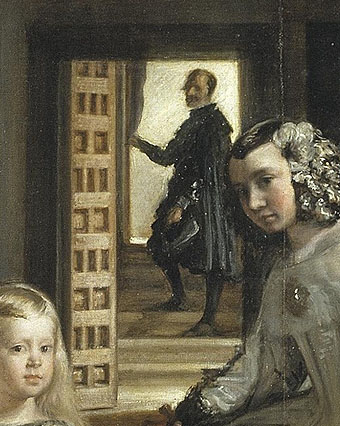
I’ve long been fascinated by the detail of the queen’s chamberlain, Don José Nieto Velázquez, standing on the steps at the back of the picture. Lines of perspective draw our attention to his figure, not only the perspective of the room but also the line which can be drawn across the heads of the three figures in the foreground right. I always look to see how Don José is treated in subsequent variations, some of which appear below.
goya.jpg

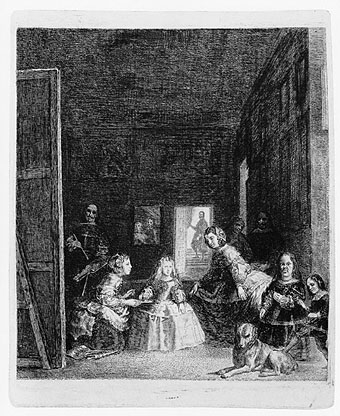
Las Meninas, after Velázquez (c. 1778) by Francisco de Goya y Lucientes.

One of the commonplaces of contemporary art is artworks about other artworks. Goya’s etching shows that this idea is by no means a new one. Goya was apparently dissatisfied with his attempt, and its main interest is the degree to which he distorts various parts of the picture.
clarke.jpg

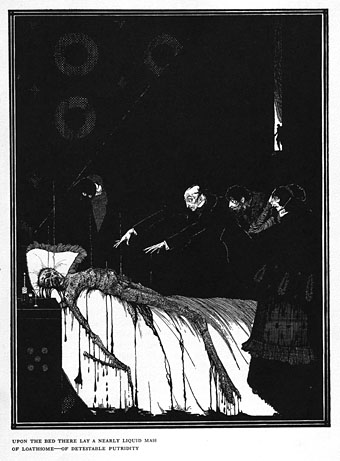
The Facts in the Case of M Valdemar (1919) by Harry Clarke.

Harry Clarke scholar Nicola Gordon Bowe proposed in The Life and Work of Harry Clarke (1989) that the figure in the background of this Poe illustration was a version of Don José. Clarke’s picture also has a similar grouping of foreground figures which adds to the speculation. The division of space in the Velázquez painting would have held considerable appeal for an artist used to dealing with similar divisions in his stained glass window designs. Will at A Journey Round My Skull recently uploaded a set of high-resolution scans of Clarke’s Poe drawings and paintings.
picasso.jpg

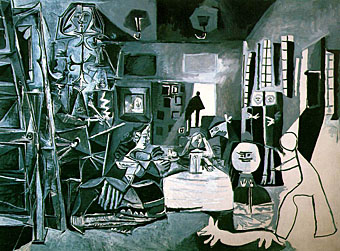
Las Meninas (after Velazquez) (1957) by Pablo Picasso.

In the 1950s Picasso took to producing a series of variations on favourite paintings. There are 44 versions of Las Meninas, some more abstract than others. This one reminds me of Guernica and I like the humour of presenting Velázquez’s dog—one of the great dogs of art history—as though it’s been drawn by Nicolas Pertusato, the child who attempts to rouse the animal with his foot. Velázquez here has a head surmounting a spindly body comprised of the Order of Santiago cross.
dali.jpg

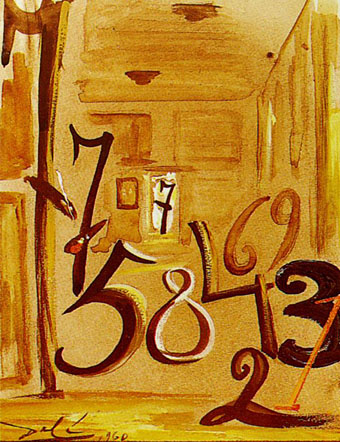
Las Meninas (1960) by Salvador Dalí.

Salvador Dalí venerated Velázquez and he happily quoted other artists throughout his career so it’s no surprise to find variations of Las Meninas. This wins the award for the most eccentric, with the figures reduced to numerals. Closer examination shows it to be quite clever the way each number corresponds to a different figure. The use of the number 7 for the artist and for Don José makes sense when you consider that they share the same surname. Don José turns up alone is another painting the same year, a work entitled Maelstrom: Portrait of Juan de Pareja fixing a string of his mandolin.
hamilton.jpg

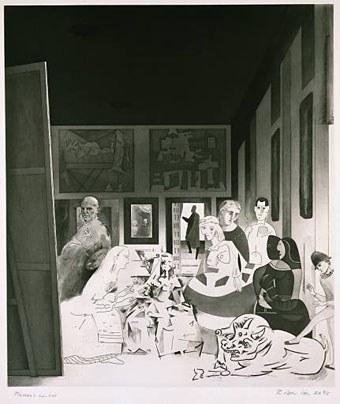
Picasso’s Meninas (1973) by Richard Hamilton.

Richard Hamilton’s aquatint is equally playful, substituting Velázquez with Picasso and his works.
haunter.jpg

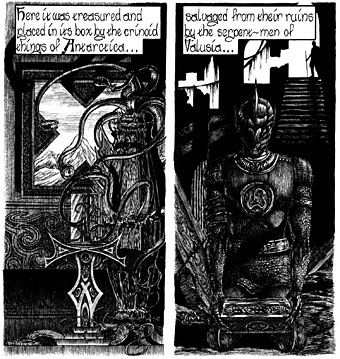
The Haunter of the Dark (1986).

I seem to have referred to my own work quite a lot recently, and here’s some more of it. The panel on the right quotes from Harry Clarke’s Poe illustration and so can be considered as continuing a trace element of the shadowy Don.
witkin.jpg

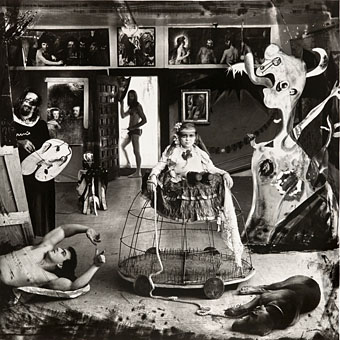
Las Meninas (Self Portrait) (1987) by Joel-Peter Witkin.

Joel-Peter Witkin has quoted Picasso’s works frequently in his photo-tableaux so the Picasso-esque figure on the right is perhaps inevitable. Witkin also has a considerable fondness for dead things so it’s quite likely that the dog in this photograph isn’t sleeping.

I’ll be surprised if there haven’t been a lot more variations during the past twenty years. If anyone knows of any which are better than this item by Antonio Guijarro Morales, please leave a comment.

Previously on { feuilleton }
Picasso-esque
Reflections of Narcissus
My pastiches
Guernica, seventy years on
The art of Harry Clarke, 1889–1931

Melancholy Lucifers

feuchere.jpg

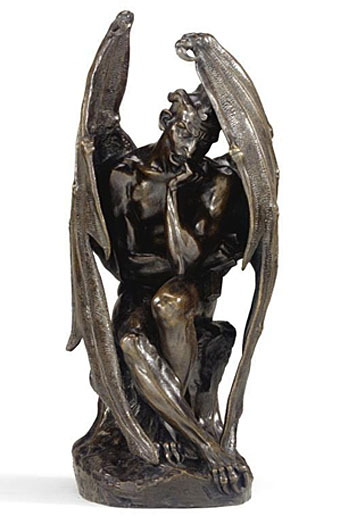
Satan (1833).

I always enjoy it when a search for a piece of information about an artist leads to works you hadn’t come across before. Today it was a quest for the identity of the Satan statue above, created, as it turns out, by French sculptor Jean-Jacques Feuchère (1807–1852). The Louvre site has another view of what seems to have been a popular work, produced in a range of bronzes.

lawh.jpg

I did actually know the artist’s name a few years ago since I’d used the statue as a starting point for the Satan figure on the cover of Cradle of Filth’s Lovecraft & Witch Hearts in 2002. One function of postings such as this is that it allows me to make a note of details which otherwise might flee the memory. Here Feuchère’s statue was combined with some squid tentacles and seated on an elaborate Gothic throne which is mostly obscured by the band’s name. (See a larger version sans lettering here.)

Continue reading “Melancholy Lucifers”

Plates: Volume 2

plates.jpg

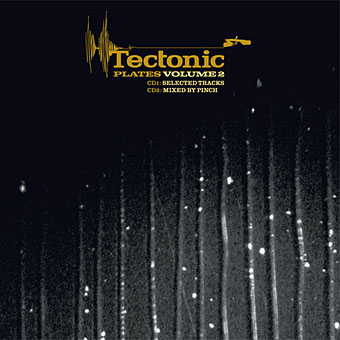
My third CD design for the Tectonic label is another piece of relative minimalism which once again features photos by Liz Eve. All the backgrounds on this occasion are microscope close-ups of vinyl records, very fitting for a double-CD collection of recent 12″ releases.

The Tectonic logo (which predates my involvement with the label) is based on the Technics logo and for this release I tidied the label logo slightly, a process which led to the discovery that the Technics design used a variant of the Clarendon typeface for its letter shapes (it’s not an exact match). This in turn led me to use Clarendon in various weights across the packaging, something which made a change from the usual sans serif or monospace font. The great Saul Bass frequently used Clarendon for his title sequences; if it’s good enough for Saul, it’s certainly good enough for me.

Tectonic main man Rob Ellis talked to Fact magazine about the new release earlier this week.

Previously on { feuilleton }
Aerial by 2562
New things for November

The Best of Michael Moorcock

mm1.jpg

The first of the books I’ve been designing for Tachyon Publications appears this month. Two more are due to follow and I’m working on another at the moment; more about those titles later.

The Best of Michael Moorcock was a pleasure to be involved with not only because I’ve been reading Moorcock’s fiction for a very long time but I’ve also been fortunate during that time to get to know the writer and Linda Moorcock, his wife. Mike likes the work I’ve done in the past for Savoy Books and we did have an anthology of his favourite pieces by other writers planned for Constable & Robinson back in 2005. That book didn’t work out so this makes up for its cancellation. This is an excellent anthology, put together initially as a private enterprise by editor John Davey who managed the difficult task of compiling a collection which ranges over forty years of writing. Ann and Jeff VanderMeer came aboard as co-editors for the Tachyon edition.

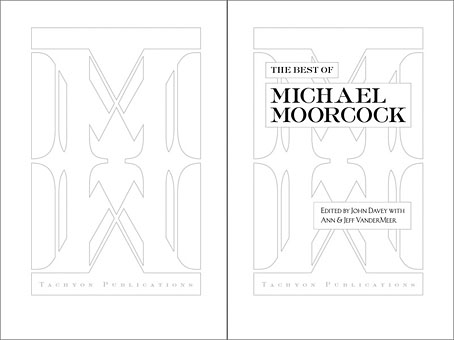
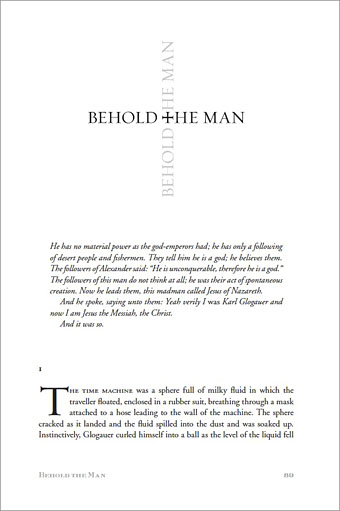
I’ve been working mainly on the interior design of the Tachyon volumes (although I’ve also done the cover for Jeff VanderMeer’s forthcoming Booklife) and for this title I took a cue from Ann Morn’s cover design which features a pair of gates emblazoned with large letter Ms. The title spread above takes the letter M from the typeface used for the author’s name and multiplies that to create an equivalent set of gates for the reader to pass through. I try to play down the pyrotechnics for fiction—the words are the important thing, not the graphic design—but since this was a story collection I thought I’d try illustrating each piece using the title typography alone. Most of these are done by using a suitable typeface but for a few pieces I managed to create an arrangement that reflected the story. Behold the Man (below) is the Nebula Award-winning story of a journey back in time to find the historical Jesus. The cross shape not only relates to the Biblical theme but also implies the crossed time streams and Moorcock’s layered, cross-cut narrative.

mm2.jpg

The Best of Michael Moorcock is available now from the usual sources and received a glowing review in the Guardian. Later this month, and other work permitting, I’m hoping to make a start on what will effectively be a companion volume, Savoy’s long-delayed Into the Media Web, another collection by John Davey which this time collects the best of Moorcock’s copious essays, reviews and other non-fiction.

Previously on { feuilleton }
Designing Booklife
The Sonic Assassins
Revenant volumes: Bob Haberfield, New Worlds and others
An announcement redux