
Weekend links 755

emsh.jpg

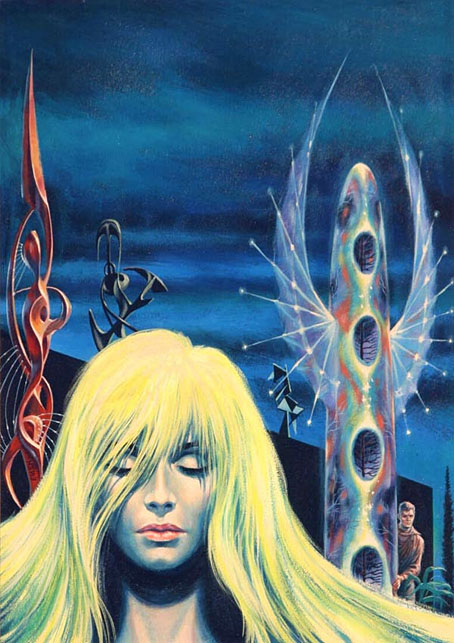
A painting by Ed Emshwiller for the cover of Fantastic Stories of Imagination, July 1962, illustrating The Singing Statues by JG Ballard .

• This week in the Bumper Book of Magic: my comments about the creation of the book’s cover and magical alphabet have been posted at Alan Moore World. At (Quasi), Smoky Man (in Italian) looks at other parts of the book, and includes my answers to his questions about the creation of The Soul, a character originally planned for a comic strip that Alan Moore and I were working on. I’ve been trying recently to find the first sketches I made of The Soul back in 2000 or 2001, without success. If I do find any of them I’ll post them here.

• New music: Juk-Shabb by Cryo Chamber Collaboration is this year’s installment in the Lovecraft-themed album series (previously) from Cryo Chamber. Also this week: Xerrox Vol. 5 by Alva Noto; Nocturne (Soundtrack for an Invisible Film) by Avi C. Engel; and Cat Location Conundrum by Moon Wiring Club.

Code: Damp: An Esoteric Guide to British Sitcoms by Sophie Sleigh-Johnson, being “an alternative occult and esoteric history of England told through one of its most popular cultural forms: the comedy sitcom”.

…the joy of art isn’t only the pleasure of an end result but also the experience of going through the process of having made it. When you go out for a walk it isn’t just (or even primarily) for the pleasure of reaching a destination, but for the process of doing the walking. For me, using AI all too often feels like I’m engaging in a socially useless process, in which I learn almost nothing and then pass on my non-learning to others. It’s like getting the postcard instead of the holiday.

Brian Eno at Boston Review

• “The typographic choices that Godard made were thematic and not only chosen for their stylistic properties.” Arijana Zeric looks inside the design world of Jean-Luc Godard.

• Coming soon from Strange Attractor: The Stammering Librarian: Essays by Timothy D’Arch Smith, edited by Edwin Pouncey & Sandy Robertson.

• At Public Domain Review: Fantastic Planet: The Microscopy Album of Marinus Pieter Filbri (1887–88).

• At the BFI: Michael Brooke offers suggestions for where to begin with Guy Maddin.

• At The Quietus: The Strange World of…Dennis Bovell.

• Mix of the week: A mix for The Wire by KMRU.

• Steven Heller’s font of the month is Gigafly.

Fantastic Cat (1996) by Takako Minekawa | Fantastic Analysis (2001) by Mouse On Mars | Fantastic Mass (2016) by Time Attendant

Lettres et Enseignes Art Nouveau

mulier1.jpg

These lettering designs were posted at Wikimedia Commons in the summer but I’ve only just noticed them this week. I’d been searching for Étienne Mulier’s designs while working on the six-part story about Miss Adeline Carr, aka “The Soul”, in the Bumper Book of Magic, the idea being to have each chapter open with the character’s name in a different Art Nouveau lettering style. If you look at enough bookselling sites you can eventually find one or two large photos of Mulier’s pages which is what I used when creating the heading for the second chapter of the story; but I still would have preferred to have had access to the whole collection. As it happens, most of the Wikimedia plates have also come from bookselling sites but they’re a slightly better collection than the ones I found.

soul.jpg

Mulier’s plates were published in 1901, presented not in book form but as a collection of loose lithographs in a card portfolio; the “Enseignes” in the title are suggestions for shop signs. Mulier also throws in a couple of less practical designs showing alphabets created by posing flamingos. The loose-leaf format is a useful one for something intended to be consulted by artists and craftspeople. Books could be awkward things in the days before digital scanning and photography if you wanted to trace something from a page which wouldn’t lie flat. The Mulier design I used for The Soul isn’t a perfect alphabet—the letters K and M could do with improving—but it’s a good example of the French approach to Art Nouveau lettering (and Art Nouveau design in general) which tends to be more loose and plant-like than equivalents from Germany or the Netherlands. The organic appearance of the letterforms suited the chapter I was illustrating which opens with a hunt for magic mushrooms.

mulier2.jpg

Mulier’s plates don’t appear to have been turned into printable fonts until the 1960s when the revival of interest in Art Nouveau prompted the creation of filmtype adaptations. Fontsinuse shows a rare print example on the cover of an album by Scottish prog band Beggar’s Opera, a version of the typeface which filled in the bi-chromatic letters and slightly altered their forms. “One of the ugliest typefaces ever created,” says Mr Hardwig. I can think of worse. More recently we have the inevitable digitisations, with Art Nouveau Caps being the closest to Mulier’s original. I was tempted to use a digitised version for the story but I find that many amateur (or semi-professional) digitisations of old typefaces are often crude things compared to the originals. I also liked the bi-chromatic effect so I ended up drawing my own copies of the letters I needed.

Previously on { feuilleton }
Bergling’s Art Alphabets
Typefaces of the occult revival

Weekend links 751

delville.jpg

The Treasures of Satan (1895) by Jean Delville.

• Among the new titles at Standard Ebooks, the home of free, high-quality, public-domain texts: Là-Bas, the celebrated account of Satanism in fin-de-siècle France by Joris-Karl Huysmans.

• New music: Chronicle by Arc, and The Invisible Road: Original Recordings, 1985–1990 by Sussan Deyhim & Richard Horowitz (linked here before but that was for the pre-release).

Fabulous Animals (1975), a six-part British TV series about cryptozoology presented by David Attenborough (!).

• At Colossal: “Colour and repetition form optical rhythms in Daniel Mullen’s geometric paintings“.

• At Public Domain Review: Anton Seder’s The Animal in Decorative Art (1896) turns up again.

Unseen scenes from Sergei Parajanov’s The Colour of Pomegranates.

• Steven Heller’s font of the month is Roadhouse.

Fanzine covers selected by DJ Food.

Mark Webber’s favourite records.

Satan Side (1972) by Keith Hudson | Satan Is Boring (1986) by Sonic Youth | Sataan Is Real (1991) by Terminal Cheesecake

Weekend links 749

carriage.jpg

Fantastic Sea Carriage (1556) by Johannes van Doetecum the Elder & Lucas van Doetecum, after Cornelis Floris the Younger.

• “Preiss and McElheny have acknowledged the influence of Jorge Luis Borges’s short story ‘The Library of Babel’ (1941), which offers a brilliant, brain-scratching disquisition on bibliotecas as conduits both of infinity and meaninglessness. I also found myself thinking of Arthur Fournier, in D. W. Young’s documentary The Booksellers (2019), who spoke of ‘the psychic dreaming that paper allows.'” Sukhdev Sandhu on The Secret World, a film by Jeff Preiss and Josiah McElheny about the books collected by Christine Burgin.

• Most people know Burt Shonberg’s paintings—if they know them at all—from their appearance in Roger Corman’s Edgar Allan Poe films. But Shonberg had a career outside the cinema, something explored in Momentary Blasts of Unexpected Light: The Visionary Art of Burt Shonberg, an exhibition currently running at the The Philosophical Research Society in Los Angeles.

Warriors (1996), an ad for Murphy’s Irish Stout directed by the Quay Brothers. Samurai warriors in an Irish pub scored to the theme from Yojimbo.

The Grand Jeu group have been neglected, at least in English-speaking history, from the general consciousness of “Surrealism” but they remain among its most interesting dissidents. The teenage Simplistes, led by [René] Daumal and [Roger] Gilbert-Lecompte, collectively experimented with consciousness and investigated wildly syncretic modes of destroying and recombining selves: diverse hermetic and occult systems, extrasensory perception, trances and somnambulism, mediumistic practice and collective dreaming.

[…]

The Grand Jeu was a project of paradox: artistic and ascetic, indulgent and severe, political, and mystical, ecstatic and negating, egoistic and selfless, graceful and violent. It sought to continually weave between collectivity and individuality, of art and life, multiplicity and unity, fed by a brew of political radicalism, inspired by Rimbaud’s germinal poetics of revolt and illumination, a utilitarian embrace of occult traditions and ideas, drug experimentation, Hindu sacred texts (Daumal would become an expert in Sanskrit) and some of Bergson’s philosophy. They were, in their own words, “serious players.” It was a mad mix, and in retrospect, clearly doomed to a short life—so, it turned out, were most its members.

Gus Mitchell on the “experimental metaphysics” of the Grand Jeu

• At Smithsonian magazine: Lanta Davis and Vince Reighard on the sculpted monsters and grotteschi that fill the Sacro Bosco at Bomarzo, Italy.

• At Bandcamp: George Grella compiles a list of “spooky sounds and spooky music, things to haunt nights and dreams”.

• At Colossal: Kelli Anderson’s amazing pop-up book, Alphabet in Motion: How Letters Get Their Shape.

• “The play that changed my life: Jim Broadbent on Ken Campbell’s electrifying epic Illuminatus!

• DJ Food browses some of the many album covers designed by the versatile Robert Lockhart.

Winners of the 2024 Nikon Photomicrography Competition.

• Mix of the week: XLR8R Podcast 873 by Andy Graham.

• The Strange World of…Lou Reed.

• The Internet Archive is back!

Warriors (1990) by Jon Hassell | Red Warrior (1990) by Ronald Shannon Jackson | Bhimpalasi Warriors (2001) by Transglobal Underground

Weekend links 747

burgher.jpg

Eden Flag with Solar-Anal Emblems and Hexes (2017) by Elijah Burgher.

• A note for regular readers that I’ll be in London for a couple of days next week, so the weekend post may be delayed by a day, if it arrives at all. I’ll be attending this event at The Century Club, Shaftsbury Avenue, a talk about The Moon and Serpent Bumper Book of Magic which will be published here and in the USA a few days from now. I’m told that copies of the book will be on sale if anyone wishes me to sign a copy.

• “Published two years before André Breton’s Manifeste du surréalisme (1924), which delineated the contours of the capital-S Surrealism movement, Les Malheurs represents a proto-Surrealist experiment par excellence.” Daisy Sainsbury on Les Malheurs des immortels (1922) by Paul Éluard and Max Ernst.

• “It has been two decades since Japan’s tidying boom began, and the nation remains as cluttered as ever. I know this because I live here.” Matt Alt in a long read exploring the Japanese cultivation of clutter. Don’t be shamed by minimalist interiors.

…with the Bumper Book, we wanted to present what we hope are lucid, coherent and joined-up ideas on how and why the concept of magic originated and developed over the millennia, a theoretical basis for how it might conceivably work along with suggestions as to how it might practically be employed—and, perhaps most radically, a social reason for magic’s existence as a means of transforming and improving both our individual worlds, and the greater human world of which we are components. And we wanted to deliver this in a way that reflected the colourful, psychedelic, profound and sometimes very funny nature of the magical experience itself. That, we felt, would be the biggest and most useful rabbit to pull out of the near-infinite top hat that we believe magic to be.

Alan Moore talking to Rob Salkowitz about the Moon and Serpent Bumper Book of Magic

• “When it comes to pure cinematic terror The Texas Chain Saw Massacre has no equal,” says Mat Colegate. I’d avoid being quite so definitive but it’s a film I’d put in a list of my favourite cinematic horrors.

• At Smithsonian Magazine: See 15 winning images from the Wildlife Photographer of the Year contest.

• At The Quietus: Lara Rix-Martin on the heavy existentialism of Soviet science fiction. Previously: Zone music.

• New music: Decimation Of I by Meemo Comma.

• Steven Heller’s font of the month is Exentrica.

Hex (1971) by Gil Mellé | Hex (1978) by Jon Hassell | Hexden Channel (2012) by Pye Corner Audio