Occultism for kids

wizard.jpg

My battered 1973 Gollancz hardback. Cover illustration by David Smee.

It may be all Harry Potter starter homes crowding the imaginative landscape these days but the lush fields of the early Seventies bred a peculiar brand of wizardry and wild romance, something I was reminded of recently by reviews of a new compilation of psychedelic singles (yes, another one), Real Life—Permanent Dreams on the Castle Communication label. Mention of a curio from the heady days of 1970, Tarot by Andrew Bown, summoned vague memories of a childrens’ television series, Ace of Wands, for which Tarot was the theme song. You can see the title sequence here and this clip compilation features the whole song plus trippy lyrics (“Velvet roofs, tattooed skies, patterns made from words…”). The wonderfully facetious TV Cream describes the series thus:

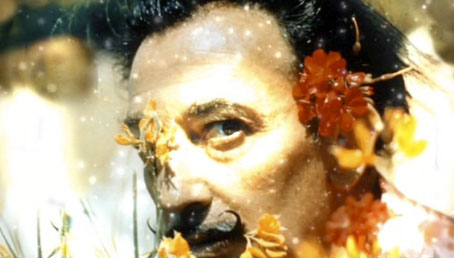
ACE OF WANDS (1970–72), THAMES TELEVISION. Jim-Morrison-alike boy magician Tarot (MICHAEL MACKENZIE) has adventures through history, for which read cheap studio set representing pyramid, cheap studio set representing Stonehenge and so on. DR WHO-style menace on a budget. Fought enemies such as Madame Midnight, Mr Stabs and Mama Doc, aided by an owl called Ozymandias (played by FRED THE OWL). Tarot cards and tarot phenomena abounded, much worthy roustabouts ensued. Prog-heavy title theme babbling – “Jet white dove/Snow black snake/Time has turned his face/From the edge of mystery” – singularly failed to assault the charts.

ace_of_wands.jpgI’ve mentioned before how magic and occultism were more popular at this time than they’ve probably ever been, and this flush of popularity, much of it coming from underground culture, managed to work its way into children’s television in a diluted form. Ace of Wands is easily the most baroque example of this, mixing the bell-bottom trendiness of Jason King with pulp plots given a psychedelic twist (hallucinogenic gases anyone?). Also from 1970 and far more down-to-earth (and, it should be said, more fun for kids) was Catweazle, written by Richard Carpenter and starring Geoffrey Bayldon. TV Cream has the details again:

CATWEAZLE (1970–71), LWT. Hairy tinker who can’t speak but who’s really an 11th Century magician (and who’s really GEOFFREY BAYLDON) tries to escape from some pissed off Norman soliders, jumps in a pond to hide and finds himself transported to Children’s Film Foundation-era Britain. Luckily there’s a posh (as always) boy on hand to explain all our modern day shit to him.

catweazle.jpgCatweazle quickly became the most popular kids’ progamme of its day and part of its attraction was the way in which Bayldon’s Norman time-traveller mistranslated modern technology as magic. So the telephone became a device called the “telling bone”, electricity was “electrickery” and so on. I had the first Catweazle annual which was an odd mixture of comic strips, text stories and articles about stage magicians with a smattering of genuine occult history.

Best of all for this Seventies kid was my favourite reading on the frequently dull Jackanory (“Ramshackle reading-is-fun relic wherein a Famous Person would sit on a chair with a pretend book and ponderously recount the contents of your local mobile library” says TV Cream) which one week had Ursula K Le Guin‘s A Wizard of Earthsea as its featured book. Try as I might, I’ve been unable to find the name of the actor who read this (black clothes, medieval chair) but I was knocked out by it. Years later the Earthsea cycle is still the only work of Le Guin’s I’ve been able to read, her science fiction seemed boring by comparison.

The inflated success of Harry Potter has had people casting about for JK Rowling’s influences over the past few years. A Wizard of Earthsea was first published in 1968 and also concerns a school of wizards, as do several other pre-HP novels. Rowling has acknowledged this although that acknowledgement hasn’t been loud or regular enough to appease a grouchy Le Guin. The Earthsea books are a lot shorter than the Potter door-stops and the first book at least is rather more sophisticated, reading equally well as a fantasy adventure for children and as a Jungian fable for adults with hints of Buddhist or Taoist philosophy. The characters are also notable for not being the Caucasians that most fantasy characters usually are, one of many details a recent TV adaptation (which Le Guin condemned) managed to ignore. It’s worth noting that JK Rowling is part of my generation (I’m 45, she’s 42) so she would have watched all this Seventies stuff herself. One of the reasons fantasy readers and writers (as opposed to snooty broadsheet critics) are often disappointed by the Potter juggernaut is that it could have been so much more considering the wealth of precedent that it draws upon. But then books rarely achieve this scale of popularity without being conservative and undemanding, Rowling’s work is merely the most recent example of this.

Le Guin spoiled the impact of her excellent first Earthsea book with several sequels of diminishing interest. A new animated film from Japan, Gedo Senki or Tales from Earthsea, based on the later works is released in the UK this month. The great British director Michael Powell had plans for an Earthsea adaptation scripted by Le Guin when he was director in residence at Francis Coppola’s Zoetrope Studios in 1980. Powell was great with fantasy (watch his Thief of Bagdad) so it’s a shame that nothing came of this. Ace of Wands is on DVD now and so is Catweazle. I can’t vouch for the former having much value beyond pure nostalgia but there’s plenty of clips from the latter at YouTube. Proceed with caution.

Previously on { feuilleton }
The art of Bob Pepper
Of Moons and Serpents
Austin Osman Spare

Chiaroscuro

baglione.jpg

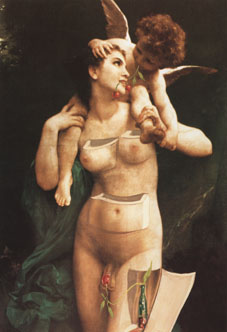
Heavenly Love and Earthly Love by Giovanni Baglione (1602–1603).

Chiaroscuro\, Chia`ro*scu”ro\, Chiaro-oscuro\, Chi*a”ro-os*cu”ro\, n. [It., clear dark.] (a) The arrangement of light and dark parts in a work of art, such as a drawing or painting, whether in monochrome or in colour. (b) The art or practice of so arranging the light and dark parts as to produce a harmonious effect.

Following from the earlier post about shadows in art, some favourite examples by masters of chiaroscuro. Another artist not represented here will be the subject of a post of his own in the next couple of days. The Dutch painter Godfried Schalcken (below) was the subject of the horror tale Schalcken the Painter by Joseph Sheridan Le Fanu, a story memorably filmed by Leslie Megahey for BBC television in 1979. Horror and the chiaroscuro effect belong together, as Fuseli’s Nightmare demonstrates, and many of Schalcken’s paintings seem even more curious and sinister after you’ve read Le Fanu’s story.

Update: John Klima points us to Hal Duncan‘s excellent story, The Chiaroscurist, which you can read at Electric Velocipede.

Continue reading “Chiaroscuro”

Cormac and Oprah

cormac1.jpg

Cormac McCarthy’s appearance on Oprah’s Book Club—his first television appearance ever—was screened last week. You can watch it online for free on her site although you need to register first. The interview is presented in chunks and only lasts for about twenty minutes but it was worthwhile for all that, even if it is chopped to pieces in that manner typical of American daytime TV.

cormac2.jpg

Most of the discussion skated on the surface but I was surprised (and pleased) when Oprah mentioned having read several of his books, including his ferocious masterwork, Blood Meridian. Main topic was The Road, of course, but we also got to hear something about Cormac’s dedicating himself to a life of precarious unemployment in order to have the freedom to write. He’s playing my tune but I imagine many of Oprah’s viewers would have struggled to comprehend that decision. Faulkner’s name was mentioned, and James Joyce when they talked about the lack of punctuation in his prose. In the end it was enough to simply see the man as a human being sat in a chair. And kudos again to Oprah for championing his work.

Meanwhile, The Sopranos screened its final episode on Sunday night. I watched the last couple of seasons via BitTorrent so I’m privy to the controversial ending which I won’t reveal here even though plenty of news sites have done so already. All I’ll say is I approve of the ending and regard the naysayers as foolish in complaining about a series which throughout its run tried to be different, challenging and better than the half-baked fare which is usually offered as television drama. For those who know the ending (or aren’t so concerned about it), series creator David Chase discussed his intentions and the audience reaction with the New Jersey Star-Ledger.

Update: A David Chase comment from 2001 turned up via the NYT. I’m sure these are sentiments Cormac McCarthy would also agree with.

What’s the difference between what’s art and what isn’t art? That’s the hard question to answer. The only thing that I guess I believe is that a lot of what I see on the air and in other places is giving answers, and I don’t think art should give answers. I think art should only pose questions. And art should not fill in blanks for people, or I think that’s what’s called propaganda. I think art should only raise questions, a lot of which may be even dissonant and you don’t even know you’re being asked a question, but that it creates some kind of tension inside you.

Previously on { feuilleton }
In praise of Cormac
Cormac McCarthy book covers

The South Bank Show: Francis Bacon

bacon.jpg

Non-Brits may not be aware that The South Bank Show is a long-running arts programme (or “show”, as Americans prefer) and the last bastion of cultural broadcasting on the otherwise completely moribund ITV channel. Over the years the SBS has produced some great documentaries and this one from 1985 is particularly good, capturing artist Francis Bacon in fine form, both as combative critic and sozzled pisshead when he and presenter Melvyn Bragg drink too much wine in a restaurant. Highlights include his funny dismissal of Mark Rothko whilst viewing paintings at the Tate, their tour of his cramped studio, and his drunken pronunciation of the word “voluptuous” when describing Michelangelo’s male figures.

I taped this programme when it was repeated after Bacon’s death in 1992 but you lucky people can now see and download it from Ubuweb. (Their note says the SBS is a BBC production but this is incorrect.)

Part of The South Bank Show series, David Hinton directs this documentary about British painter Francis Bacon, known for his horrifying portraits of humanity. The program consists of a series of conversations between Bacon and interviewer Melvyn Bragg, starting with commentary during a side-show presentation at the Tate Gallery in London. Later in the evening, Bacon is followed through various bars hanging out, drinking, and gambling. In another segment, Bacon provides a tour of his painting studio and a glimpse at his reference photographs of distorted humans. The artist discusses his theories, influences, and obsessions. This title won an International Emmy Award in 1985.

This isn’t necessarily the best Bacon interview, that accolade would probably have to go to the 1984 Arena documentary (which was a BBC production) Francis Bacon: The Brutality of Fact where FB is interviewed by art critic and long-time supporter David Sylvester. Sylvester interviewed Bacon many times over twenty years or so and Thames & Hudson printed the Arena interview along with several of their other talks in Sylvester’s book of the same name. Essential reading for anyone interested in the artist’s work.

Bacon’s work has affected my own on a number of occasions. The cover to Reverbstorm #4 borrowed the carcass from his Painting (1946); some of the paintings I was doing in 1997 (like this one and this one) are distinctly Bacon-esque and we used two of his paintings on the cover design for Savoy’s edition of The Killer (Dave Britton’s idea on that occasion).

His work remains popular for the over-inflated art market. Sketches and unfinished paintings that he was throwing out, and detritus like discarded cheque books, sold for nearly a million pounds last month. And earlier this week his Study from Innocent X (1960) went for $52.6m in a New York auction. Bacon once said that “some artists leave remarkable things which, a hundred years later, don’t work at all. I have left my mark; my work is hung in museums, but maybe one day the Tate Gallery or the other museums will banish me to the cellar—you never know.” I think we can assume this won’t be happening for a while yet.

Elsewhere on { feuilleton }
The gay artists archive

Previously on { feuilleton }
T&H: At the Sign of the Dolphin
20 Sites n Years by Tom Phillips

The Bradbury Building: Looking Backward from the Future

bradbury1.jpg

The Bradbury Building, 304 South Broadway, Los Angeles.

This looks like an old photograph but it actually dates from 1989 and comprises part of the Changing Times: Los Angeles in Photographs, 1920-1990 archive that the UCLA Library has recently made public.

bellamy.jpgThe Bradbury Building (constructed in 1893) was one of the few places I insisted on searching out when I was visiting the city in 2005. That enthusiasm dates from first seeing the building’s interior in Blade Runner where Ridley Scott turned its carefully-preserved atrium into JF Sebastian’s run-down apartment building. All that wrought-iron and polished terracotta (and those elevators!) would be compelling enough on their own but their history as a setting for a several film and TV productions only adds to their enchantment. That a building from the 1890s should be known primarily for its role in a science fiction film perhaps isn’t so surprising when it transpires that the Bradbury’s architect, George Wyman, had been inspired by a passage in a contemporary novel of futurist fantasy, Edward Bellamy’s Looking Backward: From 2000 to 1887:

It was the first interior of a twentieth-century public building that I had ever beheld, and the spectacle naturally impressed me deeply. I was in a vast hall full of light, received not alone from the windows on all sides, but from the dome, the point of which was a hundred feet above. Beneath it, in the centre of the hall, a magnificent fountain played, cooling the atmosphere to a delicious freshness with its spray. The walls and ceiling were frescoed in mellow tints, calculated to soften without absorbing the light which flooded the interior.

Wyman’s exterior is fairly nondescript even beside the younger buildings which now surround it, a fairly ordinary office building of the period. It’s the Bellamy-inspired atrium which captures the imagination and one can only wonder what the result might have been had Bellamy been a bit more liberal with his descriptions of America in the year 2000.

bradbury4.jpg

The building exterior and South Broadway entrance.

Blade Runner wasn’t the first film to make use of the Bradbury’s interior, Billy Wilder’s film noir Double Indemnity used the building’s offices as a location in 1944 and six years later Edmond O’Brien found his way there in the climax to another noir thriller D.O.A., directed by Rudolph Maté. This is the film that famously begins with O’Brien’s character staggering into a police station to report a murder—his own. He’s been dosed with a slow-acting poison, something possibly radioactive, as was the fashion of the time. He has a few hours in which to find his killer and his breathless chase leads him to an empty Bradbury building at night, all spider-webbed with shadows.

doa.jpg

D.O.A. (1950).

bradbury3.jpg

The atrium roof, circa 1961.

culp.jpg

Robert Culp: ‘Demon With A Glass Hand’ (1964).

“I was born ten days ago. A full grown man…born ten days ago. I woke on the streets of this city. I don’t know who I am, where I’ve been, or where I’m going. Someone wiped my memories clean. And they tracked me down and they tried to kill me. Why? Who are you? I ran. I managed to escape them the first time. The hand…my hand…told me what to do….”

The splendid atrium was put to even better use in 1964 for what’s often regarded as the best episode of The Outer Limits, the award-winning ‘Demon With a Glass Hand‘ written by Harlan Ellison. In that TV play the mysterious, amnesiac Trent (a great performance by Robert Culp) finds himself trapped inside the Bradbury after the building is besieged by the Kyben, alien invaders who chased him from the future and who who want both him and the computer he has fitted into his artificial hand. The building proves to be the location of a “time mirror” which enables Trent to return to the future after he’s defeated the Kyben and saved the future human race.

blade_runner.jpg

Blade Runner (1982).

We had been searching for locations for a building. We wanted to go on location to an old, decrepit building and take a suite of rooms and use that as Sebastian’s apartment. One day we were downtown Los Angeles looking at a possible location, and I took a stroll across the street with Ridley and a few other people and Ridley took a look inside the beautiful Bradbury building. What we did to that building you wouldn’t believe. On a superficial level we trashed it with high-tech, then filled it with smoke on the inside and shot at night. We also added a canopy with big columns to make it look like it was an old apartment building. All of a sudden we had a very gothic, eerie environment.

Lawrence G. Paull, Blade Runner production designer in Future Noir: The Making of Blade Runner by Paul M. Sammon.

bradbury2.jpg

One of my photographs from 2005.

It’s tempting to see Blade Runner‘s vision of Los Angeles as a movie mash-up of the Bradbury’s noir thriller heritage with Bellamy and Ellison’s science fiction scenarios. In Britain such an elegant interior would only ever be used for Victorian costume dramas. The Bradbury’s movie life has mostly been a result of expediency and its convenience as a cheap, ready-made set, but this hasn’t prevented talented filmmakers from showing what can be done with a decent storyline and some photogenic architecture.

D.O.A. is now available as a free download after its copyright lapsed. And you can read Edward Bellamy’s Looking Backward (if you must) here. ‘Demon With A Glass Hand’ is available on DVD along with the rest of the Outer Limits episodes. Blade Runner was finally released in a better DVD edition last year but we’re still awaiting the multi-disc edition of Ridley’s masterpiece.

Previously on { feuilleton }
Raw Deal
Film noir posters
Kiss Me Deadly
The future is now
Blade Runner DVD
Downtown LA by Ansel Adams