Beardsley and His Work

beardsley1.jpg

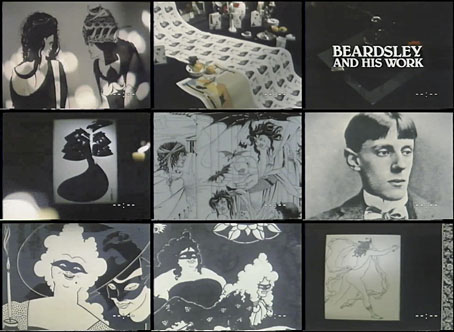
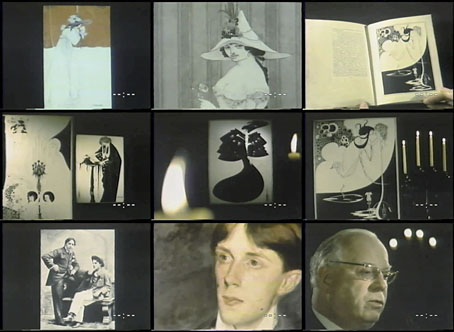
Back in 2008 I wrote at some length about Aubrey, an excellent BBC TV dramatisation of the last years of Aubrey Beardsley’s life written by John Selwyn Gilbert, and screened once in 1982. Mr Gilbert himself added a comment to that post in which he mentioned that he’d written and directed a documentary which was screened in tandem with the play, Beardsley and His Work. I have the documentary on tape but it’s a copy of a copy and is also missing ten minutes or so of its opening so it’s good to find that the entire thing is now on YouTube. (Thanks to Dominique for drawing my attention to this.)

Beardsley and His Work is essential viewing for Beardsleyphiles since it’s the only place you’ll see Beardsley scholar Brian Reade—author of the huge monograph, Beardsley (1967)—and Brigid Brophy—author of two excellent studies, Black and White (1968) and Beardsley and His World (1976)—talking at length about the artist. In addition there’s another artist, Ralph Steadman, examining some of Beardsley’s original artwork and discussing the techniques of ink drawing. The fifty-minute film is divided into four chunks, unfortunately, but is otherwise complete:

Part one | part two | part three | part four
beardsley2.jpg

Elsewhere on { feuilleton }
The Aubrey Beardsley archive

Weekend links 124

despont.jpg

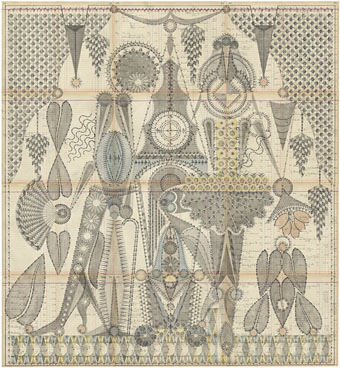
Couple with Clock Tower (2011) by Louise Despont.

Assuming such a thing doesn’t already exist, there’s a micro-thesis to be written about the associations between the musicians of Germany’s Krautrock/Kosmische music scene in the early 1970s and the directors of the New German Cinema. I’d not seen this clip before which shows the mighty Amon Düül II jamming briefly in Fassbinder’s The Niklashausen Journey, a bizarre agitprop TV movie made in 1970. More familiar is the low-budget short that Wim Wenders helped photograph a year earlier showing the Düül performing Phallus Dei. Wenders later commissioned Can to provide music for the final scene of Alice in the Cities. And this is before you get to Werner Herzog’s lengthy relationship with Popol Vuh which includes this memorable moment. Any others out there that I’ve missed?

Album sleeves in their original locations. And speaking of album sleeves, photo prints of some very famous cover designs by Storm Thorgerson will be on display at the Public Works Gallery, Chicago, throughout September and October.

Crazy for kittehs: the quest to find the purring heart of cat videos: Gideon Lewis-Kraus goes where few journalists dare to tread. Also at Wired, the same writer explores the Cat Cafés of Tokyo.

The City of Rotted Names, a “shamelessly Joycian cubist fantasy” by Hal Duncan, available to read in a variety of formats on a pay-as-thou-wilt basis until Monday only.

• Jailhouse rockers: How The Prisoner inspired artists from The Beatles to Richard Hawley.

How To Survive A Plague, a documentary about HIV/AIDS activism in the US.

• Deborah Harry: hippy girl in 1968, punk in 1976, and Giger-woman in 1981.

Alan Garner answers readers’ questions about his new novel, Boneland.

• For steampunk aficionados: ‘COG’nitive Dreams by Dana Mattocks.

• David Bowie, Iggy Pop, Madonna & Asparagus: Kraftwerk in 1976.

• New music videos: Goddess Eyes I by Julia Holter | Sulphurdew by Ufomammut | Warm Leatherette by Laibach.

Borges and I

borges.jpg

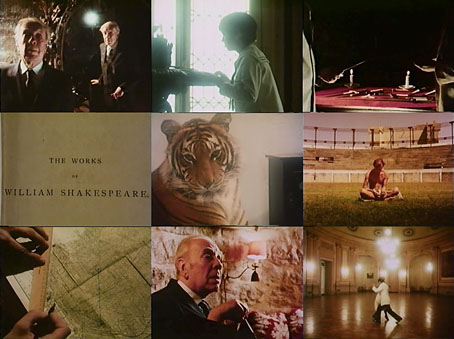
Another piece of revenant television to tick off the “When will I see this?” list. I mentioned David Wheatley’s film Borges and I back in January in a post about the director’s dramatisation of the life and work of René Magritte. Wheatley’s student film secured for him a job as a BBC director at a time when the Arena arts series was one of the best things being produced by the corporation. Borges and I was filmed in 1982 and broadcast a year later, an event I managed to miss to my considerable regret. Once again Ubuweb has turned up the goods with a copy from an American video tape. It’s not ideal—all the Spanish sequences would have been subtitled in the original broadcast—but I’m not going to complain. This 80-minute film is not only the best Anglophone documentary I’ve seen on Borges, it was produced in collaboration with the author who for much of the running time discusses his life and work in English. The tape copy also frustratingly lacks credits but the unseen American interviewer and narrator would appear to be translator and collaborator Norman Thomas di Giovanni, a writer who later found himself and his work marginalised by the Borges estate. Between the interviews and readings there are dramatised sequences from The Meeting, Funes, the Memorious, The South, The Circular Ruins, Death and the Compass, and The Sartorial Revolution, one of the collaborations with Adolfo Bioy Casares. Plus, of course, the expected complement of mirrors, tigers and a duel with knives. The budget must have been generous: scenes were shot in Argentina and Uruguay, and we also see Borges at his favourite lodging in Paris: L’Hôtel in the Rue des Beaux-Arts, a building which now bears plaques celebrating the visits of Borges and another famous literary resident, Oscar Wilde.

Previously on { feuilleton }
René Magritte by David Wheatley
L’Hôtel, Paris
Borges documentary
Borges in Performance

Robert Hughes, 1938–2012

hughes.jpg

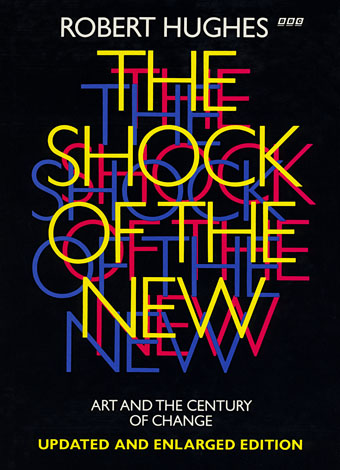
Read this book. Revised edition, 1991, no designer credited.

“Robert Hughes”: those were the first words I wrote in the first post for this blog, six years ago, referencing a piece Hughes had written about Rembrandt for the Guardian that week. Re-reading his polemic Culture of Complaint: The Fraying of America earlier this year I was feeling guilty about not having read more of his books; in slight mitigation I did watch every appearance of his on British television following The Shock of the New, and still have his American Visions series imprisoned on VHS in a box somewhere, along with The Fatal Shore, The New Shock of the New, some one-off things he did about Barcelona and Goya, and Visions of Space, a series of three films about European architects: Albert Speer, Mies van der Rohe, and Antonio Gaudi. Thanks to YouTube many of these exceptional documentaries can be given a fresh viewing; follow the links. Hughes used to write for the Guardian regularly so it’s no surprise they’ve filled several pages with memorials:

Obituary by Michael McNay
“Robert Hughes was Australia’s Dante,” says his friend Peter Carey
Robert Hughes on art
Robert Hughes quotes: 20 of the best

Elsewhere:
NYT obituary by Randy Kennedy
“Robert Hughes: The art critic with a dash of the streetfighter”: Judith Flanders at the Telegraph
At Open Culture: Remembering Robert Hughes, the Art Critic Who Took No Prisoners

The Catherine Wheel by Twyla Tharp

catherinewheel.jpg

The music links this weekend were all related to my favourite Talking Heads period, 1979–1982, which not only encompasses the release of the band’s Fear Of Music and Remain In Light albums but also saw the individual group members produce some great solo records. I’d been playing one of these, the first Tom Tom Club album, all week while the sun was out. Now the temperature has dropped again, and we’re back to this summer’s default setting of perma-rain, the music doesn’t feel quite so appropriate. In 1981 while Tina Weymouth and Chris Frantz were exercising their funk muscles David Byrne was recording My Life In The Bush Of Ghosts with Brian Eno. The score Byrne produced immediately prior to this for the Twyla Tharp Dance Company often sounds like My Life… avant la lettre, with similar musicians (Eno included), sounds and rhythms. This is one reason I favour Songs From The Broadway Production Of “The Catherine Wheel” over Byrne’s subsequent solo albums.

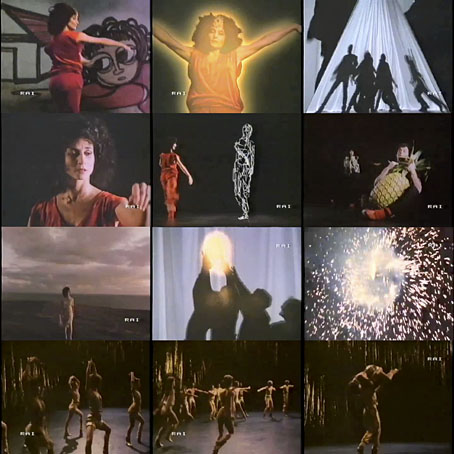
The Catherine Wheel was a seventy-two minute dance film choreographed and directed by Twyla Tharp. The film was part-produced by the BBC and as far as I’m aware was only ever broadcast the once in Britain in 1983. Byrne’s score runs continuously as on the CD and cassette versions, the vinyl release being a re-sequenced editing of the tracks favouring the handful of songs. In dance terms the film was very innovative for the time, employing some subtle video effects and a couple of sequences where a duet is danced with a wire-frame CGI figure. A long end sequence, The Golden Section, predates The Catherine Wheel, and was apparently the origin of the project. Since I hadn’t seen any of this in nearly thirty years my search for Tom Tom Club videos at the weekend made me wonder whether YouTube had any Catherine Wheel clips, only to find that the entire film can be viewed here in a recording from Italian TV. (That copy was removed, link now goes to another one.) I’m so familiar with Byrne’s album it’s been fascinating seeing this again, especially since I only saw it on a small black-and-white TV originally and recalled very little of the performance. All the music works well enough on its own but seems completed when heard in this context, especially during The Golden Section. The film is also available on DVD from Kultur so this is another item for the shopping list.

Previously on { feuilleton }
Moonlight in Glory
My Life in the Bush of Ghosts