Hiatus

crash.jpg

Ho hum. Internet problems here mean posting will be sporadic for the next few days. My apologies. In the meantime the archive feature has been activated to bring up posts from the past. Stay tuned.

Update: Still contending with a week of All The Technical Problems, not only internet-related but things like my main work computer throwing kernel panics like they’re going out of fashion. Consequently I’ve been rather preoccupied while I attempt to get back to the usual operational status and do important things like attend to deadlines. It’ll still be a few more days before there’s further activity here, I’m afraid. Stay tuned.

Update 2: UK residents will tell you that the iniquities of British Telecom are like Walt Whitman’s contradictions: vast and multitudinous. All being well, however, normal service should be resumed here on the 20th.

Lines and colours

block1.jpg

OMG Particles II.

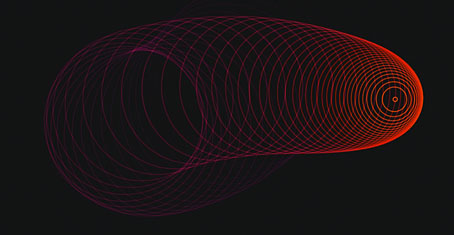
From the Algorithms Are Fun Dept., some of the more colourful examples of script pyrotechnics and coding samples at mbostock’s pages. Many of the routines have data-crunching applications but a few eye-candy pieces may be found among them. What’s most surprising is how many of them work immediately, and also operate at great speed which makes them difficult to capture in screen grabs. Via Coudal.

block2.jpg

Lorenz Toy.

block3.jpg

Transform Transitions.

Previously on { feuilleton }
Eyecandy
The Kaleidoplex
Colorscreen

The Last Angel of History: Afrofuturism, science fiction and electronic music

lastangel1.jpg

There’s been a resurgence of interest recently in Afrofuturism (see this recent newspaper article, and this site), not before time when the term has been around since 1993. The concept itself goes back a long way, at least as far as the remarkable body of work produced by Sun Ra (1914–1993) whose vast discography dates from 1956, and has to be considered the first concerted attempt to craft an expansive cosmic/futuristic mythos in music.

lastangel2.jpg

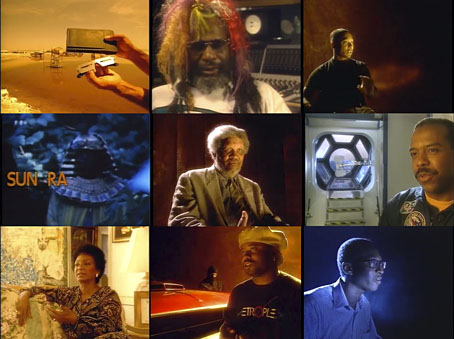
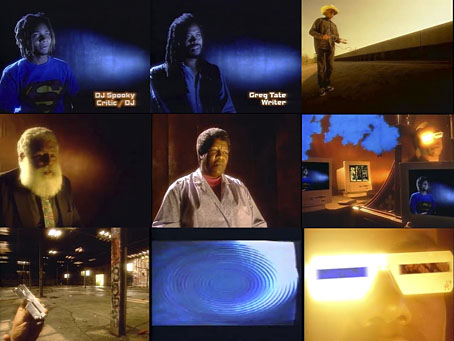
Sun Ra and his Arkestra make fleeting appearances in The Last Angel of History (1997), a 45-minute documentary by John Akomfrah which looks at Afrofuturism via its manifestations in fiction, contemporary music, and in space travel. The connecting tissue is a somewhat dated bit of cyperpunk fluff but it’s worth sticking around for the cast of interviewees. On the musical side there’s George Clinton, Derrick May, Juan Atkins, Carl Craig, DJ Spooky, Goldie, and A Guy Called Gerald; on the writing side there’s Ishmael Reed (whose early novels would have been published by my colleagues at Savoy Books if the company hadn’t gone bust in the early 80s), Samuel R. Delany (Savoy did publish one of his novels), Octavia Butler, Kodwo Eshun and Greg Tate; Nichelle Nichols has a chance to talk about something other than Star Trek for once, since she helped with NASA’s recruitment programme. There’s also Bernard A. Harris Jr, one of the first African-Americans in space. The techno-fetishism seems overheated now that we’ve all calmed down about computers and the internet, but that doesn’t negate the important points: SF as a reflection of the present moment and a means to imagine a different situation or way of life. With 2014 being Sun Ra’s centenary year I’m anticipating a lot more of this.

The Last Angel of History: part 1 | part 2 | part 3

Previously on { feuilleton }
Rammellzee RIP

Weekend links 191

strongowski.jpg

Two cover designs from Eliash Strongowski’s 30 Days—30 Covers project.

My thanks once again to Dennis Cooper for placing this blog on his end-of-year lists. Meanwhile. one of the albums I designed earlier this year, Cold Mission by Logos, made the 30 Best Album Covers of 2013 list at FACT.

• “Many of their more outlandish ideas never saw fruition: an organ powered by an entire factory, an electro-acoustic orchestra mounted on a fleet of airplanes.” Colin McSwiggen reviews Sound in Z: Experiments in Sound and Electronic Music in Early 20th Century Russia by Andrey Smirnov.

Queer Pagan Punk, a major film retrospective of the work of Derek Jarman, will take place in February and March 2014 at the BFI Southbank, London.

• “For over forty years, Iain Sinclair’s work has combined obsessive myth-making with urban despair. But what do we know about him?” asks Fatema Ahmed.

• “Rather than trying to intercept alien communications, perhaps we should go looking for alien artefacts.”

• Mix of the week: Radio Belbury Programme 12, and Winter Hours, the Cafe Kaput 2013 winter mix.

BEEP BEEP. BLOOP BLEEP: Road Runner cartoons soundtracked by a Eurorack synthesizer.

Historia Discordia: Documenting the Origins, History & Chaos of the Discordian Society.

gebbie.jpg

Pink Boy by Melinda Gebbie.

Suffered From The Night: Queering Stoker’s Dracula edited by Steve Berman.

• At Dangerous Minds: An interview with soundtrack composer Cliff Martinez.

Sarah Schoenfeld puts recreational drugs under the microscope.

• Powerplant Art-déco, a set of photos by Romain Veillon.

Adrian Curry chooses the best film posters of 2013.

Portent’s Content Idea Generator

Tarkovsky at Pinterest

The Sea Named Solaris (1977) by Tomita | Is That What Everybody Wants? (2002) by Cliff Martinez | Reyja (2011) by Ben Frost & Daníel Bjarnason

Weekend links 188

blackwell.jpg

The Baron in the Trees (2011), a book-cut sculpture by Su Blackwell.

Kurt Andersen at Vanity Fair examines the latest claims that Vermeer used a combination of lenses and mirrors to aid the creation of his remarkable paintings. David Hockney caused a considerable fuss in 2006 when he made similar assertions. Andersen recounts how Tim Jenison (who isn’t an artist) decided to test the hypothesis by building a replica of the room from Vermeer’s The Music Lesson (1662–65) which he then painted with the assistance of a lens-and-mirror apparatus. I’m agnostic on this issue, and don’t regard it as a devaluing of the work of Vermeer (or any other artist) if some special apparatus was used to help create the paintings; artists for centuries have been using whatever technology was available.

One point which isn’t mentioned in the article: lens optics were being developed to a high standard in the Netherlands during Vermeer’s time. One of the developers of the microscope, Antonie van Leeuwenhoek, was a contemporary of Vermeer’s in Delft, and is even alleged to be portrayed in some of the artist’s paintings.

• Before Alfred Hitchcock’s film and Daphne Du Maurier’s short story, The Birds was an “eerie yet satirical and rather metaphysical novel” by Frank Baker, inspired in part by Arthur Machen. Michael Dirda reviews a new edition. Related: “The Day of the Claw: A Synoptic Account of Alfred Hitchcock’s The Birds“, an essay by Ken Mogg examining avian menace through the ages.

Kevin Brownlow and Carl Davis on how they brought Abel Gance’s 270-minute silent masterwork, Napoleon (1927), back to the screen.

Finally, he was asked about the growth of surveillance and the militarization of the police.

“The phenomenon itself shouldn’t be surprising—the scale was surprising—but the phenomenon itself is as American as apple pie,” Chomsky said. “You can be confident that any system of power is going to use technology against its enemy: the population. Power systems seek short-term domination and control, not security.”

Matthew Robare on “American Anarchist” Noam Chomsky in (of all places) The American Conservative.

• “Why the hell wouldn’t I?” Evan J. Peterson on reading/performing his poetry in public, and his new book, The Midnight Channel.

The adversaria of Google Books: captured mark of the hand and digitization as rephotography.

• No surprise that the rabies-haunted town of Scarfolk is soon to have its history fixed in print.

Mazzy Star made a rare TV appearance last week, playing a song from their recent album.

The Sorcerer Blog is obsessively devoted to William Friedkin’s cult film.

• Unexpected Artefacts: Pushing the envelope with Bristol’s Emptyset.

• Mix of the week: Secret Thirteen Mix 097 by Lee Gamble.

• At PingMag: Ryokudo—Tokyo’s Green Roads.

Norman Records’ Top 50 albums of 2013.

Birds Of Fire (1973) by Mahavishnu Orchestra | Attack Of The Killer Birds (2006) by Émilie Simon | One Thousand Birds (2012) by Six Organs of Admittance