Weekend links 675

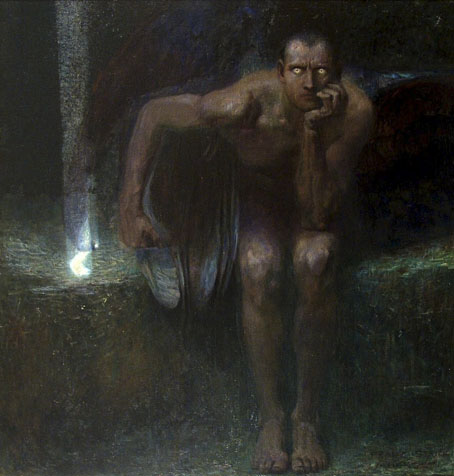
stuck.jpg

Lucifer (1890) by Franz Stuck.

• “I wanted to reclaim the word ‘psychonauts’ and take it back into the 19th century, where it describes not only renegades and rebels, but also establishment scientists, doctors, and pillars of the literary establishment. The word that was used at the time was “self-experimenter.” Mike Jay (again) talking to Steve Paulson about psychoactive research and the scientists who taste their own medicine.

• “How did countercultures commune before the internet?” asks J. Hoberman, reviewing Heads Together: Weed and the Underground Press Syndicate, 1965–1973 by David Jacob Kramer.

• At Public Domain Review: Medieval advice concerning the mythical Bonnacon: “the protection which its forehead denies this monster is furnished by its bowels”.

• DJ Food unearths posters and badges for The Kaleidoscope, a short-lived Los Angeles music venue of the late 60s.

• At Spoon & Tamago: Gaku Yamazaki has documented thousands of unusual road signs across Japan.

• New music: Psalm013: Unland by Pram of Dogs, and Intimaa by Bana Haffar.

• At Unquiet Things: A sneak peek from the forthcoming The Art of Fantasy.

• The Strange World of…Shirley Collins.

• At Dennis Cooper’s: Bruce Posner Day.

Kenneth Anger: a life in pictures.

• RIP Tina Turner.

Kaleidoscope (1967) by Kaleidoscope (UK) | Kaleidoscope (1984) by Rain Parade | Collideascope (1987) by The Dukes Of Stratosphear
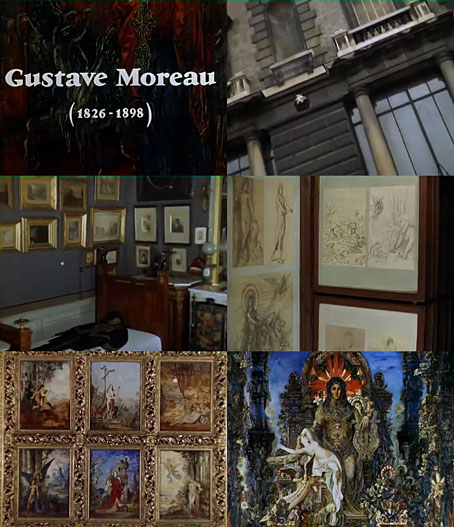
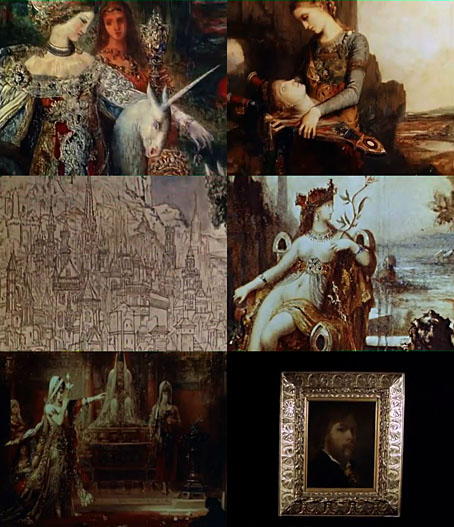
Gustave Moreau (1826–1898), a film by Nelly Kaplan

moreau1.jpg

André Breton has acknowledged that his personal ideal of female beauty was established in his adolescence when he visited the Gustave Moreau museum in Paris; like Joris-Karl Huysmans’s protagonist, Des Esseintes, Breton was enthralled by Moreau’s depiction of figures such as Salomé.

Keith Aspley, Historical Dictionary of Surrealism

André Breton happens to be one of four narrators whose voices may be heard (all speaking French) in this short study of Gustave Moreau’s paintings and drawings made in 1961. Director Nelly Kaplan was an Argentinian writer and film-maker who moved to Paris in the 1950s where she became creatively involved with Abel Gance, and with what was left of the original Surrealist movement based around the autocratic Breton. I’ve often drawn attention to Breton’s pettiness, especially his penchant for excommunicating from his circle anyone he disagreed with, but he deserves credit for championing Gustave Moreau during the decades when the artist was resolutely beyond the critical pale. A lesson I learned from the Surrealists early on is that you don’t let other people dictate the limits of your cultural tastes.

moreau2.jpg

Moreau was still beyond the pale in 1961 so Kaplan’s film was in the vanguard of the reappraisals that were to take place later in the decade, culminating in major exhibitions in the early 1970s. One of the curators of the Hayward exhibition of 1972, Philippe Jullian, made an unfinished Moreau painting, The Chimeras, a key reference in his landmark study of Symbolist art, Dreamers of Decadence (1971). You see a few details from this picture in Kaplan’s film when the camera is roaming the walls of the Moreau Museum, formerly the artist’s residence in the rue de la Rochefoucauld, Paris. The years of neglect had their advantages, one of them being that the house/museum hasn’t had to change very much in order to accommodate visitors; the same goes for Moreau’s art which didn’t get scattered around the world like the works of his contemporaries. The upper floors of the museum are filled with original paintings, together with preliminary sketches which you see here in their hinged frames which allow you to leaf through them like pages of a book. No film or book does justice to the jewelled splendour of the finished paintings, however, especially the detailed works like Jupiter and Semele. You really have to see these things in person if you can.

Previously on { feuilleton }
New Life for the Decadents by Philippe Jullian
More chimeras
Philippe Jullian, connoisseur of the exotic
Ballard and the painters

Edmund Dulac’s illustrated Poe

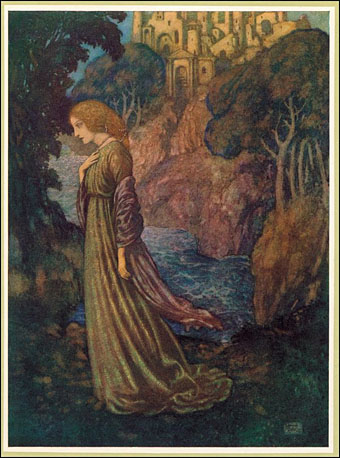
dulac10.jpg

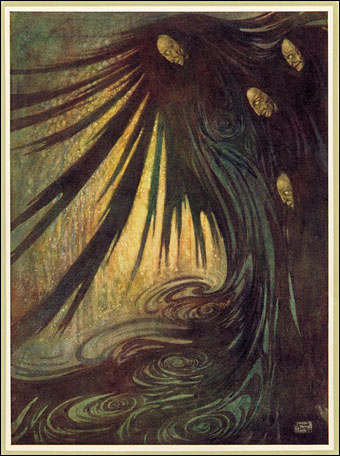
The Haunted Palace.

There’s always more Poe. Which means, in the context of these pages, there’s always another illustrated edition to be found. It’s good to finally discover a complete edition of The Bells, and Other Poems; I’d seen a few of these paintings before—Alone was used on the cover of a biography of Poe by Wolf Mankowitz—but the collection tends to be overshadowed by Dulac’s other books. The Internet Archive has had a scan available for several years but most of the colour plates are missing, picture theft being a common hazard for library books. These copies are from a more recent addition to Project Gutenberg.

dulac01.jpg

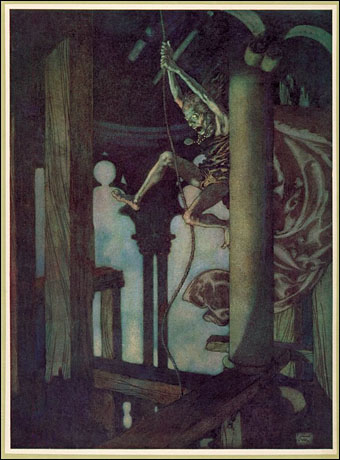
The Bells.

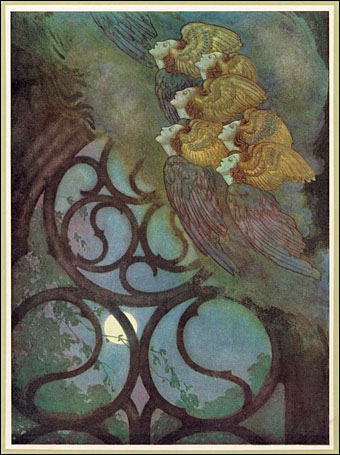
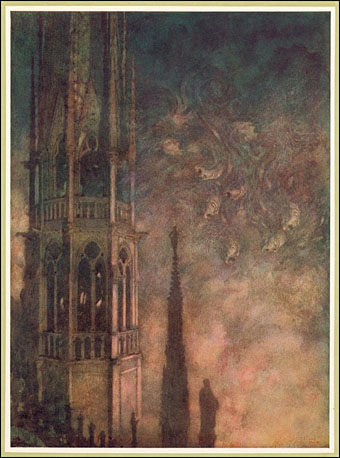
The Bells was published 12 years after W. Heath Robinson had produced his own illustrated edition of Poe poems in 1900. The two books complement each other more than you might expect; all of Robinson’s illustrations are line drawings with an Art Nouveau quality that soon vanished from his work, and was long gone by the time he found a popular audience for his drawings of whimsical inventions. Dulac’s edition includes a few monochrome drawings but these are little more than spot illustrations scattered among the watercolour plates. Several of the paintings, especially the one for Israfel, are Symbolist art as much as they’re illustration. This might seem inevitable given the Symbolist tendencies of Poe’s verse but not all illustrators manage to reflect these qualities.

dulac02.jpg

The Bells.

dulac03.jpg

The Bells.

dulac04.jpg

Annabel Lee.

Continue reading “Edmund Dulac’s illustrated Poe”

The Secret World of Odilon Redon

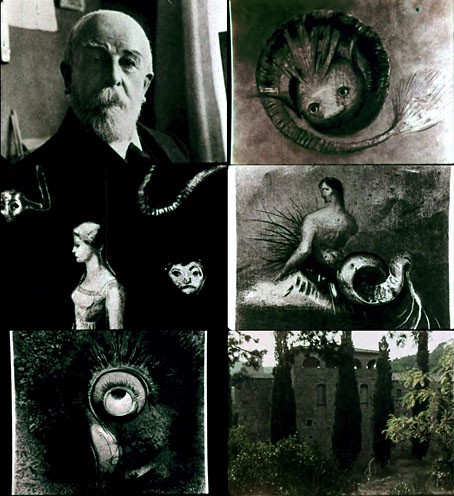
redon.jpg

Documentaries about French artist Odilon Redon aren’t very common at all so it’s a shame this one isn’t better quality. The Secret World of Odilon Redon is another introductory film from the Arts Council of Great Britain, made in 1973, the same year as Magritte: The False Mirror. The print is in even worse condition than the Magritte, with washed-out colour and a quavering score that sounds like it was taken from a mispressed record; but the voiceover by Richard Hurndall makes it worthwhile, a series of quotes from Redon’s memoirs, in which the artist discusses his work and his philosophy. The accompanying visuals, which include views of places where he lived and worked, do nothing for the vivid colours of his pastel drawings but if you want those there are plenty of other resources elsewhere.

For a more Surrealist approach there’s Guy Maddin’s Odilon Redon, or The Eye Like a Strange Balloon Mounts Toward Infinity, a dreamlike excursion into the strange world of the artist’s etchings.

Previously on { feuilleton }
Odilon Redon’s Temptations
More chimeras
Odilon Redon’s musical afterlife
Odilon Redon and Magazine
Odilon Redon lithographs
The eyes of Odilon Redon

Weekend links 625

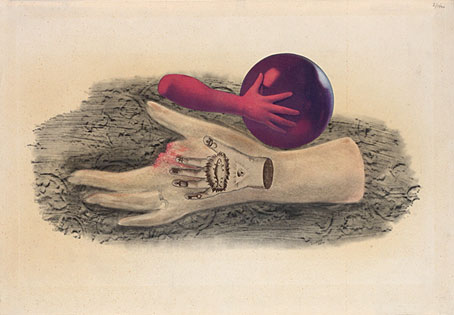
styrsky.jpg

Hand (1940) by Jindřich Štyrský.

• “I love very much Symbolist painters like Odilon Redon, Ferdinand Knopf or Léon Spilliaert. Or Nordic European painters such as Munch or Gallen-Kallela. I like the way they often mix nature and mythology. Some Surrealist painters are very inspiring too: De Chirico, Tanguy, Toyen, Styrsky, or Dorothea Tanning, for instance.” Lucile Hadžihalilović talking to Mark Cousins about her new film, Earwig, and her approach to cinema.

• “It was no accident that Mishima chose to experiment with science fiction. It was a genre he had long admired. He adored Arthur C. Clarke, and lavished praise on Godzilla…” Alexander Lee on Yukio Mishima’s sole venture into science fiction, Beautiful Star.

• Old music: Roforofo Fight by Fela Kuti, a great favourite round here, is receiving a 50th anniversary reissue.

Readers of Berlin’s Third Sex were confronted with a whole fête galante of misfits, deviants, and sexual mutineers cavorting on the legal edgelands of society. There’s the “gathering of obviously homosexual princes, counts and barons” discussing Wagner, the women-only ball where a “dark-eyed Carmen sets a jockey aflame”, the drag act burlesquing Isadora Duncan, a café in the city’s north where Jewish lesbians play chess, gaggles of gay labourers meeting up to gossip before tending to their needlework, the Russian baron distributing alms to hustlers in the Tiergarten, a canal-side tavern where soldiers from the nearby barracks find gay men only too willing to pick up their tab, and the encrypted classified ads with which the lonesome and horny sought to make the vast metropolis just a little smaller.

James Conway on the pioneering sexology of Magnus Hirschfeld

• At Aquarium Drunkard: The Miles Davis Septet playing live at Chateau Neuf, Oslo, in 1971.

Industrial Symphony No. 1 by David Lynch & Angelo Badalamenti featuring Julee Cruise.

• Mix of the week: Ghosts & Goblins 1 by The Ephemeral Man.

• New music: The Homeland Of Electricity by Scanner.

• Steven Heller’s font of the month is Pufff.

• Galerie Dennis Cooper presents Ilse Bing.

• RIP Paula Rego and Julee Cruise.

Teacher Of Electricity (1970) by Old Gold | Electricity (1980) by Orchestral Manoeuvres In The Dark | Night Electricity Theme (2017) by Dean Hurley