New Life for the Decadents by Philippe Jullian

jullian1.jpg

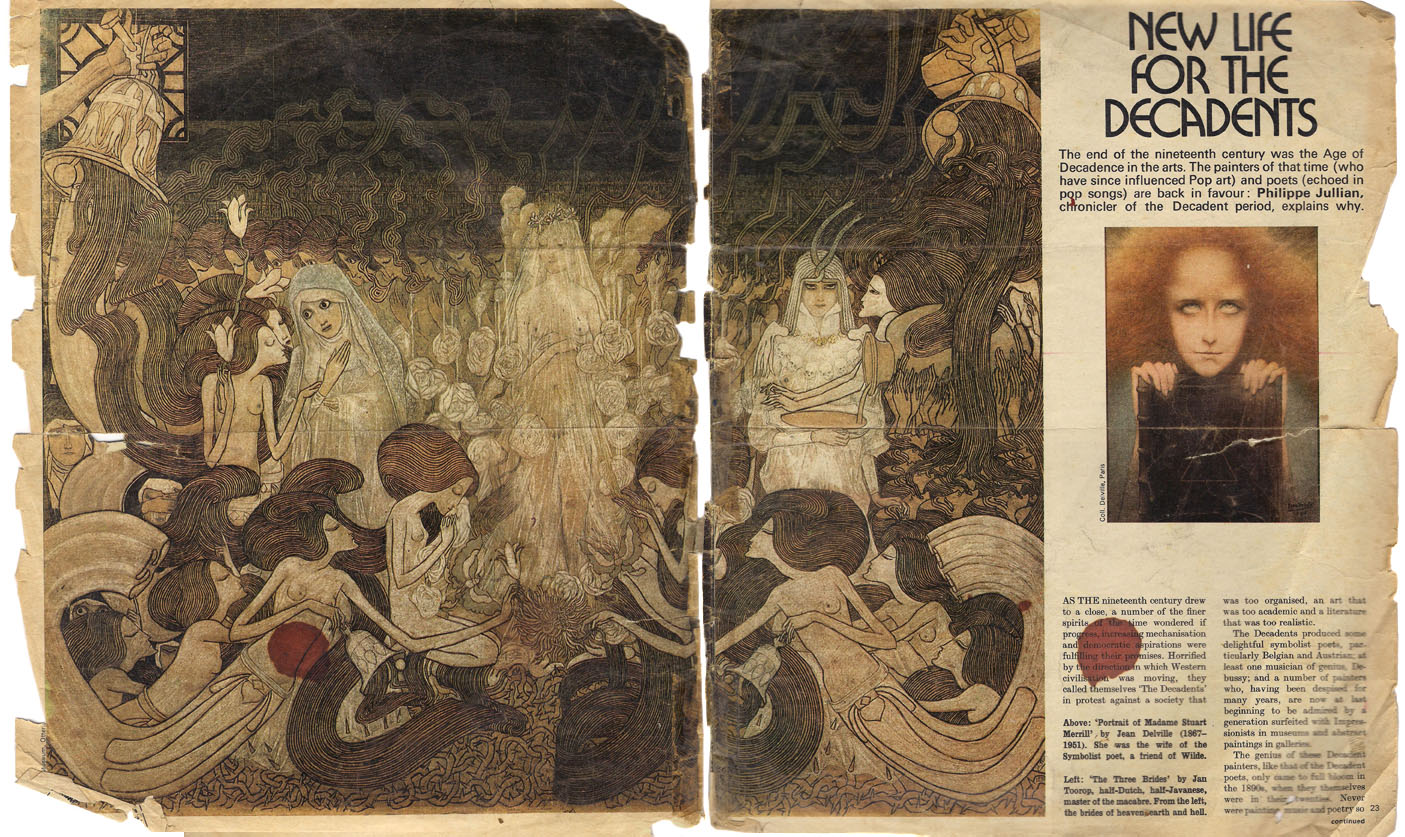
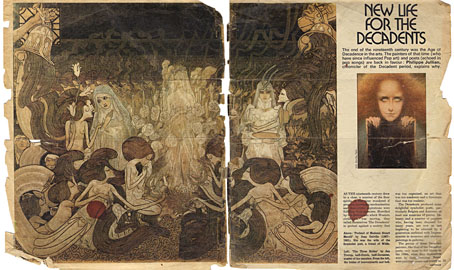
This essay by cult writer Philippe Jullian appeared in an edition of the Observer colour supplement in 1971, shortly after Jullian’s chef d’oeuvre, Dreamers of Decadence, had been published in Britain. Esthètes et Magiciens (1969), as Jullian’s study was titled in France, was instrumental in raising the profile of the many Symbolist artists whose work had been either disparaged or ignored since the First World War. A year after the Observer piece, the Hayward Gallery in London staged a major exhibition of Symbolist art with an emphasis on the paintings of Gustave Moreau; Jullian alludes to the exhibition in his article, and also wrote the foreword to the catalogue. His Observer article is necessarily shorter and less detailed than his introductory essay, emphasising the reader-friendly “Decadence” over the more evasive “Symbolist”. But as a primer to a mysterious and neglected area of art the piece would have served its purpose for a general reader.

Many thanks to Nick for the recommendation, and to Alistair who went to the trouble of providing high-res scans that I could run through the OCR. The translators of the article, Francis King and John Haylock, had previously translated Jullian’s biography of Robert de Montesquiou.

*

New Life for the Decadents

The end of the nineteenth century was the Age of Decadence in the arts. The painters of that time (who have since influenced Pop art) and poets (echoed in pop songs) are back in favour: Philippe Jullian, chronicler of the Decadent period, explains why.

AS THE nineteenth century drew to a close, a number of the finer spirits of the time wondered if progress, increasing mechanisation and democratic aspirations were fulfilling their promises. Horrified by the direction in which Western civilisation was moving, they called themselves “The Decadents” in protest against a society that was too organised, an art that was too academic and a literature that was too realistic.

The Decadents produced some delightful symbolist poets, particularly Belgian and Austrian; at least one musician of genius, Debussy; and a number of painters who, having been despised for many years, are now at last beginning to be admired by a generation surfeited with Impressionists in museums and abstract paintings in galleries.

The genius of these Decadent painters, like that of the Decadent poets, only came to full bloom in the 1890s, when they themselves were in their twenties. Never were painting, music and poetry so close to one another. The gods of the Decadents were primarily Wagner and Baudelaire, then Swinburne and Poe. The Decadent movement, so active all over Europe, turned towards two great sources of inspiration: the Pre-Raphaelites, and a French painter whose glory was for a while eclipsed by the Impressionists but who is now once again accorded his place among the great—Gustave Moreau.

The women whom the Decadents loved and of whom they dreamt resembled the women created 30 years previously by Rossetti, Burne-Jones and Moreau.

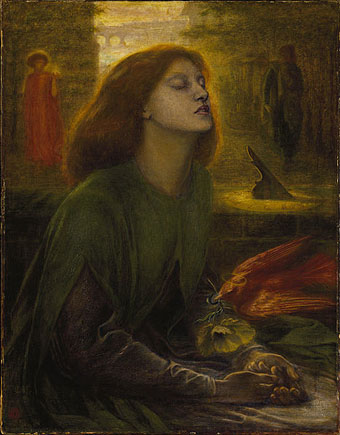
Nothing could be more naturalistic than the artistic style elaborated by the Pre-Raphaelites in the middle of the nineteenth century. Dante Gabriel Rossetti’s model, inspiration, mistress and finally wife was the sweet and sad Elizabeth Siddal, on whom so many fin-de-siècle ladies had to model themselves on the Continent as did all the aesthetic ladies of England in the 1880s. She posed for Rossetti as Beatrix and as the Belle Dame sans Merci.

She was a rare spirit, about whom everything was nebulous and evanescent: the thick, wild hair; the tunic of a simplicity to challenge the elaboration of the crinolines then in vogue; the frail hands burdened with lilies; the gaze turned towards eternity. She also posed, fully dressed and lying in a bath, her hair outspread around her bloodless face, as Ophelia for another Pre-Raphaelite, Millais. Elizabeth died of pulmonary tuberculosis in 1862.

A macabre episode, which might have been imagined by Poe, was the exhumation of a sheaf of Rossetti’s poems that had been buried in Elizabeth Siddal’s coffin. When this symbol of the New Woman died, the grief-stricken poet had insisted on placing the poems inspired by her under her long hair before the coffin was sealed.
jullian4.jpg

Beata Beatrix (1864–1870) by Dante Gabriel Rossetti.

Continue reading “New Life for the Decadents by Philippe Jullian”

Elihu Vedder’s Rubáiyát

vedder01.jpg

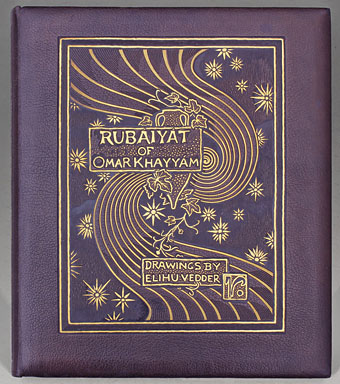
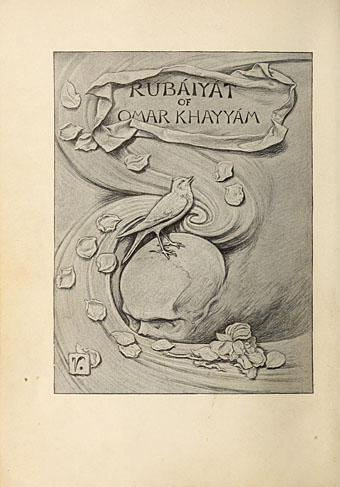
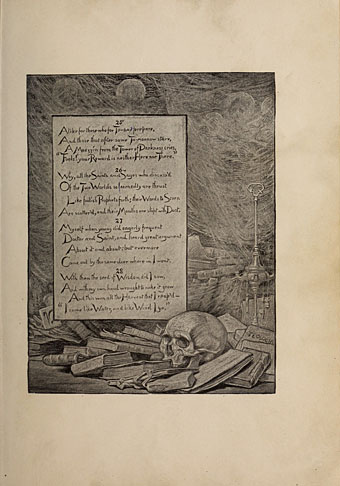
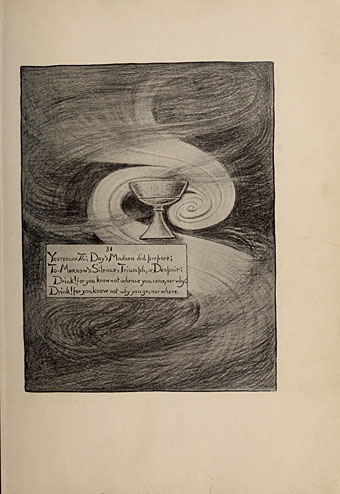
A slight return to Omar Khayyam. The Edmund J. Sullivan post prompted comments about other editions so I thought I’d see what else was at the Internet Archive. The problem there is that the Rubáiyát was a very popular book in the latter part of the 19th century which means there are not only multiple editions of the Edward Fitzgerald translation but many translations by other hands, as well as numerous parodies. Anne S mentioned the Edmund Dulac edition which I suppose I ought to at least acknowledge since Dulac’s passion for Persian and Arabian art made him an ideal illustrator. But I do enjoy finding illustrated books that are less familiar, hence Elihu Vedder’s edition of 1894.

vedder02.jpg

Elihu Vedder (1836–1923) was an American Symbolist painter, and also something of a poet himself, producing a few volumes of his own illustrated verse. Many illustrators favour an Orientalist interpretation of the Rubáiyát despite the popularity of the quatrains being more a result of their universality than their exotic qualities. Vedder produced over 50 drawings that concentrate on the mystical aspects of the poem, setting hand-lettered texts against illustrations that are either very similar to his paintings or direct copies of some of his canvases. It’s unfortunate that the reproductions in this edition—a reprinting of Vedder’s 1884 original—aren’t better. The book is still one of the more remarkable editions, however. Browse the rest of it here or download it here.

vedder03.jpg

vedder04.jpg

Continue reading “Elihu Vedder’s Rubáiyát”

The art of Fabrizio Clerici, 1913–1993

clerici1.jpg

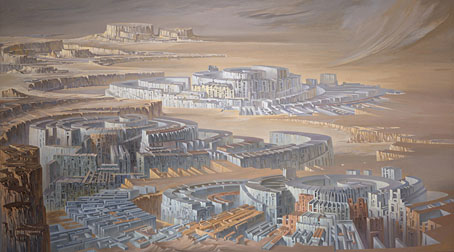
Un istante dopo (1978).

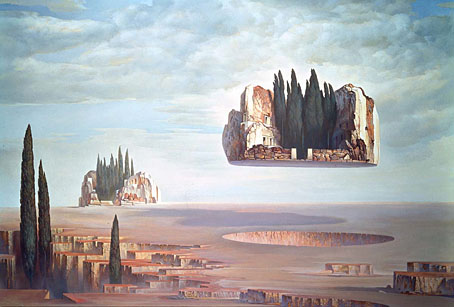
An Italian painter of the fantastic who’s managed to stay off my radar for one reason or another despite doing many of the things I like to see: weightless structures, imaginary architecture, and (towards the end of his career) a series of variations on Arnold Böcklin’s endlessly adaptable The Isle of the Dead. The latter paintings are some of the best Böcklin variants I’ve seen. These alone would have made him worthy of attention but the rest of his oeuvre is an equally accomplished development of late Surrealism (or, if you need another category, Fantastic Realism). The official website is a very good one so there’s plenty more to see. (Thanks to Michelangelo for the tip!)

clerici2.jpg

La tromba d’aria (1965).

clerici3.jpg

Latitudine Böcklin (1974).

Elsewhere on { feuilleton }
The fantastic art archive

Previously on { feuilleton }
A Picture to Dream Over: The Isle of the Dead
The Isle of the Dead in detail
Arnold Böcklin and The Isle of the Dead

The art of Carlos Schwabe, 1866–1926

schwabe01.jpg

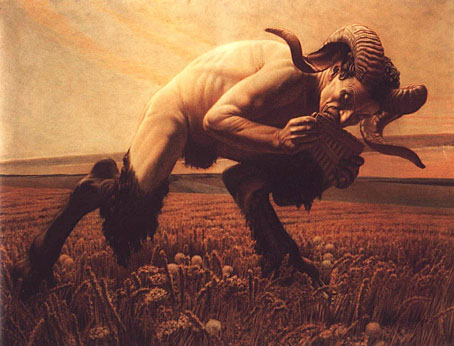
Le Faune (1923).

Yesterday’s Pan prompted me to repost Carlos Schwabe’s wonderful painting of a faun, one of my favourite faun/satyr depictions, and easily one of the best in the entire Symbolist corpus. Other satyr aficionados of the period such as Arnold Böcklin and Franz Stuck had an unfortunate knack for making their goat gods look rather foolish.

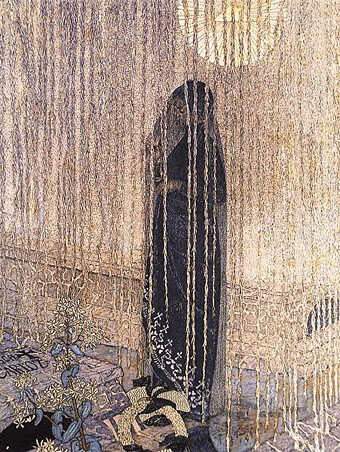
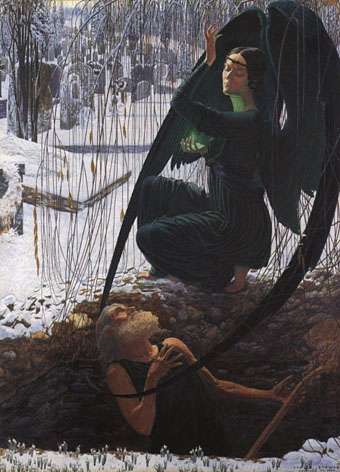
Schwabe was a German artist, and one of the more mystical of the Symbolists, with a fondness for winged figures and a preoccupation with death. The mystical end of the Symbolist spectrum is the one I enjoy the most so I often point to Schwabe or Jean Delville as exemplars of this type of art. Both Schwabe and Delville were connected briefly by Joséphin Péladan’s very mystical Salon de la Rose + Croix although Delville later gravitated to Theosophy. Schwabe produced illustrations for an edition of Baudelaire’s Les Fleurs du Mal, and would have featured in the Baudelaire posts last week if some of those drawings hadn’t appeared here already. The title page was a new find, however, so it’s included below.

schwabe09.jpg

Jour de morts (1890).

schwabe04.jpg

La mort du fossoyeur (1895).

Continue reading “The art of Carlos Schwabe, 1866–1926”

Tony George-Roux’s Fleurs du Mal

tgr1.jpg

More illustrated Baudelaire. This edition of Les Fleurs du Mal dates from 1917 but the illustrations by Tony George-Roux have a distinctly Symbolist quality even though Symbolism as an art movement was pretty much over by this point. Baudelaire died twenty years before the first Symbolist manifesto was published but that manifesto named him as one of the leading poets of the movement so the connection is a fitting one. There’s a touch of Félicien Rops in some of these plates.

Tony George-Roux (1894–1928) was French, and if he produced more work along these lines I’ve yet to find it. The illustrations, engraved for this edition by Charles Clement, aren’t the best reproductions so I’ve added an additional plate at the end found on another site.

tgr2.jpg

Continue reading “Tony George-Roux’s Fleurs du Mal”