8 x 8: A Chess Sonata in 8 Movements

8x8-1.jpg

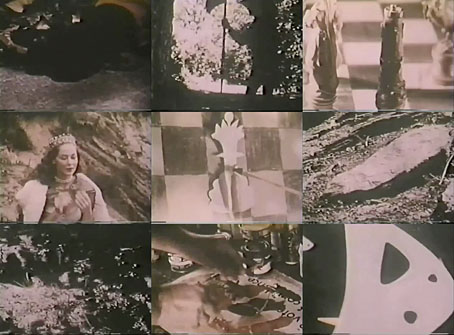
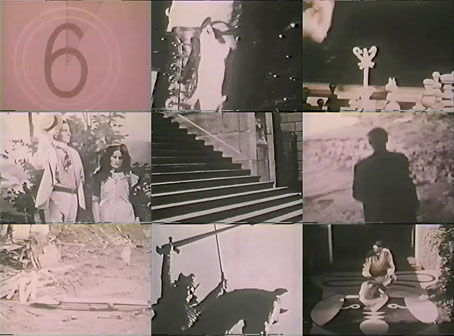
Continuing the Cocteau theme, this fascinating film remains (for the time being) unavailable in a better copy despite its artistic all-star cast. 8 x 8: A Chess Sonata in 8 Movements (1957) can be regarded as a follow-up to Hans Richter’s Surrealist anthology Dreams That Money Can Buy (1947), the directorial credit this time being shared between Richter, Jean Cocteau and Marcel Duchamp. The latter famously quit the art world to devote more time to chess-playing so his involvement with a chess-based fantasy (self-described as “a fairytale for grownups”) isn’t so surprising:

It explores the realm behind the magic mirror which served Lewis Carroll 100 years ago to stimulate our imagination.

The cast comprises famous friends including Cocteau himself, Max Ernst, Dorothea Tanning, Paul Bowles, Fernand Leger, Alexander Calder, Duchamp, and, in the Venetian episode, Peggy Guggenheim in her favourite sunglasses. In places it’s closer to Kenneth Anger’s Inauguration of the Pleasure Dome (1954) than Dreams That Money Can Buy, especially since Anger’s film was another assemblage of unique personalities. One detail I’ve not seen remarked upon elsewhere is the presence behind the camera of Louis & Bebe Barron who assisted with the sound. The Barrons are better known today for their still astonishing all-electronic score for Forbidden Planet (1956). Watch 8 x 8 at Ubuweb or YouTube.
8x8-2.jpg

Previously on { feuilleton }
Dreams That Money Can Buy
Weekend links 177

wickerman.jpg

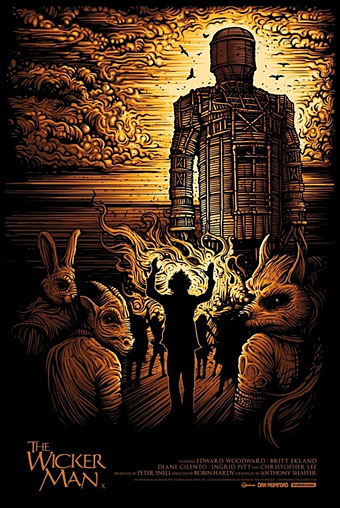
A new Wicker Man poster by Dan Mumford appears on the cover of the forthcoming DVD/BR reissues. Prints are available.

• The long-awaited release of a restored print of Robin Hardy’s The Wicker Man approaches. Dangerous Minds has a trailer while The Guardian posted a clip of the restored footage. The latter isn’t anything new if you’ve seen the earlier uncut version, but the sound and picture quality are substantially better. I’ve already ordered my copy from Moviemail.

• “It’s a fairly bleak place, and it has this eerie atmosphere. East Anglia is always the frontline when there’s an invasion threatening, so there are lumps of concrete dissolving into sand, bits of barbed wire and tank tracks that act as a constant reminder. I really love it.” Thomas Dolby talking to Joseph Stannard about environment and memory.

Dome Karukoski is planning a biopic of artist Tom of Finland. Related: Big Joy, a documentary about the life and work of James Broughton, poet, filmmaker and Radical Faerie.

The desire to be liked is acceptable in real life but very problematic in fiction. Pleasantness is the enemy of good fiction. I try to write on the premise that no one is going to read my work. Because there’s this terrible impulse to grovel before the reader, to make them like you, to write with the reader in mind in that way. It’s a terrible, damaging impulse. I feel it in myself. It prevents you doing work that is ugly or upsetting or difficult. The temptation is to not be true to what you want to write and to be considerate or amusing instead.

Novelist Katie Kitamura talks to Jonathan Lee.

Leonora Carrington: The Celtic Surrealist opens on Wednesday at the Irish Museum of Modern Art, Dublin.

Julia Holter turns spy in the video for This Is A True Heart.

Alexis Petridis talks to graphic designer Peter Saville.

hashim.jpg

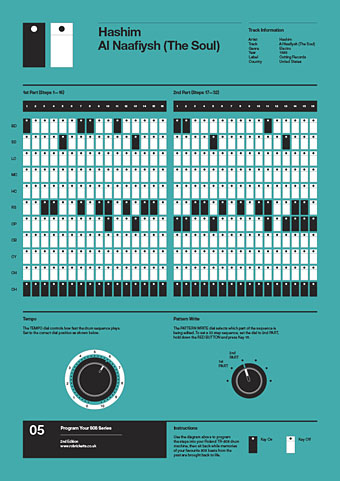
Al-Naafiysh (The Soul) by Hashim. From the Program Your 808 poster series by Rob Rickets.

Rob Goodman on The Comforts of the Apocalypse.

Post-Medieval Illustrations of Dante’s Sodomites.

• Annoy Jonathan Franzen by playing Cat Bounce!

Paolozzi at Pinterest

The Surrealist Waltz (1967) by Pearls Before Swine | The Jungle Line (1981) by Low Noise (Thomas Dolby) | Al-Naafiysh (The Soul) (1983) by Hashim

Max and Dorothea

ernst1.jpg

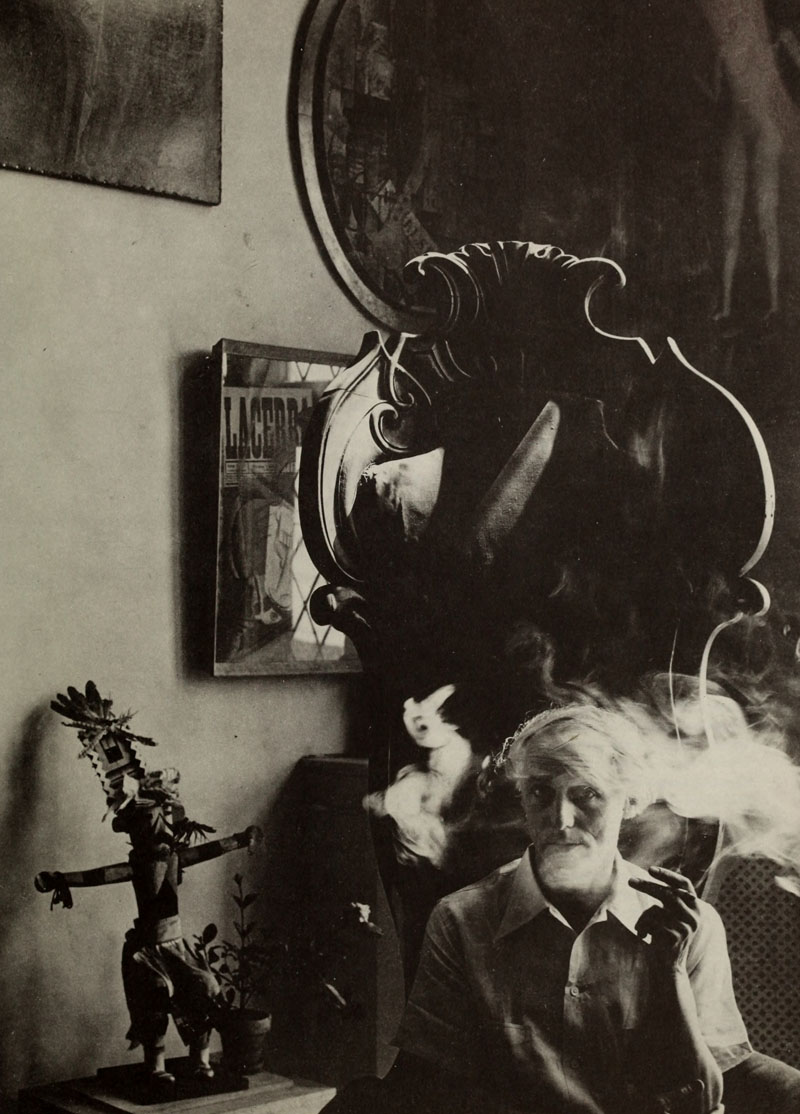
Photo by Arnold Newman (1942).

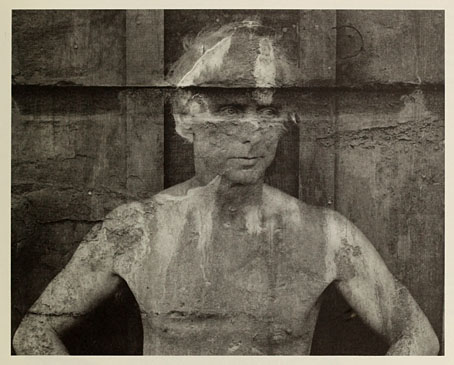
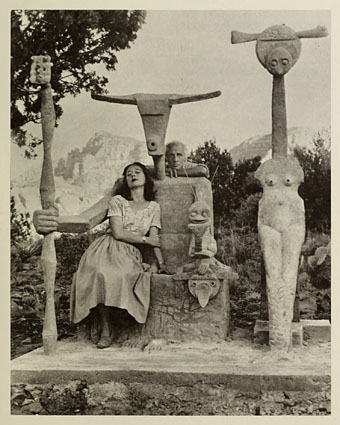
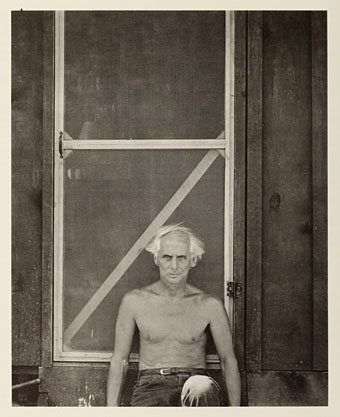
I love this photo of Max Ernst by Arnold Newman, one of several pictures of the artist together with Dorothea Tanning in Max Ernst: A Retrospective, a catalogue for a 1975 Guggenheim Museum exhibition at the Internet Archive. The catalogue itself isn’t so revelatory (and most of the reproductions are monochrome) but it’s good to see a connection made between Arnold Böcklin’s Isle of the Dead and Ernst’s work. It’s an obvious parallel: all those porous landscapes and “fishbone forests” which offer a kind of mutated Symbolism. Browse the book here or download it here.

ernst2.jpg

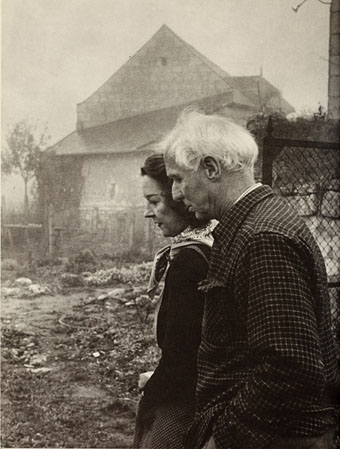
Photo by Henri Cartier-Bresson (1961).

ernst3.jpg

Photo by Frederick Sommer (1946).

ernst4.jpg

No photographer credited.

ernst5.jpg

Photo by Frederick Sommer (1946).

Previously on { feuilleton }
Dorothea Tanning, 1910–2012
Dreams That Money Can Buy
La femme 100 têtes by Eric Duvivier
A Picture to Dream Over: The Isle of the Dead
Dorothea Tanning: Early Designs for the Stage

Tom Adams book covers

adams01.jpg

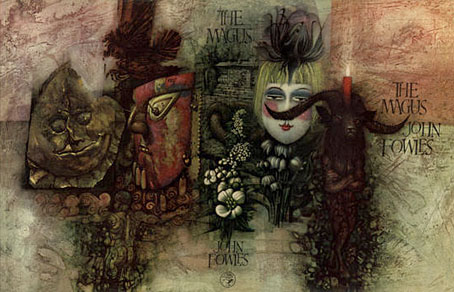
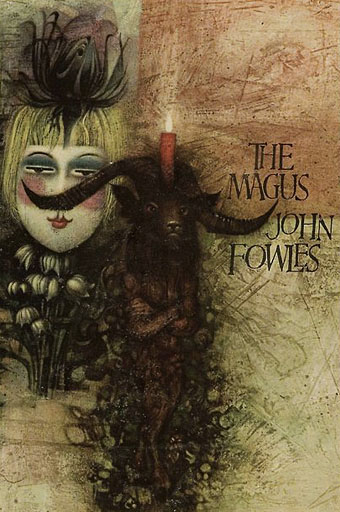
Dust jacket for The Magus (1966) by John Fowles.

I pulled my 1982 paperback of John Fowles’ The Magus from the bookshelf recently. After flicking through the pages I decided to start re-reading it, having realised that in the thirty years which have elapsed since I first read it I couldn’t remember much at all about it. One thing I did remember, however, was the cover of the first edition, a painting and design I’d admired in the past without knowing the name of the artist responsible.

adams02.jpg

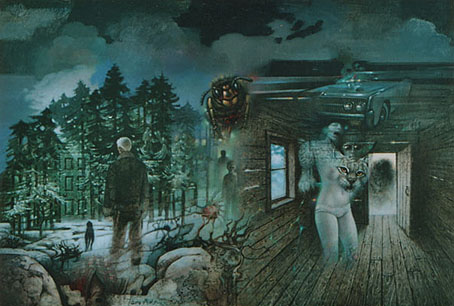
American illustrator Tom Adams is the artist in question, and looking at his painting again it further occurred to me that his cover deployed an evocative but not wholly specific assemblage of figures and objects that I’d often seen elsewhere, notably on the first edition cover of Peter Straub’s Ghost Story. So it was no great surprise to discover that Tom Adams was also responsible for that cover painting. The Fowles and Straub novels are big books which slowly reveal their layered mysteries. Adams’ approach to illustrating them strikes me as an ideal solution when neither of the novels can be easily reduced to a single image. (This hasn’t prevented subsequent designers from trying.) Fowles approved wholeheartedly of the painting but this isn’t a particularly fashionable technique at the moment, the trend being to try and condense complex narratives into a single motif.

adams03.jpg

Cover painting for Ghost Story (1979) by Peter Straub.

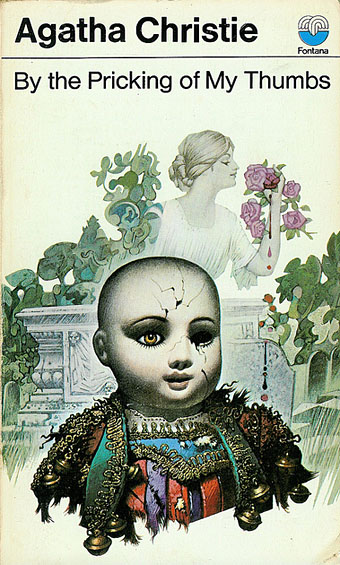
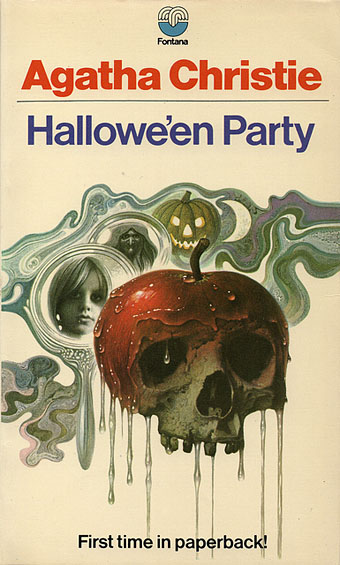
Looking for more of Adams’ art tipped me into an entire world of Agatha Christie book covers which were the artist’s main body of work for many years. Adams is understandably celebrated by Christie-philes (Paper Tiger published a book of his Christie covers in 1981) but outside Sherlock Holmes and Father Brown I’ve never had much of a taste for the classic detective story so this was a previously undiscovered niche. Here Adams sidesteps the chore of painting Christie’s meddlesome sleuths in favour of a remarkable display of grotesque Surrealism which—for a sceptic such as myself—makes the books seem potentially interesting. As with The Magus and Ghost Story there’s the same assemblage of evocative figures or objects but with an additional macabre twist. Many of these covers are so grotesque they could easily function as horror illustrations so it’s no wonder he was asked to illustrate the Straub. This Flickr page has many more examples (warning: wretched user-unfriendly Flickr layout in operation) as does this site. The artist has a website where prints of The Magus painting may be purchased.

adams04.jpg

adams05.jpg

Continue reading “Tom Adams book covers”

The art of Roland Cat

cat02.jpg

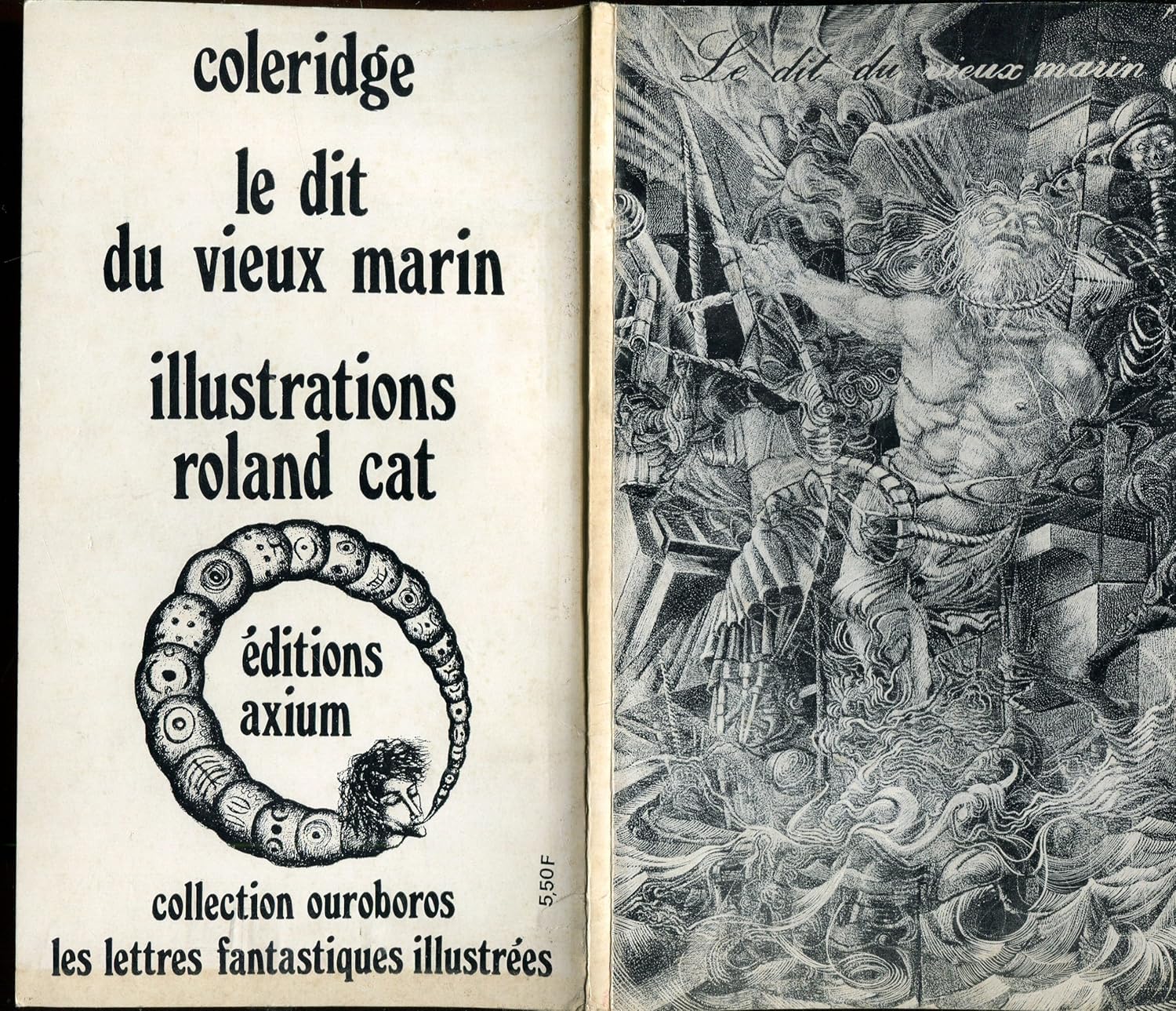
The Rime of the Ancient Mariner (Axium, 1969).

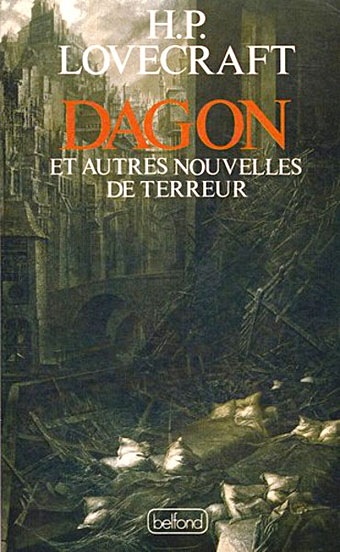
The work of French artist Roland Cat is less Surreal—although some of it could be classed as such—than Fantastic in a manner similar to that of contemporaries such as Michel Henricot, Jean-Pierre Ugarte, Jean-Marie Poumeyrol, Gérard Trignac and others. Art of this nature receives support and encouragement from the French to a degree which often seems inversely proportional to the ignorance it receives from the Anglophone art world. For years the only example of Cat’s work I’d seen was the picture that Dave Britton used on the cover of the Savoy edition of New Worlds magazine in 1979. The examples here are the result of a web trawl, hence the missing titles and dates.

The Coleridge illustration above was for a volume that was part of a series produced by a French publisher in 1969, each edition of which was illustrated by a different artist. This forum post has more details. For more about Roland Cat see this short appraisal at Visionary Review.

cat08.jpg

Sleep (1980).

cat01.jpg

Dagon (Belfond, 1987).

Continue reading “The art of Roland Cat”