The most unusual magazine ever published: Man, Myth and Magic

mmm1.jpg

Collect the set!

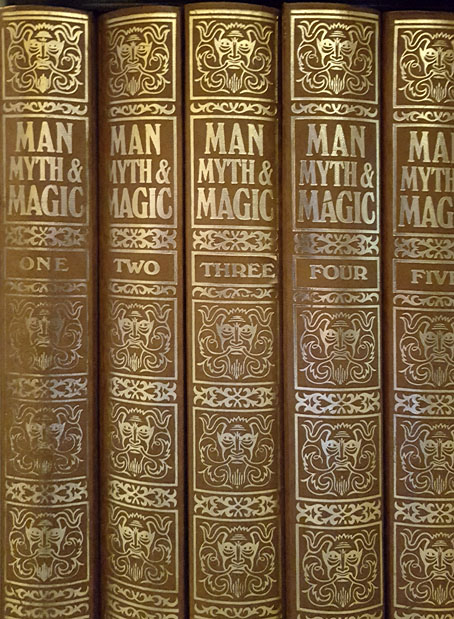
I don’t really need a digital copy of Man, Myth and Magic—I’ve been the fortunate owner for many years of the bound set of original magazines you see above—but I imagine a few readers of this post will welcome a download of all 3144 pages of the 1995 edition. For the impatient I’ll put the link up front: go thou here.
mmm2.jpg

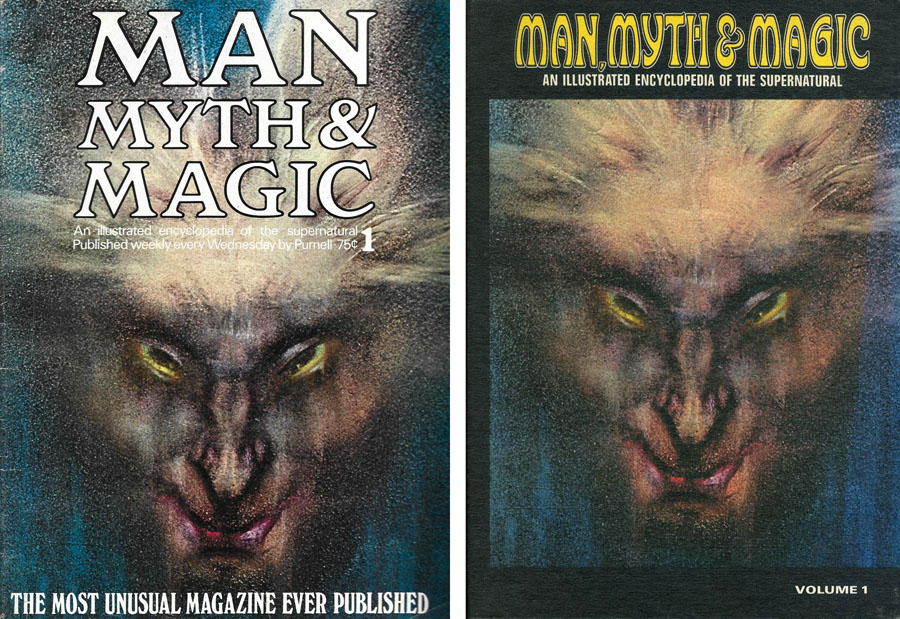
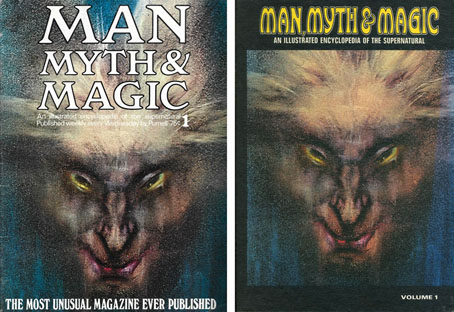
The world goes Spare: A US copy of issue no. 1 and the first volume of the 24-volume set. Austin Spare’s cover art is known either as The Elemental or The Vampires are Coming.

Man, Myth and Magic exists in several different versions along with a number of spin-off books which mined its texts for information and reused its picture archive. The first edition was the “Illustrated Encyclopedia of the Supernatural” which appeared in the UK each week from 1970 to 1971 as 112 magazine-sized issues, a series that built eventually into a collection of seven volumes. The first issue famously used a detail of a picture by Austin Osman Spare on its cover, giving Spare and his art a prominence unlike anything he received during his lifetime. The same part-work was published a couple of years later in the USA with an accompanying TV ad. Magic and the supernatural was the selling point but the encyclopedia was as much about religion and general anthropology as the occult, with the editorial stance being unsensational, factual and neutral. The seven-volume set was later republished in book form as 24 hardcover volumes, then revised in 1995 as a new set of 21 volumes with a different subtitle, “The Illustrated Encyclopedia of Mythology, Religion and the Unknown”. In the early 1970s you could also find a hardback collection of the first six issues bearing the subtitle “The most unusual book ever published”, a rather unrealistic claim. My mother bought one of these, giving me my first encounter with the encyclopedia itself and many other things besides, not least the Austin Spare drawings in Kenneth Grant’s piece of borderline cosmic horror about Spare and “resurgent atavisms”.

mmm3.jpg

Richard Cavendish was Editor-in-Chief of all the editions of Man, Myth and Magic, with Brian Innes acting as picture editor and subsequently co-editor for the 1995 edition. Cavendish had been the author of The Black Arts in 1967, a book which I still rate as one of the best general introductions to Western occultism. The Black Arts may have a title designed to grab the attention of Dennis Wheatley readers but it was a serious study that set the tone for the encyclopedia. The editorial board of Man, Myth and Magic was composed of heavyweight academics, together with John Symonds (Aleister Crowley’s literary executor and biographer), while the group of special consultants included Katharine Briggs (folklore), William Gaunt (art) and Francis Huxley (anthropology). Symonds brought Kenneth Grant on board. Grant at this time was the official head of Crowley’s Ordo Templi Orientis, and his presence gave the editorial team access to his large collection of Austin Spare artwork.
mmm4.jpg

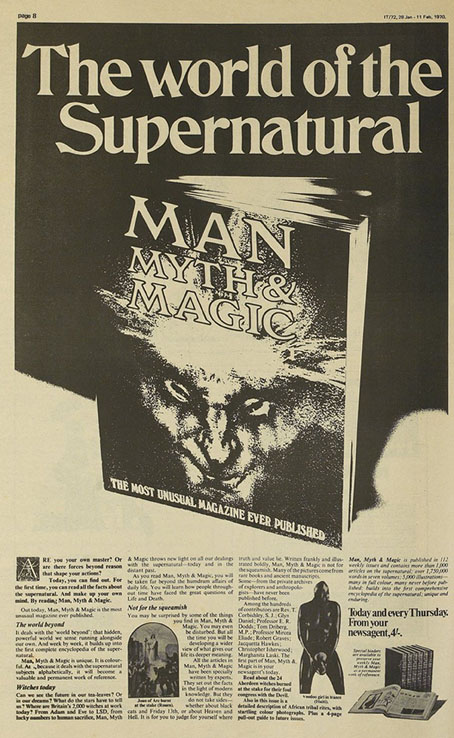
“From Adam and Eve to LSD, from lucky numbers to human sacrifice…” International Times, Jan 28, 1970.

Among the never-to-be-repeated list of contributors were Geoffrey Ashe, Robert Baldick, Robert Graves, Celia Green, Douglas Hill, Christina Hole, Christopher Isherwood, Patrick Moore, Kathleen Raine and JB Rhine. Kenneth Grant and John Symonds weren’t the only contributors who’d known Aleister Crowley, there was also Tom Driberg MP, a man whose promiscuous homosexuality and alleged treachery made him one of the more notorious members of Parliament. The other British politician among the contributors was the comparatively prosaic John Selwyn Gummer, a future government minister and current member of the House of Lords. (I wish I could tell you which article was Gummer’s but he’s listed in the contributor section without a credit. I’d have to hunt through the volumes to find out.) Elsewhere you’ll find entries by both Francis Kings—confusingly listed without their identifying initials—in what may be the only time the pair appeared together in the same publication. Francis H. King, writing here about Japan, was a well-regarded author whose novels included a number of gay romances; Francis X. King was an occultist and author of non-fiction books whose research was packaged under lurid titles such as Sexuality, Magic and Perversion, and Satan and Swastika. The contents of Man, Myth and Magic have long been rendered superfluous by the internet but the contributor list gives the encyclopedia a curiosity value if nothing else. All of the entries are unique pieces of writing which are unavailable outside these pages.

I confess that I hadn’t known that Man, Myth and Magic had been revised and reprinted until I discovered this scanned edition, I’d always thought the encyclopedia was too much of its time to be republished. Richard Cavendish in the editorial preface for the 1995 edition says that some of the articles were amended or expanded to take account of new researches and developments. So they have been, although at first glance the page layout looks very much as it did in the original printing. Closer examination reveals that some of the more dated pictures have been replaced, like the photo of a typical hippy girl in the entry about bells. Dated pictures aside, what you see here is still 95% the original “illustrated encyclopedia of the supernatural”.
mmm5.jpg

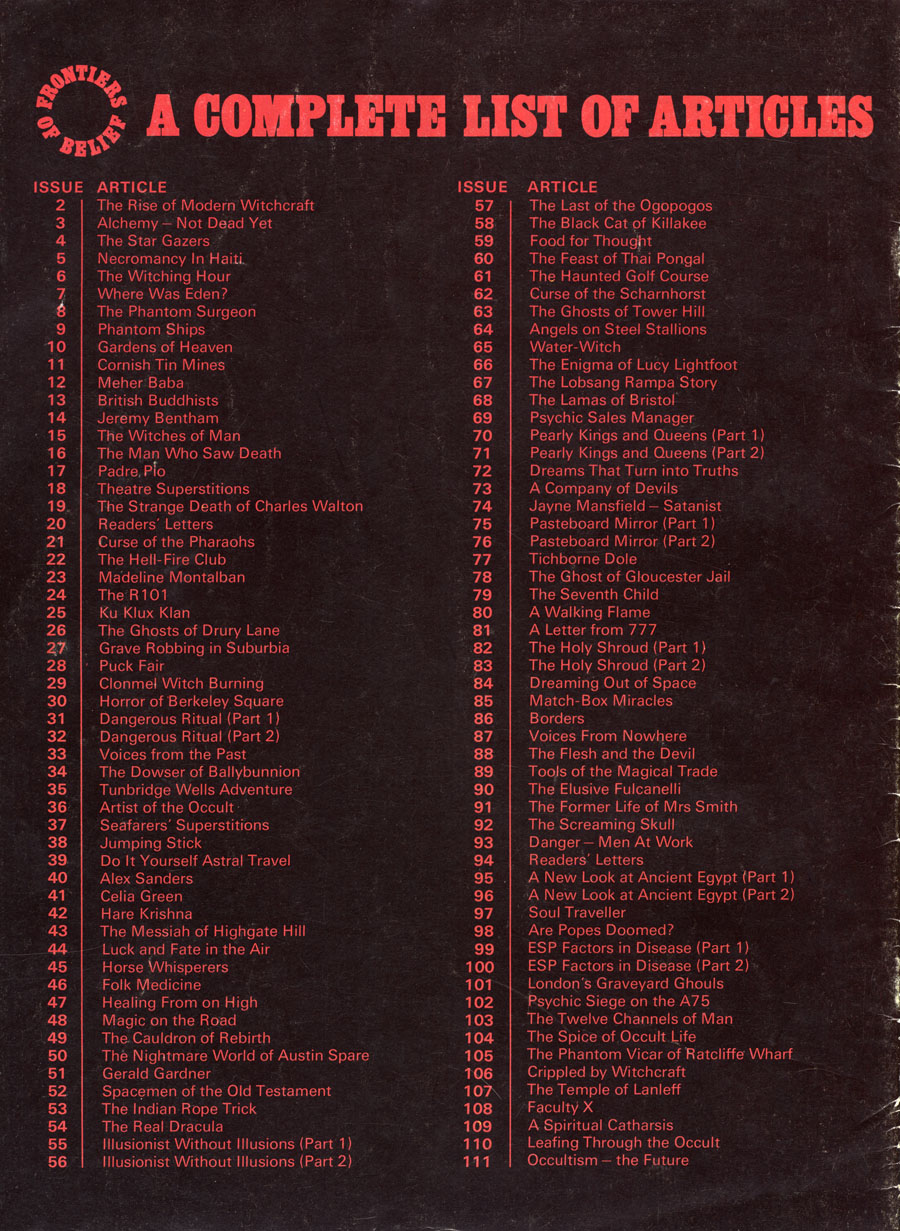
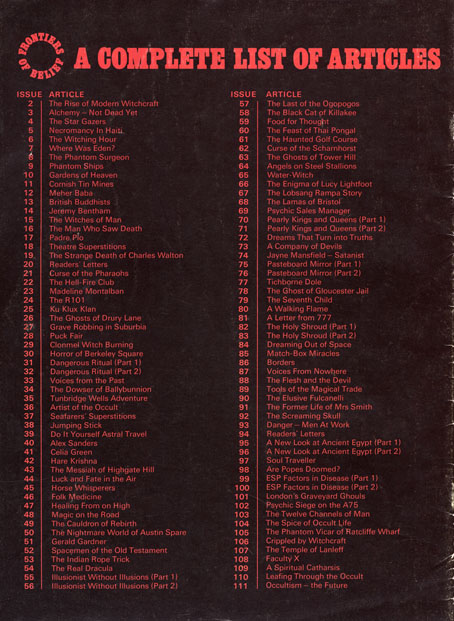
Frontiers of Belief.

The most substantial change in the later reprintings was the absence of the “Frontiers of Belief” section, a series of mostly topical essays which ran each week across the inside back cover and the back of the magazine. Collectors of the volume binders could also purchase an additional binder to store the issue covers and the FoB supplements. Whoever compiled my own volumes failed to do this, but I did once own a partial set of the magazine as separate issues, and still have the FoB articles from those issues. Two of these pieces—a profile of artist Wilfried Sätty and Kenneth Grant on HP Lovecraft—have appeared here in the past. As far as I know none of the FoB pieces have ever been officially reprinted. The very last piece was “Occultism—The Future”, in which a number of writers were asked for their prognostications. The ubiquitous Dennis Wheatley—who, for once, didn’t contribute to the previous pages— delivered a typically ominous warning against involvement in the Black Arts. A more sober final word was provided by Colin Wilson:

In science a new cycle has begun, a revolt against the old rigid reductionism, a recognition that ‘materialism’ leaves half the universe unexplained. Biologists, psychologists, even physicists, are cautiously trying to feel their way into new worlds. They are acknowledging at last that they are dealing with a living universe, a universe full of strange forces. The magic of the past was an intuitive attempt to understand and control these forces: the science of the future will be a fully conscious attempt. Magic will be the science of the future, or should we say that science will be the magic of the future?

Previously on { feuilleton }
Jan Parker’s witches
Typefaces of the occult revival
Dreaming Out of Space: Kenneth Grant on HP Lovecraft
MMM in IT
The Occult Explosion
Wilfried Sätty: Artist of the occult
Owen Wood’s Zodiac

Weekend links 687

crane.jpg

The Peacock Garden (1898) by Walter Crane.

• “The trio [Remedios Varo, Leonora Carrington & Kati Horna] became known as the ‘three witches’ for their exploration of the supernatural and metaphysical—which ranged…’from tarot readings to shamanic psychedelics to attempts to stop or slow time.'” Teresa Nowakowski on Remedios Varo: Science Fictions, an exhibition of Varo’s paintings at the Art Institute of Chicago which includes the one that Thomas Pynchon singled out for description in The Crying of Lot 49.

Philip K. Dick giving a lecture on “orthogonal time” to a small audience at the Festival International de la Science-Fiction, Metz, in 1977. Dick’s talks and interviews aren’t exactly scarce, but this one was of interest for me since I recently designed an edition of John Crowley’s Great Work of Time, a novella which involves a similar concept. If you were at the Metz Festival in 1977 you could also see a live performance by Cluster. Lucky you.

• “Our minds remain open when the LSD wears off.” Steve Paulson on psychedelic drugs and their usefulness as therapeutic tools.

• At Cartoon Brew: Stephen Irwin’s animated films “combine the influences of David Lynch, Struwwelpeter, and the Brothers Grimm.”

• Steven Heller looked at NB3, the third book about Neville Brody’s graphic design. Elsewhere, Heller’s font of the month is Scusi.

The glowing, prismatic nervous system of a sea star wins the Scientific Image of the Year.

• At Unquiet Things: Forgotten worlds and wonderlands from The Art of Fantasy.

• “Don’t waste my time with blood-free monster movies,” says Anne Billson.

• At Aquarium Drunkard: King Tubby And Soul Syndicate — Freedom Sounds In Dub.

• Mix of the week is DreamScenes – August 2023 at Ambientblog.

Time Machine (1970) by Stray | Time Captives (1973) by Kingdom Come | The Existence Of Time (2012) by Monolake

Weekend links 686

bickus.jpg

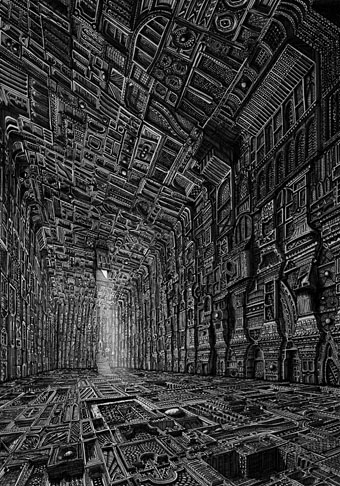
The Great Lab (2020); speculative architecture by Gytis Bickus. “This room is where the majority of the hallucinogenic substances are archived, within the walls & floors. It seems as though the architecture itself is being affected by the hallucinogenic substances stored within its fabric.”

• “They ran the recording through a vocoder, so it sounded staticky, like a voice infused with white noise, and put it at the end of the song. Then they went home.” Mark Dent on Change The Beat by Beside (aka Bee-side or Beeside), a song produced by Bill Laswell & Michael Beinhorn that includes one of the most sampled vocal lines in hip-hop. A great piece of audio-archaeology: I knew the sample but had no idea this song was its source. I only got to hear the Change The Beat very recently when I found a copy of Materialism, a collection of early Laswell productions, in a charity shop.

• At Unquiet Things: Artist, Chemist, Goofball: Catching Up With Tyler Thrasher.

• DJ Food looks at psychedelic posters created for London’s Middle Earth club.

His last commissioned work for Radio Berlin was a fantastical play he had composed himself. The transcript, titled “Lichtenberg: A Cross-Section,” ranks among the strangest things that he ever wrote. Beings who live on the moon are charged with the task of investigating the career of Georg Christoph Lichtenberg, a prominent physicist of the German Enlightenment. The moon beings have uncanny names—Labu, Quikko, Sofanti, and Peka—and they convene as the Moon Committee for Earth Research, which deploys odd contraptions for its work, each of them “easier to use than a coffee grinder.” There is a “Spectrophone,” which permits them to hear and see everything that happens on Earth; a “Parlamonium” that translates human speech into music; and an “Oneiroscope” that allows the researchers to observe human dreams. With the aid of these devices, the moon beings seek to understand why humans are so afflicted with misery. Their investigations finally reach the tentative conclusion that even if humans are unhappy, “perhaps it is their unhappiness that allows them to advance.” To honour the scientific achievements of Herr Lichtenberg, they conclude by naming a crater in his honour, a crater from which shines a “magical light that illumines the millennium.”

Peter E. Gordon on Walter Benjamin’s radio years

• At Dennis Cooper’s: Spotlight on…Brigid Brophy In Transit (1968).

15 lighthouses from the Smithsonian Magazine Photo Contest.

Sathnam Sanghera’s favourite songs.

• RIP William Friedkin and Jamie Reid.

• New music: The Long Song by Drøne.

Lighthouse (1978) by Tim Blake | Walk To The Lighthouse (1980) by John Carpenter | The Lighthouse (1994) by Hector Zazou ft. Siouxsie

Expositiana

expo09.jpg

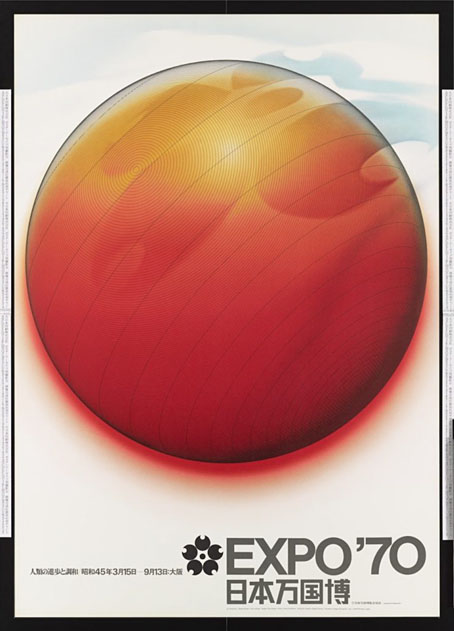
Poster design by Eiko Ishioka.

After writing about Expo 2000 I went looking for films of some of the other world expositions. In previous posts I’d managed to exhaust the Paris Exposition Universelle of 1900 as a subject but never really followed up on my intention to explore the 20th-century events. The 1900 exposition was the first for which a quantity of film footage exists; it was also the one where motion pictures were presented as a new invention among others, like electric light, that would dominate the coming century. The ephemerality of these big events is part of their fascination, and a reason to look for films that document them. Expositions are like temporary theme parks, where the emphasis, since 1939 at least, has tended towards the way things might look in the future. Architects and designers aren’t exactly given free reign at an exposition but they’re also not having to tailor their designs to the requirements of urban planning committees. The events provide a concentrated dose of futurity for a short time in a small geographical space. It ought to be noted that “world exposition” has a specific meaning (see this list), referring to large, general events which run for six months or more. Smaller expositions devoted to single subjects also exist, although “small” here is relative, these can still be sizeable affairs.

Most of the footage that follows is from American expositions. Americans seem to prefer the term “World’s Fair”, although not exclusively—there was a Brussels World’s Fair—and not consistently: the Seattle event in 1962 was the Century 21 Exposition. There’s a lot more footage out there, of course, but I was looking for official films and documentaries rather than home movies.


The New York World’s Fair, 1939

expo01.jpg

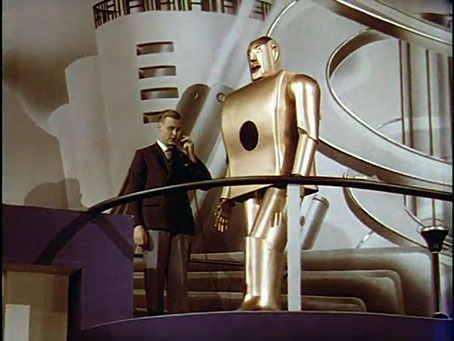
The Middleton Family at the New York World’s Fair

This drama illustrates the contribution of free enterprise, technology, and Westinghouse products to the American way of life. The Middleton Family at the New York World’s Fair pits an anti-capitalist bohemian artist boyfriend against an all-American electrical engineer who believes in improving society by working through corporations. The Middletons experience Westinghouse’s technological marvels at the Fair and win back their daughter from her leftist boyfriend.

Memorable moments: the dishwashing contest between Mrs. Modern and Mrs. Drudge; Electro, the smoking robot; and the Westinghouse time capsule.

Too much drama in this one, and not enough expo, but the 1939 world’s fair is where the preoccupation with the future begins. The Middletons were a promotional device, also seen in newspaper and magazine ads. This is the world’s fair that gave us the word “Futurama”. A shame, then, that Electro, the cigarette-smoking robot, doesn’t tell the All-American Family to bite his shiny metal ass.

expo05.jpg

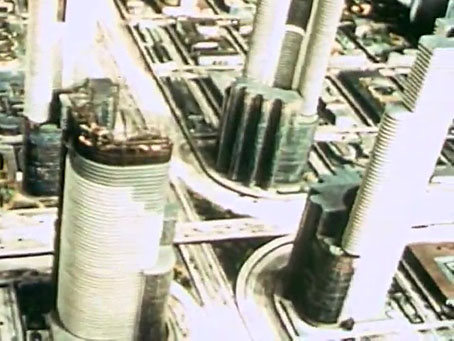
To New Horizons
The Hugh Ferriss view of the future (sponsored by General Motors), all skyscrapers and superhighways. Pedestrians? What are they?


The Brussels World’s Fair, 1958

expo04.jpg

L’Expo 58, il y a un an
A retrospective view of the Brussels event in murky monochrome. The Czech film below is better value although the second half is mostly concerned with the Czech pavilion.

expo08.jpg

Ceskoslovensky pavilon – Expo 58


The Century 21 Exposition, 1962

expo03.jpg

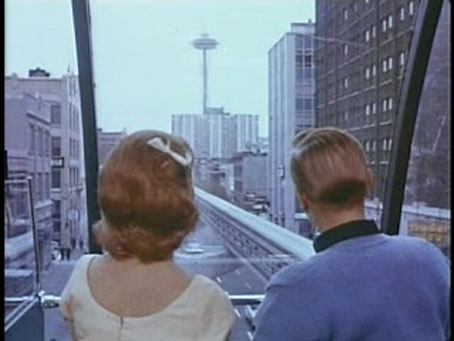
• Century 21 Calling
A trip to the Seattle exposition in which our guides are a hyperactive teen couple who look like the squares from Hairspray after they’ve been dosed with bop pills. For a generation of Brits “Century 21” will always mean Gerry Anderson’s Space-Age imagination.

Continue reading “Expositiana”

Evoluon

evoluon1.jpg

“Evoluon”: a Space Age name for a Space Age building in Eindhoven, Holland, constructed in 1966 by the Dutch electrical and electronics company, Philips. The building was designed by Leo de Bever and Louis Christiaan Kalff, and functioned for a number of years as a science museum, combining exhibits of innovative gadgetry with a three-dimensional representation of “the future” familiar from exposition architecture. I’d guess that Kalff was responsible for the flying-saucer shape, having already designed a range of lamps for Philips with similar shapes in the 1950s.

evoluon2.jpg

Bert Haanstra’s Evoluon was a short promotional film which was broadcast regularly by the BBC from 1968 to 1972 for trade test purposes, although I don’t recall ever seeing it before. Being someone who’s always liked architecture that looks like it fell out of a science-fiction magazine (preferably with a name to match: Skylon, Atomium, Space Needle, etc), an exhibition centre shaped like a flying saucer would have made an impression. British TV schedules were often empty during the daytime so films like this were broadcast for the benefit of TV retailers who needed something better than the testcard flickering on the screens of their brand-new colour boxes. As a science museum Evoluon looks like it was more fun to visit than the London Science Museum, with a profusion of interactive exhibits. (Although this isn’t to say that the London museum isn’t worthwhile, I went there several times in the 1970s. They have many large historical exhibits in the bigger halls, including the re-entry module from Apollo 10.) The music in Haanstra’s film isn’t much better than the bland testcard soundtracks but you do hear a snatch of eerie sound produced by a Cristal Baschet when the unique instrument makes a brief appearance. Philips’ own record division had many more suitable soundtracks at this time via their very collectable Prospective 21e Siècle recordings of avant-garde music. Most of these records aren’t easy listening by any means but the series was aiming at the same idea of a shiny future filled with surprising novelties.

spacelab.jpg

And speaking of “futuristic” music, a computer-generated Evoluon may be seen flying through the 3-D concert visuals for Spacelab by Kraftwerk who also played one of their recent concerts inside the building. I thought they could have done more with the visuals for this number, and with some of the other videos in the 3-D collection. Maybe they look better through 3-D glasses. I wouldn’t know, my eyesight has always been (and will remain) resolutely two-dimensional.

Previously on { feuilleton }
The world of the future
Space Needle USA