Six Into One: The Prisoner File

prisoner1.jpg

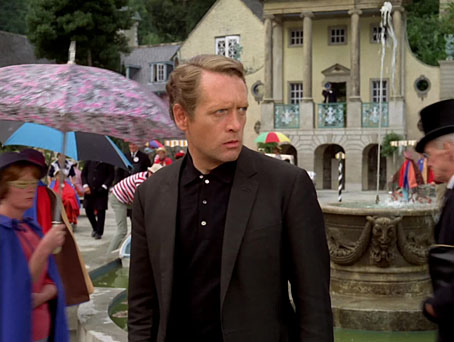
Patrick McGoohan.

Network DVD had a sale recently so I finally capitulated and bought the blu-ray set of The Prisoner which I finished watching this weekend. The picture quality is so outstanding it might have been made yesterday, and many of the extras are also essential for Prisoner obsessives, not least a restored print of the original cut of the first episode, something that was believed lost for years.
prisoner2.jpg

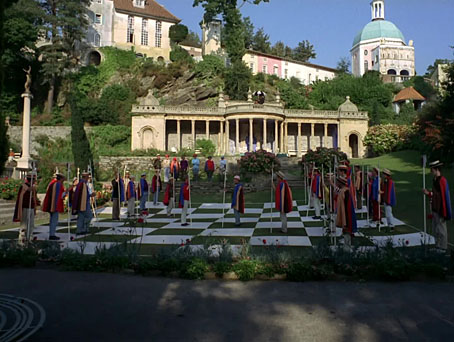
Episode 9: Checkmate.

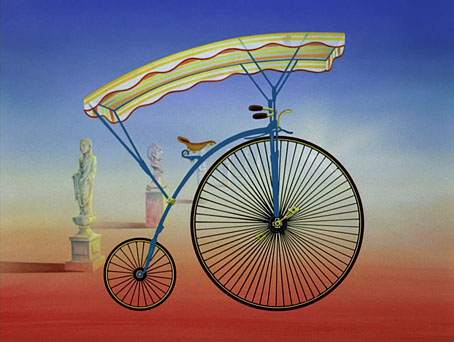
There’s no need to enthuse about the series when I’ve done so already; this time round I’ll note that while the Cold War background is thoroughly outmoded some of the themes of particular episodes seem more relevant than ever. The model of total surveillance seen in the Village has for some time seemed to be one that Western governments and tech corporations would love to emulate. (“The whole world as the Village?” asks The Prisoner. “That’s my hope,” says Number 2.) The Prisoner isn’t the only drama to deal with authoritarian control, of course, but it also deals with the soft tyranny of closed communities, ideology and group-think. Episode 12, A Change of Mind, concerns a process whereby disobedient Villagers are confronted by their peers, declared “unmutual” then bundled off for corrective therapy; when they return they repent their antisocial crimes in public. In 1967 such a scenario would have seemed reminiscent either of McCarthyite America, or Soviet Russia and Maoist China; in 2015 you can be declared “unmutual” for minor infractions every day on the internet, and find yourself rounded upon by a sanctimonious horde.
prisoner5.jpg

The allegorical and symbolic qualities of The Prisoner have kept the series fresh for almost 50 years while the character who launched the genre that gave rise to series—James Bond—has required several overhauls in order to keep up with changing times. Bond may bicker with his superiors but he’s always been a tool of the status quo, an agent of the Control virus in Burroughsian terms. In episode 8, The Dance of the Dead, The Prisoner is lectured by a judge in a kangaroo court on the importance of “the rules”. “Without rules, we have anarchy,” she says. The Prisoner, who happens to be dressed in a Bondian dinner jacket, replies “Hear, hear.”
Continue reading “Six Into One: The Prisoner File”

Weekend links 281

fini.jpg

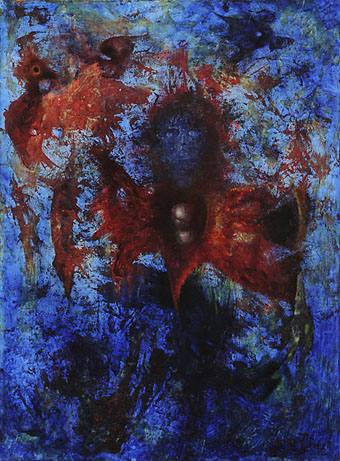
Chimère du soir (1961) by Leonor Fini. Réalisme irréel is an exhibition of Fini’s work currently running at the Weinstein Gallery, San Francisco.

• ” ‘Paris invented the flâneur,’ he notes, ‘and continues to press all leisurely and attentive walkers into exercising that pursuit, which is an active and engaged form of interaction with the city, one that sharpens concentration and enlarges imaginative empathy and overrides mere tourism.’ ” David L. Ulin reviewing The Other Paris by Luc Sante.

• “A lot of posters promise so much that how can they ever deliver?” Nicolas Winding Refn talking to Mat Colegate about his book, The Act Of Seeing, a collection of posters for exploitation films.

• “Sexuality is present throughout and often subverts a narrative we might read entirely differently from a straight poet.” Callum James reviews Physical by Andrew McMillan.

This movie will lose a lot of people along the way, but then again, as far back as 1962, Ballard wrote a manifesto for a new form of science fiction, Which Way to Inner Space?, in which he insisted that “from now on, most of the hard work will fall, not on the writer, but on the readers. The onus is on them to accept a more oblique narrative style, understated themes, private symbols and vocabularies.” This is exactly what Wheatley wants from his audience.

Mike Holliday comparing Ben Wheatley’s forthcoming film of High-Rise with JG Ballard’s novel. Ballard’s suggestion for a new SF now seems increasingly like a road not taken. But that’s another discussion entirely…

The Lost Library of John Dee, an exhibition of books owned by the Elizabethan magus, opens at the Royal College of Physicians museum, London, in January.

Clive Hicks-Jenkins has been writing about his illustration heroes including Alexander Alexeieff.

Cameron: Cinderella of the Wastelands. The exhibition has just finished but the art is still online.

• Mixes of the week: FACT Mix 518 by Fis, and Secret Thirteen Mix 165 by Damien Dubrovnik.

• At Dirge Magazine: Tenebrous Kate on Fantômas, the French King of Crime.

• Suitably seasonal: Polish Night Music by David Lynch & Marek Zebrowski.

Kickin’ In, a previously unreleased EP of music by Patrick Cowley.

Jean-Michel Jarre‘s favourite albums.

Seeing It As You Really Are (1970) by Hawkwind | Seeing Out The Angel (1981) by Simple Minds | Seeing Red (1998) by Red Snapper

MC Escher book covers

escher08.jpg

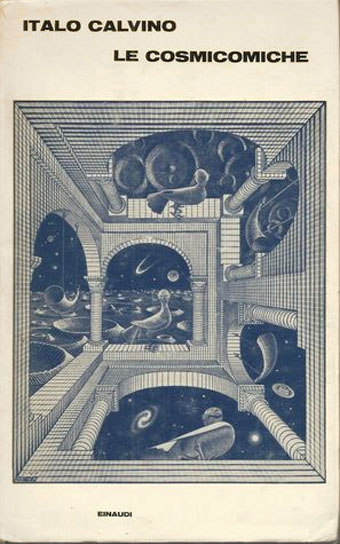
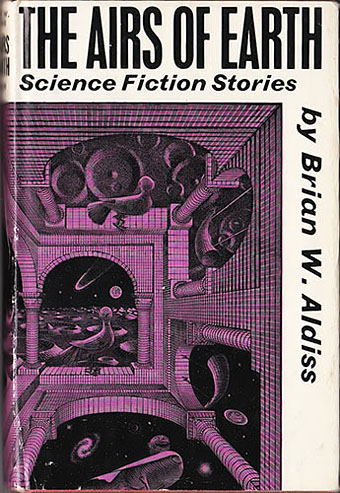
1963. Art: Other World (1947).

MC Escher’s prints have been touring the UK this year: a few months ago they were in Scotland, this month they can be seen at the Dulwich Picture Gallery in London. The renewed attention prompted the BBC to produce a documentary, The Art of the Impossible: MC Escher and Me, in collaboration with Professor Roger Penrose. One of the programme researchers saw my earlier post about the use of Escher’s work on album covers, and asked if I wanted to appear on camera talking about this, something I politely refused to do. I’m happy to hold forth from a keyboard, however, so here’s a post about some of the books that have used Esher’s work to decorate their covers. Most of these are fiction but there must be many more non-fiction titles—especially in the fields of science and mathematics—that borrow Escher’s prints.

escher09.jpg

The first edition of Calvino’s comic stories from 1965.

escher10.jpg

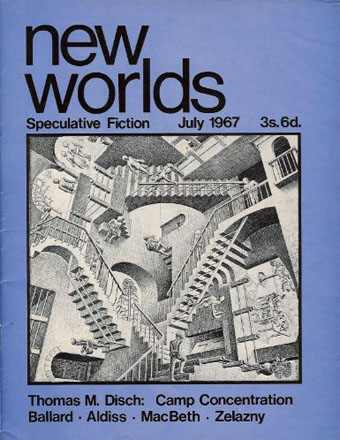
Art: Relativity (1953).

Not a book but editor Michael Moorcock has claimed that this was the first UK magazine to print any of Escher’s work.

Continue reading “MC Escher book covers”

Weekend links 279

ray.jpg

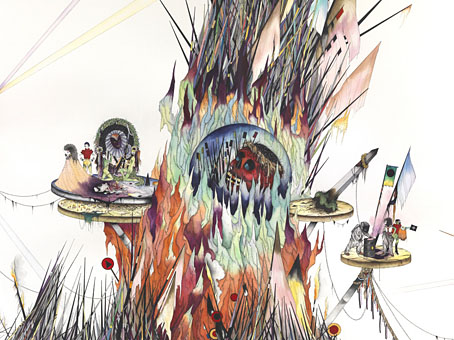
Untitled painting by Jen Ray.

• Lots of architecture links this week so it’s fitting that one of them is director Ben Wheatley talking to David Fear about his forthcoming film of JG Ballard’s High-Rise: “I was just thinking about this the other day, how hard it was to get a hold of stuff before the Internet. You really had to hunt down stuff or have someone who knew what was up to say, ‘You gotta read Naked Lunch, mate. You gotta read Crash.’ […] They were secretive things you had to ferret out, those books. It was the same with music and certain movies. And drugs.” Related: Souvenir d’un Futur, photographs by Laurent Kronental of the high-rise banlieues of Paris.

• “In Ancient Egypt, if a lowly official received the glyph of an owl from the Pharaoh, it was understood that the recipient should take his own life.” Carey McHugh in a brief history of the owl.

• I’d always thought the red buildings seen briefly in Blow-Up (1966) had been painted to Antonioni’s orders. Not so, says Another Nickel In The Machine.

He belongs right up there with Poe and Kafka. The best writer of weird fiction in the past half century. And the reason he belongs there is Ligotti’s both visceral and intellectual, formally experimental and able to tell a traditional horror story with equal ease. He’s also modernized the weird tale, from his early work on. The later workplace stories complete that process. The other thing he brings is a very dark sense of humor and a sense of the absurdity of the world—and a critique of that world that serves as subtext. All of these elements in harmony—symbiosis and contamination—equal genius. I read his work in a continuum that includes Kafka, Poe, Angela Carter, Bruno Schulz, Rikki Ducornet, and the great Caitlin R. Kiernan, but also absurdists and realists and flat-out surrealists. I appreciate that Ligotti stories can be revisited and reveal new dimensions.

Jeff VanderMeer on Thomas Ligotti

David Ferry talks to the people trying to excavate the remains of sets from Cecil B. DeMille’s first film of The Ten Commandments.

• As part of the ongoing vinyl reissue deluge, Crammed Discs are releasing a 10-disc box of albums by the great Tuxedomoon.

• At Strange Flowers: I see for it is night, remembering Marie Cermínová, better known as Surrealist artist Toyen.

Blue Sun Chiming, an animated video by Elisa Ambrogio for the song of that name by Six Organs of Admittance.

• At BLDGBLOG: Occult Infrastructure and the “Funerary Teleportation Grid” of Greater London.

• Enigmatic music makers Watch Repair are now selling their works at Bandcamp.

• Video by Harald Albrigtsen of whales basking under the Northern Lights.

• The urban explorations of Russian photographer Ralph Mirebs.

• Mix of the week: Secret Thirteen Mix 164 by Discipula.

The lost rivers that lie beneath London

Egypt (1985) by Tuxedomoon | Whales Tails (1986) by Cocteau Twins | London’s Lost Rivers (1996) by Coil

Relativity

escher1.jpg

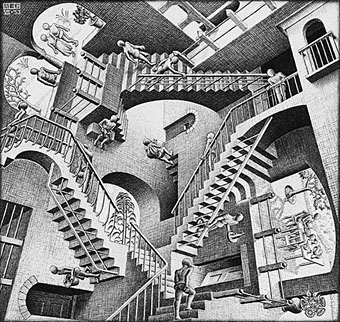
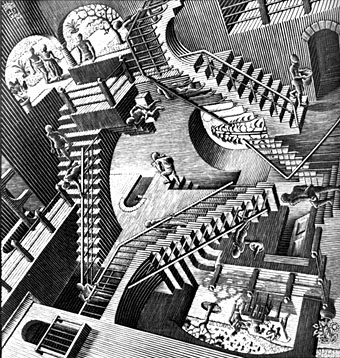
Relativity (1953) by MC Escher.

Escher’s famous lithograph has a less familiar companion piece in the woodcut below.

escher2.jpg

escher3.jpg

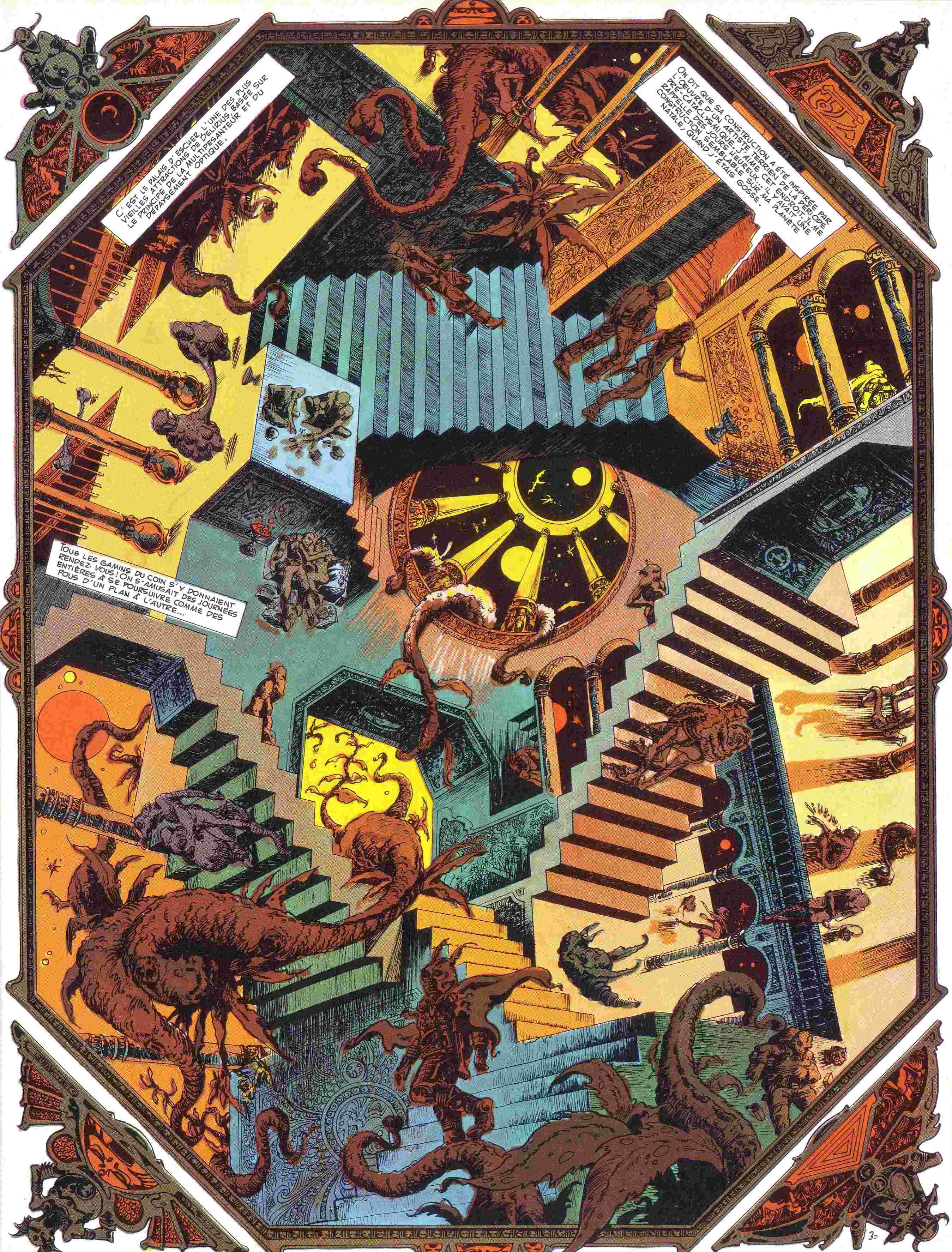
Delirius (1972) by Philippe Druillet.

Lone Sloane’s adventure on the pleasure planet of Delirius was written by Jacques Lob, and features this diversion in the Palais d’Escher. Possibly the first fictional use of one of Escher’s prints.

Continue reading “Relativity”