Mass

mass.jpg

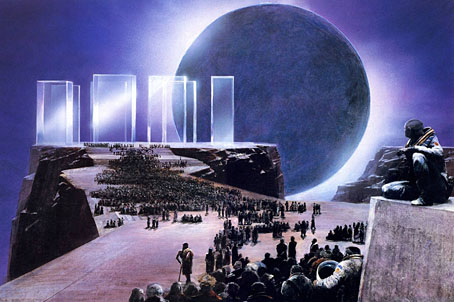
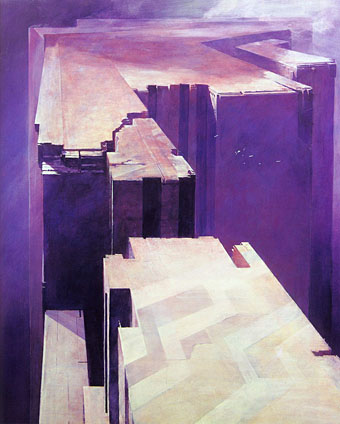
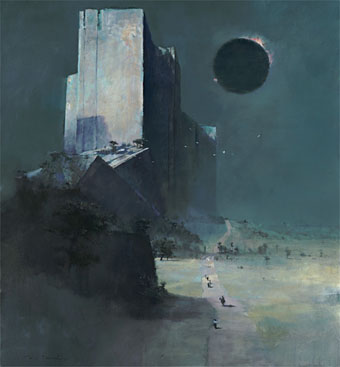
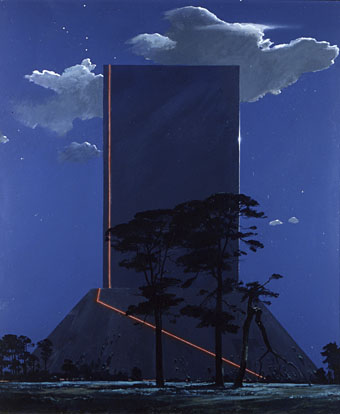
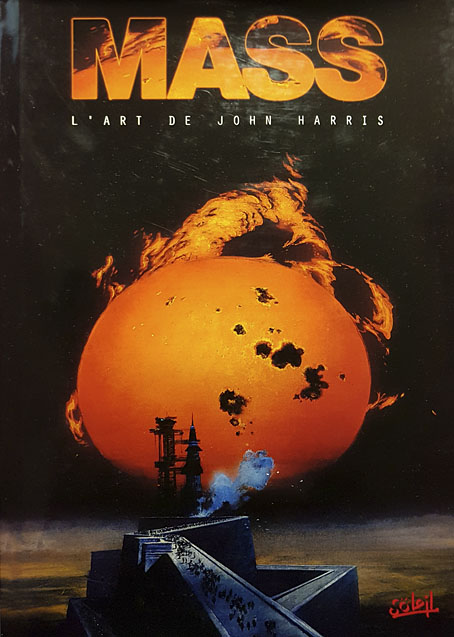
In the post this week, Mass, the first collection of paintings by John Harris in a hardback edition published by Soleil in 2000. The text is in French throughout but that’s okay, I wanted this for the pictures. It was also cheaper and in better condition than other options. I like a bargain. Having looked at a lot of Harris’s work on various web pages over the past few weeks it’s immediately evident how much better the paintings look here: there’s a lot more detail which, in Harris’s case, includes visible brushstrokes and the grain of the canvas. You’d expect as much from a book but it’s a further reminder that art books in particular aren’t threatened by the existence of ebooks, especially now that so many people view web pages on small screens. There’s still no substitute for seeing the paintings themselves, as Robert Hughes was always insisting, but you can only do this if the works are on display somewhere. When illustration ranks so low in the art-world hierarchy some kind of mediation is unavoidable.

Previously on { feuilleton }
The sublimities of John Harris

Weekend links 689

cossard.jpg

Salammbô (1899) by Adolphe Cossard.

• At Unquiet Things: “A mystery that no longer exists: Wrinkle in Time cover artist revealed”. S. Elizabeth explains. I did a little research of my own into this enigma without success. Good to know that it’s been resolved.

• James Balmont’s latest guide to Japanese cinema is an examination of the transcendental oeuvre of Yasujiro Ozu.

• At Spoon & Tamago: Trains intersect with everyday life in nostalgic illustrations by Shinjiro Ogawa.

• DJ Food discovered a set of Zodiac posters by Bruce Krefting from 1969.

• At Wormwoodiana: John Howard on looking for misplaced Machens.

• At Vinyl Factory: Discovering Mort Garson with Hilary Wood.

• At Dennis Cooper’s: More Ozu in Yasujiro Ozu Day.

• New music: Multizonal Mindscramble by Polypores.

• Mix of the week is a mix for The Wire by Aho Ssan.

• Ioneye in conversation with Bill Laswell.

Train Song (1969) by Pentangle | Love On A Real Train (1984) by Tangerine Dream | Tokyosaka Train (2002) by Funki Porcini

The sublimities of John Harris

harris01.jpg

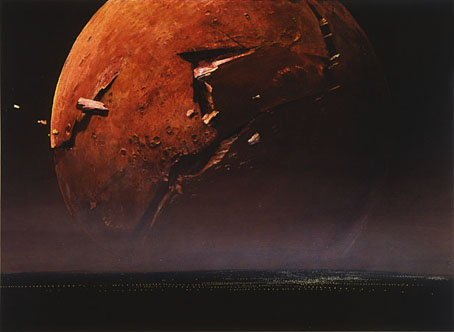
I might never have paid much attention to John Harris’s paintings if they hadn’t appeared so often at Adam Rowe’s 70s Sci-fi Art. Harris is also featured in Rowe’s new book, Worlds Beyond Time, with a few examples that sent me looking for more. I like science-fiction art when it’s dealing with megastructures, especially if those structures aren’t readily interpretable as buildings, spaceships or alien artefacts. This is SF art in the service of the philosophical Sublime, a quality which, since the 1940s, you don’t find very much in painting outside the work of illustrators or artists of the fantastic. Some of these structures, like the one that Harris calls “The Wall” (below), might be relatives of the abandoned concrete edifices in Jean-Pierre Ugarte’s paintings. Another point in Harris’s favour is the way he uses SF-like imagery as outlets for his own visionary experiences: there’s a series entitled Mass which depicts images that came to him following a period of transcendental meditation. The Mass series later gave a title to the first book of Harris’s art which was published by Paper Tiger in 2000.

More John Harris

harris02.jpg

harris13.jpg

harris14.jpg

harris15.jpg

Continue reading “The sublimities of John Harris”

Weekend links 688

horna.jpg

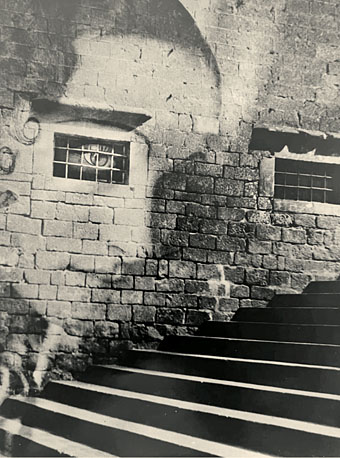
Ascending to the Cathedral, Barcelona (1938/1960) by Kati Horna.

The rise and fall of Kowloon Walled City, Hong Kong’s infamous urban monolith. Related: a four-and-a-half-hour walkthrough of Stray, a game in which you help a cat escape from a deteriorated robot-filled housing complex.

• Quote of the week: “The true master requires the precision of a poet and the imagination of a scientist.” Thus Vladimir Nabokov at Lawrence Weschler’s Wondercabinet.

• New music: Orion Nebula by Christian Wittman, and Chthonic by Lawrence English & Lea Bertucci.

Chapter by chapter, Flaubert lampoons his poor pair, who fail at discipline after attempted discipline: landscape architecture, anatomy, history, literature, phrenology, religion, even love, and on and on. In each pursuit, they never lose the optimism or the hubris of thinking they can put their knowledge to work in the world. When they become interested in pedagogy, they adopt a pair of abandoned children who are at turns mystified by and contemptuous of their efforts to improve their well-being. The fruit trees fail, the novel is abandoned, a cat is boiled alive, the children cause scandals.

David Schurman Wallace explores the hazards of distraction with a detour through Flaubert’s Bouvard and Pecuchet

• At AnOther: Peter De Potter’s new book explores the erotic performance of social media.

• At Dennis Cooper’s: Hobart LaRoche presents…15 experimental video games.

Take a look at a book chronicling the albums of Island Records.

• At Colossal: Gabriel Schama’s laser-cut plywood reliefs.

Orion (1986) by Metallica | Shades Of Orion (1993) by Shades Of Orion | Orion (2001) by Jah Wobble and Bill Laswell

Weekend links 687

crane.jpg

The Peacock Garden (1898) by Walter Crane.

• “The trio [Remedios Varo, Leonora Carrington & Kati Horna] became known as the ‘three witches’ for their exploration of the supernatural and metaphysical—which ranged…’from tarot readings to shamanic psychedelics to attempts to stop or slow time.'” Teresa Nowakowski on Remedios Varo: Science Fictions, an exhibition of Varo’s paintings at the Art Institute of Chicago which includes the one that Thomas Pynchon singled out for description in The Crying of Lot 49.

Philip K. Dick giving a lecture on “orthogonal time” to a small audience at the Festival International de la Science-Fiction, Metz, in 1977. Dick’s talks and interviews aren’t exactly scarce, but this one was of interest for me since I recently designed an edition of John Crowley’s Great Work of Time, a novella which involves a similar concept. If you were at the Metz Festival in 1977 you could also see a live performance by Cluster. Lucky you.

• “Our minds remain open when the LSD wears off.” Steve Paulson on psychedelic drugs and their usefulness as therapeutic tools.

• At Cartoon Brew: Stephen Irwin’s animated films “combine the influences of David Lynch, Struwwelpeter, and the Brothers Grimm.”

• Steven Heller looked at NB3, the third book about Neville Brody’s graphic design. Elsewhere, Heller’s font of the month is Scusi.

The glowing, prismatic nervous system of a sea star wins the Scientific Image of the Year.

• At Unquiet Things: Forgotten worlds and wonderlands from The Art of Fantasy.

• “Don’t waste my time with blood-free monster movies,” says Anne Billson.

• At Aquarium Drunkard: King Tubby And Soul Syndicate — Freedom Sounds In Dub.

• Mix of the week is DreamScenes – August 2023 at Ambientblog.

Time Machine (1970) by Stray | Time Captives (1973) by Kingdom Come | The Existence Of Time (2012) by Monolake