Jim Cawthorn, 1929–2008

cawthorn1.jpg

“Jim Cawthorn and I have been inseparable for over twenty-five years, sometimes to the point where I can’t remember which came first—the drawing or the story. It is his drawings of my characters which remain for me the most accurate, both in detail and in atmosphere. His interpretations in strip form will always be, for me, the best.” Michael Moorcock.

Jim Cawthorn—illustrator, comic artist and fantasy historian—died this week. Cawthorn was the first illustrator employed by Savoy Books and one of the key factors in drawing me to their doors in the early 1980s. His illustrations made their books special and his comics adaptation of Moorcock’s The Jewel in the Skull was a big influence on my early black and white work.

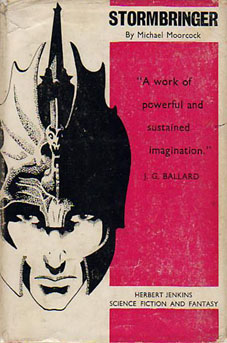
Mike Moorcock, Dave Britton and I seem to be in a minority in regarding Cawthorn as one of the finest fantasy illustrators of his generation. His carefully stipled drawings of the late Fifties and early Sixties are all miniature masterpieces and I don’t care how many artists attempt lavish paintings of Moorcock’s Elric character, for me the definitive representation remains the drawing used on the cover of the first edition of Stormbringer in 1965. Cawthorn was Moorcock’s illustrator of choice for many years and was involved with the Moorcock-edited run of New Worlds right from the start with his cover illustrating Ballard’s Equinox story. He also provided reviews for New Worlds, and his critical faculties were demonstrated to the full in 1987 with Fantasy: The 100 Best Books, an overview of the genre credited to Cawthorn and Moorcock for which Cawthorn himself wrote most of the entries.

I wrote in more detail about Cawthorn’s work for the Savoy site several years ago. For an overview of his career and influences, there’s Dave Britton’s interview from 1979.

Update: some extra pictures added.

cawthorn2.jpg

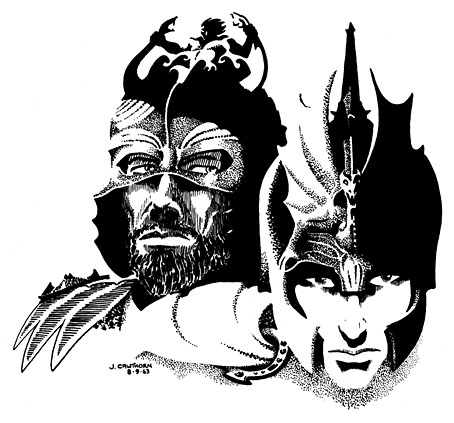
Jagreen Lern and Elric (1963).

Continue reading “Jim Cawthorn, 1929–2008”

Welcome to Mars

welcometomars.jpg

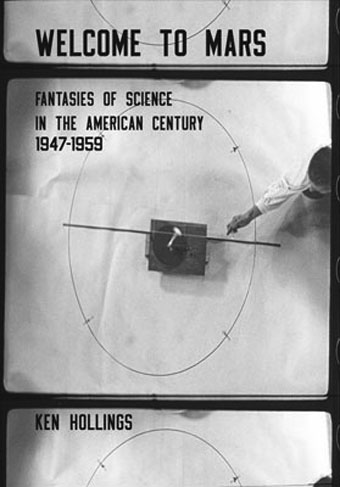
Arriving today—and barely surviving the postman’s attempts to cram it through the letterbox—is the latest volume from Strange Attractor, Welcome to Mars by Ken Hollings. I’m really looking forward to reading this since it touches on areas of interest which span the development of Cold War technologies to pulp science fiction, examining the interconnections between these disparate zones; most histories of the period prefer to stay in one area or the other. A glance at the chapter titles immediately pushes my buttons: “1947 Rebuilding Lemuria”, “1951 Absolute Elsewhere”. If all that wasn’t enough there’s an intro by Erik Davis and the first 250 copies come with a CD of “classy analogue Outer Space exotica” by Simon James. Order from the SA Shoppe and get a free postcard!

Welcome to Mars is a map of the post-war Zone, a non-fiction Gravity’s Rainbow that follows the arc of Germany’s V2 rocket to the end of the rainbow – to America.’ Erik Davis

Welcome to Mars is an iconoclastic, penetrating and darkly humorous history of America from 1947-1959, the decade in which the nation defined its image and created the blueprint for the world we live in today.

Welcome To Mars draws upon newspaper accounts, advertising campaigns, declassified government archives, old movies and newsreels from this unique period when the future first took on a tangible presence. Ken Hollings depicts an unsettled time in which the layout of Suburbia reflected atomic bombing strategies, bankers and movie stars experimented with hallucinogens, brainwashing was just another form of interior decoration and strange lights in the sky were taken very seriously indeed.

Seamlessly interweaving developments in technology, popular culture, politics, changes in home life, the development of the self, collective fantasy and overwhelming paranoia, Hollings has produced an alarming and often hysterically funny vision of the past that would ultimately govern all of our futures.

“Ken Hollings shows brilliantly how the extraordinary web of technologies that drove the Cold War have shaped not just our culture but the very way we think of ourselves as human beings. Welcome to Mars offers a rare and fascinating glimpse of the roots of the strange humanoid culture we live in today.” Adam Curtis

‘Ken Hollings has placed his critical focus at the precise point where the high technologies of information control and social manipulation intersect the passionate search for scientific ways to probe the human mind. Welcome to Mars is a searingly accurate and deeply disturbing exposé of the fantasies of American modernism that have inspired the many nightmares and the few hopeful visions of our new Millennium.’ Dr Jacques Vallée

Previously on { feuilleton }
SAJ again
Strange Attractor Journal Three
How to make crop circles

The Panic Broadcast

panic.jpg

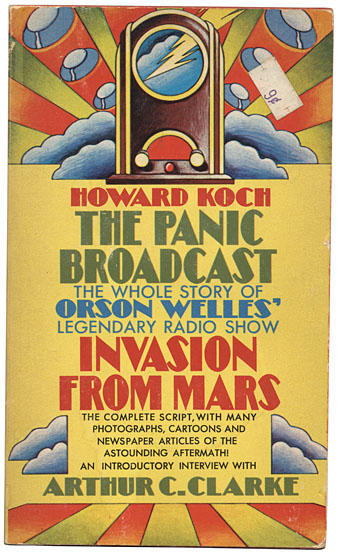
It was 70 years ago today—October 30, 1938—that Orson Welles and the Mercury Theatre traumatised American radio listeners with their brilliant adaptation of The War of the Worlds. I wrote about that recording last year so rather than repeat myself, here’s the final words from Howard Koch’s 1970 book about the play, The Panic Broadcast. (That’s the cover of my cheap paperback edition.) Koch was charged by Welles and producer John Houseman with the task of condensing and updating HG Wells’ novel and he ends his book with an examination of the lessons to be learned from the resulting hysteria. America’s current crop of demagogues on TV and radio—and the audiences prepared to take everything they say at face value—render his words as apposite now as they were forty years ago.

Meanwhile, how can we protect ourselves from politically biased information coming to us through the mass media? It isn’t as simple as dialing another station as in the case of the Martian scare. In my opinion, the only safeguard we have is the cultivation of a skeptical attitude toward all authority, to regard no person or office sacrosanct, to accept nothing that doesn’t accord with our experience and our knowledge acquired from other sources.

Most of my generation were brought up to give unquestioned obedience to authority, whether parental, religious or political. The result has been a compliant and conformist society that has tolerated a war every decade, all sorts of racial and economic inequities and a progressive spoliation of our planet. The management, shall we say, has been less than perfect.

But for the first time there are signs of a change and we have good reason to hope that the world won’t be lost by default. Today all authority is being questioned and challenged, especially by the young. The American people have become more concerned with public affairs on every level. They are taking less on faith; the individual intelligence is beginning to assert itself in self-protection and therein lies the promise of a society with the attributes for survival.

If the nonexistent Martians in the broadcast had anything important to teach us, I believe it is the virtue of doubting and testing everything that comes to us over the airwaves and on the printed pages – including those written by the author of this book.

The Mercury Theatre on the Air | An archive of the radio shows

Previously on { feuilleton }
The night that panicked America
War of the Worlds book covers

The art of Josiah McElheny

mcelheny1.jpg

Island Universe (2008).

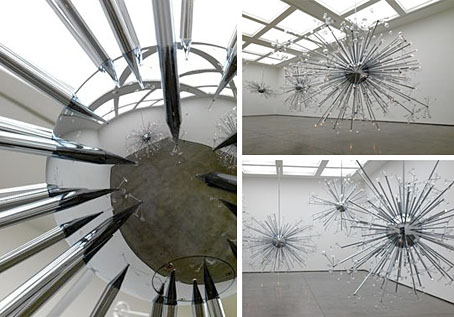
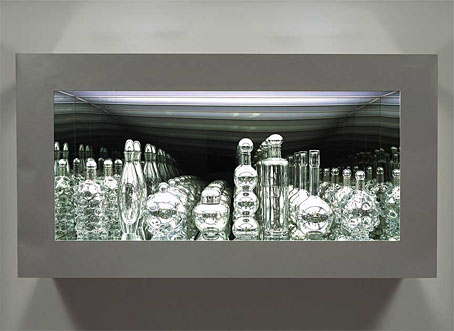
Island Universe is a new work by American artist Josiah McElheny at London’s White Cube gallery. McElheny’s recurrent use of glass and mirrors would be enough to capture my attention anyway—I particularly like the Modernity piece below—but Island Universe also features a specially-commissioned sound accompaniment by one of my favourite musicians, Paul Schütze.
mcelheny2.jpg

Modernity circa 1952, Mirrored and Reflected Infinitely (2004).

McElheny collaborated with cosmologist David Weinberg for Island Universe to create abstract sculptures that are scientifically accurate models of Big Bang theory as well as illustrations of the ideas that followed the general acceptance of the theory. The varying lengths of the rods are based on measurements of time, the clusters of glass discs and spheres accurately represent the clustering of galaxies in the universe, and the light bulbs mimic the brightest objects that exist, quasars. Island Universe proposes a set of possibilities that could have burst into existence depending on the amount of energy or matter present at the universe’s origin.

I can’t help but compare that description of McElheny’s new work with another exhibition that opened this week, TH.2058 by Dominique Gonzales-Foerster which will be filling Tate Modern’s vast Turbine Hall for the next few months. Josiah McElheny extrapolates from documentary fact and creates something beautiful at the same time. Ms Gonzales-Foerster borrows from pre-existing works of written and filmed science fiction and has to rely on those works to sustain much of the interest:

It rains incessantly in London – not a day, not an hour without rain, a deluge that has now lasted for years and changed the way people travel, their clothes, leisure activities, imagination and desires. They dream about infinitely dry deserts.

This continual watering has had a strange effect on urban sculptures. As well as erosion and rust, they have started to grow like giant, thirsty tropical plants, to become even more monumental. In order to hold this organic growth in check, it has been decided to store them in the Turbine Hall, surrounded by hundreds of bunks that shelter – day and night – refugees from the rain.

A giant screen shows a strange film, which seems to be as much experimental cinema as science fiction. Fragments of Solaris, Fahrenheit 451 and Planet of the Apes are mixed with more abstract sequences such as Johanna Vaude’s L’Oeil Sauvage but also images from Chris Marker’s La Jetée. Could this possibly be the last film?

On the beds are books saved from the damp and treated to prevent the pages going mouldy and disintegrating. On every bunk there is at least one book, such as JG Ballard’s The Drowned World, Jeff Noon’s Vurt, Philip K Dick’s The Man in the High Castle, but also Jorge Luis Borges’s Ficciones and Roberto Bolaño’s 2666.

On one of the beds, hidden among the giant sculptures, a lonely radio plays what sounds like distressed 1958 bossa nova. The mass bedding, the books, images, works of art and music produce a strange effect reminiscent of a Jean-Luc Godard film, a culture of quotation in a context of catastrophe.

There’s a list of works used in the Tate installation, nearly all of which are far more stimulating artworks in their own right than the one which is hijacking them into its “culture of quotation”. I’m sure I can’t be the only person to think that the Tate would have been better served asking McElheny and Schütze to expand their work to fill the Turbine Hall instead. Those Island Universes could only get better if they were bigger.
mcelheny3.jpg

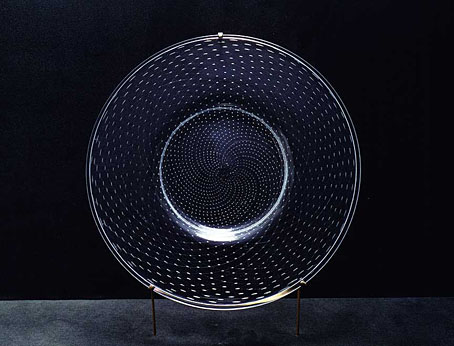
Studies in the Search for Infinity (detail, 1997-1998).

A PBS feature on Josiah McElheny

Update: Writer M John Harrison reviews TH.2058 for the Guardian and fails to be impressed:

It occurred to me that the biggest disaster in that room is the disaster for art. TH.2058 seems to finalise the hollowing-out of everything into the shallowest of semiotics. Foerster’s reading list is more powerful and important than her installation. Every one of the books on those bunk beds will give you a frisson that you don’t get from the show, so you would be as well just reading them for yourself.

Previously on { feuilleton }
Doris Salcedo’s Shibboleth
The Garden of Instruments

Holman Hunt and the Pre-Raphaelite Vision

hireling.jpg

The Hireling Shepherd by William Holman Hunt (1851).

Holman Hunt and the Pre-Raphaelite Vision is an exhibition of Victorian paintings at Manchester’s City Art Gallery which they describe as “the first international exhibition in over 40 years dedicated to the life and work of Pre-Raphaelite master William Holman Hunt.” It helps that they own some prime examples of Hunt’s work, including The Hireling Shepherd, a painting I used to look at a great deal when I first moved to Manchester.

This isn’t my favourite Holman Hunt work—that would be The Lady of Shalott—but The Hireling Shepherd has a wealth of the insane detail which was his forte. For anyone who’s tried painting in this hyper-real manner it’s good seeing how he rendered the flowers, grass and fabrics. The picture is laden with typical Victorian morality, of course; the shepherd is distracted so his flock is straying. That never interested me, far more fascinating was looking at the original of the work which Brian Aldiss uses in his experimental science fiction novel, Report on Probability A (1968). In one of Aldiss’s parallel universes Holman Hunt’s painting is exactly the same as the one we know but for the addition of a book entitled Low Point X which can be seen lying incongruously on the grass. Whenever I’ve been in the City Gallery I’m always disappointed that the book is missing from the picture.

Holman Hunt and the Pre-Raphaelite Vision runs to 11 January 2009.