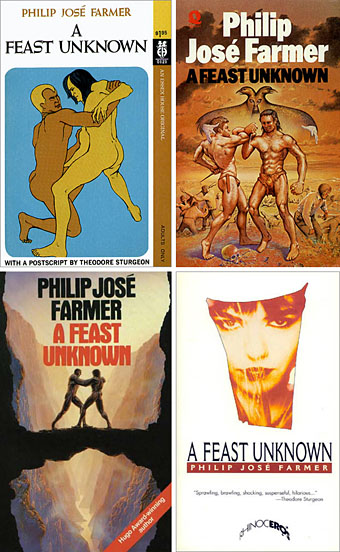
Groovy book covers

groovy.jpg

top left: Leo & Diane Dillon (1969); top right: Tom Huffman (1968).
bottom left: Gray Morrow & Henry Berkowitz (1967); bottom right: no credit.

Great examples of typically florid Sixties’ cover design at Font of all Wisdom – Unique lettering in design, a Flickr pool. The masterful Leo & Diane Dillon illustrated many of Harlan Ellison’s books, inside and out.

Elsewhere on { feuilleton }
The book covers archive

Previously on { feuilleton }
Harlan Ellison: Dreams with Sharp Teeth

Patrick McGoohan and The Prisoner

prisoner1.jpg

Patrick McGoohan as The Prisoner.

“I will not be pushed, filed, stamped, indexed, briefed, debriefed or numbered. My life is my own.”

The Prisoner, which ran for seventeen episodes from 1967 to 1968, was the best original drama series there’s ever been on television. Period, as Harlan Ellison would say. Best because it grabbed the format of the TV adventure series with both hands to subvert the expectations of the audience and the people who were paying for it. Best because it dared to do this at a time when there was little precedent for experiment in a medium that was barely a decade old. Best because it had something important to say while still being entertaining. And best because it had Patrick McGoohan in the central role at the peak of his acting career.

Fiction can be anything, but to look at what we’re offered by TV channels you wouldn’t know it. Cop shows, hospital shows, detective shows and soap operas proliferate, ad infinitum. The Prisoner came out of Danger Man, an immensely successful post-James Bond spy series which may have been popular but, McGoohan’s presence aside, has little to recommend it today. It lacked the camp bravura of The Avengers and couldn’t compete with the budgets of the Bond films. But it’s fair to say that without it McGoohan wouldn’t have had the chance to do something radical. ITC’s Lew Grade thought he was getting Danger Man 2 with better production values; what he received—to his eventual dismay—was the kind of television one would expect if the staff of Michael Moorcock’s speculative-fiction magazine New Worlds had been given a fat budget and free reign. Like New Worlds, The Prisoner seized familiar genre themes but took them as a means to an end, not an end in themselves. The series borrowed from science fiction and spy thrillers—brainwashing and mind control, Cold War paranoia, the limitless surveillance and duplicity of Orwell’s Nineteen Eighty-Four—and used a drama format to say something direct and personal to its audience about individual freedom, the limits and excesses of the state, and the importance of being able to say “No” when the world insists that you capitulate.

prisoner3.jpg

Number Six by Roland Topor.

McGoohan was the driving force as well as the star. His own company, Everyman Films, produced the series for ITC; he planned everything with the writers, wrote three episodes and directed five of them himself. The Prisoner only lasted for a season and a half—cut short after Grade lost his patience—but the form was potentially endless, flexible enough to present a familiar Cold War spy story on the one hand, while having an entire episode play as a Western, on the other. In one of the later episodes McGoohan is largely absent when his mind is transferred to another man’s body and he finds himself living a new life, ostensibly a free man. (But freedom in The Prisoner is always circumscribed.) The last three episodes collapse everything that’s preceded them into intense and increasingly surreal psychodrama. Like Moorcock’s fluid character Jerry Cornelius, whose exploits were running in New Worlds while The Prisoner was being broadcast, McGoohan had found a vehicle to say what he wanted about the world using popular culture. It’s a coincidence but I’ve always found it apt that the cover illustration for Moorcock’s novella The Deep Fix (1966) included a figure obviously modelled on McGoohan’s Danger Man. The book’s tagline “Drugs took him into a nightmare world where logic ceased to exist” could be a description of a later Prisoner episode. Apt too that the first novel based on the series in 1969 was by New Worlds regular Thomas M Disch.

prisoner2.jpg

(James Colvin was a Moorcock nom-de-plume.)

The Prisoner was produced in the era of the social dramas of The Wednesday Play and Play for Today yet it remains relevant in a way its worthier contemporaries could scarcely manage. Social realism dates as quickly as yesterday’s news but allegory stays fresh. And it’s a dismal truth that the world of infinite surveillance has crept closer in a way that few would have imagined possible in 1968. The cameras that follow McGoohan’s Number Six everywhere are a familiar sight on Britain’s streets; a headline in yesterday’s Independent newspaper read: “Big Brother database a ‘terrifying’ assault on traditional freedoms“. McGoohan, who was raised in Ireland, would have appreciated the adherence of another Irishman, James Joyce, to the Luciferian cry of disobedience in Ulysses, “Non serviam!”—”I will not serve”. Joyce’s Stephen Dedalus defies God and his family; McGoohan’s Number Six defies everything else. That example, of the man who can “make putting on his dressing gown appear as an act of defiance”, is something we need as much now as we did in 1968. Hollywood is currently threatening a big-screen version but why wait for more compromised studio product when you can go to the source. Get yourself a deep fix—it’s a masterpiece.

Previously on { feuilleton }
Thomas M Disch, 1940–2008
Revenant volumes: Bob Haberfield, New Worlds and others

Oliver Postgate, 1925–2008

clangers.jpg

The Clangers (and a Froglet).

Lots of eulogies for Oliver Postgate doing the rounds just now, somewhat inevitable when his Smallfilms productions for the BBC furnished the imaginations of generations of British children in the Sixties and Seventies. Smallfilms’ films matched their name, being short animations created on minimal budgets by a trio of Postgate (writing, narration), Peter Firmin (artwork and animation) and Vernon Elliot (music). Postgate’s voice was the single constant across the disparate stories. For anyone of a certain age his distinctive tones carry that punch of primal recognition common to all things which make a strong impression during childhood.

noggin.jpg

Noggin the Nog.

I watched everything Smallfilms produced but being a space-obsessed Space Age kid my favourites were always The Clangers, a family of hooting, pink creatures who shared a moon-like planetoid with a Soup Dragon and (in an orbiting nest) an Iron Chicken. Being equally obsessed with Norse mythology, however, I also enjoyed Noggin the Nog, which never seemed to get repeated very often, probably because the early films were made in black and white. Oliver Postgate seemed to like dragons; as well as the Soup Dragon, Noggin had a very traditional Ice Dragon with a pile of treasure while the otherwise non-fantasy Ivor the Engine—tales of a small Welsh steam train—included a tiny dragon among the cast of characters, perhaps derived from the national emblem of Wales. Postgate and Peter Firmin reworked some of these stories into book form and my favourite books in our school library were the Noggin the Nog ones and Tove Jansson’s tales of the Moomins. The Clangers aren’t as alien as they first appear when you know that their true identity can be found in the 1967 tale of Noggin and the Moon Mouse.

Needless to say, YouTube has numerous opportunities for us to sate curiosity or indulge nostalgia, including BBC 4’s 2005 documentary about Smallfilms. The Guardian gathered a few choice examples as an addendum to their obituary page.

Lengthy Times obituary
The homespun genius of Oliver Postgate
See Emily play | The BBC meets the girl from Bagpuss

Previously on { feuilleton }
Occultism for kids

The Sonic Assassins

assassins1.jpg

Searching through discs for scans of Jim Cawthorn art turned up this comic strip curio from a November 29th, 1971 issue of UK underground magazine Frendz. Cawthorn and writer Michael Moorcock present rock band Hawkwind as musical superheroes and although this is done largely as a promotional piece for that year’s new album, In Search of Space, the Sonic Assassins tag was one which stuck, becoming almost a secondary name for the band in later years. The name Void City also recurred later as the name of a track on the Choose Your Masques album. It may have been around this time that Cawthorn painted special T-shirt designs for Hawkwind; up to 1980 Dave Brock was still wearing his Baron Meliadus shirt on stage.

assassins2.jpg

Previously on { feuilleton }
Jim Cawthorn, 1929–2008
Design as virus #7: eyes and triangles
Barney Bubbles: artist and designer

Jim Cawthorn, 1929–2008

cawthorn1.jpg

“Jim Cawthorn and I have been inseparable for over twenty-five years, sometimes to the point where I can’t remember which came first—the drawing or the story. It is his drawings of my characters which remain for me the most accurate, both in detail and in atmosphere. His interpretations in strip form will always be, for me, the best.” Michael Moorcock.

Jim Cawthorn—illustrator, comic artist and fantasy historian—died this week. Cawthorn was the first illustrator employed by Savoy Books and one of the key factors in drawing me to their doors in the early 1980s. His illustrations made their books special and his comics adaptation of Moorcock’s The Jewel in the Skull was a big influence on my early black and white work.

Mike Moorcock, Dave Britton and I seem to be in a minority in regarding Cawthorn as one of the finest fantasy illustrators of his generation. His carefully stipled drawings of the late Fifties and early Sixties are all miniature masterpieces and I don’t care how many artists attempt lavish paintings of Moorcock’s Elric character, for me the definitive representation remains the drawing used on the cover of the first edition of Stormbringer in 1965. Cawthorn was Moorcock’s illustrator of choice for many years and was involved with the Moorcock-edited run of New Worlds right from the start with his cover illustrating Ballard’s Equinox story. He also provided reviews for New Worlds, and his critical faculties were demonstrated to the full in 1987 with Fantasy: The 100 Best Books, an overview of the genre credited to Cawthorn and Moorcock for which Cawthorn himself wrote most of the entries.

I wrote in more detail about Cawthorn’s work for the Savoy site several years ago. For an overview of his career and influences, there’s Dave Britton’s interview from 1979.

Update: some extra pictures added.

cawthorn2.jpg

Jagreen Lern and Elric (1963).

Continue reading “Jim Cawthorn, 1929–2008”