Weekend links 24

early.jpg

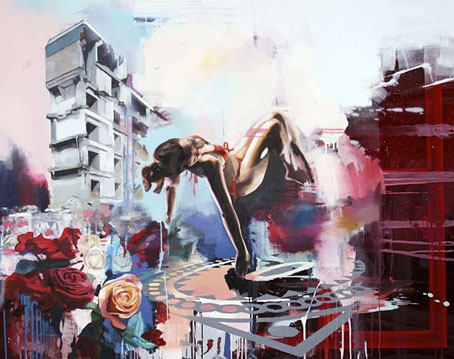
Delta-Wing (2009) by Chloe Early.

• “Feted British authors are limited, arrogant and self-satisfied, says leading academic”. Stating the bleeding obvious but it still needs to be said, apparently, especially when the announcement of the Booker list this year caused the usual confusion when Amis Jr. and McEwan weren’t included, as though the mere existence of their novels makes them prize-worthy. And as someone pointed out, the word “male” is missing from that headline.

Hero of Comic-Book World Gets Real: Alan Moore again, in the NYT this time. Related: a review of Unearthing live.

• Announcing The Hanky Code by Brian Borland & Stephen S Mills, a 40-poem book to be published next year by Lethe Press. For an explanation of the Hanky Code there’s this, and there’s also an iPhone app.

Folk—the ‘music of the people’—is now hip again, says (who else?) Rob Young who can also be heard on the archived podcast here. Related: the folk roots of Bagpuss. Related to the latter: The Mouse Mill.

zvorykin.jpg

An endpiece from The Firebird and other Russian Fairy Tales by Boris Zvorykin.

‘Yes’ to Catastrophe: Roger Dean, Prog and SF. A lengthy and thoughtful analysis of Roger Dean’s early work.

Into the Media Web, the enormous Michael Moorcock book which I designed, is officially published this week.

Cassette playa: in praise of tapes. I’ve complained about tapes in the past but people continue to find them useful. Some technologies die harder than others.

Boy BANG Boy: “Quiet moments made suddenly very loud with the attitude and opinion of what it means to be a young male in an impossibly diverse world.” An exhibition opening at Eastgallery, London, on August 5th.

Empty your heart of its mortal dream: Alfred Kubin’s extraordinary novel, The Other Side.

Ghostly and Boym Partners devise a new way to deliver digital music.

Besti-mix #27: a great selection by producer Adrian Sherwood.

Agnostics are troublemakers. Amen to that.

• RIP Harry Beckett.

Acousmata.

Let Us Go In To The House Of The Lord by Pharoah Sanders (live, 1971): Part 1 | Part 2
Julius Klinger’s Salomé

klinger1.jpg

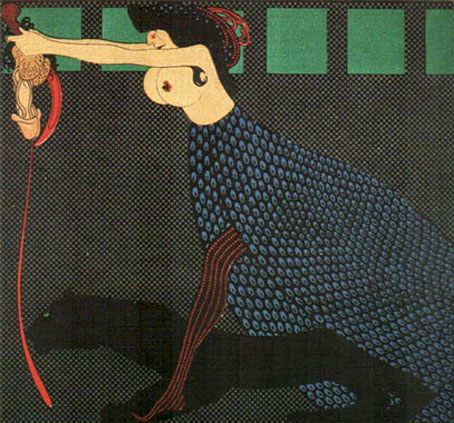
Salomé (1909).

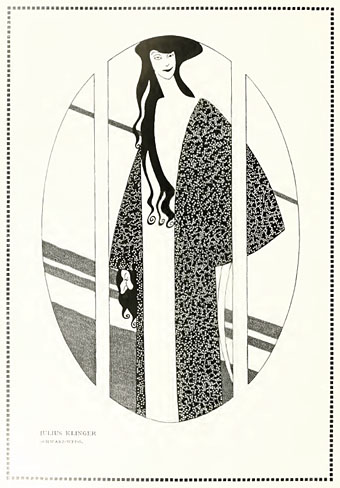
I thought this current thread was finished yesterday but it seems not. Julius Klinger (1876–1942) was an Austrian artist and designer whose early work can be found in the first numbers of Jugend magazine. Subsequent work includes a number of erotic illustrations such as top-heavy Salomé here, a depiction which startles when you notice she’s carrying a set of severed genitals in place of the more usual human head. Given that many feminist and Freudian art critics tend to see the Salomé story as an emasculation metaphor this is perhaps appropriate.

klinger2.jpg

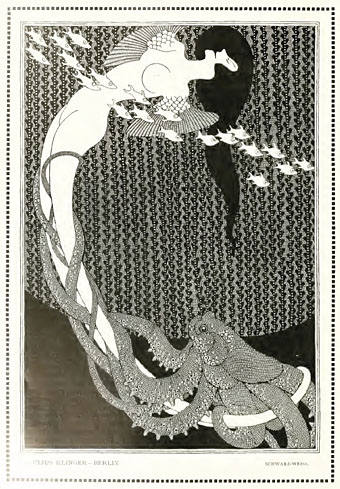
This pair of untitled pieces are from a feature on Klinger’s black-and-white work in #21 of Deutsche Kunst und Dekoration (1907), the entire edition of which can be downloaded here. The picture above may be another Salomé but is more likely that other decapitating heroine, Judith, with the head of Holofernes. The picture below, meanwhile, is entirely mysterious, and another fine addition to the artistic sub-genre of human/cephalopod encounters. Thanks to billy for pointing the way to all of these.

klinger3.jpg

Elsewhere on { feuilleton }
The illustrators archive
The Salomé archive

Peacock couture

lamarr.jpg

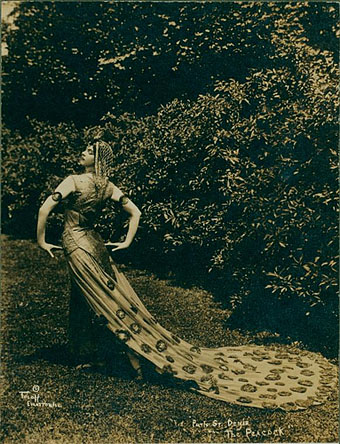
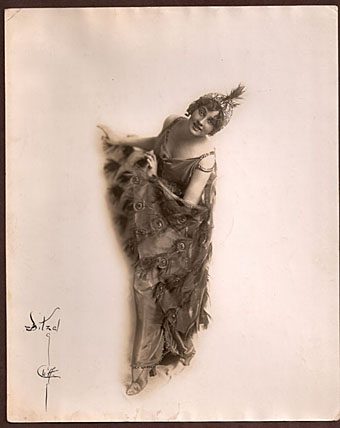
Hedy Lamarr strikes a pose in a peacock dress for Samson and Deliah (1949), one of Hollywood’s many tiresome Biblical epics. If the photo isn’t just a promo shot and Hedy appears wearing this it’s no doubt a highlight but it’s so long since I saw the film the only thing I remember is Victor Mature bringing down the temple at the end. Ms Lamarr’s outfit wasn’t the first of its kind, of course, the examples below from dancer Ruth St Denis and film star Betty Blythe have appeared here before, but Hedy’s dress is a lot more extravagant; Aubrey Beardsley would have loved it. I might have said it was the most extravagant but that honour should go to a Chinese wedding dress made of 2,009 peacock feathers which was unveiled last year. Impressive if completely impractical.

Thanks to Thom for the Hedy tip!

denis1.jpg

Ruth St Denis—The Peacock.

blythe2.jpg

Betty Blythe.

Previously on { feuilleton }
Betty Blythe
Ruth St Denis
The Feminine Sphinx
Alla Nazimova’s Salomé

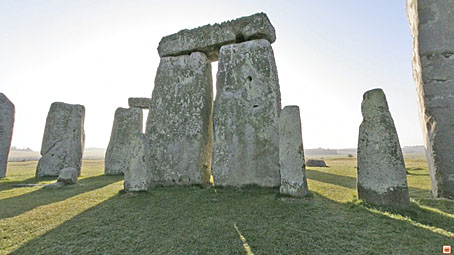
Stonehenge panorama

stonehenge.jpg

I would have posted this for the Solstice yesterday had it not been for the Chronophage. The panorama is at a BBC page since the corporation is one of the few organisations with the weight to gain permission to photograph the stones up close. Unless you’re an archaeologist or an English Heritage official your view is restricted to the path which surrounds the monument, something you can experience via Google Maps. There did used to be exceptions to this. I was fortunate to be at the Stonehenge Festival in 1982 which took place for a few days over Midsummer in one of the fields a short distance away. On Solstice Day the people from English Heritage let everyone—festival-goers and bemused tourists alike—wander inside the circle where a couple of pagan weddings took place. A couple of years later further festivals were prevented with heavy police action so I feel privileged to have been there on that day.

There was more Stonehenge recently at Bldg Blog with a post about Harold Egerton’s stunning photograph of the stones at night. And while we’re on the subject, let’s not forget Woodhenge, Seahenge , Timisoara’s Stonehedge, and the Ballardesque Carhenge.

Elsewhere on { feuilleton }
The panoramas archive

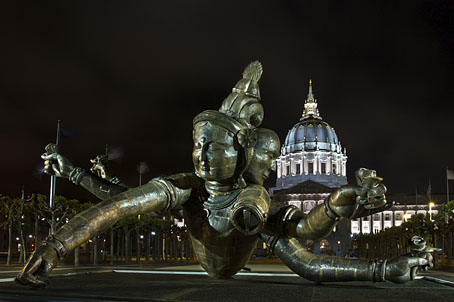
Three Heads Six Arms by Zhang Huan

huan.jpg

A new sculpture by Chinese artist Zhang Huan which was officially dedicated in San Francisco’s City Hall Plaza last week. The photo is by Flickr user David Dasinger and similar views can be found in this Flickr pool. Huan’s copper figures may be intended to evoke Buddhist serenity but I can never see that plaza without remembering the horrible ending of Philip Kaufman’s Invasion of the Body Snatchers.

Three Heads Six Arms is part of a series of monumental works depicting the fragmented extremities of Buddhist statues. The series was inspired by Zhang’s discovery of religious sculptures that had been destroyed during the Cultural Revolution for sale in a Tibetan market. (More.)

Via Erik Davis.

Previously on { feuilleton }
The art of Arnaldo Pomodoro
Sculptural collage: Eduardo Paolozzi
Dead monuments
The art of Igor Mitoraj