Weekend links 122

jackson.jpg

Transmitter Crowbar Discharge Unit, Bates Linear Accelerator. Photo by Daniel Jackson from his Dark Machines series.

The language we use for writing about art is oddly pornographic: We know it when we see it. No one would deny its distinctiveness. Yet efforts to define it inevitably produce squeamishness, as if describing the object too precisely might reveal one’s particular, perhaps peculiar, investments in it. Let us now break that unspoken rule and describe the linguistic features of IAE in some detail.

IAE has a distinctive lexicon: aporia, radically, space, proposition, biopolitical, tension, transversal, autonomy. An artist’s work inevitably interrogates, questions, encodes, transforms, subverts, imbricates, displaces—though often it doesn’t do these things so much as it serves to, functions to, or seems to (or might seem to) do these things. IAE rebukes English for its lack of nouns: Visual becomes visuality, global becomes globality, potential becomes potentiality, experience becomes…experiencability. […] Whatever the content, the aim is to sound to the art world like someone worth listening to, by adopting an approximation of its elite language.

International Art English by Alix Rule & David Levine

For years I’ve been calling it Artspeak: the frequently disingenuous, misleading or merely confused jargon that passes for descriptive writing in the art world. Alix Rule and David Levine apply the more neutral label of International Art English. In a lengthy essay at Triplecanopy they reveal the origins of IAE’s terminology and show why the stuff has spread like semantic kudzu.

• “What a bizarre focal point Anish Kapoor’s spiral callipers are: a Laocoönian observation platform strangled in red steel at a cost of many millions, while electricity pylons, with their austere elegance, once hymned by the poets of the 1930s, have been removed, at enormous cost, from the same site to be buried in the radioactive tilth of landfill dumps and industrial detritus.” Iain Sinclair reports on the Olympics.

Alfred Kubin in…Nottingham! The Other Side, an exhibition of “haunting drawings of death, trauma and fantastical creatures inhabiting imaginary worlds”, running to the end of September.

Francis Ford Coppola and Stewart Copeland discuss the making of Rumble Fish (1982). Over at The Rumpus there’s Coppola talking about his career and his latest film, TWIXT.

Eraserhead: The Making of a Cult Classic. In the 1980s Kenneth George Godwin interviewed everyone responsible for making David Lynch’s film. Fascinating reading.

Skin Job, the debut poetry collection by Evan J. Peterson, is twenty-one poems about monsters, horror, and science fiction. Evan made a trailer.

• Wood, brass and “the latest advances in nanotechnology”: Teka, an OLED lamp by Aldo Cibic and Tommaso Corà.

Tonite Let’s All Make Love in London (1967): Peter Whitehead’s film of the capital at its swinging height.

“Beam Us Up, Mr. Scott!”: Why Misquotations Catch On by Maria Konnikova.

Hari Kunzru‘s ten favourite books about underground London.

The Periodic Table of Heavy Metals.

Alan Garner: A life in books.

Fuck yeah, manuscripts!

• (HR) Giger Counter.

• This week was all about Vangelis in the 1970s: Creation du Monde (1973) | Spiral (1977) | Himalaya / Summit (1979).

Weekend links 121

lambshead.jpg

Title spread for The Thackery T. Lambshead Cabinet of Curiosities (2011) edited by Ann & Jeff VanderMeer.

I was surprised this week to find myself nominated as Best Artist in the World Fantasy Awards. The results will be announced at the World Fantasy Convention in November. Among the books nominated for Best Anthology is the Thackery T. Lambshead Cabinet of Curiosities for which I provided title page designs and some illustrations. Editors Ann & Jeff are well-represented (and ought to win for their landmark The Weird anthology), and I’m pleased to see Mark Valentine receive a nod for his excellent Wormwood magazine. Mark and Roger Dobson published my first Lovecraft adaptation, The Haunter of the Dark, in a large-format edition under their Caermaen imprint in 1988.

I remember having a conversation with my father about it. I told him what I’d really have liked to find, in my exhaustive search of the canon, was a gay superhero. You know: fucking dudes, saving the world. Never mind the fact that superheroes, with their notoriously contour-hugging apparel, are usually assumed gay by default. I wanted something that had existed, something from history. My father considered my criteria.

“I think what you want is Gore Vidal.”

Henry Giardina on Gore Vidal’s Bully Republic at the Paris Review.

• Appreciations and memorials for the late Gore Vidal continue to surface: “He was punk rock with a traditional, smooth exterior. But there was nothing traditional about him, not really. He defied singular category,” says Aaron Tilford at Lambda Literary. “Jokes course through Vidal’s entropy-heavy commentaries like a warm, reviving current. They, more than the barbs to which they form a counterpoint, are what make his essays a continuing pleasure to read,” says “J.C.” at the TLS.

• “Winterson’s opposition to strict realism is less an artistic critique than a cultural one. She uses the term ‘realism’ to describe an entrenched way of viewing the world, which it is the writer’s duty to challenge.” Hannah Tennant-Moore on Jeanette Winterson at n+1.

The Ghosts of Bush by Robin The Fog: “A final hauntological perambulation around the hidden corners of Bush House, Aldwych, London, June 2012”.

• “For everything that is not shown, the filmmaker counts on the power of imagination of his viewers.” Lebbeus Woods on Chris Marker and La Jetée.

Joseph Burnett on “Rainbow Ambiguity: Defying conservatism in mainstream LGBT culture”.

• Leigh Brackett book and magazine covers at Golden Age Comic Book Stories.

BLDGBLOG visited the Whitechapel Bell Foundry in London.

Stilled Life: A collection of photography by Thom Ayres.

• Underground subversion: Stickers on the Central Line.

Andrei Codrescu on five favourite Fantastical Tales.

Vangelis performs an analogue synth freakout for Spanish TV in 1982 | Oro Opus Alter, a track from the forthcoming album by Ufomammut | New World, a track from the forthcoming album by The Irrepressibles. Can’t wait.

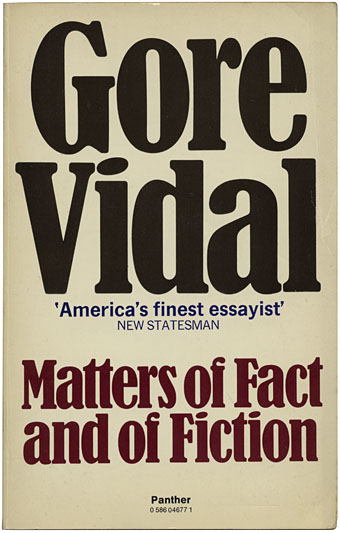
Gore Vidal, 1925–2012

vidal.jpg

You could spend all day picking out choice quotes. So much is still pertinent.

From ‘Women’s Liberation: Feminism and Its Discontents’:

Those who have been treated cruelly will treat others cruelly. This seems to be a fact of our condition. The Patriarchs have every reason to be fearful of woman’s revenge should she achieve equality. He is also faced with the nightmare (for him) of being used as a sexual object or, worse, being ignored (the menacing cloud in the middle distance is presently no larger than a vibrator). He is fighting back on every front.

Take pornography. Though female nudes have been usually acceptable in our Puritan culture, until recently the male nude was unacceptable to the Patriarchs. After all, the male—any male—is a stand-in for God, and God wears a suit at all times, or at least jockey shorts. Now, thanks to randy Lilith, the male can be shown entirely nude but, say the American censors, never with an erection. The holy of holies, the totem of our race, the symbol of the Patriarchs’ victory over the Great Mother, must be respected. Also, as psychologists point out, though women are not as prone to stimulus through looking at pictures as men (is this innate or the result of conditioning?), they are more excited by pictures of the male erect than of the male at ease. And excitement of course is bad for them, gives them ideas, makes them insatiable; even the ancient Greeks, though freer in sexual matters than we, took marriage seriously. As a result, only unmarried girls could watch naked young men play because young girls ought to be able to look over a field which married women had better not know about.

Today we are witnessing the breakup of patterns thousands of years old. The patriarchal response is predictable: if man on top of woman has been the pattern for all our known history, it must be right. This of course was the same argument he made when the institution of slavery was challenged. After all, slavery was quite as old an institution as marriage. With the rejection of the idea of ownership of one person by another at the time of our Civil War, Women’s Lib truly began. If you could not own a black man, you could not own a woman either. So the war began. Needless to say, the forces of reaction are very much in the saddle (in every sense), and women must fight for their equality in a system which wants to keep them in manageable family groups. buying consumer goods. raising future consumers, until the end of time—or the world’s raw resources, which is rather closer at hand.

The New York Review of Books, July 22, 1971

From ‘Pink Triangle and Yellow Star’:

Although our mental therapists and writers for the better journals usually agree that those who prefer same-sex sex are not exactly criminals […] or sinful or, officially, sick in the head, they must be, somehow, evil or inadequate or dangerous. The Roman Empire fell, didn’t it? because of the fags?

Our therapists, journalists, and clergy are seldom very learned. They seem not to realize that most military societies on the rise tend to encourage same-sex activities for reasons that should be obvious to anyone who has not grown up ass-backward, as most Americans have. In the centuries of Rome’s great military and political success, there was no differentiation between same-sexers and other-sexers; there was also a lot of crossing back and forth of the sort that those Americans who do enjoy inhabiting category-gay or category-straight find hard to deal with. Of the first twelve Roman emperors, only one was exclusively heterosexual. Since these twelve men were pretty tough cookies, rigorously trained as warriors, perhaps our sexual categories and stereotypes are—can it really be?—false. It was not until the sixth century of the empire that same-sex sex was proscribed by church and state. By then, of course, the barbarians were within the gates and the glory had fled.

Today, American evangelical Christians are busy trying to impose on the population at large their superstitions about sex and the sexes and the creation of the world. Given enough turbulence in the land, these natural fascists can be counted on to assist some sort of authoritarian—but never, never totalitarian—political movement. Divines from Santa Clara to Falls Church are particularly fearful of what they describe as the gay liberation movement’s attempt to gain “special rights and privileges” when all that same-sexers want is to be included, which they are not by law and custom, within the framework of the Fourteenth Amendment.

The Nation, November 14, 1981

Previously on { feuilleton }
Gore Vidal on American tolerance

Weekend links 119

peterderome.jpg

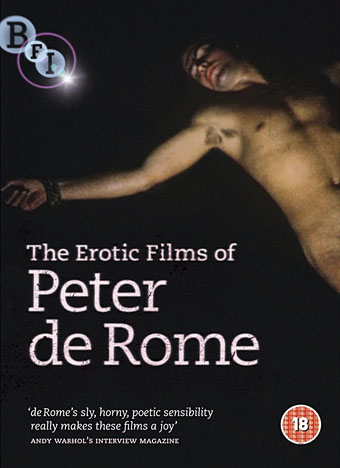
The BFI’s recent DVD release of Peter de Rome’s gay porn films has been mentioned here a couple of times already but I only bought a copy this week. It’s a remarkable release for a number of reasons, not least for showing how much attitudes towards pornography in Britain have changed in recent years. De Rome’s films are explicit enough to ensure that in the 1970s and 1980s anyone caught selling them in the UK might have been imprisoned. That you can now buy them uncut from a high street shop on a disc packaged with the usual care by the British Film Institute means another small part of our iniquitous past has gone for good. Among the extras there’s a documentary with the 88-year-old director discussing his work. This week he talked to BUTT magazine who also have one of his shorter films from the DVD, Hot Pants, on their site.

• “Reading this book, it is hard not to feel that the largest mental health problem – the really crazy thing – is society’s attitude to drugs in general and LSD in particular…” Phil Baker reviews Albion Dreaming: A Popular History of LSD in Britain by Andy Roberts.

• “Loved by aristocrats and immortalized in literature, Denham Fouts remains virtually unknown in his own hometown.” Richard Wall on The World’s Most Expensive Male Prostitute.

The very etiology of rabies is mythic: once the bite heals and the virus has traveled to the brain, “the wound will usually return, as if by magic, with some odd sensation occurring at the site.” Then there’s the fact that no definitive diagnosis can be made without taking a biopsy of the sick animal’s brain, leaving only one gory solution: decapitation.

Rabies is horror’s muse. In almost all iterations of the genre, those we most trust suddenly turn strange: a boyfriend morphs into a wolf at midnight, a fiancé turns out to be harboring a mad first wife in the attic, a friend is bit by a zombie and goes berserk.

Alice Gregory reviews Rabid: A Cultural History of the World’s Most Diabolical Virus by Bill Wasik and Monica Murphy.

• The Horror of Philosophy: Erik Davis talks to Eugene Thacker about Lovecraft, medieval mysticism, and thinking the world-without-us.

Eagle Scouts Returning Our Badges: A Tumblr for those protesting the current anti-gay stance of the Boy Scouts of America.

• His Father’s Best Translator: Lila Azam Zanganeh on the late Dmitri Nabokov.

Les Liaisons dangereuses: illustrations by Alastair (Hans Henning Voigt).

• Andrea Scrima looks at Robert Walser’s Der Spaziergang (The Walk).

10 Great Places to Meet Lesbians If You Have a Time Machine.

• Jesse Bering in Scientific American asks “Is Your Child Gay?

As Above, So Below (1981) by Tom Tom Club | Genius Of Love (1981) by Tom Tom Club | Mea Culpa (1981) by Brian Eno & David Byrne.

Be prepared

sherer2.jpg

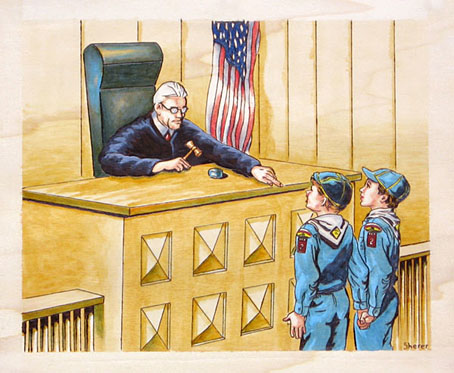
Sodomites (no date) by Robert Sherer.

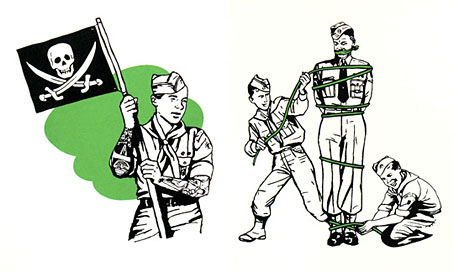
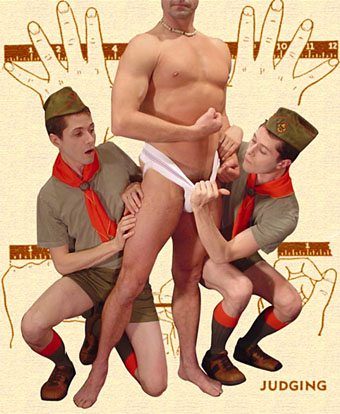
The Boy Scouts of America yet again proved itself a retrograde organisation by deciding this week after a two-year review to maintain its policy of exclusion for gay scouts and gay scout leaders. The Girl Scouts of America don’t have this kind of policy, nor do UK Scouting organisations. In honour, then, of the Boy Scouts of America’s decision here’s some work by a trio of North American artists all of whom have used scouting iconography for subversive or satirical purposes. Robert Sherer and Jason Driskill are both American while Daryl Vocat is Canadian. Vocat’s portfolio of prints is particularly funny, showing scouts tattooing each other and making bombs; William Burroughs would love it. Poor old Chuck Norris, meanwhile, would no doubt collapse with a fit of the vapours at the sight of Sherer’s scouts holding hands.

vocat.jpg

Prints from A Boy’s Will (no date) by Daryl Vocat.

driskill.jpg

Judging (2004) by Jason Driskill.

Elsewhere on { feuilleton }
The gay artists archive