Elihu Vedder’s Rubáiyát

vedder01.jpg

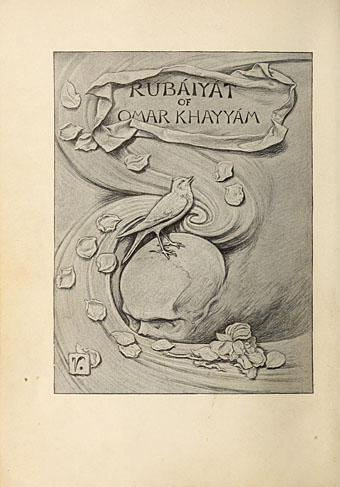
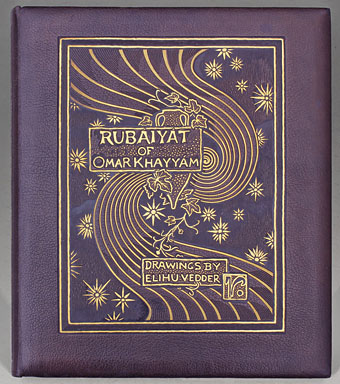
A slight return to Omar Khayyam. The Edmund J. Sullivan post prompted comments about other editions so I thought I’d see what else was at the Internet Archive. The problem there is that the Rubáiyát was a very popular book in the latter part of the 19th century which means there are not only multiple editions of the Edward Fitzgerald translation but many translations by other hands, as well as numerous parodies. Anne S mentioned the Edmund Dulac edition which I suppose I ought to at least acknowledge since Dulac’s passion for Persian and Arabian art made him an ideal illustrator. But I do enjoy finding illustrated books that are less familiar, hence Elihu Vedder’s edition of 1894.

vedder02.jpg

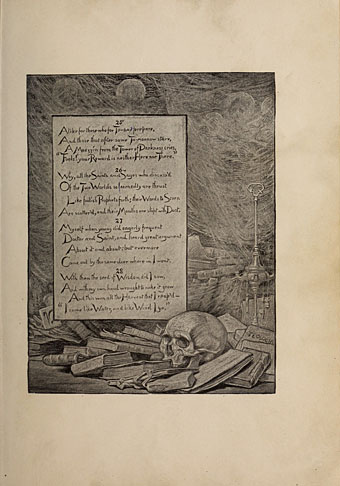
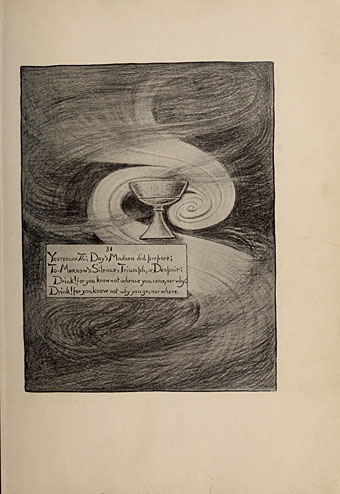
Elihu Vedder (1836–1923) was an American Symbolist painter, and also something of a poet himself, producing a few volumes of his own illustrated verse. Many illustrators favour an Orientalist interpretation of the Rubáiyát despite the popularity of the quatrains being more a result of their universality than their exotic qualities. Vedder produced over 50 drawings that concentrate on the mystical aspects of the poem, setting hand-lettered texts against illustrations that are either very similar to his paintings or direct copies of some of his canvases. It’s unfortunate that the reproductions in this edition—a reprinting of Vedder’s 1884 original—aren’t better. The book is still one of the more remarkable editions, however. Browse the rest of it here or download it here.

vedder03.jpg

vedder04.jpg

Continue reading “Elihu Vedder’s Rubáiyát”

Leonor Fini: comment vivre sans chat

fini1.jpg

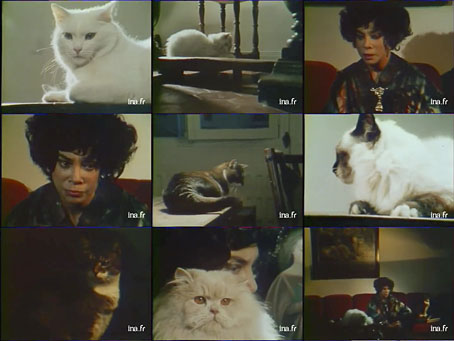
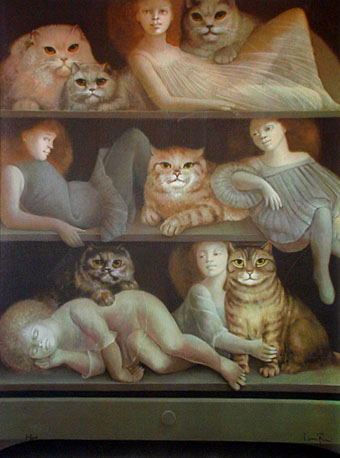
“How to live without a cat” is the translation but this short television film is in French so the rest is a mystery unless you can understand the language. As with the Max Ernst film, language isn’t much of an issue when you have an opportunity to see La Fini and her many moggies. Leonor Fini was an obsessive cat owner and cat painter, and she could also look pretty feline herself on occasion. (A piece of typically Surrealist apocrypha has it that the pupils of her eyes were cat-like until she was 4 years old.) The Fini website lists a number of European documentaries about the artist and her work but most remain frustratingly elusive. This one is an official release to YouTube from the Ina.fr archives. At the end of the film there’s a shot of the painting below; Fini’s cats are always very self-possessed.

fini2.jpg

Sunday Afternoon (1980) by Leonor Fini.

Previously on { feuilleton }
Angels of Anarchy: Women Artists and Surrealism
The art of Leonor Fini, 1907–1996
Surrealist women

November

november01.jpg

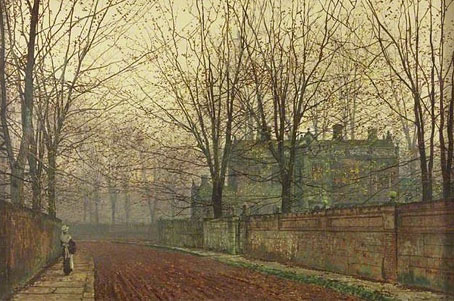
November Morning, Knostrop Hall, Leeds (1883) by John Atkinson Grimshaw.

The month of November in paintings. John Atkinson Grimshaw (1836–1893) returned continually to autumnal scenes, and became very adept at capturing the light of the season as it manifests in the Northern Hemisphere. Many of the paintings below reflect the gloomier qualities of the month when the leaves are finally stripped from the trees.

november12.jpg

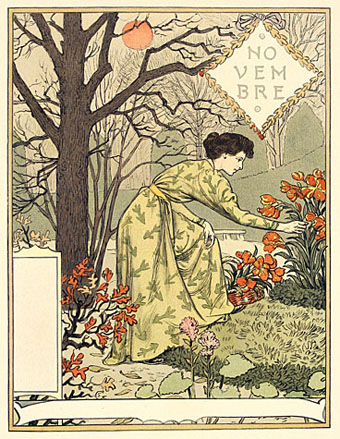
La Belle Jardiniere – November (1896) by Eugène Grasset.

november09.jpg

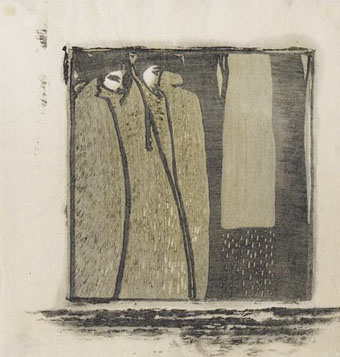
November (1902) by Koloman Moser.

Continue reading “November”

Weekend links 232

hackett.jpg

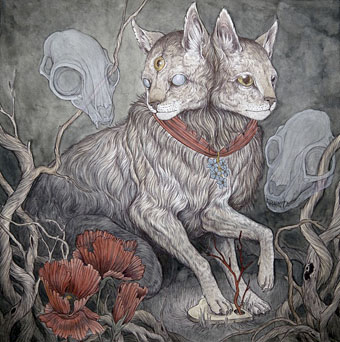
Forget Me Not (no date) by Caitlin Hackett.

• Halloween brings out the articles about weird fiction: “No one would now write of [HP Lovecraft] as the critic Edmund Wilson did, in the New Yorker in 1945: ‘The only real horror in most of these fictions is the horror of bad taste and bad art.’ The true horror was in fact that of judging Lovecraft by the standards of a defunct literary culture,” says John Gray. At The Atlantic there’s Jeff VanderMeer on the uncanny power of weird fiction, while Matt Seidel at The Millions explores the mysteries and attractions of Robert Aickman’s “strange stories”.

The Witching Hour is a video essay by Pam Grossman “examining the many different faces of witches in film”. Pam’s video opens with a scene from Suspiria; over at FACT, Goblin’s Claudio Simonetti talks about the creation of Suspiria‘s peerless soundtrack.

• David Rudkin and Alan Clarke’s uncanny television film, Penda’s Fen, is given a 40th anniversary screening later this month at the Horse Hospital, London. For those who can’t attend (and those who haven’t already read it) there’s my post from 2010.

Nabokov sees each day’s weather as a palette: “The weather this morning was soso: dullish, but warm, a boiled milk sky, with skin – but if you pushed it aside with a teaspoon, the sun was really nice, so I wore my white trousers”. He listens carefully to the sound of the rain, which his letters brilliantly orchestrate. He provides fantastic descriptions of puddles, some of which contain shifts in perspective reminiscent of the nearly cinematic transitions found in the novel he would write shortly afterwards, King, Queen, Knave:

“I looked out of the window and saw: a red-haired housepainter caught a mouse in his wheelbarrow and killed it with the stroke of a brush, then he tossed it in a puddle. The puddle reflected the dark-blue sky, quick black upsilons (reflections of swallows flying high) and the knees of a squatting child, who was attentively studying the little grey round corpse.”

Eric Naiman on Vladimir Nabokov’s Letters to Véra

• Occult rock: Peter Bebergal talks to Expanding Minds about his new book, Season of the Witch: How the Occult Saved Rock and Roll. There’s an hour-long film of Black Sabbath saving rock and roll in Paris, 1970, here.

• Mixes of the week: Burning The Existence, “a three-hour sonic exploration of the outer fringes of Goth”, and a horror soundtrack mix by Death Waltz.

• “‘Capital loathes the old,’ [Gareth] Evans said, ‘for anchoring us in the reality of the lived.'” Iain Sinclair on London’s lost cinemas.

Desirina Boskovich, co-editor of the Steampunk Users Manual, offers “7 Reasons Why Steampunk Is Totally ‘Now'”.

• Penguin has new collage covers by Julian House for The Cut-Up Trilogy by William Burroughs.

Hear a homemade synthesizer turn weather into music.

• Grotesque doodles by William Makepeace Thackeray.

full fathom five is Thom’s new blog.

Weird Dream (1976) by Harmonia 76 | Weird Caravan (1980) by Klaus Schulze | Weird Gear (1991) by Ultramarine

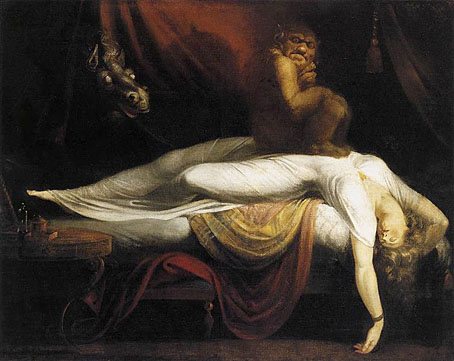
Fuseli’s Nightmare

nightmare1.jpg

The Nightmare (1781).

Christopher Frayling’s Nightmare: The Birth of Horror (1996) opens with a prologue examining Henry Fuseli’s most celebrated painting:

Henry Fuseli, who later wrote that “one of the most unexplored regions of art are dreams”, and who was said to have supped on raw pork chops specifically to induce his nightmare, made his name with this painting. And engraved versions, produced in 1782, 1783 and 1784, distributed the image across Europe, until Fuseli’s masterpiece became the way of visualising bad dreams.

Although The Nightmare was painted just before the Romantic craze in Western Europe—which revelled in peeling back the veneer of rational civilisation to reveal the “natural” being or the raw sensations beneath, sometimes through the gateway of dreams—it was well-known to the writers and painters of the early nineteenth century. One of them wrote that “it was Fuseli who made real and visible to us the vague and insubstantial phantoms which haunt like dim dreams the oppressed imagination”.

The Nightmare was fascinating—and scary—because it operated at so many different levels at once. It was set in the present (the stool and bedside table are “contemporary” in style), and it was concerned not so much with an individual’s nightmare—the usual subject-matter of dream paintings, often involving famous individuals and their prophecies—as with nightmares in general. It was not A Nightmare, but The Nightmare; not a vision but a sensation. This gave it a direct impact, unmediated by history, which put a lot of critics off.

nightmare2.jpg

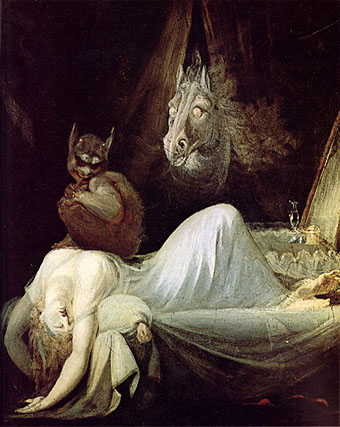
The Nightmare (1791).

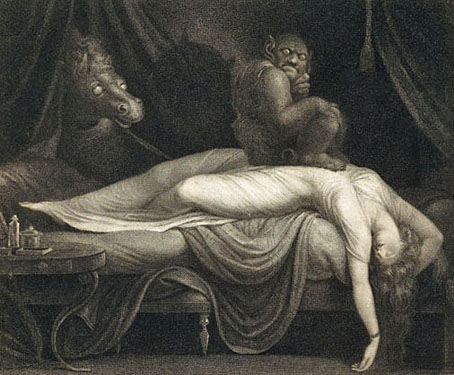
Later generations of critics have had no such problems, of course, nor have the legions of artists and cartoonists who’ve plagiarised and parodied this memorable scene. I had a vague notion of collecting some of the derivations but a quick image search reveals an endless profusion of squatting figures and thrusting horse heads. Wikipedia did provide two of the engraved versions, however. Of the two paintings above I’ve always preferred the later one: the incubus, or “mara” as Frayling calls it, looks more sinister, and the horse head has become an almost unavoidable sexual symbol. No wonder that Siegmund Freud had a copy of The Nightmare on the wall of his waiting room.

nightmare3.jpg

Engraving by Thomas Burke (1783).

Continue reading “Fuseli’s Nightmare”