A profusion of Peake

gormenghast_box.jpg

Bellgrove, young Titus and Barquentine by Mervyn Peake. Case designed by Robert Hollingsworth.

I’d thought about posting the covers of my boxed set of Gormenghast paperbacks a couple of years back when there was a flurry of blogospheric attention being given to Penguin cover designs…thought about it then never got round to it. The reason for doing so now is twofold: firstly I’ve been re-reading the books, and secondly some Gormenghast-related news emerged this week which gives this post an additional relevance.

gormenghast1.jpg

Fuchsia by Mervyn Peake.

The set of Peake paperbacks which Penguin published in 1968 (and their subsequent reprints) were the first editions of Peake’s trilogy which I encountered so I can’t help but regard them as the ones, the only copies I could countenance reading. That may change, however (see below). I’ve no idea how scarce the boxed edition is but the books are reprintings from 1970 so I presume Penguin put out a boxed gift set to make the most of Peake’s posthumous success. I always liked the presentation which is the standard Penguin Modern Classics format of the period, it leaves to you how much you want to regard the books as works of fantasy or simply novels of a rather grotesque and highly imaginative reality. Titus Groan‘s sketch of a glowering and thoroughly unglamorous Fuchsia was a daring choice for a cover intended to lure a newer, younger audience to Peake’s work. The drawing says a great deal about the author’s unsentimental attitude towards his creations; compared to the florid and often delicate covers of the fantasy books being published by Ballantine in the late Sixties (a series which included the Gormenghast trilogy), it seems shockingly unpleasant.

Continue reading “A profusion of Peake”

The Art of Fontana Modern Masters

fontana1.jpg

Design by John Constable, painting by Oliver Bevan (1971).

James Pardey was in touch again this week with news of his a book cover site which follows his earlier (and justly praised) Art of Penguin Science Fiction. The new site The Art of Fontana Modern Masters presents the abstract cover designs for Fontana’s collection of pocket-sized introductions to notable writers, philosophers and scientists. My own copy of the Joyce volume from the initial run of the series is shown above. A note on the back cover states that Oliver Bevan’s painting is part of a single work arranged across ten books which “can be rearranged to form a variety of patterns”. In a pitch to some presumed “collect-the-set” mentality among intellectuals, this idea was continued on later books in the series and James’s site gives an idea of how the covers might be arranged. Until I saw all these covers together I hadn’t realised how impressive the series looks. As with the Penguin site there’s copious information about the production and evolution of the designs.

fontana2.jpg

If that’s not enough, James has a short essay about the series at Eye magazine and HarperCollins (who bought out Fontana) are producing a fine art print of the entire run of covers as shown above. For more details about that, go here.

Elsewhere on { feuilleton }
The book covers archive

Previously on { feuilleton }
Penguin science fiction

Vision Quest

vision.jpg

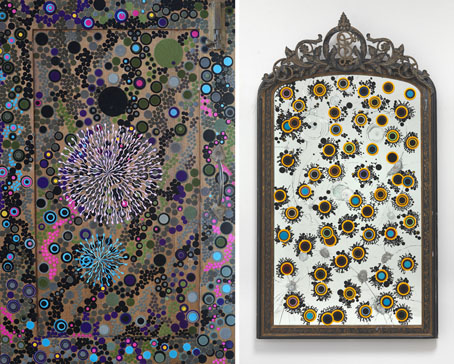
Artwork: Accepting Fear Rather Than Trying to Understand It by Jason Leinwand.

Pam at Phantasmaphile follows last year’s Fata Morgana: The New Female Fantasists show by curating a new exhibition, Vision Quest, at Observatory, Brooklyn, NYC later this month:

…each piece in VISION QUEST explores the archetype of the shamanic voyage, using the tools of paint, pencil, or paper in lieu of fire, flower, feather.  Taken together this work represents a full spectrum of what it means to go underground and out of body; to go there and come back again, perhaps just a little bit wiser or, at the very least, more wide awake.

PARTICIPATING ARTISTS
Jesse Bransford • William Crump • Scott Gursky • Juliet Jacobsen • Ashley Lande • Adela Leibowitz • Jason Leinwand • Christopher Mir • Joe Newton • Herbert Pfostl • Christopher Reiger • Christine Shields • Erika Somogyi • Jessie Rose Vala

More details at Phantasmaphile. Meanwhile, a reminder that the similarly-themed Strange Attractor Salon opens this week at Viktor Wynd Fine Art, London. It’s looking like I’ll be too busy to attend the opening as the world crawls back to work after the holiday season but many of the other featured artists should be there on Thursday night if you happen to be in the East End.

Previously on { feuilleton }
Strange Attractor Salon
Fata Morgana: The New Female Fantasists

Bruegel in winter

bruegel1.jpg

The Hunters in the Snow (1565).

Most of the snow here in Manchester melted over Christmas but it’s likely there’ll be more on the way given the unusually low temperatures. Whatever the complaints about the weather, the empty-handed hunters painted by Pieter Bruegel the Elder (c.1525–1569) had it worse. Of the two paintings, Winter Landscape with a Bird Trap is the lesser composition but seems slightly more optimistic.

bruegel2.jpg

Winter Landscape with a Bird Trap (1565).

I upgraded WordPress a few hours ago with the result that the latest version of the software no longer works with a couple of the plug-ins I was using. I try to keep WP plug-ins to a minimum but fell foul on this occasion so there’s now no tag cloud at the foot of the page until I work out a way to restore it by other means. If anything here seems awry or broken over the next couple of days, that’s the explanation.

Previously on { feuilleton }
Winter panoramas
Winter music
Winter light
La Tour by Schuiten & Peeters

Winter light

friedrich1.jpg

Dolmen in the Snow (1807).

Some paintings for the Winter Solstice by one of my favourite Romantic artists, Caspar David Friedrich (1774–1840). Snow scenes tend to inspire picturesque cliché but in Friedrich’s paintings winter is merely another season in which to evoke his Christian mysticism through the depiction of landscape. The pagan dolmen above is an unusual subject, far more common are churchyard ruins and mountainside crosses although he was also happy enough painting luminous landscapes, especially of mountains and the sea. His treatment of natural light is quite extraordinary and his photo-realist style makes an interesting contrast with the similar effects captured by JMW Turner‘s palette of blurs and smears.

friedrich2.jpg

Monastery Graveyard in the Snow (1819).

I hadn’t noticed before until I looked through some online galleries that Friedrich was painting the same trees over and over. The gnarled trunks in the dolmen painting are almost identical (but reversed) to the foreground trees in the graveyard picture and similarly-shaped trees occur in other paintings. If you’re wondering why the graveyard picture is in black and white, the original was destroyed during the Second World War. Colour copies can be found but I think these may have been tinted from a monochrome photo print.

friedrich3.jpg

Winter Landscape (1811).

Previously on { feuilleton }
Winter Solstice
The art of John Atkinson Grimshaw, 1836–1893
The art of Karl Friedrich Schinkel, 1781–1841