MCMLXX

data70.jpg

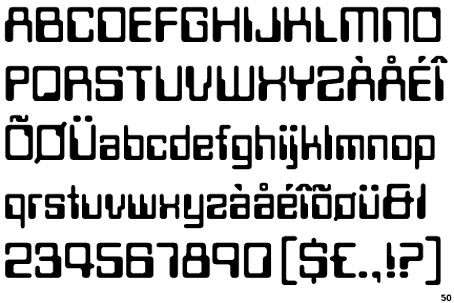
Data 70, a typeface by Bob Newman.

The presence of electronic artists Data 70 in the Spatial mix at the weekend had me thinking about the preponderance of cultural items that were given “70” as a suffix in the 1960s or in the year 1970. The air of futuristic optimism in the 60s drew attention to the birth of a new decade in a manner that hadn’t really happened before, and certainly didn’t happen for 1980 by which time the optimism had been sunk by a decade of political and fuel crises, and the end of the space race.

Data 70 take their name from the “futuristic” computer-like typeface designed by Bob Newman in 1970. Newman’s typeface wasn’t the first of the Space Age designs—Colin Brignall’s Countdown appeared in 1965—but Data 70 was everywhere in the 1970s. Data 70 (the group) dedicated a piece of music to Newman.

A few more 70s follow. These are only the ones I’ve been able to remember or stumble across so I’m sure there are more. And note: to qualify for this micro-category something has to be named “70” only where the suffix signifies modernity or the future, no Expo 70 (the world’s fair in Osaka) or anything annual that happened to be labelled 70 as part of a series.

boccaccio.jpg

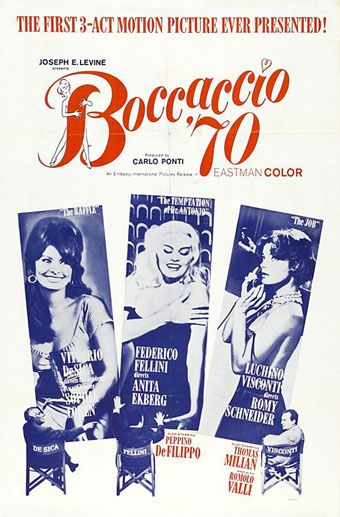
Boccaccio 70 (1962).

The label might imply the future but the predominant tone of these entries is sex. Boccaccio 70 set things in motion by updating the Decameron to modern Italy. Despite the claims of the poster, anthology films are nothing new, and this one has four stories directed by Vittorio De Sica, Federico Fellini, Mario Monicelli and Luchino Visconti. Italo Calvino was one of the writers.

Continue reading “MCMLXX”

The White People by Arthur Machen

aklo.jpg

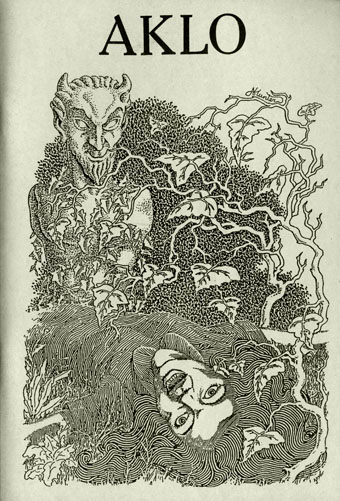
Aklo: A Journal of the Fantastic, Spring 1988 edition, edited by Mark Valentine & Roger Dobson. Illustration by Alan Hunter.

1: The White People

The White People by Arthur Machen was written in 1899 but not published until it appeared in Horlick’s Magazine, January 1904. The magazine, which ran for just over a year, was edited by Machen’s Golden Dawn colleague AE Waite which no doubt explains the unlikely venue. HP Lovecraft enthused about the story in Supernatural Horror in Literature (1927):

Less famous and less complex in plot than The Great God Pan, but definitely finer in atmosphere and general artistic value, is the curious and dimly disquieting chronicle called The White People, whose central portion purports to be the diary or notes of a little girl whose nurse has introduced her to some of the forbidden magic and soul-blasting traditions of the noxious witch-cult — the cult whose whispered lore was handed down long lines of peasantry throughout Western Europe, and whose members sometimes stole forth at night, one by one, to meet in black woods and lonely places for the revolting orgies of the Witches’ Sabbath. Mr. Machen’s narrative, a triumph of skilful selectiveness and restraint, accumulates enormous power as it flows on in a stream of innocent childish prattle, introducing allusions to strange “nymphs,” “Dols,” “voolas,” “white, green, and scarlet ceremonies,” “Aklo letters,” “Chian language,” “Mao games,” and the like. The rites learned by the nurse from her witch grandmother are taught to the child by the time she is three years old, and her artless accounts of the dangerous secret revelations possess a lurking terror generously mixed with pathos. Evil charms well known to anthropologists are described with juvenile naiveté, and finally there comes a winter afternoon journey into the old Welsh hills, performed under an imaginative spell which lends to the wild scenery an added weirdness, strangeness, and suggestion of grotesque sentience. The details of this journey are given with marvellous vividness, and form to the keen critic a masterpiece of fantastic writing, with almost unlimited power in the intimation of potent hideousness and cosmic aberration.

Lovecraft borrowed Machen’s naive narrator a year later for The Dunwich Horror: Wilbur Whateley’s diary is written “by a child of three-and-a-half who looked like a lad of twelve or thirteen”, and makes reference to “Aklo”, “the Dho formula” and “the Voorish sign”. (The journal in The White People refers to “a wicked voorish dome”.)

Lovecraft wasn’t alone in being impressed by the story, it’s long been regarded as Machen’s greatest piece of short fiction with good reason:

…it remains the purest and most powerful expression of what Jack Sullivan has called the “transcendental” or “visionary” supernatural tradition. Most other tales in that tradition, Blackwood’s The Wendigo, EF Benson’s The Man Who Went Too Far, and Machen’s own The Great God Pan, merely describe encounters with the dark primeval forces that reign beyond the edge of civilisation; The White People seems an actual product of such an encounter, an authentic pagan artefact…

TED Klein, The Penguin Encyclopedia of Horror and the Supernatural (1986)


2: The House of Souls
sime.jpg

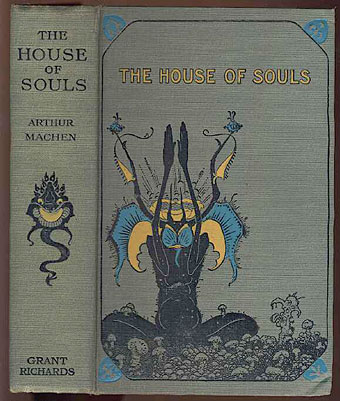
The House of Souls (1906). Cover illustrations by Sidney Sime.

The story was first collected in The House of Souls in 1906, a book that features a splendidly weird cover illustration by Sidney Sime. Inside there’s some of Machen’s finest supernatural writing including The Great God Pan, The Inmost Light and The Three Imposters. Also included is A Fragment of Life, a visionary piece that begins as a domestic drama but by the end has almost intersected with The White People.

And by coincidence (or is it?), I’ve just noticed that Tartarus Press are publishing a facsimile edition of the 1906 volume later this month.


3: The Ceremonies
ceremonies.jpg

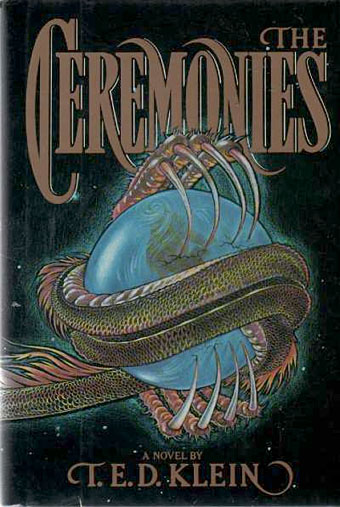
The Ceremonies (1984). Illustration by David Palladini.

TED Klein’s debut novel is also his only novel to date. Klein was editor of The Twilight Zone Magazine at this time, and he used the publication’s popularity to promote the weird fiction of the past; writers like Machen and Algernon Blackwood weren’t as visible in the mid-80s as they are today. The Ceremonies was expanded from a 1972 novella, The Events at Poroth Farm, and borrows much from The White People: the ceremonies of the title refers to those in the story, and the story itself—which a character is instructed to read by moonlight—is described as a key to occult mysteries. There’s a lot about the novel to recommend—Klein’s prose for a start—but I felt it could have been much weirder than it was. The book reads like a typical King/Straub narrative that’s aiming for more without quite getting there, and placing something as unique as Machen’s story at its heart only makes its eventual shortcomings all the more apparent.


4: A drawing
whitepeople.jpg

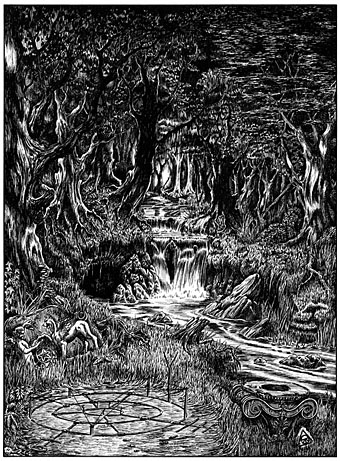
The White People (1990) by John Coulthart.

And speaking of aiming for more without quite getting there, my drawing from 1990. This was going to be one of a series based on Machen’s story but I ran out of steam, feeling that the usual approach of drawing separate scenes wasn’t going to deliver the essence of the piece. If I tried this today I’d probably go for a more surreal approach the way Sätty did with Poe.


5: Roses
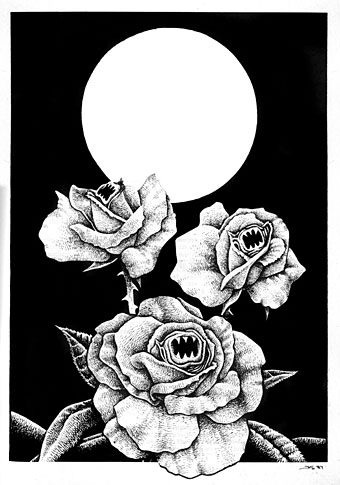
roses.jpg

The Singing Roses (1987) by Jeffrey Salmon. From Dagon magazine no. 18/19, July–October, 1987.

“And what is sin?” said Cotgrave.

“I think I must reply to your question by another. What would your feelings be, seriously, if your cat or your dog began to talk to you, and to dispute with you in human accents? You would be overwhelmed with horror. I am sure of it. And if the roses in your garden sang a weird song, you would go mad. And suppose the stones in the road began to swell and grow before your eyes, and if the pebble that you noticed at night had shot out stony blossoms in the morning?

The White People

*

Sweet tortures fly on mystery wings / Pure evil is when flowers sing / My heart / My heart is a rose

Love’s Secret Domain (1991) by Coil


6: Ghost Box
zann.jpg

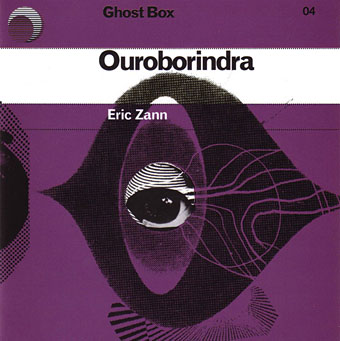
Ouroborindra (2005) by Eric Zann. Design by Julian House.

Track 4: Dôls
Track 6: Voolas
belbury.jpg

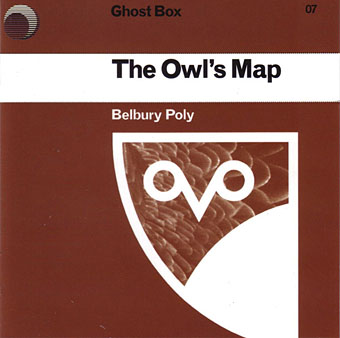
The Owl’s Map (2006) by Belbury Poly. Design by Julian House.

Track 11: Scarlet Ceremony

Among the sleeve notes there’s this:

And the noise and the singing would go on and on for a long time, and the people who were in a ring swayed a little to and fro; and the song was in an old, old language that nobody knows now, and the tune was queer.

Arthur Machen, The White People


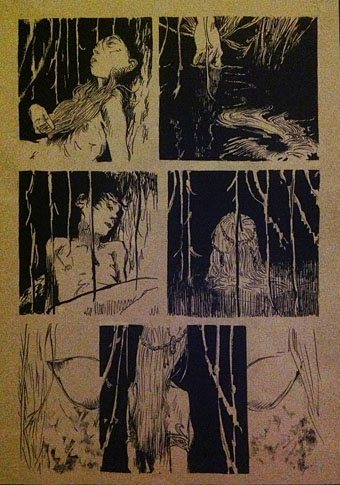
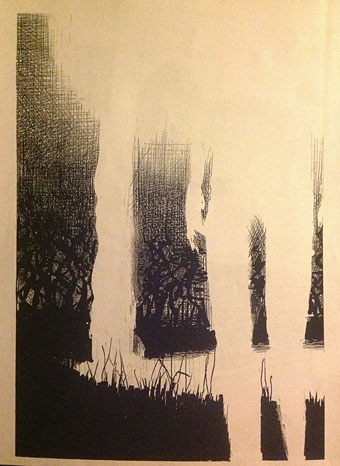
7: The White People by Ibrahim R. Ineke
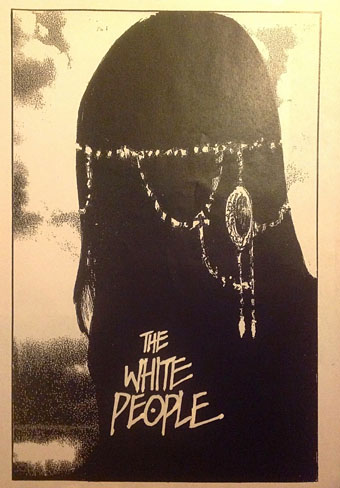
ineke1.jpg

A very impressive comic-strip adaptation, the first of its kind, as far as I’m aware. See the full run of pages here. (And thanks to Ibrahim for getting in touch!)
ineke2.jpg

ineke3.jpg

ineke4.jpg

For those who can’t afford a limited edition from Tartarus Press, Machen’s story may currently be found in Penguin’s The White People and Other Weird Stories. The perfect thing now the nights are drawing in.

Update: See also The Forbidden Forest, a short animation based on the story. (Thanks, Richard!)

Elsewhere on { feuilleton }
The Lovecraft archive

Previously on { feuilleton }
The Bowmen by Arthur Machen
Rex Ingram’s The Magician
The Great God Pan

Weekend links 232

hackett.jpg

Forget Me Not (no date) by Caitlin Hackett.

• Halloween brings out the articles about weird fiction: “No one would now write of [HP Lovecraft] as the critic Edmund Wilson did, in the New Yorker in 1945: ‘The only real horror in most of these fictions is the horror of bad taste and bad art.’ The true horror was in fact that of judging Lovecraft by the standards of a defunct literary culture,” says John Gray. At The Atlantic there’s Jeff VanderMeer on the uncanny power of weird fiction, while Matt Seidel at The Millions explores the mysteries and attractions of Robert Aickman’s “strange stories”.

The Witching Hour is a video essay by Pam Grossman “examining the many different faces of witches in film”. Pam’s video opens with a scene from Suspiria; over at FACT, Goblin’s Claudio Simonetti talks about the creation of Suspiria‘s peerless soundtrack.

• David Rudkin and Alan Clarke’s uncanny television film, Penda’s Fen, is given a 40th anniversary screening later this month at the Horse Hospital, London. For those who can’t attend (and those who haven’t already read it) there’s my post from 2010.

Nabokov sees each day’s weather as a palette: “The weather this morning was soso: dullish, but warm, a boiled milk sky, with skin – but if you pushed it aside with a teaspoon, the sun was really nice, so I wore my white trousers”. He listens carefully to the sound of the rain, which his letters brilliantly orchestrate. He provides fantastic descriptions of puddles, some of which contain shifts in perspective reminiscent of the nearly cinematic transitions found in the novel he would write shortly afterwards, King, Queen, Knave:

“I looked out of the window and saw: a red-haired housepainter caught a mouse in his wheelbarrow and killed it with the stroke of a brush, then he tossed it in a puddle. The puddle reflected the dark-blue sky, quick black upsilons (reflections of swallows flying high) and the knees of a squatting child, who was attentively studying the little grey round corpse.”

Eric Naiman on Vladimir Nabokov’s Letters to Véra

• Occult rock: Peter Bebergal talks to Expanding Minds about his new book, Season of the Witch: How the Occult Saved Rock and Roll. There’s an hour-long film of Black Sabbath saving rock and roll in Paris, 1970, here.

• Mixes of the week: Burning The Existence, “a three-hour sonic exploration of the outer fringes of Goth”, and a horror soundtrack mix by Death Waltz.

• “‘Capital loathes the old,’ [Gareth] Evans said, ‘for anchoring us in the reality of the lived.'” Iain Sinclair on London’s lost cinemas.

Desirina Boskovich, co-editor of the Steampunk Users Manual, offers “7 Reasons Why Steampunk Is Totally ‘Now'”.

• Penguin has new collage covers by Julian House for The Cut-Up Trilogy by William Burroughs.

Hear a homemade synthesizer turn weather into music.

• Grotesque doodles by William Makepeace Thackeray.

full fathom five is Thom’s new blog.

Weird Dream (1976) by Harmonia 76 | Weird Caravan (1980) by Klaus Schulze | Weird Gear (1991) by Ultramarine

Albin Grau’s Nosferatu

nosferatu01.jpg

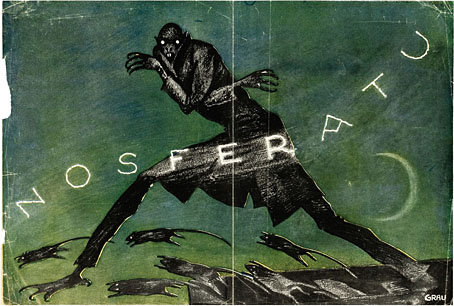
For many directors a film like Nosferatu: A Symphony of Horror (1922) would have been a career peak, but Friedrich Murnau went on to make The Last Laugh (1924), Faust (1926) and Sunrise (1927). All those films improve cinematically on Nosferatu but the vampire film continues to cast the longest shadow: quoted, remade, and with even its production fictionalised in Shadow of the Vampire (2000). The lasting success of Nosferatu wasn’t all Murnau’s doing, however.

nosferatu05.jpg

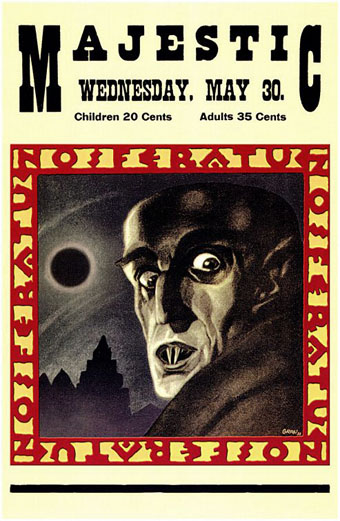
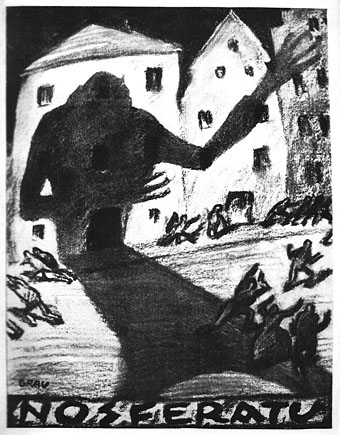
It’s arguable that without the preliminary work of production designer Albin Grau (1884–1971) the film might have been little more than a curious precursor of the Universal Dracula (1931). Grau was responsible for the set design and the extraordinary appearance of Max Schreck’s Count Orlok; Grau also created the film’s memorable poster and advertising imagery in which the vampire’s appearance hints at something even more terrible than the figure that stalks before the camera.

nosferatu03.jpg

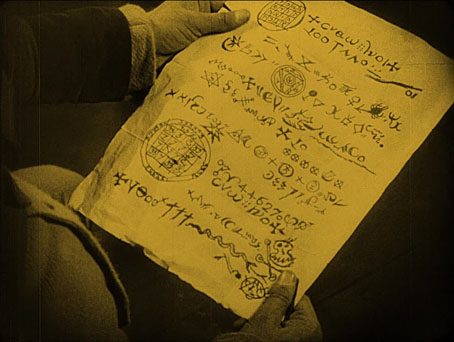
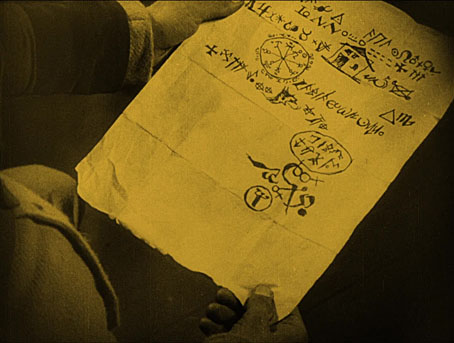
A great deal of German silent cinema is labelled “Expressionist” even if the films themselves show little in the way of overt Expressionism. Nosferatu isn’t very Expressionist at all but Albin Grau’s sketches and posters certainly tend in that direction, so much so that they make me wonder how different the film might have been if it had been as stylised as The Cabinet of Dr. Caligari (1919). In addition to his artistic pursuits, Grau was an occultist which explains the attention to detail in the bizarre contract drawn up between Knock and Count Orlok, a document that looks more like a page from a grimoire than anything used by an estate agent. There’s a quote from Grau in his occult capacity in John Symonds’ Aleister Crowley biography, The Great Beast, complaining in 1925 about Crowley’s ascension to the heights of the Ordo Templi Orientis.

nosferatu11.jpg

Nosferatu: The Knock-Orlok contract.

nosferatu12.jpg

Nosferatu comes out of the occult preoccupations, having been Grau’s project from the beginning when he formed a film company, Prana-Film, with Enrico Dieckmann. The pair announced plans for three films: Dreams of Hell, The Devil of the Swamp, and a drama about a vampire. Only Nosferatu materialised then sank the company almost as soon as it was finished: Prana-Film had spent more on publicity than on the film itself, and went deep into debt. The success of the film might have helped their finances but the death blow was struck by Florence Stoker and the British Society of Authors who won a court case against the company for filming Dracula without permission. The efforts of the Stoker estate to destroy Nosferatu are recounted in detail in David J. Skal’s fascinating Hollywood Gothic (1990). Many of Murnau’s minor films were lost through various misfortunes, and it’s a fluke that a handful of prints of Nosferatu survived. Happily for us, it’s not only vampires that manage to remain undead.

Continue reading “Albin Grau’s Nosferatu”

The occult Knapp

knapp01.jpg

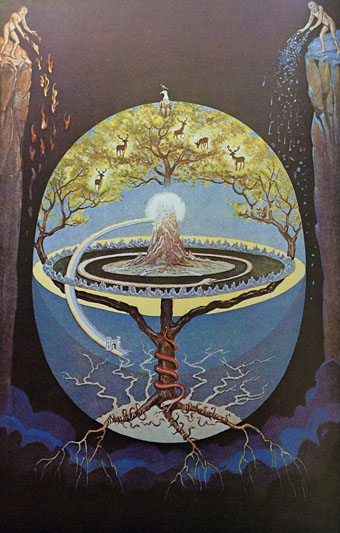
Yggdrasil, the World Tree of Norse mythology.

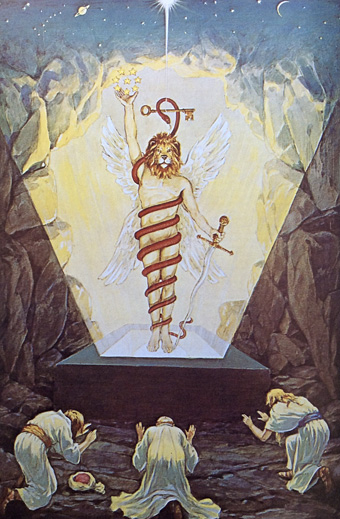
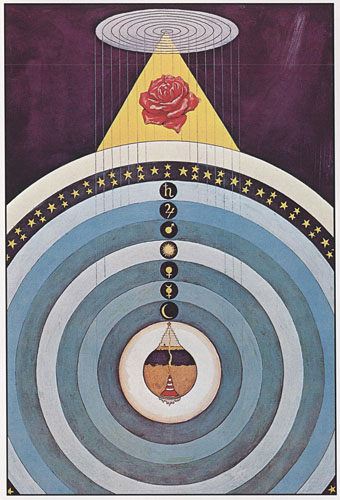
Following up the work of Etidorhpa‘s illustrator, J. Augustus Knapp (1853–1938), I realised that I’d already encountered some of his later paintings. After illustrating books by John Uri Lloyd, Knapp moved to California where he met occult historian, mystic and book collector Manly Palmer Hall. Knapp exchanged Lloyd’s fungi researches and weird fiction for Hall’s mysticism, illustrating The Initiates of the Flame (1922), and Hall’s magnum opus, The Secret Teachings of All Ages (1928). Knapp’s 54 paintings for the latter volume have since proved convenient for the occult encyclopedias that followed, many of which plundered Hall’s study for its illustrations. Knapp’s depictions aren’t always very successful—Odin’s wolves look silly rather than fierce—but they served Hall’s purpose of fixing mythological characters and metaphysical schemes in a colourful manner for a contemporary audience.

knapp06.jpg

Mithra in the form of Boundless Time.

Hall and Knapp also produced their own Tarot deck (see here and here) which can still be bought today from the University of Philosophical Research in Los Angeles. The UPR was founded by Manly Hall, and has a collection of Knapp’s paintings. They also sell Hall’s books, of course, and you can browse a copy of The Secret Teachings of All Ages if you visit the library, as I discovered in 2005 when Jay Babcock and I paid the place a visit.

knapp10.jpg

The Key to Dante’s Divine Comedy.

Continue reading “The occult Knapp”