Weekend links 539

earle.jpg

Fire, Red and Gold (1990) by Eyvind Earle.

Roger Penrose won a Nobel Prize recently for his work in physics. I read one of his books a few years ago, and was intimidated by the “simple” equations, but I always like to hear his ideas. This 2017 article by Philip Ball is an illuminating overview of Penrose’s life and work.

• At Dangerous Minds: Joe Banks on the incidents that led to Lemmy’s dismissal from Hawkwind in 1975, an extract from Hawkwind: Days of the Underground. The book is available from Strange Attractor in Europe and via MIT Press in the USA.

• “Not married but willing to be!”: men in love (with each other) from the 1850s on. It’s always advisable to take photos like these with a pinch of salt but several of the examples are unavoidably what they appear to be.

Most of all, this resolutely collaborative production stood against the vanity and careerism of individual authorship; Breton called it the first attempt to “adapt a moral attitude, and the only one possible, to a writing process.” The text itself is peppered with readymade phrases, advertising slogans, twisted proverbs, and pastiches of such admired predecessors as Rimbaud, Apollinaire, and Lautréamont, whose pluralistic credo, “Poetry must be made by all. Not by one,” anticipates the sampling aesthetic by a century. But the intensity was draining, and as the book moves toward its final pages and the writing becomes increasingly frenetic, you can almost feel the burnout taking hold. After eight days, fearing for his and Soupault’s sanity, Breton terminated the experiment.

Mark Polizzotti reviews a new translation by Charlotte Mandell of The Magnetic Fields by André Breton and Philippe Soupault

• The hide that binds: Mike Jay reviews Dark Archives: A Librarian’s Investigation into the Science and History of Books Bound in Human Skin by Megan Rosenbloom.

• “A photographer ventures deeper into Chernobyl than any before him.” Pictures from Chernobyl: A Stalker’s Guide by Darmon Richter.

John Van Stan’s reading of Frankenstein by Mary Shelley uses my illustrations (with my permission) for each of its chapters.

Susan Jamison, one of the artists in The Art of the Occult by S. Elizabeth, talks to the latter about her work.

William Hope Hodgson: The Secret Index. A collection of Hodgson-related posts at Greydogtales.

Gee Vaucher talks to Savage Pencil about her cover art for anarchist punk band, Crass.

Weird, wacky and utterly wonderful: the world’s greatest unsung museums.

Tom Cardamone chooses the best books about Oscar Wilde.

• At Dennis Cooper’s: Jean-Pierre Melville Day.

You by The Bug ft. Dis Fig.

Magnetic Dwarf Reptile (1978) by Chrome | Magnetic Fields, Part 1 (1981) by Jean-Michel Jarre | Magnetic North (1998) by Skyray
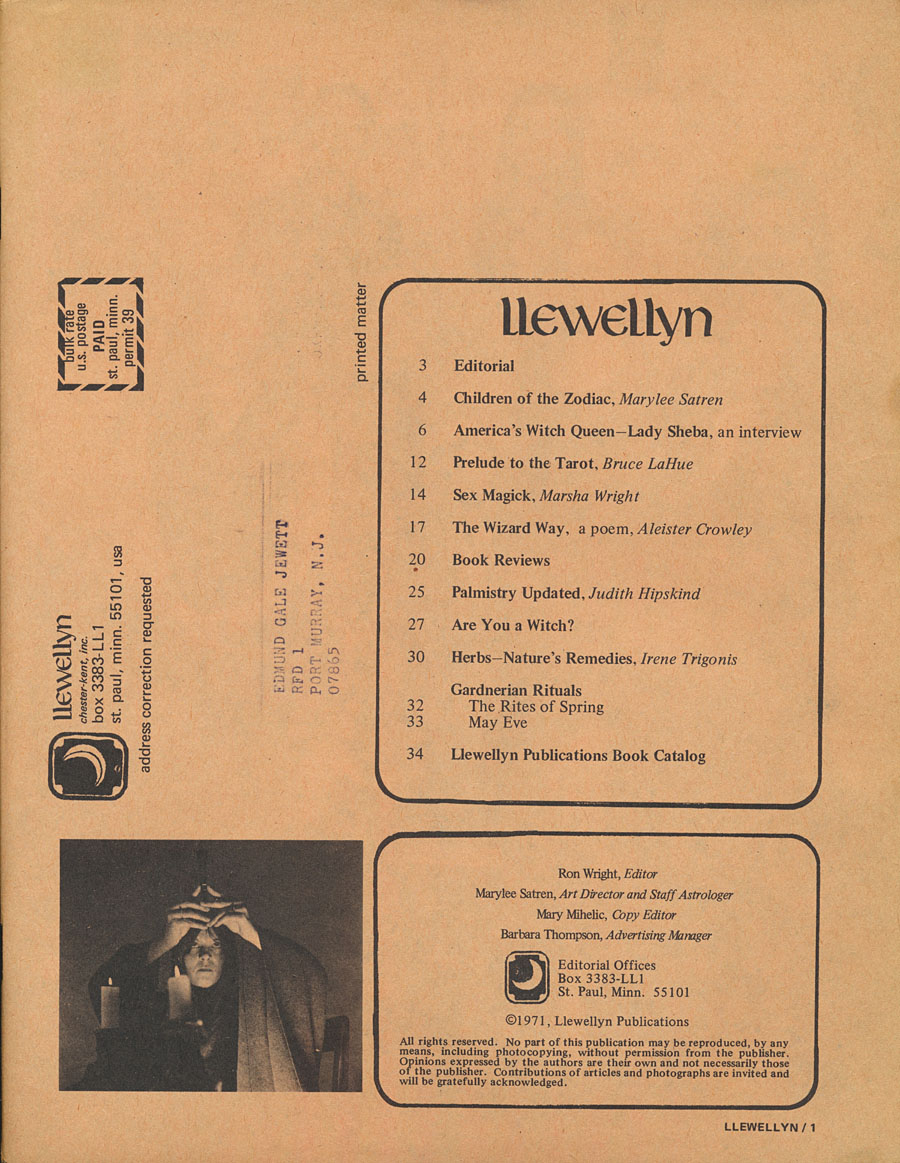
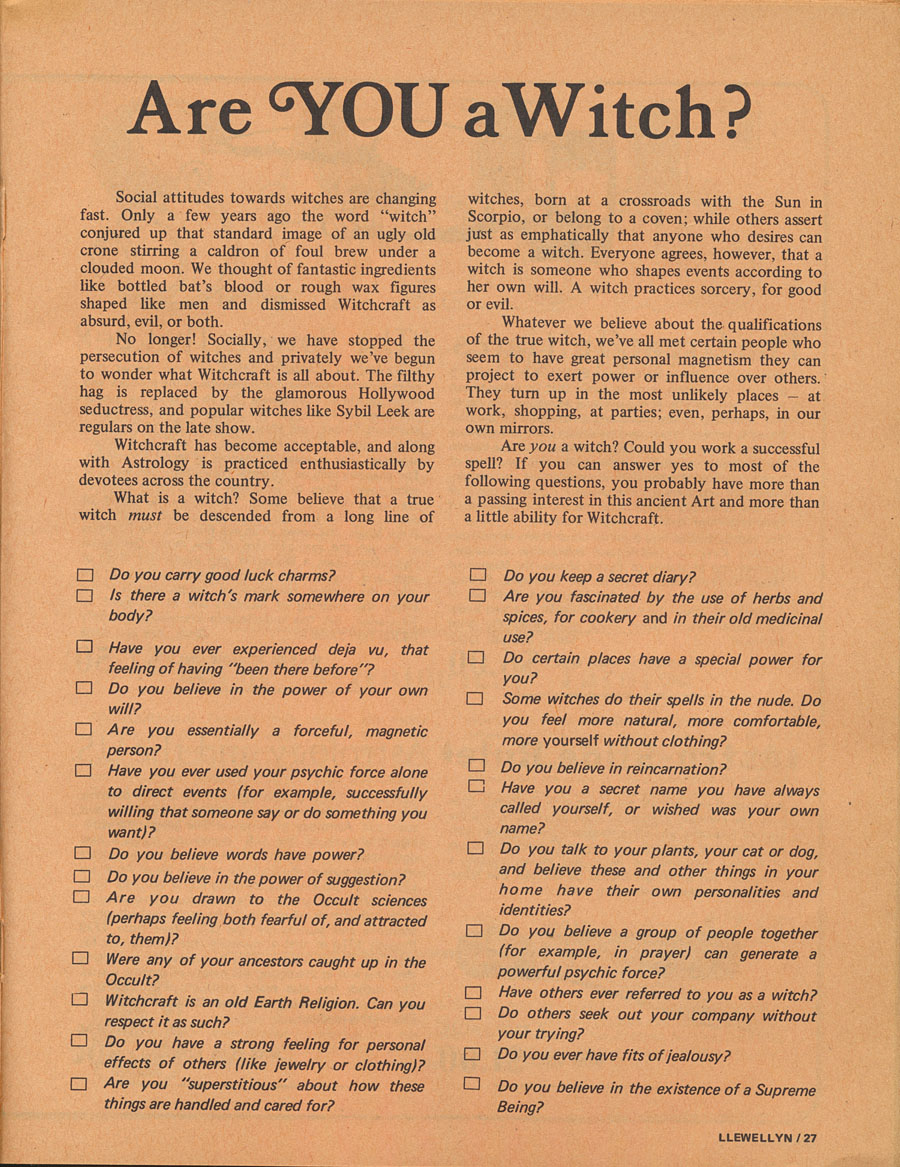
Llewellyn occult magazine and book catalogue, 1971

llewellyn1.jpg

A table of contents that reads like a track list from an album by Blood Ceremony: Children of the Zodiac, America’s Witch Queen, Prelude to the Tarot, Sex Magick, The Wizard Way…

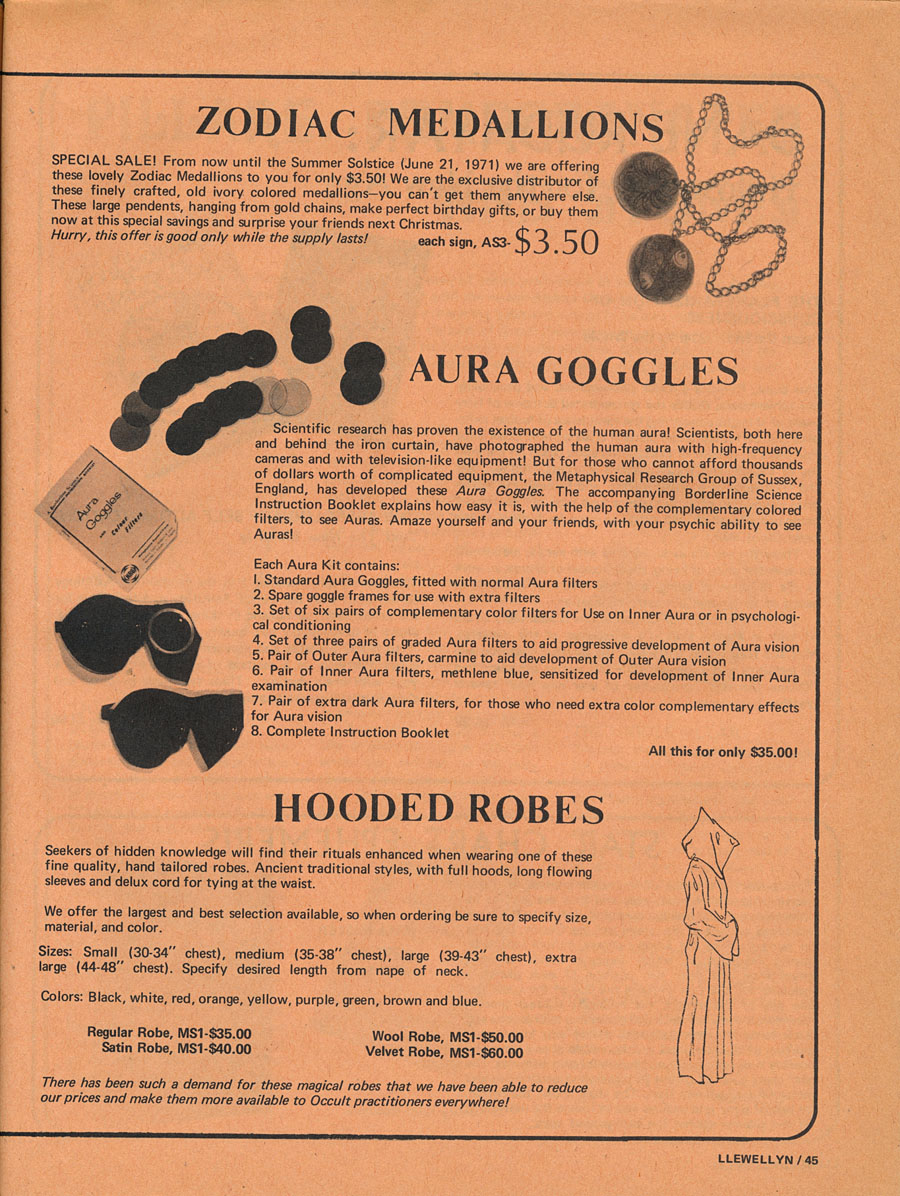
Are you a witch? Maybe you are but you don’t know it yet. You can find out by answering the questionnaire in the Llewellyn occult magazine and book catalogue for 1971, a publication which contains a number of witchy articles among its catalogue pages. This is one of many catalogues and publicity brochures from the Ted Nelson Junk Mail Cartons (6,856 items) at the Internet Archive, and is such a product of its time that it’s a shame there aren’t more like it. In addition to a photo of the hippyish Llewellyn staff there’s an interview with Lady Sheba, “America’s Witch Queen”, reprints of incantations by Aleister Crowley and Gerald Gardner, and headlines set in Davida, one of the typefaces of the occult revival. Among the artefacts for sale are a set of “Aura Goggles” from the Metaphysical Research Group, a company that sounds like something from a Charles Williams novel but which has been trading in the UK for many years, and is still active today. They no longer seem to carry Aura Goggles, however. A shame.

llewellyn2.jpg

llewellyn3.jpg

Previously on { feuilleton }
The Art of the Occult
Calendrier Magique
Typefaces of the occult revival
MMM in IT
The Book of the Lost
The Occult Explosion
Forbidden volumes
The Sapphire Museum of Magic and Occultism
Occultism for kids

Rooms with a paranormal view

room1.jpg

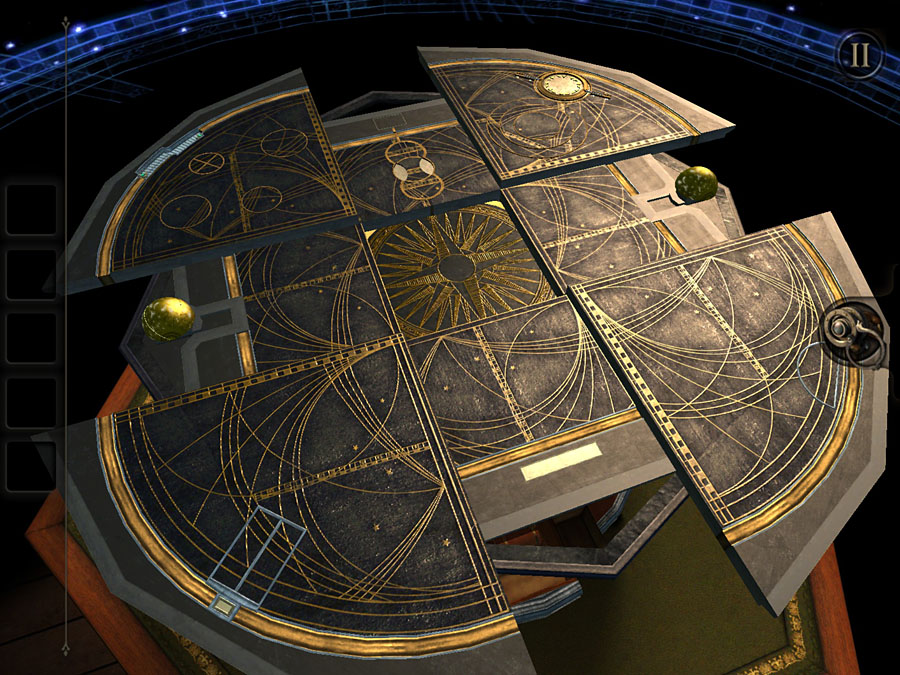
The Room: the cosmic tabletop.

A few words of praise for the Room series from Fireproof Games. I don’t play many computer games, and I think this may be my first post dedicated to such a thing, but I maintain an interest in the medium. The Room and its sequels only came to my attention a couple of weeks ago when I was wondering if there was anything Myst-like available for the tablet. I never got to play the original Myst but enjoyed its follow up, Riven, although the enjoyment was mostly for the graphics, the music and the island environments. The game itself was less satisfying, requiring pen and paper to keep track of its complexities, and involving a great deal of fruitless journeying from one location to another in the search for new clues.

room2.jpg

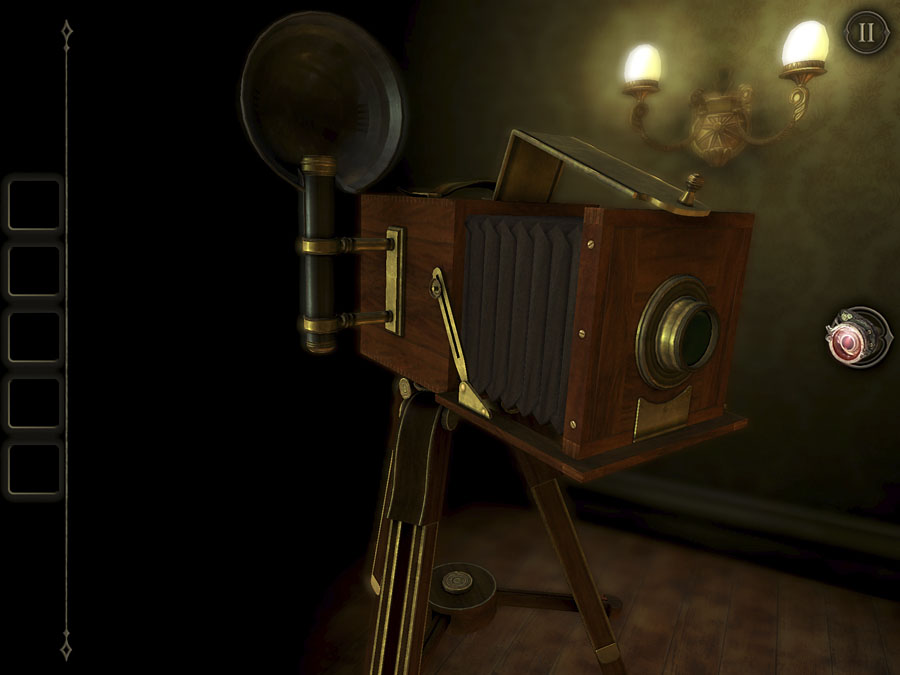
The Room 2: the camera.

The Room follows the template established by Myst in presenting you with a number of mechanical artefacts, all of which have to be examined and opened or operated before you can proceed to the next stage. The dominant aesthetic is 19th-century-mechanical—there’s a lot of wood and brass to these devices—but to call it steampunk would be a mistake; there’s little steam involved, and most of the cogs are kept inside their cases. There is a hint of Jules Verne, however, in the notes from an absent inventor whose initials, “A.S.”, may be a nod to Journey to the Centre of the Earth. As the title suggests, the location is a single room, while in the sequels, The Room 2 and The Room 3, you’re presented with a series of connected spaces. The third installment is the closest to the original Myst with a central hub that leads to other areas of a rambling complex of buildings, not all of which are revealed at the outset. The main structure is based on William Beckford’s Fonthill Abbey which pushes things into Gothic territory even without the developments outlined below.

room3.jpg

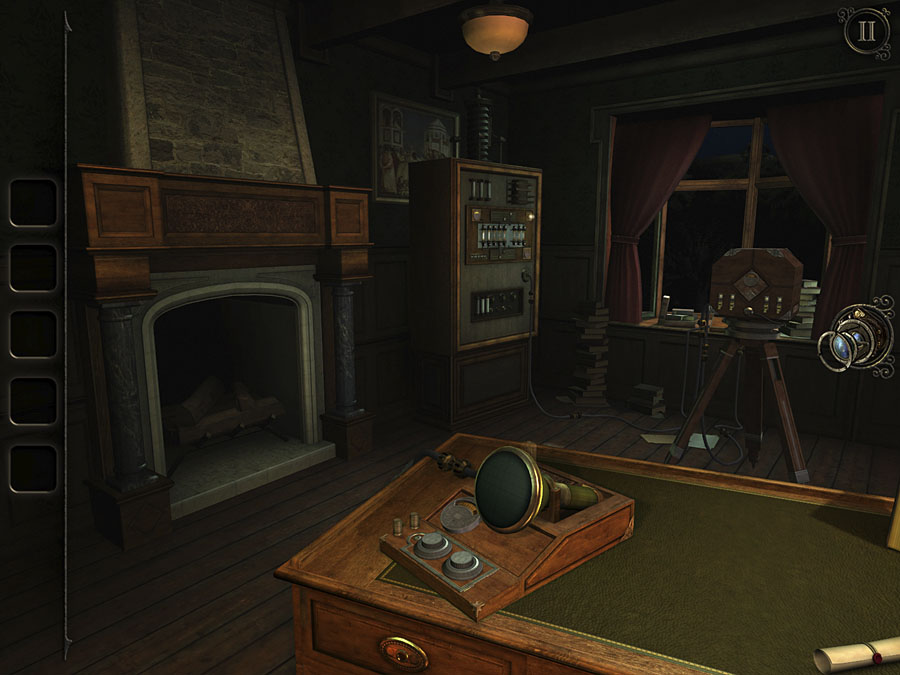
The Room 3: the oscilloscope is one of several which need to be powered up and manipulated in order to open the Null portals.

The MacGuffin for all the games is a new element, the Null, whose discovery and potential obsesses the creators of the games’ devices, and whose manipulation of space creates many of the portals that lead to new rooms. As the series progresses, the Null becomes a growing menace that leads to full-on cosmic horror, with oil-slick Tentacles From Beyond writhing around the interdimensional portals you have to travel through. This development was surprising and, for this player, very welcome, turning the games from a series of eleborate puzzles into something much more sinister. The aesthetic evolves accordingly, with an increasing profusion of occult sigils and pentacles, and, in The Room 2, Tarot cards and séance devices. (Fireproof have a set of their Tarot designs available as a free download.) In the second game there’s a further requirement to piece together mundane machines—a camera or a typewriter, say—before they will function properly. This process reaches a peak in The Room 3 where you’re faced with a succession of increasingly complex tasks, from woodworking and metal forging to electro-mechanical engineering and astronomy. As with the Myst universe, there are no monsters here (although there is the occasional ghost), nothing needs to be fought with weapons, it’s just you, a room full of objects and a continual background murmur of unnerving whispers and distant sounds. The gameplay in The Room 3 is sufficiently non-linear to lead to a variety of different endings, not all of which may be survivable. I managed to escape the Tentacles From Beyond when they finally destroyed the house but I also missed finding an important artefact. I’ll be returning, wiser and, I hope, more attentive to the half-hidden details.

room4.jpg

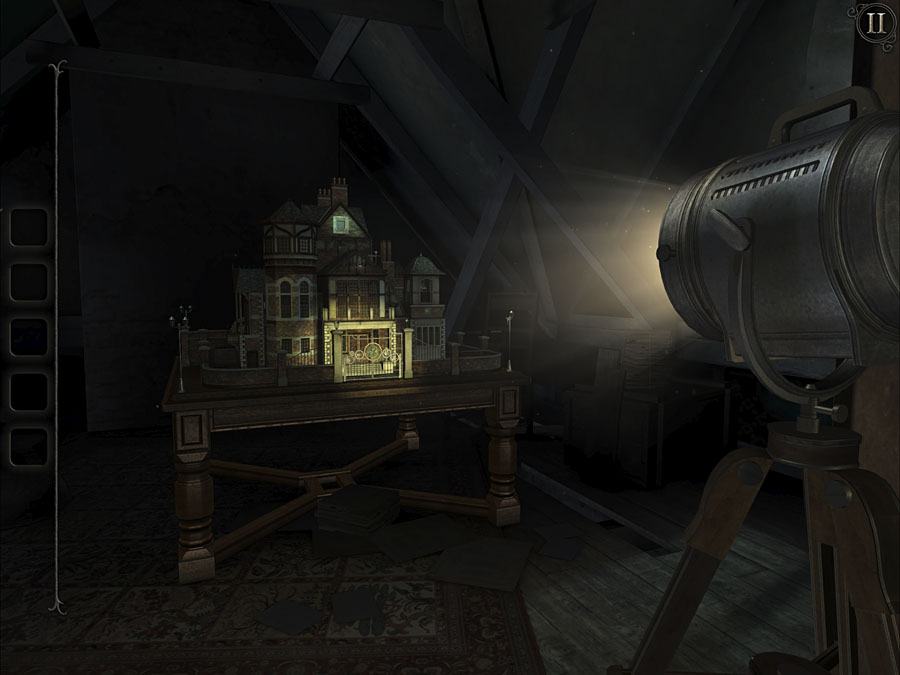
The Room—Old Sins: the haunted doll’s house as seen at the beginning of the game.

I’m currently playing the fourth game in the series, Old Sins, which returns you to a single room but plays with scale via a large doll’s house. The exterior of the building is all detailed model work, while the interiors—accessed through Null physics—are scaled-down replicas of the rooms in a house where another Null investigator and his wife have gone missing. It’s not clear yet whether the attic where the toy house is stored is also the attic of the real house the model is based upon but having dealt with a similar model in The Room 3 this seems likely.

While I enjoyed the surface details of Riven I was never very interested in the fantasy background of the Myst universe. The Room series is much closer to my own core preoccupations, a beguiling blend of antique technology with borderline occultism and those Tentacles From Beyond, a scenario that wouldn’t be out of place in an issue of Weird Tales. Just the thing for the darkening days of October.

The Art of the Occult

occult1.jpg

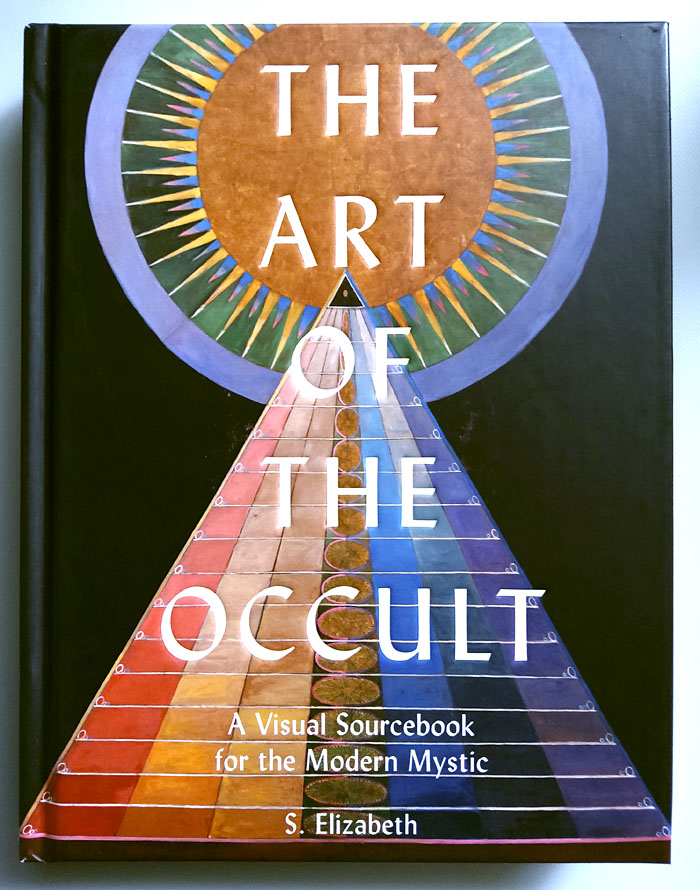
Cover art: Group X, No. 1, Altarpiece (1915) by Hilma af Klint. Design by Paileen Currie.

A surprise arrival in today’s post, the occult art compendium by S. Elizabeth which I would have wanted to read even if it didn’t contain one of my pictures:

From theosophy and kabbalah, to the zodiac and alchemy; spiritualism and ceremonial magic, to the elements and sacred geometry – The Art of the Occult introduces major occult themes and showcases the artists who have been influenced and led by them. Discover the symbolic and mythical images of the Pre-Raphaelites; the automatic drawing of Hilma af Klint and Madge Gill; Leonora Carrington’s surrealist interpretation of myth, alchemy and kabbalah; and much more.

Most of the books I’ve seen on this subject have either been very general and in need of an update (Thames and Hudson’s venerable Magic: The Western Tradition) or exhibition catalogues which are never comprehensive and become increasingly hard to find since they don’t get reprinted. The Art of the Occult is an ideal introduction to the subject for the curious reader, as well as being a useful overview for the aficionado (or initiate) which spans several hundred years of art and illustration, from the earliest occult manuscripts to contemporary works. Occult art is a house with many mansions, a form which can encompass photo-realism, Symbolism, Surrealism or total abstraction without the definition breaking down. The Art of the Occult contains a satisfyingly wide range of examples, 200 in all, and includes many artists whose work I hadn’t seen before. It also reinforces the origin of abstract art in occult concerns, a lineage that went unmentioned for many years by critics who couldn’t accept that their beloved “pure” idiom was tainted by mysticism.

occult2.jpg

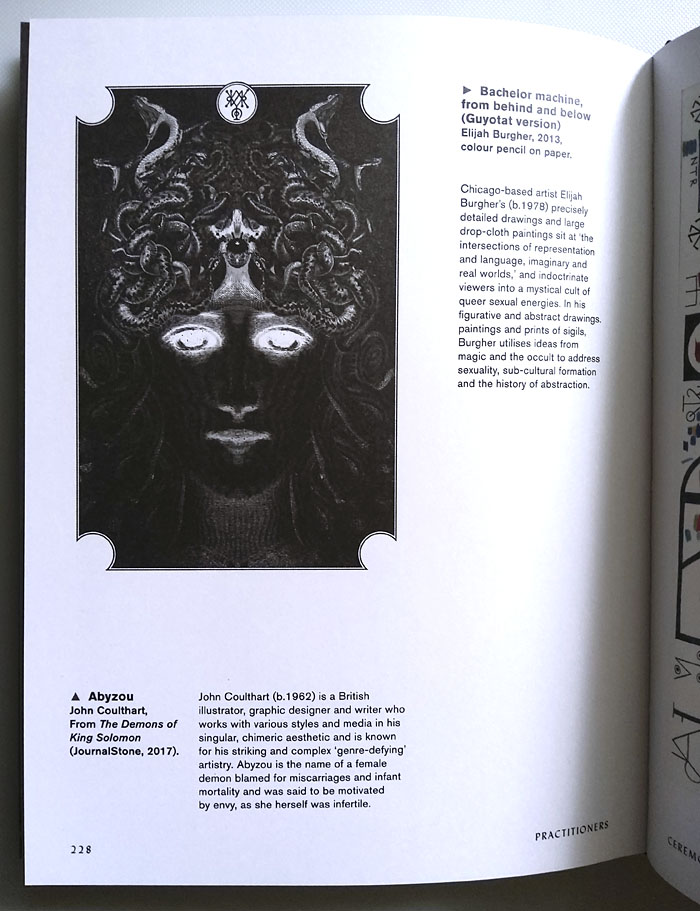
My piece is a portrait of the serpent-haired Abyzou, one of the Solomonic demons I depicted for The Demons of King Solomon in 2017. The picture was one of the better representations in a series I would have preferred to have more time to work on. I was pleased to see my contribution facing one of Elijah Burgher’s sigil drawings; I like Burgher’s art so he makes a good companion. This is the first and maybe the only book where my name is listed in an index between Pamela Colman Smith and Aleister Crowley.

The Art of the Occult will be published by White Lion Publishing on 13th of October, just in time for the annual spook-fest.

Update: Haute Macabre has a new post by S. Elizabeth showing more pages from the book’s interior plus the opportunity to win a copy.

Previously on { feuilleton }
Calendrier Magique
The Demons of King Solomon
Typefaces of the occult revival
The art of Frieda Harris, 1877–1962
The art of Fay Pomerance, 1912–2001
Songs for the Witch Woman
Wilfried Sätty: Artist of the occult
The art of Scott Treleaven

Weekend links 535

beardsley.jpg

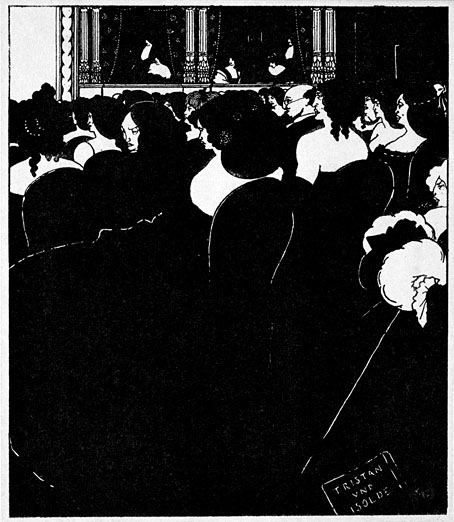
The Wagnerites (1894) by Aubrey Beardsley.

• “Part of my problem with influence is that the concept is too univocal; most of us are impacted by many others during our lifetimes, but often in oblique ways. So many of the most interesting bits of cultural transmission happen nonlinearly, via large groups of people, and in zigzag mutations. Assigning influence can also have the unintentional effect of stripping artists of their own originality and vision.” Geeta Dayal reviewing Wagnerism by Alex Ross.

• “Buñuel stubbornly refused to have any group affiliation whatsoever. Even though critics always tried to categorize him, he never wanted to explain the hidden meanings of any of his films and often denied that there were any.” Matt Hanson on the surreal banality of Luis Buñuel’s The Exterminating Angel.

• Next month Soul Jazz release the fourth multi-disc compilation in their Deutsche Elektronische Musik series devoted to German music from the 1970s and 80s. The third collection was the weakest of the lot so I wasn’t expecting another but this one looks like it may be better.

James Balmont chooses the five best films by Kiyoshi Kurosawa, who he calls “cinema’s master of horror”. I’ve yet to see any of these so I can’t say whether the label is warranted or not.

• At Wormwoodiana: Mark Valentine in a two-part post here and here charts the emergence of an under-examined sub-genre, the metaphysical thriller.

• Power Spots: 13 artists choose favourite pieces of music by Jon Hassell. A surprising amount of interest in his first album, Vernal Equinox.

• At Spine: George Orwell’s Animal Farm receives new cover designs for its 75th anniversary.

• “Pierre Guyotat’s work is more relevant now than ever,” says Donatien Grau.

• Mix of the week: FACT mix 775 by Sarah Davachi.

May 24th by Matthew Cardinal.

• Ry Cooder with Jon Hassell & Jim Keltner: Video Drive-By (1993) | Goose And Lucky (1993) | Totally Boxed In (1993)