Exuma: Obeah men and the voodoo groove

exuma.jpg

Do Wah Nanny by Exuma (Kama Sutra LP, 1971).

I came down on a lightning bolt
Nine months in my Mama’s belly.
When I was born, the midwife scream and shout,
I had fire crystals coming out of my mouth.
I’m Exuma, I’m the Obeah Man!

So you’ve listened to Dr John‘s Gris-Gris over and over and become addicted to its swampy, voodoo-inflected psychedelia. Where to go next? Dr John’s subsequent career isn’t much help even though he dallied with voodoo themes on his next couple of albums; nothing there quite achieves the distinctive flavour (dare we say “gumbo”?) of his first album. Praise Dambala, then, for Exuma, whose career was launched on the back of Dr John’s success but who often manages to sound more “authentic” (whatever that means) than the New Orleans maestro. These are recording studio confections so authenticity doesn’t really enter into it even though both artists strive to sound like feathered and beaded voodoo-priests lifting the curtain on their spooky rituals.

Screamin’ Jay Hawkins was one of the first to go this route in the 1950s, albeit in a more comical fashion, with I Put A Spell On You (1956) and the very swampy Alligator Wine (1958). The latter wasn’t written by some chicken-sacrificing Baron Samedi but by Leiber and Stoller, a pair of Jewish boys in New York City. Mac Rebennack also started out doing rock’n’roll novelty records, among them Bad Neighborhood by Ronnie & the Delinquents and Morgus The Magnificent by Morgus & the 3 Ghouls. His new persona of Dr John (full designation: Dr John Creaux, the Night Tripper) was taken wholesale from Robert Tallant’s Voodoo in New Orleans (1946), a book which features a chapter detailing the exploits of the original voodoo chieftain of that name, and whose text includes a number of the songs and chants (including the classic I Walk on Guilded Splinters) adapted by Rebennack for Gris-Gris. His debut album sounds like it was recorded in some deconsecrated church in a New Orleans swamp but was actually created between very mundane pop sessions at Phil Spector’s Los Angeles studio with other session musician friends. Which brings us to Exuma. But who was Exuma? Perfect Sound Forever asked the same question:

Who was Exuma?

• He was a spirit who came from a planet, now extinct, brought to us on a lightning bolt, who had communed with Charon, the ferryman of the River Styx and Vodun priests. When he informed the world of his travels and even warned of Armageddon, he left the Earth, perhaps tiring of the corporeal and moving to the ethereal.

• He was born McFarlane Anthony McKay on Cat Island in the Bahamas in the early 1940’s. He then relocated to New York, to study architecture at the age of 17. He ran out of money for his studies and in 1962, participated in folk music hootenannies. Gaining confidence, he started a group called Tony McKay and the Islanders. He also was in a show called A Little of This ’n’ That in 1965, along with Richie Havens.

• He was a marketing nightmare. Who knew how to peg him? Finding his records has never been an easy task. Often, through dint of color, he was placed in the Soul or R&B bin, even though his music, while soulful, does not belong in either. When his first album was released in 1970, there were sections for music of other countries, however, since he lived in New York and recorded for Mercury, it may have looked out of place there. His music was not Ska or Reggae. He was a contemporary of Bob Dylan’s and Peter Paul and Mary, even playing the Café Wha? and the Bitter End in Greenwich Village, but his music wasn’t quite from the same branch of Folk singing as Dylan, Woody Guthrie or Ramblin’ Jack Elliott. His albums couldn’t be placed in Rock; besides, who would get it if it was put there?

All of the above answers are, in varying degrees, “correct.”

Continues here. Typically with fugitive culture of this kind there isn’t much information around but there’s another appreciation of Exuma’s talents here. As with much black music there’s a political dimension also, despite the magickal doodlings. On Fire in the Hole from the second album, Exuma sings “You can’t build a nation off of bloodshed and expect the blood not to stain the land.” The reference originally would have been to the Vietnam War but that line and others can’t help but have a resonance today.

McFarlane Anthony McKay left the planet Earth in 1997 but happily his early albums are all available on CD. If you’re feeling unfulfilled by current servings of musical minestrone get yourself down to the swamp for a dose of gumbo, authentic or not.

Exuma (LP Mercury 1970, CD TRC 1993)
Exuma II (LP Mercury 1970, CD TRC 1993)
Do Wah Nanny (LP Kama Sutra 1971, CD Castle 1993)
Snake (LP Kama Sutra 1972, CD Castle 1993)
Reincarnation (LP Kama Sutra 1972, CD Castle 1993)
Life (LP Buddah 1973, CD Castle 1993)
Penny Sausage (Inagua 1980)
Going to Cat Island (??)
Universal Exuma (??)
Rude Boy (ROIR 1986) (originally released as Street Life)

Previously on { feuilleton }
Metabolist: Goatmanauts, Drömm-heads and the Zuehl Axis
A playlist for Halloween
Ghost Box
Voodoo Macbeth
Davy Jones

Jodorowsky on DVD

jodorowsky_dvd.jpg

I am an artist. Now the pictures are not made by artists. They are made by companies and produced by multinationals. The art in the picture is lost. Now when artists make pictures, they make them for museums. But museums, for me, are cemeteries.
Alejandro Jodorowsky.

More from the About-Bleeding-Time Dept. (emphasis on “bleeding” in this case). Some of the most extraordinary films ever made finally receive an authorised DVD release in May.

Anchor Bay will release a special limited edition collector’s box set, The Films of Alejandro Jodorowsky, on DVD on 5/1/2007 (SRP $49.98). The set will contain El Topo, The Holy Mountain and Fando Y Lis on DVD, fully restored and remastered from new HD transfers in anamorphic widescreen video, with Dolby Digital 5.1 and 2.0 audio (El Topo is 125 minutes in Spanish, The Holy Mountain is 114 minutes in English, Fando Y Lis is 93 minutes in Spanish). The box set will also include 2 music CDs containing the soundtracks for El Topo and The Holy Mountain, as well as a DVD of Jodorowsky’s never-before-released first film, La Cravate. El Topo and The Holy Mountain will also be available separately (SRP $24.98 each). The El Topo DVD will contain audio commentary by the director, the original theatrical trailer (with English voice-over), a 2006 on-camera interview with the director as well as an exclusive new interview, a photo gallery and original script excerpts. The Holy Mountain DVD will include audio commentary with the director, deleted scenes with commentary, the original theatrical trailer (with English voice-over), the Tarot short with commentary, a restoration process short, restoration credits, a photo gallery and original script excerpts. Fando Y Lis will include audio commentary with the director and the La Constellation Jodorowsky documentary. Subtitles on the discs will be available in English, French, Spanish and Brazilian Portuguese.

Jodorowsky’s official site (in Spanish)
Jodorowsky discusses the new releases with Premiere Magazine
• Jay interviews Jodo: Mean Magazine | LA Weekly

Previously on { feuilleton }
Jordan Belson on DVD
Further back and faster
Kenneth Anger on DVD…finally
The Brothers Quay on DVD
El Topo
Gangsters on DVD
Blade Runner DVD
The Invasion of Thunderbolt Pagoda

Of Moons and Serpents

mas.jpg

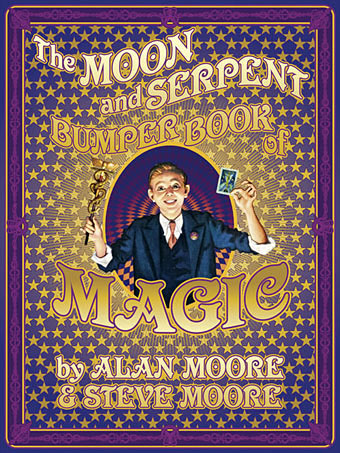
It’s lunar, it’s serpentine, it’s grandly thaumaturgical. Cover design by yours truly.

Via Top Shelf:

Splendid news for boys and girls, and guaranteed salvation for humanity! Messrs. Steve and Alan Moore, current proprietors of the celebrated Moon & Serpent Grand Egyptian Theatre of Marvels (sorcery by appointment since circa 150 AD) are presently engaged in producing a clear and practical grimoire of the occult sciences that offers endless necromantic fun for all the family. Exquisitely illuminated by a host of adepts including Kevin O’Neill, Melinda Gebbie, John Coulthart, José Villarrubia and other stellar talents (to be named shortly), this marvelous and unprecedented tome promises to provide all that the reader could conceivably need in order to commence a fulfilling new career as a diabolist.

Its contents include profusely illustrated instructional essays upon this ancient sect’s theories of magic, notably the key dissertation “Adventures in Thinking” which gives reliable advice as to how entry into the world of magic may be readily achieved. Further to this, a number of “Rainy Day” activity pages present lively and entertaining things-to-do once the magical state has been attained, including such popular pastimes as divination, etheric travel and the conjuring of a colourful multitude of sprits, deities, dead people and infernal entities from the pit, all of whom are sure to become your new best friends.

Also contained within this extravagant compendium of thaumaturgic lore is a history of magic from the last ice-age to the present day, told in a series of easy-to-absorb pictorial biographies of fifty great enchanters and complemented by a variety of picture stories depicting events ranging from the Paleolithic origins of art, magic, language and consciousness to the rib-tickling comedy exploits of Moon & Serpent founder Alexander the False Prophet (“He’s fun, he’s fake, he’s got a talking snake!”).

In addition to these manifold delights, the adventurous reader will also discover a series of helpful travel guides to mind-wrenching alien dimensions that are within comfortable walking distance, as well as profiles of the many quaint local inhabitants that one might bump into at these exotic resorts. A full range of entertainments will be provided, encompassing such diverse novelties and pursuits as a lavishly decorated decadent pulp tale of occult adventure recounted in the serial form, a full set of this sinister and deathless cult’s never-before-seen Tarot cards, a fold-out Kabalistic board game in which the first player to achieve enlightenment wins providing he or she doesn’t make a big deal about it, and even a pop-up Theatre of Marvels that serves as both a Renaissance memory theatre and a handy portable shrine for today’s multi-tasking magician on the move.

Completing this almost unimaginable treasure-trove are a matching pair of lengthy theses revealing the ultimate meaning of both the Moon and the Serpent in a manner that makes transparent the much obscured secret of magic, happiness, sex, creativity and the known Universe, while at the same time explaining why these lunar and ophidian symbols feature so prominently in the order’s peculiar name. (Manufacturer’s disclaimer: this edition does not, however, reveal why the titular cabal of magicians consider themselves to be either grand or Egyptian. Let the buyer beware.)

A colossal and audacious publishing triumph of three hundred and twenty pages, beautifully produced in the finest tradition of educational literature for young people, The Moon and Serpent Bumper Book of Magic will transform your lives, your reality, and any spare lead that you happen to have laying around into the purest and most radiant gold.

A 320-Page Super-Deluxe Hardcover, co-written by Alan Moore and Steve Moore, and illustrated by various luminaries from the comic book field.

Cover design by John Coulthart.

A 2009 RELEASE!
ISBN 978-1-60309-001-8

The art of Cameron, 1922–1995

cameron_work01.jpg

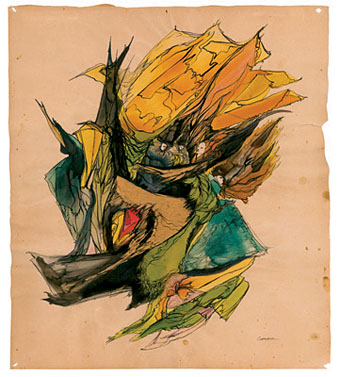
Fairy Queen (1962), ink and dyes on parchment.

A rare exhibition of work by occult artist Cameron, aka Marjorie Cameron Parsons Kimmel, can be seen at the Nicole Klagsbrun Gallery in New York.

Nicole Klagsbrun Gallery is pleased to present an exhibition of work by Cameron (1922–1995), curated by Michael Duncan, George Herms, and Nicole Klagsbrun. The exhibition runs from January 12 until February 10, 2007. An opening reception will be held on Friday, January 12, from 6–8 pm.

This survey is the first solo gallery exhibition of artist, performer, poet, and occult practitioner, Cameron (Marjorie Cameron Parsons Kimmel). A maverick follower of the esoteric mysticism of Aleister Crowley and his philosophical group, the OTO (Ordo Templi Orientis), Cameron was also an accomplished painter and draftsman and mentor to younger artists and poets such as Wallace Berman, George Herms, and David Meltzer. While enlisted in the Navy, she was assigned the tasks of drawing maps and working in a photographic unit, which led to attendance at art classes after being discharged. In Los Angeles, she became the wife and spiritual avatar of scientist and mystical thinker Jack Parsons (1914–1952), one of the founders of the Jet Propulsion Laboratory and an influential leader of the OTO.

marjorie_cameron.jpg

The mundane Cameron during the Second World War.

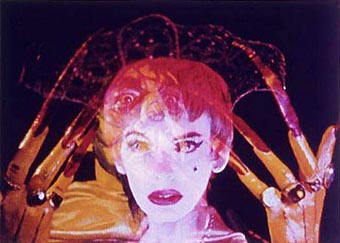
In the early 1950s, Cameron met the fellow LA artist and jazz enthusiast Wallace Berman who was fascinated by her artwork, poetry, and mystical aura. In 1955 Berman used his photograph of Cameron as the cover of his literary and artistic journal Semina and included in the issue a drawing she had made the previous year. The drawing became renowned when the police cited it as ?lewd? and shut down Berman’s 1957 exhibition at Ferus Gallery. After this experience, Cameron, like Berman, refused to show her art in commercial galleries. She remained, however, a crucial figure in the Berman circle. Cameron’s romantic aesthetic and commanding persona prompted filmmaker Curtis Harrington to commemorate her output as a visual artist in The Wormwood Star (1955), a lyrical short film recording the art and atmosphere of her candlelit studio. Filmmaker Kenneth Anger cast her in a leading role opposite Anäis Nin in his film Inauguration of the Pleasure Dome (1954).

cameron.jpg

The occult Cameron, manifesting as the Scarlet Women for Kenneth Anger.

Despite the grim fatality of much of her writings, Cameron?s artworks portray a fanciful, even wistful lyricism. In the early 1960s she corresponded with Joseph Campbell, citing her interest in his book The Hero with a Thousand Faces, as well as in the fiction of Hermann Hesse and Isak Dinesen. Consumed by myth and the idea of protean growth, Cameron depicted the process of metamorphosis and transformation in hundreds of line drawings where ominous figures and landscapes emerge from uniformly striated, passionately articulated ink marks. Other gouache drawings and paintings depict mythic figures of her own creation engaged in ritualistic, symbolic acts.

For now, her work is barely visible on the web but there’s another small gallery of her pictures here. And just to show how MySpace is seemingly intent on resurrecting everyone who ever lived, Marjorie Cameron, Babalon 156 is in your extended network.

Nicole Klagsbrun Gallery
526 West 26th St, no. 213,
New York.

Via Jay.

Previously on { feuilleton }
Kenneth Anger on DVD…finally
Austin Osman Spare

Robert Anton Wilson, 1932–2007

raw.jpg

There are few people who really change your life but Robert Anton Wilson—who died earlier today—certainly changed mine. Wilson’s Illuminatus! trilogy (written with Robert Shea) was my cult book when I was at school in the 1970s, a rambling, science fiction-inflected conspiracy thriller that opened the doors in my teenaged brain to (among other things) psychedelic drugs, HP Lovecraft, James Joyce, William Burroughs and Aleister Crowley as well as being a crash-course in enlightened anarchism. I’ve had people criticise the books to me since for their ransacking of popular culture but this was partly the point, they were collage works, and they worked as a perfect introduction for a young audience to worlds outside the usual circumscribed genres.

The philosophical side of Wilson’s work was probably the most important at the time (and remains so now), his “transcendental agnosticism” made me start to question the adults around me who were trying to force my life to go in a direction I wasn’t interested in at all. I’m sure I would have resisted that kind of pressure anyway but the value of RAW’s writings in Illuminatus! and the later Cosmic Trigger came with being given an intelligent rationale for those decisions; I couldn’t necessarily articulate why I was “throwing my life away” by wanting to drop out of the whole education system but Wilson’s work had convinced me it was the right thing to do. I still mark the true beginning of my life as May 1979, the month I left school for good.

He wouldn’t want us to be maudlin, I’m sure. It’s typical for a writer who spent so much of his life writing about drugs and coincidences that he managed to die on Albert Hofmann’s birthday. So I’ll just say thank you Robert, for changing my life. And Hail Eris!

Previously on { feuilleton }
The Absolute Elsewhere