Der Eigene: Kultur und Homosexualität

eigene1.jpg

Der Eigene, collected edition, 1906. Design credited to Adolf Brand.

The subtitle is from an article (see below); Der Eigene, the world’s first homosexual periodical was devoted to an ideal of “masculine culture” which looked to Ancient Greece for a model of same-sex relationships. Adolf Brand (“Editor, photographer, poet, polemicist, activist, anarchist, enfant terrible“) founded Der Eigene in Berlin 1896, and to give some idea of how advanced the Germans were in these matters, consider that not only was this a year after Oscar Wilde had been imprisoned in Britain but that Brand’s publication was only the first of several journals advocating gay rights at a time when homosexual acts were still illegal in Germany. The radicalism fell short of including women, unfortunately; like many Grecophile pioneers of the time, Brand’s world had no place for females. All this activity was part of a peculiar ferment in Germany around 1900 which saw the rise of many small groups devoted to naturism, Theosophy, occultism in general, and various pagan revivals. There were also plenty of fiercely nationalist factions, of course, and these took a dim view of Brand’s outspoken homo-anarchism. When the nationalists later turned into the Nazis they destroyed Germany’s nascent gay culture.

eigene3.jpg

Morgendämmerung (Dawn) by Sascha Schneider, 1897. This drawing also appeared in Jugend magazine the same year.

The pictures here are from sets at Wikimedia Commons where the section devoted to the magazine has finally been amended with some higher-resolution copies. It’s a shame there isn’t more to see given that Der Eigene ran until 1932. I’ll be hoping for further works to come to light as the digitisation of rare publications gathers pace.

eigene2.jpg

Der Eigene, November, 1920.

Elsewhere on { feuilleton }
• The gay artists archive

Previously on { feuilleton }
• Sanctuarium Artis Elisarion
• Jugend Magazine revisited
• The art of Sascha Schneider, 1870–1927
• Hadrian and Greek love
Combinaisons Ornementales

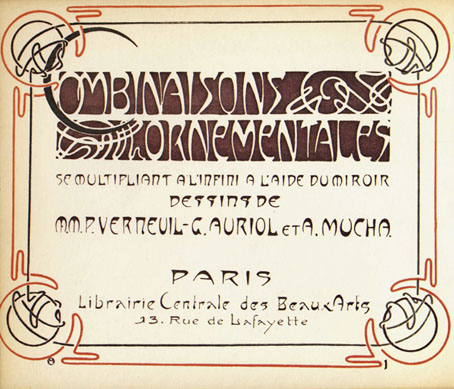
combinaisons1.jpg

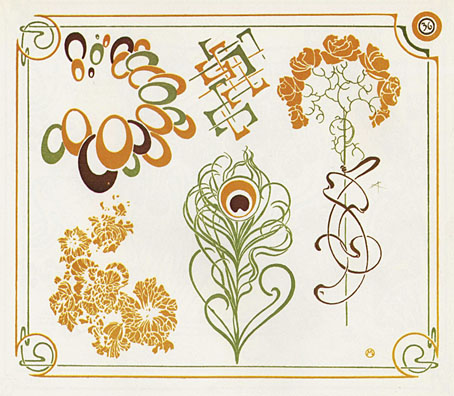
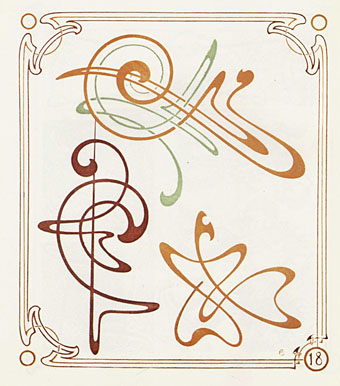
After writing about Charles J Strong’s Book of Designs a couple of days ago, it seems pertinent to point the way to a far more essential Art Nouveau design book which can also be found at the Internet Archive. Combinaisons Ornementales was a collaboration between Maurice Verneuil, George Auriol and Alphonse Mucha published in 1901, and comprises 60 plates of beautifully elegant designs (“multipliable to infinity with the aid of a mirror”) which range from Mucha’s abstractions to Verneuil’s flower motifs. The examples shown here are all by Mucha; I borrowed one of the flourishes and the peacock feather for the Dodgem Logic cover design earlier this year.

combinaisons2.jpg

For a quick look at all the plates, the NYPL Digital Gallery has scans. Mucha produced another design book the following year, Documents Decoratifs, although I’ve yet to see an edition of that online.

combinaisons3.jpg

Previously on { feuilleton }
• Charles J Strong’s Book of Designs
• Mucha’s Zodiac
• Dodgem Logic #4
• Peacocks

Salon Futura #1

salon-futura.jpg

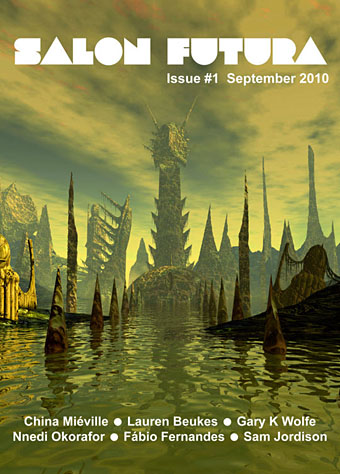
It’s been a pleasure this week seeing my 1999 portrait of Cthulhu’s rotting domicile, R’lyeh, used as the cover image for Salon Futura, a new online magazine edited by Cheryl Morgan. Cheryl describes SF as “a new and hopefully somewhat different magazine devoted to the discussion of science fiction, fantasy and other forms of speculative literature.” Among the contents there’s a podcast interview with Gary K Wolfe, Nnedi Okorafor and Fábio Fernandes (the latter is a contributor to the steampunk book I’m currently designing for Tachyon); there are video interviews with writers Lauren Beukes and China Miéville, and the Guardian‘s Sam Jordison writes an appraisal of EL Doctorow’s 1994 novel The Waterworks (about New York City’s minatory Croton Reservoir) which stimulated my interest enough to make me want to search out the book. And speaking of minatory architecture, {feuilleton} approves of the presence of Taschen’s fat volume of Piranesi works spied on China Miéville’s bookshelf. China always has interesting things to say; go and see for yourself.

Previously on { feuilleton }
• Le horreur cosmique

Owen Wood’s Zodiac

wood-zodiac.jpg

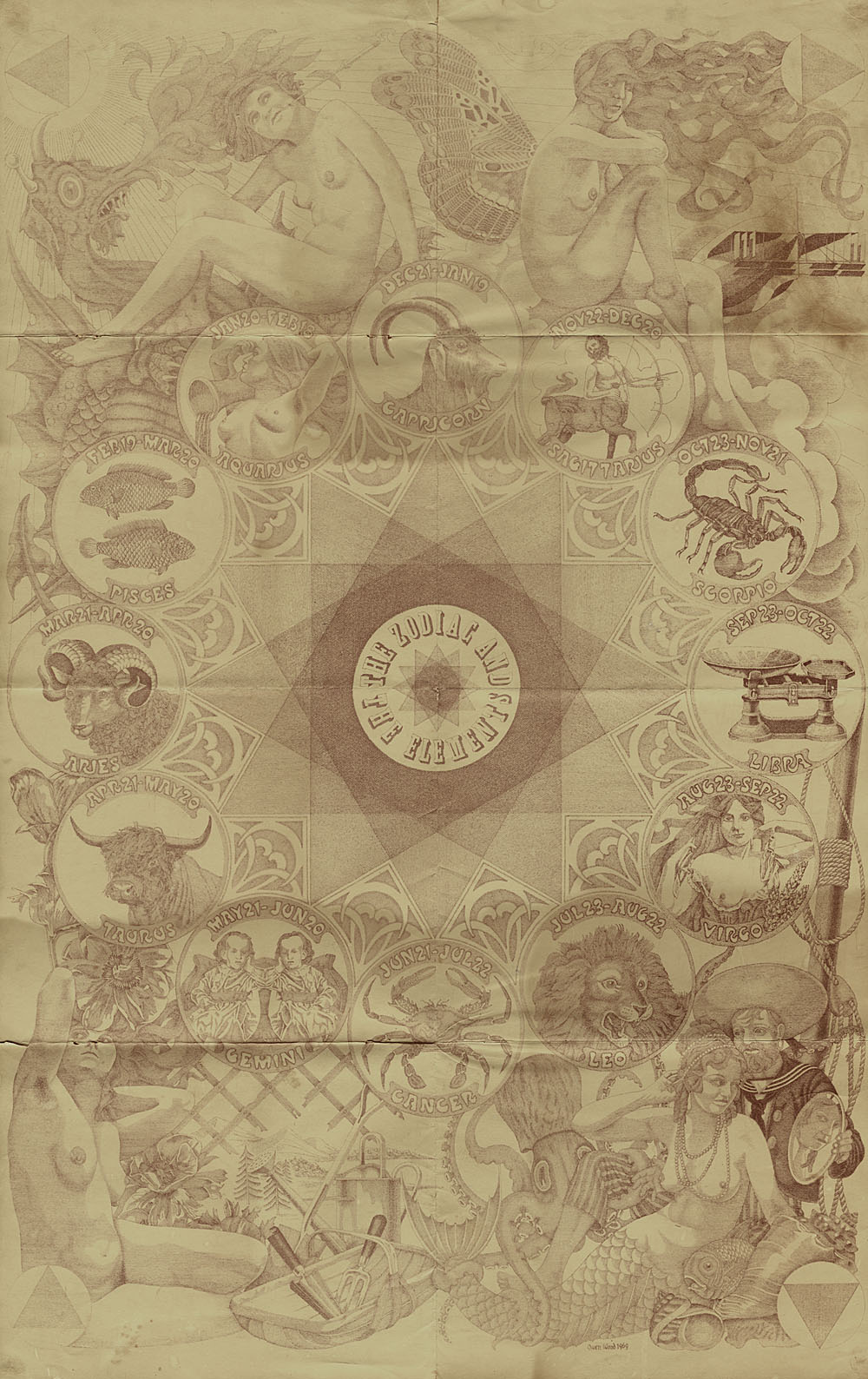
Yesterday’s zodiacal illustrations reminded me of this grubby item (depicting the twelve houses of the zodiac and four elements) which I took the trouble to scan since there’s no other example of it on the web. (Click for a larger version.) The artist, Owen Wood, was a highly-regarded illustrator commissioned to produce a poster in 1969 for the landmark magazine Man, Myth & Magic which was serialised weekly in the UK the following year. MMM had a few other giveaways in their early issues but Wood’s poster was by far the best piece. I thought I might have another copy somewhere but it didn’t turn up in a cursory search; if I find it I’ll replace this one. Wood’s very fine and intricate line-drawing deserves better appraisal than this dishevelled item which suffered from being pinned in too many smoke-filled rooms over the years. This obituary of the artist has details of his career.

wood-zodiac2.jpg

Fire (detail).

Elsewhere on { feuilleton }
• The illustrators archive

Previously on { feuilleton }
• Palladini’s Zodiac
• Austin Osman Spare

Gekko Hayashi: homoerotics and monsters

gekko1

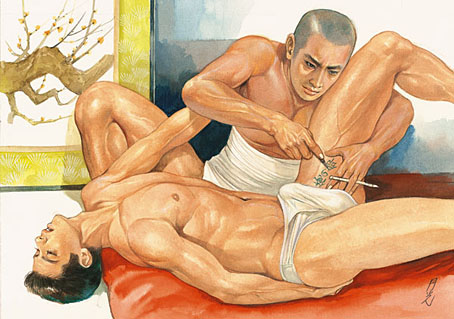
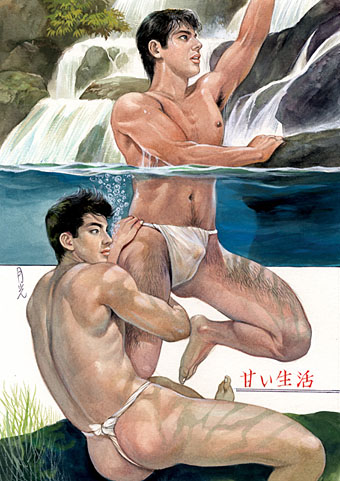
Needless to say, it’s primarily the homoerotics which concern us here. Gekko Hayashi is the name under which Japanese artist Goji Ishihara (1923–1997) produced his gay erotica, and these examples are among a small handful to be found on the web. Far more common is his Ishihara work which included some spectacular grotesqueries for the Illustrated Book of Japanese Monsters (1972) and the Illustrated Book of Hell (1975). Sate your appetite for the monstrous at Pink Tentacle.

gekko2

Hayashi/Ishihara’s work may be scarce but you can read about both his personas thanks to ComiPress, who posted an overview of the artist’s career, and Comics212, who examined the gay side of his output. There is a book collection of Hayashi’s gay art but that appears to be out-of-print. This Japanese page has many samples from the Ishihara work.

The dual career of Hayashi/Ishihara brings to mind another artist equally adept at commercial illustration and gay art, Oliver Frey. As “Zack”, Frey gained an enthusiastic audience in UK gay mags while he was also popular with quite a different audience for his illustrations in computer game magazines throughout the 1980s. He was also no slouch at painting monsters as I recall. A collection of Zack comic strips, Bike Boy, is published this month by Bruno Gmünder.

Continue reading “Gekko Hayashi: homoerotics and monsters”