A Trip to Mars

mars3.jpg

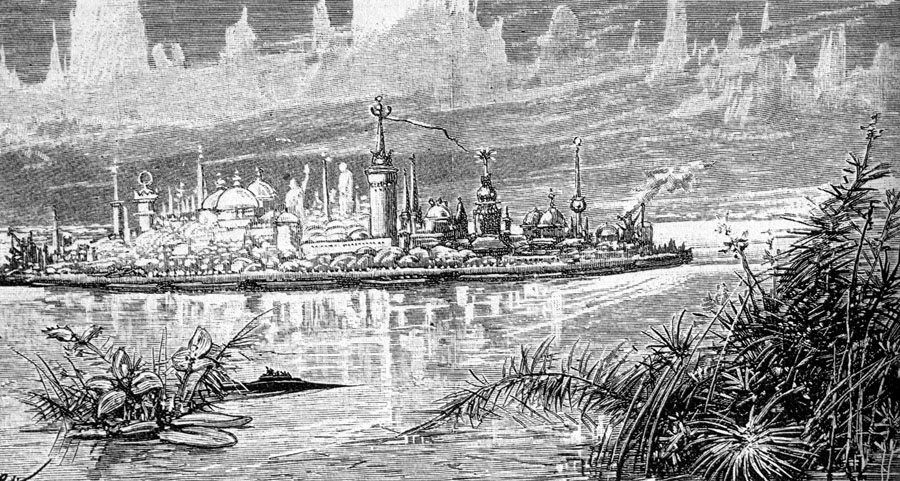
A floating Martian city from Letters from the Planets (1890) by WS Lach-Szyrma. Illustration by Paul Handy.

In honour of the remarkable landing on Mars of the Curiosity Rover, a handful of random illustrations from the vast stock of imagery generated by the Red Planet over the past century-and-a-half. When it comes to Mars I’m afraid you can keep your terraforming and geodesic domes, I prefer the more fanciful scenarios involving air-boats, cloaks and actual canals. Paul Handy’s illustration above shows what I believe is a Venusian vehicle sailing past a Martian city, Lach-Szyrma’s book concerning a journey through the solar system. I only have small copies of these pictures in a book, so far they don’t seem to have turned up online.

mars2.jpg

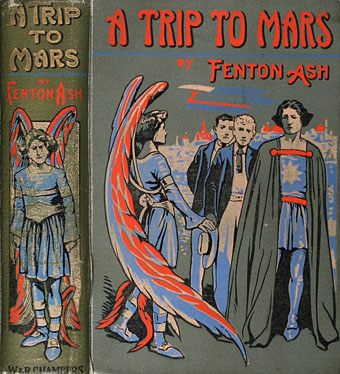
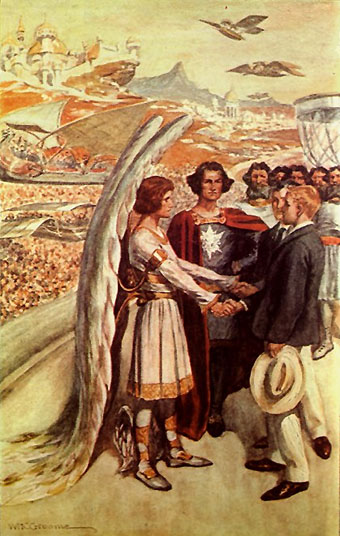
A Trip to Mars (1909) by Fenton Ash. Illustrations by WHC Groome.

Fenton Ash was the nom de plume of British author Francis Henry Atkins. A Trip to Mars concerns another exploratory journey taken this time by a pair of Edwardian schoolboys.

mars1.jpg

Continue reading “A Trip to Mars”

Muto Manifesto, volume 7

muto7-1.jpg

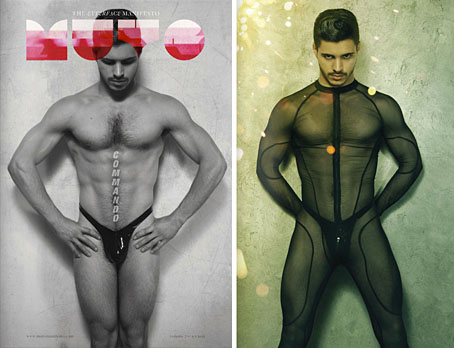
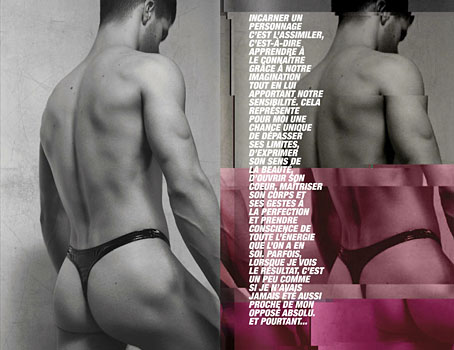
In which Muto Manifesto, the photo-magazine created by ace French photographers Exterface, celebrates a year of publication with a new edition that’s available in two print editions (one of which is already sold out). The model is the splendid Matthieu Charneau who featured in the first issue. See page samples here and in the online version at Issuu. Via Homotography.

muto7-2.jpg

Elsewhere on { feuilleton }
The gay artists archive

Previously on { feuilleton }
Muto: The Exterface Manifesto
Exterface

The End of Books, 1894

robidabooks01.jpg

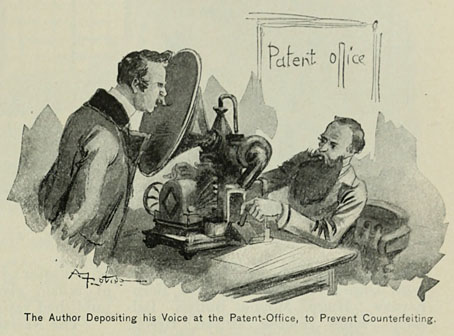
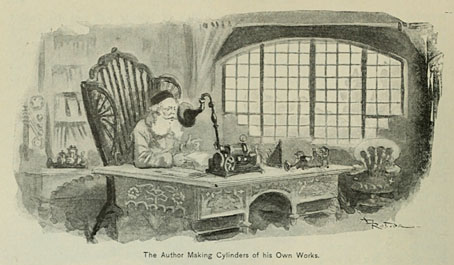
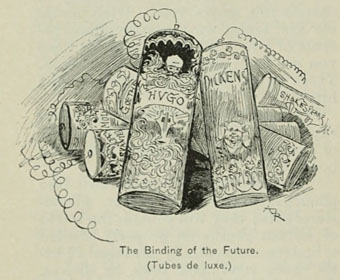
More illustrations from Albert Robida, and a riposte to anyone thinking that the idea of the end of books is a recent thing. This article by bibliophile Octave Uzanne appeared in Volume 16 of Scribner’s Magazine (July–December 1894). The piece opens with a description of various scientists and artists at a Royal Society evening making predictions about life in the future. Among other proposals there’s that old saw of science fiction, the meal of condensed nutrients which would supposedly put an end to world hunger. Uzanne’s account of the future of the book involves authors speaking their works into recording devices. Despite Robida’s somewhat comic extrapolations Uzanne seemed to have been semi-serious; even if he wasn’t he made a good job of predicting audio books, and (after a fashion) television: those wanting illustrations would have images projected by one of Edison’s Kinetoscopes.

There will be registering cylinders as light as celluloid penholders, capable of containing five or six hundred words and working up on very tenuous axles, and occupying not more than five square inches; all the vibrations of the voice will be reproduced in them; we shall attain to perfection in this apparatus as surely as we have obtained precision in the smallest and most ornamental watches.

As to the electricity, that will often be found in the individual himself. Each will work his pocket apparatus by a fluent current ingeniously set in action; the whole system may be kept in a simple opera-glass case, and suspended by a strap from the shoulder.

As for the book, or let us rather say, for by that time books “will have lived,” as for the novel, or the storyograph, the author will become his own publisher. To avoid imitations and counterfeits he will be obliged, first of all, to go to the Patent-Office, there to deposit his voice, and register its lowest and highest notes, giving all the counter-hearings necessary for the recognition of any imitation of his deposit. The Government will realize great profits by these patents.

The full article may be read here.

robidabooks02.jpg

robidabooks03.jpg

Continue reading “The End of Books, 1894”

Weekend links 118

owczarek.jpg

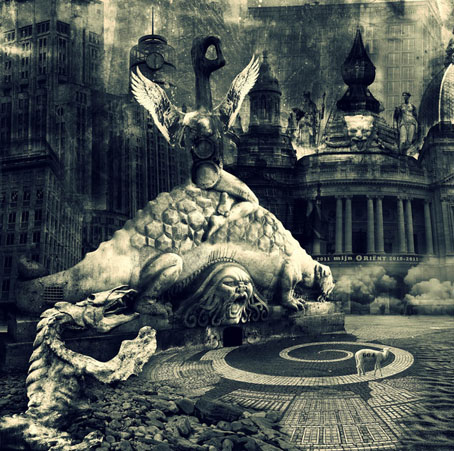
The Garden of Urban Delights (2010) by Marcin Owczarek.

His protagonists are misfits: alienated, implicitly gay, longing for love, frequently hard to be around, always fixated on small pleasures that compensate for an essential feeling of not belonging. […] His patroness Edith Sitwell termed him “that rare being, a born writer.” William Burroughs dedicated The Place of Dead Roads to him, declaring Welch “certainly the writer who most directly influenced my work.” John Waters has called In Youth is Pleasure “so precious, so beyond gay, so deliciously subversive, [it] is enough to make illiteracy a worse social crime than hunger.”

Sadie Stein on Denton Welch, a writer I’m embarrassed about still not having read. Edith Sitwell and William Burroughs had a famously disputatious correspondence in the pages of the TLS over The Naked Lunch. An appreciation of Welch’s work was one of the few things they had in common.

• Don’t mention guitars: Robert Hampson on acousmatic music, the curse of Loop and the rebirth of Main.

• No Straight Lines: A Collection Of Queer Comics part one, part two, part three. A history by Justin Hall.

Pieces Of Gold by The Aikiu: shots from gay porn videos repurposed via some smart editing.

• RIP İlhan Mimaroğlu, electroacoustic composer. Ubuweb has a selection of his recordings.

“A good ground rule for writing in any genre is: start with a form, then undermine its confidence in itself,” he says. “Ask what it’s afraid of, what it’s trying to hide – then write that.” For Harrison, the most satisfying writers are “at odds with their cultural context. They’re trying to fit in and failing, or they’re trying to remove themselves and failing. The attempt to resolve the conflict is an angle – a frame or a context – in itself.”

The Guardian’s A Life in Writing profiles M. John Harrison. His new novel, Empty Space, was published on Thursday. There’s also this recent video interview with Arc magazine.

• Stephen Usery interviews editor Russ Kick about The Graphic Canon: Volume One.

At home with Prince Zaleski, the “most decadent and imperial detective in fiction”.

• A Visit with Magritte: photographs by Duane Michals.

Loitering airships could dispense drones on demand.

• Creating a Forever Object: Ian Schon’s Pen Project.

• A Tumblr for the late, lamented Arthur Magazine.

• “Few cities can boast a railway line for the dead.”

The Lost Tapes by Can: An Oral History.

Space Reflex (1963) by Dick Hyman & Mary Mayo | Space Is Deep (1972) by Hawkwind | Space Is The Place (1973) by Sun Ra | Space Moment (1995) by Stereolab | Space Pong (2006) by T++

Weekend links 108

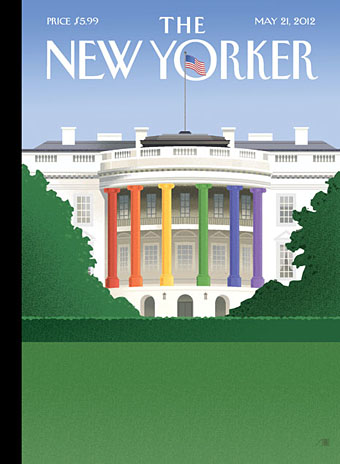
newyorker.jpg

Bob Staake’s cover illustration acknowledges President Obama’s statement last week in favour of gay marriages.

• Related to the above: Gay rights in the US, state by state, an infographic and a useful riposte to people like Orson Scott Card (yes, him again) who claim that gay Americans are equal in everything but the right to marry. On the same theme, “Now Obama’s come out on same-sex marriage, maybe so will I,” says Edmund White (yes, him again), and Eric Berkowitz, author of Sex & Punishment: 4,000 Years of Judging Desire, who writes that “In the period up to roughly the thirteenth century, male bonding ceremonies were performed in churches all over the Mediterranean.”

• The fifth edition of A Humument by Tom Phillips will be published soon by Thames & Hudson. The Tom Phillips website has just been relaunched in a form which now incorporates the notes I made in December about Phillips’ album cover designs.

• The Greenfriars are encouraging people to follow their example and get involved with their local communities (the habits are optional). Kudos for the choice of a Dürer knot.

The action centres on the arrival of a man who may or may not be a prophet, or the devil, or just a violent con-man, in a rotting, rain-drenched Hungarian hamlet. This is the “estate”, apparently some sort of failed collective, where all hope has been lost and all the buildings are falling down. It is inhabited by a cast of semi-crazed inadequates: desperate peasants cack-handedly trying to rip each other off while ogling each other’s wives; a “perpetually drunk” doctor obsessively watching his neighbours; young women trying to sell themselves in a ruined mill; a disabled girl ineptly attempting to kill her cat.

Sátántango by László Krasznahorkai is published in a new translation by George Szirtes

• The Quietus interviewed Kevin Shields following the long-awaited reissue of the My Bloody Valentine catalogue.

• The first volume of Russ Kick’s Graphic Canon (to which I’m a contributor) has been sighted in the wild.

Rise of the Living Type: Stylised 17th century floriated letterforms & grotesque mask sprinkles.

Ed Jansen’s Camera Obscura III, a tour of museums, galleries and venues, 2009–2011.

• io9 reports on the new translation of Roadside Picnic by Arkady & Boris Strugatsky.

Shanghai Expression: Graphic Design in China in the 1920s and 30s.

Liberty Realm, a monograph of drawings by Catharyne Ward.

• 100 mins of Adrian Sherwood‘s best dub productions.

Strange Flowers checked into the Chelsea Hotel.

Chelsea Girls (1967) by Nico | Chelsea Morning (1968) by Fairport Convention | Chelsea Hotel #2, Rufus Wainwright sings Leonard Cohen.