Welles at 100

welles.jpg

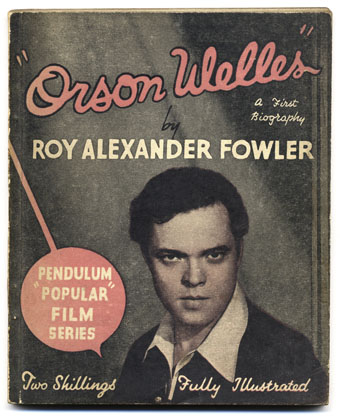
Orson Welles: A First Biography (1946) by Roy Alexander Fowler.

Happy birthday, Orson. The premature celebrity biography is nothing new, as this small volume from the Coulthart library demonstrates. Welles was only 31 in 1946 but was already the director of three feature films. If I’m less of a Welles obsessive today it’s because many of the films and radio plays that were once inaccessible can now be easily seen and heard, although a handful of unfinished projects still wait in the wings. The following is a selection of some favourite Wellesiana, old and new.

• The Mercury Theatre On The Air: Recordings of Welles’ theatre troupe at the Internet Archive and at the dedicated website. The Mercury production of The War of the Worlds is the essential one, of course, but I’m also partial to their production of Dracula which featured Agnes Moorehead playing Mina Harker, Welles as the Count, and a suitably spooky score by Bernard Herrmann. The production of Around the World in 80 Days was later expanded by Welles into an ambitious (and expensive) stage musical in collaboration with Cole Porter.

The Night America Trembled (1957) is a TV dramatisation of the alarmed reaction of some Americans to the War of the Worlds broadcast. Presented live by Ed Murrow, the drama features Warren Beatty, James Coburn, Warren Oates, and Ed Asner (who later presented the BBC’s RKO Story). Closer to Welles is The Night That Panicked America (1975) a TV movie recreation of the original broadcast with Paul Shenar as the director.

Newsreel footage of the final scenes of the so-called Voodoo Macbeth from 1936. As part of the WPA program to return Americans to work, Welles directed an all-black cast with the action of the play moved to Haiti. As usual, Welles wasn’t afraid of rearranging the Bard’s words, and this staging ends with the same lines as his 1948 film version: “Peace! The charm’s wound up.”

• My favourite Welles book is still This is Orson Welles (1992), a collection of Peter Bogdanovich’s interviews edited by Jonathan Rosenbaum. Bogdanovich’s interview tapes can be heard at the Internet Archive.

Orson Welles’ Horrorshow: Colin Fleming on Welles’ Macbeth, “the horror film no one likes to call a horror film”.

Peter Bradshaw on Citizen Kane and the meaning of “Rosebud”.

Six actors who have played Orson Welles onscreen

Previously on { feuilleton }
The Fountain of Youth
The Complete Citizen Kane
Return to Glennascaul, a film by Hilton Edwards
Screening Kafka
The Panic Broadcast

Aubrey Beardsley’s Keynotes

keynotes1.jpg

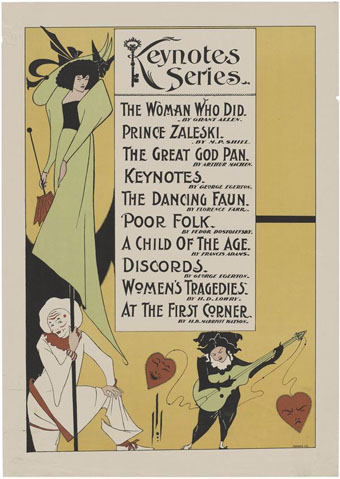
Promotional poster.

Keynotes was a series of 34 novels and short story collections published by John Lane from 1893. Aubrey Beardsley produced cover designs and embellishments for 22 of the titles in 1895 while he was working on The Yellow Book which John Lane was also publishing. Beardsley’s designs comprised a title frame with illustration or decoration which was blocked in gold on the cover and also used as a title page. For 15 of the titles he also created a series of key-shaped monograms for the authors, designs which were used on the spines and the backs of the books. Collections of Beardsley’s art often show one or two of these pieces but you seldom see them all, and even when the title frames are reproduced the type is often omitted.

keynotes4.jpg

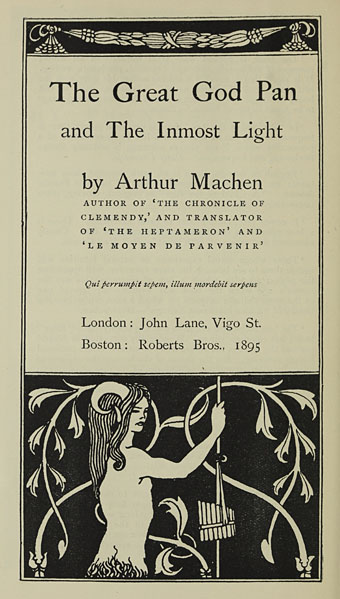
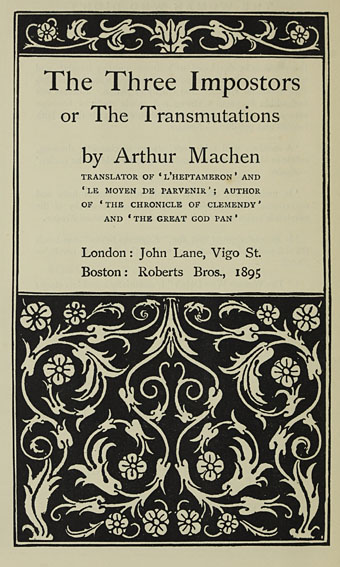
Keynotes Series of Novels and Short Stories was a small book published in 1896 intended to gather all the Beardsley designs in one place and also promote the series in general. Two of the most celebrated works to receive the Beardsley treatment are those by Arthur Machen: The Great God Pan and The Inmost Light, and The Three Imposters. The decoration for the latter gives no indication of the horrors lurking inside that volume, while the faun on The Great God Pan is a world away from the amorphous nightmare in a story that caused considerable outrage at the time. According to Stanley Weintraub’s biography, the Keynotes series was very popular despite (or because of) the stir it caused, and helped keep Beardsley’s work visible when many of his other illustrations were out of circulation.

keynotes5.jpg

Continue reading “Aubrey Beardsley’s Keynotes”

Weekend links 254

scdc.jpg

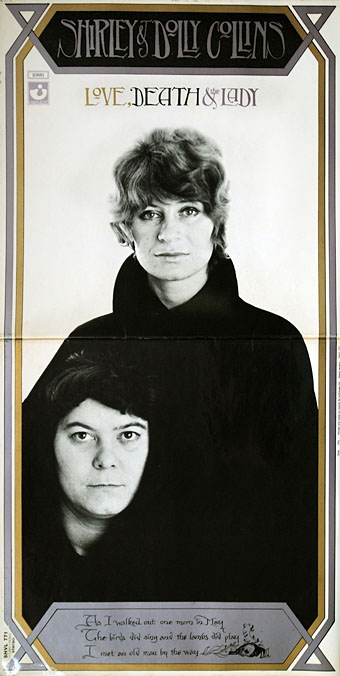
Gatefold sleeve for Love, Death and the Lady (1970) by Shirley & Dolly Collins. Photo by Allan Willmoth. No designer credited.

• “When you look at a lot of modern album covers, the art school obsession with the Helvetica kind of undermines it. So instead of looking at an artefact that comes from another place entirely, you are looking at an artefact that has been caught and tamed and made corporate.” Roger Dean talking to Liv Siddall about cover design in the 1970s.

• Erik Davis talks to Stephen Finley, author of Esotericism in African American Religious Experience, about hoodoo and metaphysical blackness. Related: Sun Ra’s Afrofuturist masterwork, Space Is The Place, has been reissued by Harte Recordings as a limited DVD, CD and hardcover book.

• “…she has managed to unearth a coal-seam of neglected songs and stories, incantations of the working people from across the English-speaking planet with their edge of discord left intact, the harmonies frayed by hard-won experience.” Alan Moore on the great Shirley Collins.

[MR] James’s influence, or his example, has rarely been more strongly with us than now. For there is presently apparent, across what might broadly be called landscape culture, a fascination with these Jamesian ideas of unsettlement and displacement. In music, literature, art, film and photography, as well as in new and hybrid forms and media, the English eerie is on the rise. A loose but substantial body of work is emerging that explores the English landscape in terms of its anomalies rather than its continuities, that is sceptical of comfortable notions of “dwelling” and “belonging”, and of the packagings of the past as “heritage”, and that locates itself within a spectred rather than a sceptred isle.

Such concerns are not new, but there is a distinctive intensity and variety to their contemporary address. This eerie counter-culture—this occulture—is drawing in experimental film-makers, folk singers, folklorists, academics, avant-garde antiquaries, landscape historians, utopians, collectives, mainstreamers and Arch-Droods alike, in a magnificent mash-up of hauntology, geological sentience and political activism. The hedgerows, fields, ruins, hills and saltings of England have been set seething.

Robert Macfarlane on the eerieness of the English countryside

• Lots of mixes to choose from this week: Songs from a Railway Station at Dusk by Abigail Ward; mix series The Ivy-Strangled Path by David Colohan is now up to Volume IV; a trove of occult psychedelia from The Ghost of the Weed Garden.

• “Blood Meridian was released on April 28, 1985 to little initial acclaim, but would later gain recognition as one of the most significant novels of the late 20th century.” Ted Gioia on the rise and fall of the Western.

• From the past week’s zones of research: the Gregory Pendennis Library Of Black Sorcery, and Vault Of Evil: Brit Horror Pulp Plus!

• At Dangerous Minds: Zappa meets claymation in the wonderful VHS rarity The Amazing Mr. Bickford.

Synthesizer manuals at the Internet Archive.

• Pages from The Graphic Canon at Pinterest.

Sabbath, a new song by Jenny Hval

French book covers

The Cruel Mother (1967) by Shirley Collins | The Unquiet Grave (1968) by Shirley Collins | Go From My Window (1970) by Shirley & Dolly Collins

More Esteban Maroto

maroto05.jpg

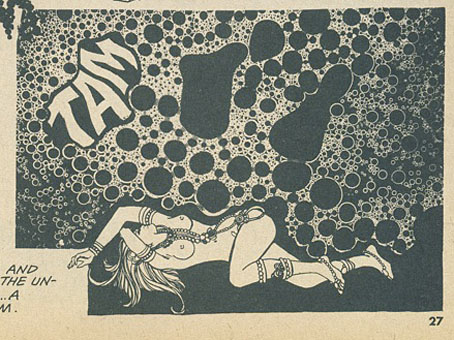
Psychedelic Kali from Vampirella 18.

Copies of the Dracula comics may be scarce these days but two of the artists who appeared in the title—Esteban Maroto and José Beá—were also appearing regularly in Vampirella around the same time. The Internet Archive has a large collection of Warren titles including an almost complete run of Vampirella. Esteban Maroto’s work stands out for me for his draughtsmanship, his page layouts, the atmosphere of heady eroticism, and the frequent touches of psychedelia of which the panel above is one of the more striking examples. The best strips are the ones he wrote himself; when he works with American writers the results tend to be more restrained. It’s a shame Vampirella was mostly a black-and-white title, so many of these pages would benefit from the same colour treatment as Wolff.

maroto01.jpg

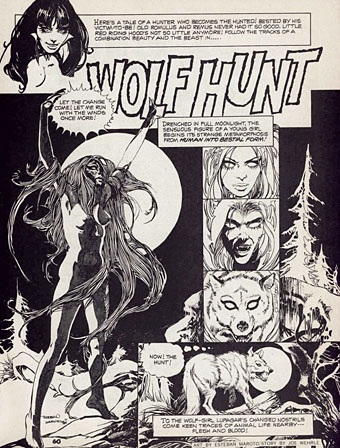
Wolf Hunt from Vampirella 14.

And speaking of wolves, there’s a similar collection of witches and lycanthropes in these stories.

maroto02.jpg

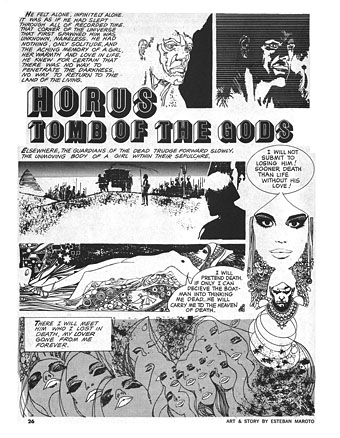
Tomb of the Gods: Horus from Vampirella 17.

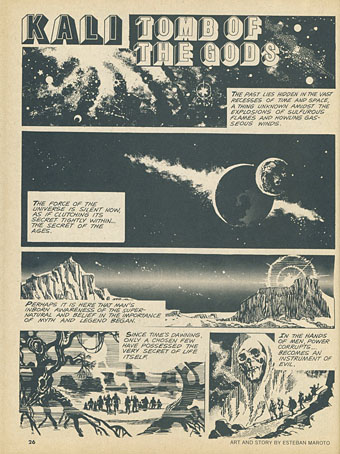
Tomb of the Gods is a short series in which mythological stories are explored Maroto-style. The exception is Gender Bender, a piece of science fiction with masculine and feminine psyches pitted against each other in a virtual arena. The story title is a surprise for anyone thinks that phrase originated in the 1980s.

maroto03.jpg

Tomb of the Gods: Kali from Vampirella 18.

Continue reading “More Esteban Maroto”

The Dracula Annual

wolff1.jpg

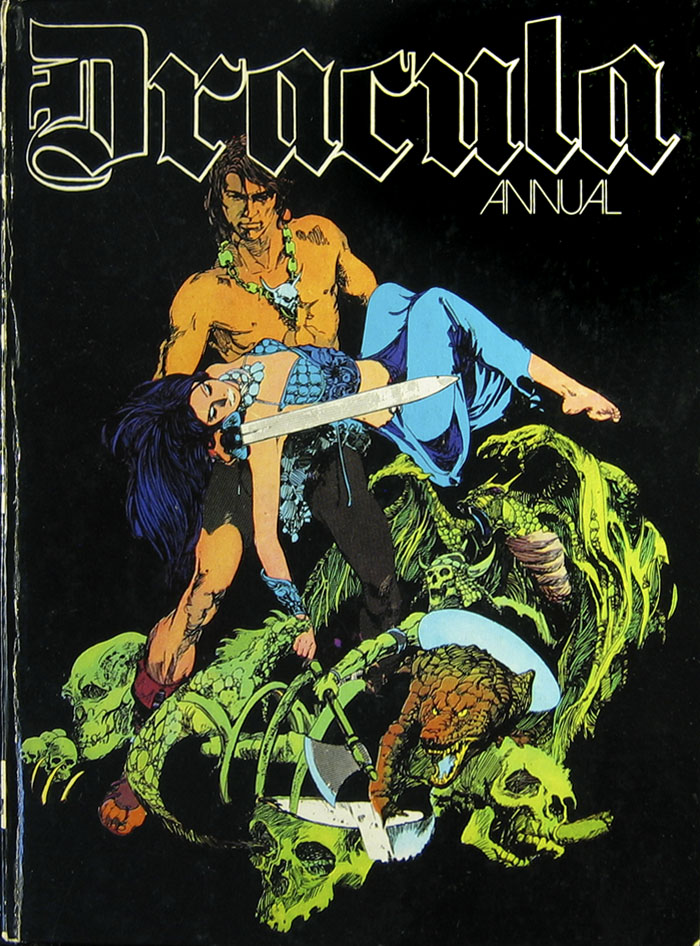
A comment by Modzilla in last month’s post about psychedelic comic book Saga de Xam is responsible for this recent book purchase. Dracula was a full-colour large-format comic book from notorious pulp imprint New English Library (later to be distributors for my colleagues at Savoy Books) that repackaged Spanish horror strips for a British audience. The comic ran for 12 issues in the early 1970s; the pages shown here are from the hardback annual that gathered all the issues into a single volume. I remember this being around in secondhand shops for years but I never paid it any attention at all so the artwork has been a revelation.

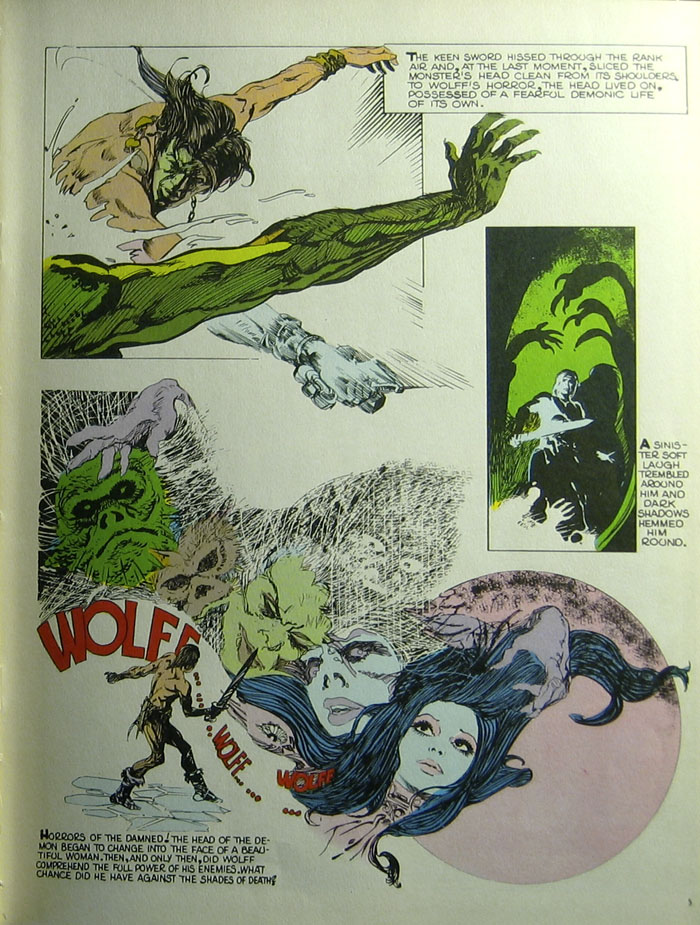
NEL’s Dracula isn’t much of a horror comic, despite its title; Dracula himself only appears in one story, and that’s a jokey throwaway piece. The two main episodic strips are Wolff, a Conan clone searching for his lost wife in a world ravaged by witches, werewolves and other supernatural threats; and Agar-Agar, a deliriously psychedelic picaresque concerning a hyper-sexual “sprite” (or a hippyish young woman with blue hair and magic powers) from the planet Xanadu. Everything in the book is redolent of the early 1970s when strains of psychedelia were still percolating through pop culture. Watered-down psychedelia used to bore me because I wanted the authentic stuff but forty years on this kind of work is much more attractive.

wolff2.jpg

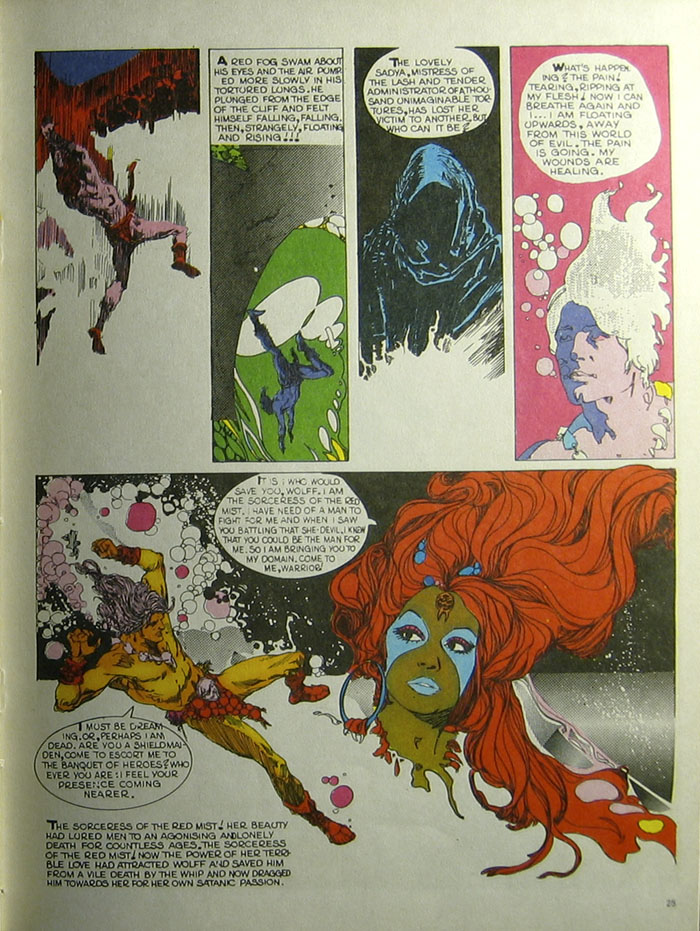
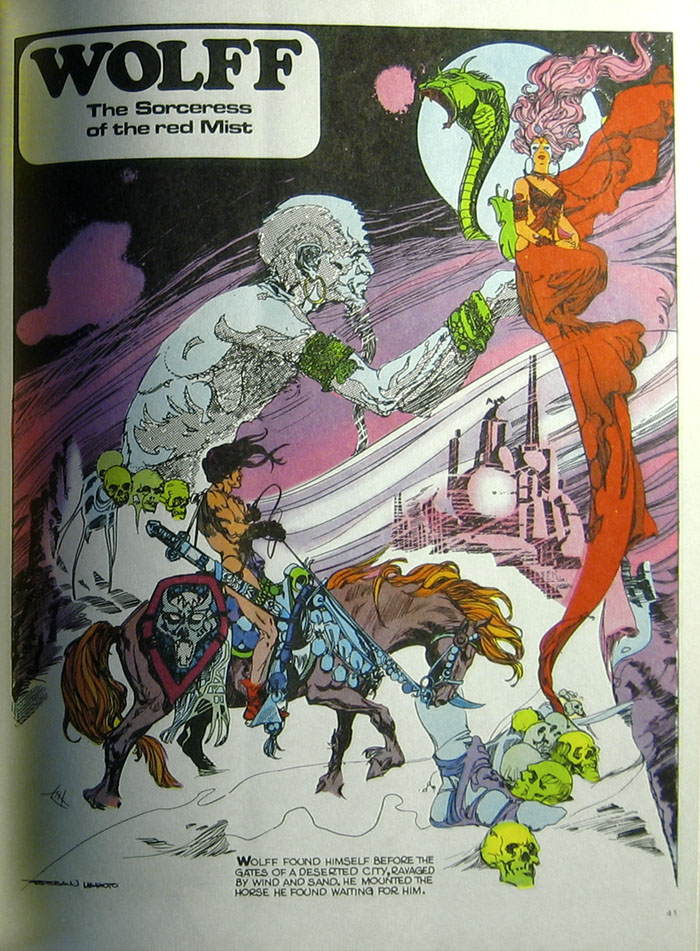
Wolff is the work of Esteban Maroto whose splash pages and inventive layouts give Barry Windsor-Smith’s Conan the Barbarian (which was running at this time) some serious competition. Wolff is very much in the Conan mould—he even shouts “Crom!” at crucial moments—a pawn of supernatural forces he often fails to comprehend. The artwork in Smith’s Conan was often praised for its details and decor but the Art Nouveau influence in Maroto’s work is much more overt. Maroto’s flame-haired witches are like Alphonse Mucha sirens—one panel even borrows from Mucha’s Salammbô—and he’s no slouch with the Frazetta-like demons either. The scripting is perfunctory but I don’t mind that when it turns up pages like these. There’s also a brief nod to Lovecraft when “R’Lyeh” is mentioned.

wolff3.jpg

wolff4.jpg

Continue reading “The Dracula Annual”