Weekend links 784

ford.jpg

An illustration by HB Ford for The Violet Fairy Book (1906), edited by Andrew Lang.

• New music: An Aesthetic – Experiments in Tape by Hawksmoor; Leylines (2025 remaster) by Aes Dana; A Fragile Geography (10th Anniversary Reissue) by Rafael Anton Irisarri.

• “Skoda Auto designers reimagine Ferat Vampire car from cult classic 1981 Czech horror film”.

• At Colossal: Chris Ware illustrates a postwoman’s day to celebrate 250 years of USPS.

Seen today, the failure of Sorcerer looks like a grim prophecy of where the film industry would be headed in the years to come. It signaled that the creative ambitions of the New Hollywood, and its indulgence of stubborn renegade auteurs, had been cast aside for a new and dispiriting blockbuster ethos. Decades later, that ethos is still with us: a Hollywood dominated by digitally smoothed, effects-encrusted moviemaking, where every backdrop looks fake (even the real ones) and action sequences carry no physical weight. It’s a wretched landscape, and Sorcerer positively towers over it. To watch the film now, from its electric opening moments through its gaspingly bleak denouement, is to encounter something more than just a magnificent ruin or an object of cultish reclamation: a thwarted masterwork that is thwarted no longer.

Justin Chang on the bleak magic of William Friedkin’s Sorcerer.

• At the BFI: The Red Shoes wallpaper by the film’s designer Hein Heckroth.

All This Violence by Caspar Brötzmann Massaker.

• RIP Lalo Schifrin and Rebekah del Rio.

• The Strange World of…Jon Spencer.

In Ultra-Violet (1983) by Cinema 90 | Violet Ray Gas (2009) by Violet | Violetta (2012) by Demdike Stare

The art of Justin Todd

todd15.jpg

I was pleased to find a copy of this book recently, a slim volume published in 1978 which isn’t especially rare but which usually sells for much more than the £2 I paid for it. Justin Todd is a British illustrator whose work was a familiar sight on book covers in the 1970s, especially when his commissions weren’t restricted to a single genre. Cover artists who work on fantasy novels are often asked to do horror covers (and vice versa), or edged towards science fiction when the material suits their style; Todd worked on fantasy, horror and the occasional SF title while also providing covers for mainstream novels, offbeat non-fiction, historical fiction and children’s stories. Fully-illustrated children’s books evidently became his main line of work in the 1980s—Alice’s Adventures in Wonderland, The Wind in the Willows, a collaboration with Angela Carter—which would have left him no time for cover commissions. I was amused to find him illustrating crank titles (previously) in the early 70s when he did the paperback cover for one of the great anti-crank books, John Sladek’s The New Apocrypha, a few years later.

todd06.jpg

The Centre of the Cyclone: An Autobiography of Inner Space (1972) by John C. Lilly.

Todd’s style is easy to recognise once you’ve seen a few examples: meticulous gouache renderings that tend to be slightly naive even when they’re depicting a wholly realistic story like Treasure Island. Gouache is a water-based paint that’s useful when you want a flat, even finish, but it doesn’t give you the depth of colour or contrast provided by oils or acrylics. Todd’s paintings embrace the limitations of the medium, with gradients and shadings that are so soft and diffused they might be taken at first for pencil drawings.

todd13.jpg

The Journey to the East (1972) by Herman Hesse.

The Magical Paintings of Justin Todd isn’t a comprehensive study of Todd’s illustration work, more a snapshot of a career in progress. In addition to 64 full-page reproductions there’s a two-page interview by editor and art director Mike Dempsey which provides valuable biographical details. I was pleased to find that many of the cover paintings were ones I hadn’t seen before, including a few Arcimboldo-like faces. Todd had a flair for this kind of visual invention, constructing faces or even whole figures out of disparate objects. I’ve had a copy of The Journey to the East for many years but until this week I don’t think I’d ever looked closely at all the tiny figures making up the central figure that strides across the landscape.

Mike Dempsey maintains a blog which includes a reminiscence of working with Justin Todd.

todd09.jpg

Stories of Five Decades (1972) by Herman Hesse.

todd02.jpg

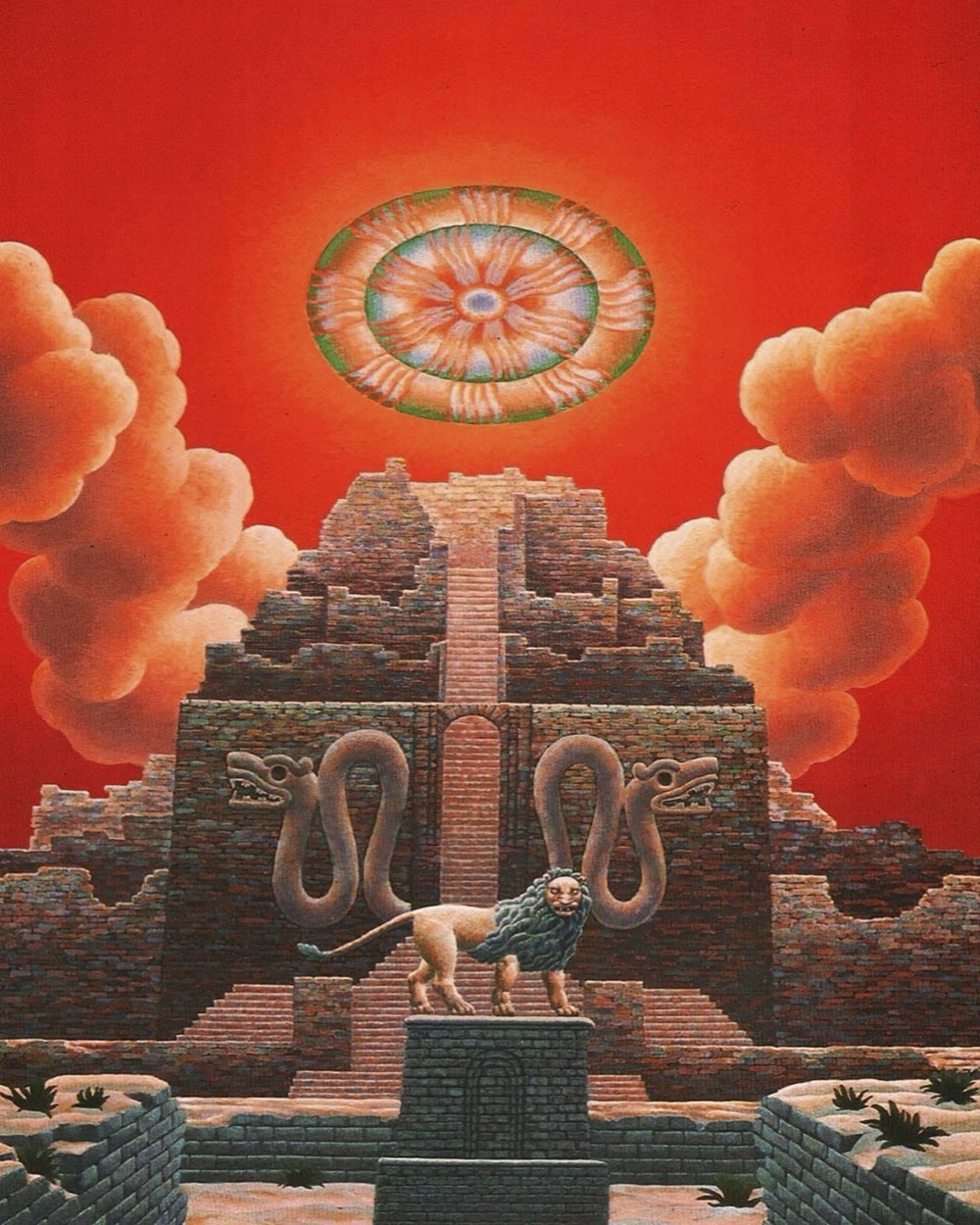
Secret Places of the Lion (1973) by George Hunt Williamson.

Continue reading “The art of Justin Todd”

Weekend links 783

robinson.jpg

An illustration by William Heath Robinson for A Midsummer Night’s Dream (1914).

• New music: How To Shoulder The Radiance Of Revelations by Dadub; Leviathan by Stephen Roddy; and Echoes Of The Hollow Earth by Cryo Chamber.

• At Sight & Sound: “Every time I look at the film, it gets better.” Steven Soderbergh on Jaws.

• At Public Domain Review: The Language of Form: Lothar Schreyer’s Kreuzigung (1920).

Leafing through the merveilleux-scientifique novels today allows for a dual rediscovery: firstly, it uncovers the previously unrecognised richness of Belle Époque scientific fiction, which did not perish with the works of Verne. The stories take in journeys to Mars, solar cataclysms, reading of auras, psychic control, weighing of souls, death rays, alien invasions, even strolls among the infinitesimally small. But exploring the genre also offers insights into the cultural history of the era, marked by a significant permeability between science and pseudo-science. Reading this work, we can learn a lot about the aspirations, fears and beliefs of early 20th-century Europe.

Fleur Hopkins-Loféron on the evolution of French science fiction after Jules Verne

• Mix of the week: A Twin Peaks mix for The Wire by Lori Eschler & Dean Hurley.

• Steven Heller’s font of the month is Kefir.

Patrick Wolf’s favourite albums.

ultrawolvesunderthefullmoon

Frou-Frou Foxes In Midsummer Fires (1990) by Cocteau Twins | Midsummer Night (2010) by The Time And Space Machine | Midsummer Boulevard (2022) by Hawksmoor

The Twilight Magus

twilight.jpg

Presenting my latest cover for Aconyte’s Arkham Horror line, and the third and final book in a trilogy by Tim Pratt.

Carl Sanford, once the Silver Twilight Lodge’s great leader and now presumed dead, lives in anonymity in Spain, plotting revenge against those who betrayed him. Alone, he calculates his first move to achieve power abroad is by being initiated into the mysterious ancient society called the Red Coterie to secretly take it over. Despite Sanford’s reputation, the Red Coterie demands proof of his occult prowess, sending him on a quest to vanquish The Blood Moon, a reclusive blood magus manipulating humans and monsters alike to achieve their own ends. As Sanford uses every scrap of cunning he possesses to outwit his enemies and prove his worth, old foes from Arkham have discovered his existence and are coming to finish him off once and for all.

The brief for this one was for a design that would continue the form of the previous two volumes while incorporating details of Antoni Gaudí’s architecture, Barcelona being one of the story’s locations. I’ve admired Gaudí’s architecture for a long time but I’ve never had the opportunity to use any of it in an illustration before. Most of the details are tiny ones but the unfinished porch of the Sagrada Família is recognisable, as is the iron dragon from the entrance gate of the Park Güell. The windows behind Sarah van Shaw and Carl Sanford are also Gaudí designs.

tile.jpg

Less recognisable, but also a Gaudí creation, is the background pattern which is more visible on the back cover of the book. My previous covers for Aconyte have all used Art Deco mofits to complement stories set in the 1920s, with several of them having elaborate background patterns. The Gaudí design was one I hadn’t seen before, a hexagonal tile in which portions of three organic forms—starfish, ammonite and algae—become whole when the tiles are placed together. It’s a beautifully simple and clever design with the additional bonus for this cover of creating a series of spirals and tendrils which suit the Lovecraftian nature of the story. If you search around you’ll find a number of places selling reproductions as either ceramic tiles or coasters in a variety of materials.

The Twilight Magus will be published in July.

Elsewhere on { feuilleton }
The Lovecraft archive

Weird ekphrasis and the Dunwich horrors

dunwich1.jpg

The Seal of Yog-Sothoth, or Old Whateley’s conception of the same. A detail from the delightful kitchen autopsy scene which you’ll find below.

My thanks to Tentaclii for bringing the following to my attention in the most recent HPLinks post. The Actual Anatomy of the Terrible: Gou Tanabe, Weird Ekphrasis, and the History of Lovecraft in Comics is a lengthy academic essay by Timothy Murphy which I doubt I would have seen otherwise. Since Lovecraftian comics is the subject, a combination of vanity and curiosity made me click the link to see whether any of my own work rated a mention. I was surprised to find much more than this, with Murphy discussing and contextualising my adaptations of The Haunter of the Dark and The Call of Cthulhu. The bulk of his essay concerns the series of doorstop adaptations that Gou Tanabe has been producing for the past decade (most of which I’ve only seen as extracts), but Murphy’s knowledge of both Lovecraft’s fiction and comics history is very thorough. Particular attention is paid to Alberto Breccia’s pioneering adaptations of the 1970s; Breccia’s version of The Dunwich Horror was the story that impressed me the most when it appeared in the Heavy Metal Lovecraft special in October 1979. Seeing someone approach Lovecraft’s fiction in a sober, realistic manner was a welcome riposte to the jokey EC formula, and very much in my mind when I decided to start adapting Lovecraft myself seven years later.

books-big.jpg

Previous hauntings: Caermaen Books (1988), Oneiros (1999), Creation Oneiros (2006).

The biggest surprise in Murphy’s essay (and the reason for my writing all of this) was the end of his appraisal when he says “Lovecraft devotees may regret Coulthart’s abandonment of further adaptations…”, referring to my own version of The Dunwich Horror which stalled in late 1989 when I was asked to start working on the Lord Horror comics series from Savoy Books. A few Dunwich pages and panels were included in my Haunter of the Dark book, most of them in collage form, but the bulk of the story has never been made public. In one of those striking coincidences that often occur when you’ve embarked on a new project, I happened to have resumed work on The Dunwich Horror only a week ago, 36 years after leaving page no. 25 in its pencilled form. A few weeks prior to this I’d been scanning all of my Lovecraft comic art for the new edition of the Haunter of the Dark that I’ve been preparing since January. I’ve already mentioned reworking some of the illustrations from the first edition of the book but this process has scaled up considerably in the past two months. I’d been a little mortified to find that the artwork scans I used for the slightly upgraded edition in 2006 were the same ones I made in 1999 using a desktop scanner that wasn’t as good as those I’ve had since. Sorting through all the artwork again reminded me that my adaptation of The Dunwich Horror had been abandoned very near the end, with only the last two parts of the ten-part story left unfinished. This in turn prompted me to seriously consider finishing the story at last, an idea I’d always dismissed as being difficult if not impossible. My work on the Lord Horror comics in the 1990s led to a change in my penmanship and working methods which meant abandoning the very fine (0.2 mm) Rotring Variant pen that I’d used for drawing all the Lovecraft comics. I still have all my old Rotring pens; what I no longer have is the desire to spend months covering sheets of A3-size paper with lines like those made by an etching needle.

Continue reading “Weird ekphrasis and the Dunwich horrors”