Weekend links 423

howe.jpg

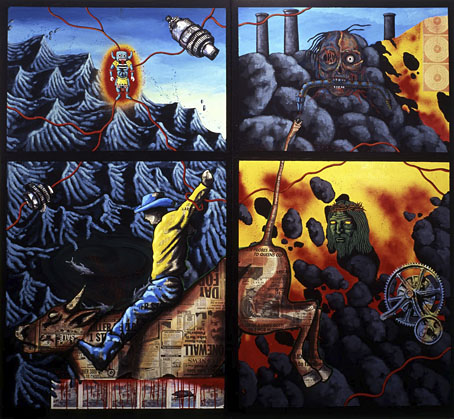
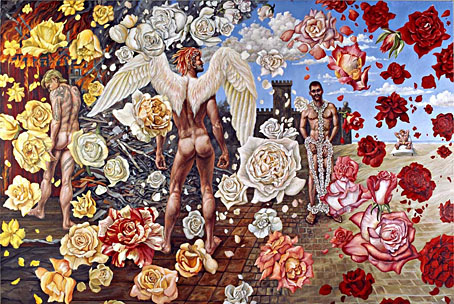
The Miracle (Genet’s Dream) (2001) by Delmas Howe.

• “Zachary Lipton, an assistant professor at the machine learning department at Carnegie Mellon University, watched with frustration as this story transformed from ‘interesting-ish research’ to ‘sensationalized crap’.” Oscar Schwartz on how the media gets AI alarmingly wrong.

• The Aesthetics of Science Fiction: what does SF look like after cyberpunk? Very Brutalist if you ask Rick Liebling, although the first example shown in his piece—the Brunel University Lecture Centre—appears briefly as future architecture in A Clockwork Orange.

• At Expanding Mind: Erik Davis talks with philosopher and religious studies professor Dustin Atlas about ancient skepticism, Madhyamaka Buddhism, the taste of honey, Montaigne, Robert Anton Wilson, and the path of doubt.

• At Muddy Colors: Part 1 of their choices for best fantasy book covers of the year so far, a list which includes my cover for Moonshine by Jasmine Gower. Thanks!

• Soundtracking with Edith Bowman, episode 84: director Todd Haynes on the music of Wonderstruck, I’m Not There, Carol and Far From Heaven.

• Mixes of the week: FACT mix 663 by Space Afrika, Secret Thirteen Mix 262 by Mieko Suzuki, and Black Minimalism, a playlist by David Toop.

• Two minutes, eight barrels: drone and GoPro footage of surfer Koa Smith riding the waves of the Namibia shoreline.

• David Lynch’s Sacred Clay: Shehryar Fazli reviews Room to Dream by David Lynch and Kristine McKenna.

Charlotte Higgins on myths, monsters and the maze: how writers fell in love with the labyrinth.

• Monstrous Geometries in the Fiction of HP Lovecraft by Moritz Ingwersen.

Listen to the mournful wails of planets and moons.

• A Peel Session by Laika

Surf Ride (1956) by Art Pepper | Surf (1976) by Tim Blake | Surfside Sex (1982) by Patrick Cowley
Weekend links 422

kolosimo.jpg

Wu Ming, a communist writing collective known for its historical fiction, sees Kolosimo as using pseudohistory as a tool to shake people from their belief that capitalist society is natural and transhistorical, opening minds to other possibilities for how humans can live. They regret that popular proponents of his theories today, like Graham Hancock and Erich von Däniken, are unable to recognize the political motivations behind his project: “Nothing of his radicality survives in today’s copycats… Every corner has been blunted, the heresy has become telegenic, but we know that the revolution will not be televised.”

The secret history of Marxist alien hunters by AM Gittlitz

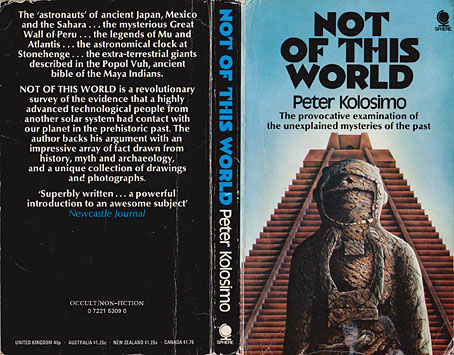
I received the Sphere edition of Peter Kolosimo’s book as a Christmas present in 1974, and being 12 years old at the time took its theories fairly seriously. As a work of pseudohistory it’s as poor as the books of Erich von Däniken but I always liked the title, and it happens to be the place I first encountered the mysterious words “Popol Vuh”, a name that would acquire a very different significance a few years later. Kolosimo also joins Kenneth Grant in taking HP Lovecraft’s work as a thin fictionalisation of supposed fact. For a serious dismantling of Not of This World see this review (the first of three parts) by “skeptical xenoarchaelogist” Jason Colavito.

• The Archons are back: Erik Davis talks with Gnostic scholar Matthew Dillon about religious mourning, the Nag Hammadi library, sex-magick Jesus, the Gnostic Eden, David Icke’s lizards, and the power of the Archons as an allegory of contemporary technological and political power.

Crystal Voyager (1973) is a surfing film by David Elfick that ends with a 23-minute sequence of slow-motion waves set to Echoes by Pink Floyd. Some of the same footage later appeared in the final scenes of Peter Weir’s The Last Wave (1977).

• Sweet artifice: “Dandies in the age of decadence favoured synthetics over nature, nowhere more so than in perfumery’s fabulous counterfeits,” says Catherine Maxwell.

• Now for a lampshade solo: Pascal Wyse on how the Radiophonic Workshop built the future of sound.

• Wilde about Paris: Alex Dean on the sex, drink and liberation of Oscar Wilde’s “lost” years.

Bee in the City: the vanguard of an invading army from Planet Bee.

• Five books that most inspired Alexander McQueen.

Colin Newman‘s favourite albums.

Echoes (1969) by Leon Thomas | Echo Waves (1974) by Ash Ra Tempel | Not Of This World (1988) by Danzig

Weekend links 421

wojnarowicz.jpg

The Death of American Spirituality (1987) by David Wojnarowicz.

Dau: “Art imitating life on an unprecedented scale”. Siddhant Adlakha on a colossal Russian feature-film project that sounds like a real-life equivalent of Synecdoche, New York. Adlakha’s piece, which claims that Dau is finished, was written a year ago but there’s still no sign of the film itself. Wikipedia has more details and links.

Metropolis Magazine from Phantasm Press is a facsimile republication of the 32-page theatre programme produced for the UK premier of Fritz Lang’s feature film.

Children Of The New Dawn is a preview of the score for Mandy by the late Jóhann Jóhannsson. From last year: The Drowned World (live) by Jóhann Jóhannsson.

Grand Panorama of a Whaling Voyage ’Round the World (1848) by Benjamin Russell & Caleb Purrington is the longest painting in North America.

• “This summer, there is only one book to take to the Terminal Beach”: Applied Ballardianism: Memoir from a Parallel Universe by Simon Sellars.

• “La série des Fredi en trois volumes est une étude sincère et consciencieuse de l’inversion sexuelle.”

• “The Book was Mallarmé’s total artwork, a book to encompass all books,” says Sylvia Gorelick.

• At BLDGBLOG: Graphic Inferno, art by Rico Lebrun based on Dante’s Divine Comedy.

• Mixes of the week: XLR8R Podcast 549 by Hólmar, and FACT Mix 661 by Kelly Lee Owens.

• “Dealing with creative block? A deck of cards might help,” says Abigail Cain.

The Instagram account archiving exquisite interiors from vintage porn.

Polish composers report from Outer Space

Wind From Nowhere (1994) by Uzect Plaush | Slolooblade : The Drowned World (1994) by Mo Boma | Inner Space Memorial for JG Ballard (2014) by Janek Schaefer

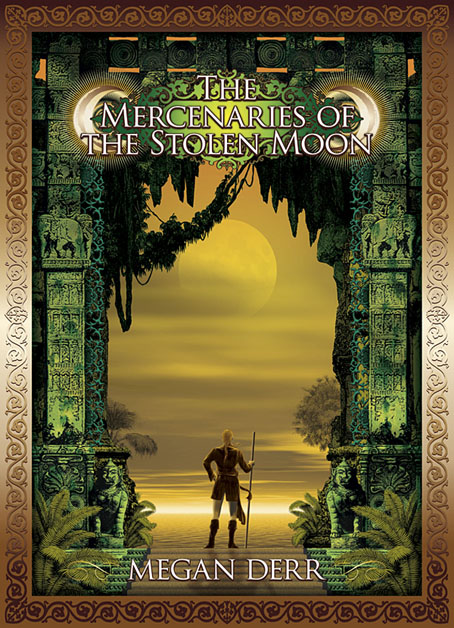
The Mercenaries of the Stolen Moon

mercenaries.jpg

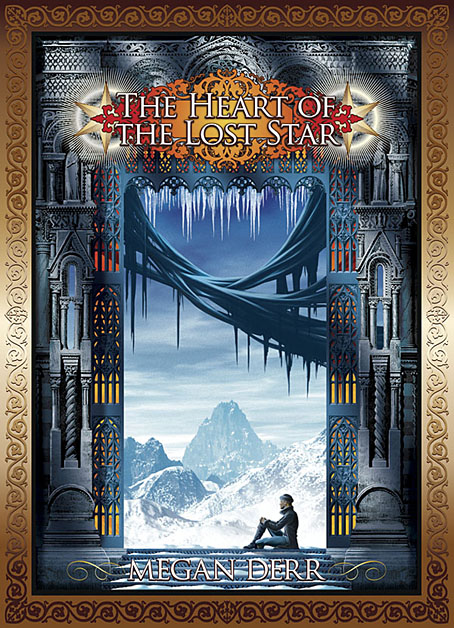
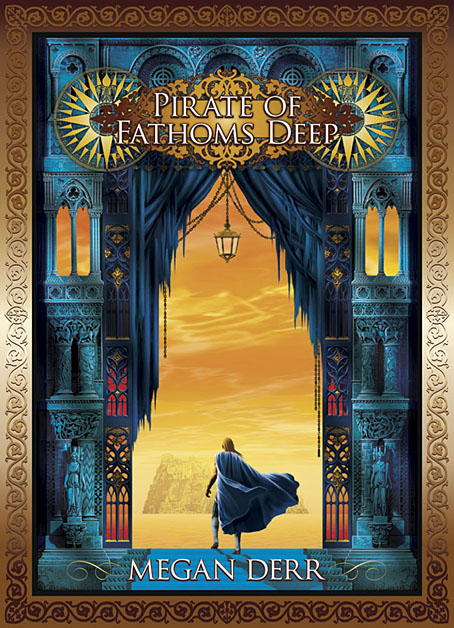
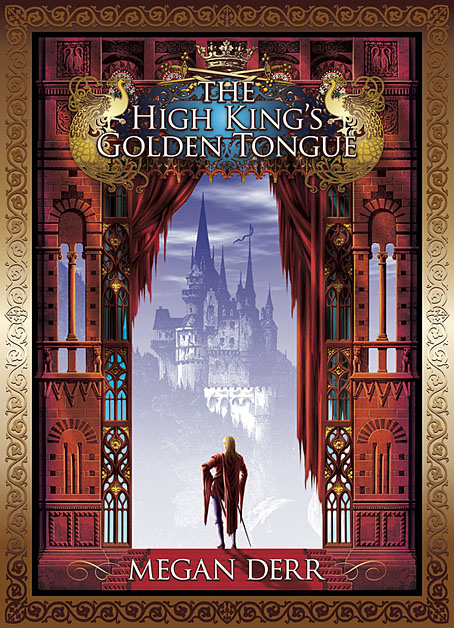
As promised last week, here’s my latest cover for Megan Derr’s gay fantasy series, Tales of the High Court. The first book wasn’t intended to have this many sequels so my initial cover design also wasn’t planned as something that might be a template for later volumes. The previous books (below) borrowed bits and pieces from a set of early Viollet-le-Duc illustrations, a decision that posed problems as the series evolved when I began to run out of usable material. The new book required a different setting so I was able to dispense with the medieval architecture in favour of a hybrid of Indian and Cambodian stonework. I’ve always enjoyed the ruined-jungle-temple aesthetic so this was fun to work on, and made a break from all the black-and-white illustration I’ve been producing for the past year or so. The Mercenaries of the Stolen Moon will be published by Less Than Three Press later this year.

loststar.jpg

derr2.jpg

derr1.jpg

Previously on { feuilleton }
The Heart of the Lost Star
Tales of the High Court

Weekend links 417

coil.jpg

Cover of How To Destroy Angels (Remixes And Re-Recordings) (1992) by Coil. Artwork: Fine Balance (1986) by Derek Jarman.

• It’s that man again: “According to the late great short story writer Robert Aickman, the problem with our excessively modern world is not that it is strange, but that it is not strange enough.” Scott Bradfield on a writer who can no longer be described as neglected or overlooked.

• Coil may have expired over a decade ago after the death of John Balance but the posthumous releases persist. Latest of these is How To Destroy Angels, an album-length presentation of music (or audio) by Coil and Zos Kia (John Gosling) from 1983/84.

• “Two decades ago, a renowned professor promised to produce a flawless version of one of the 20th century’s most celebrated novels: Ulysses. Then he disappeared.” The Strange Case of the Missing Joyce Scholar.

• At Dangerous Minds: The Fool: The Dutch artists who worked for The Beatles (and made their own freak folk masterpiece). Previously here: The art of Marijke Koger.

• RIP Nick Knox. The Cramps were always best when playing live, as here in 1986 when they performed songs from A Date With Elvis on Channel 4’s The Tube.

• “The McKenzie Tapes is a collection of live audio recordings from some of New York City-area most prominent music venues of the 1980s and 1990s.”

• Beyond the veil: two extracts from Death by Anna Croissant-Rust, one of two new books from Rixdorf Editions.

• Impulse Responses: composer Deru on scoring with the Cristal Baschet.

Fleshback: Queer Raving in Manchester’s Twilight Zone Chapter 1–3.

• “Puzzler says he has cracked code to stolen Belgian masterpiece.”

• Mix of the week: FACT mix 657 by Beatrice Dillon.

Jenzeits

Death Have Mercy (1959) by Vera Hall | Oh Death (1964) by Dock Boggs | Oh Death (1967) by Kaleidoscope