Outer Alliance Pride Day

outer.jpgToday is Outer Alliance Pride Day so let’s begin with a statement:

As a member of the Outer Alliance, I advocate for queer speculative fiction and those who create, publish and support it, whatever their sexual orientation and gender identity. I make sure this is reflected in my actions and my work.

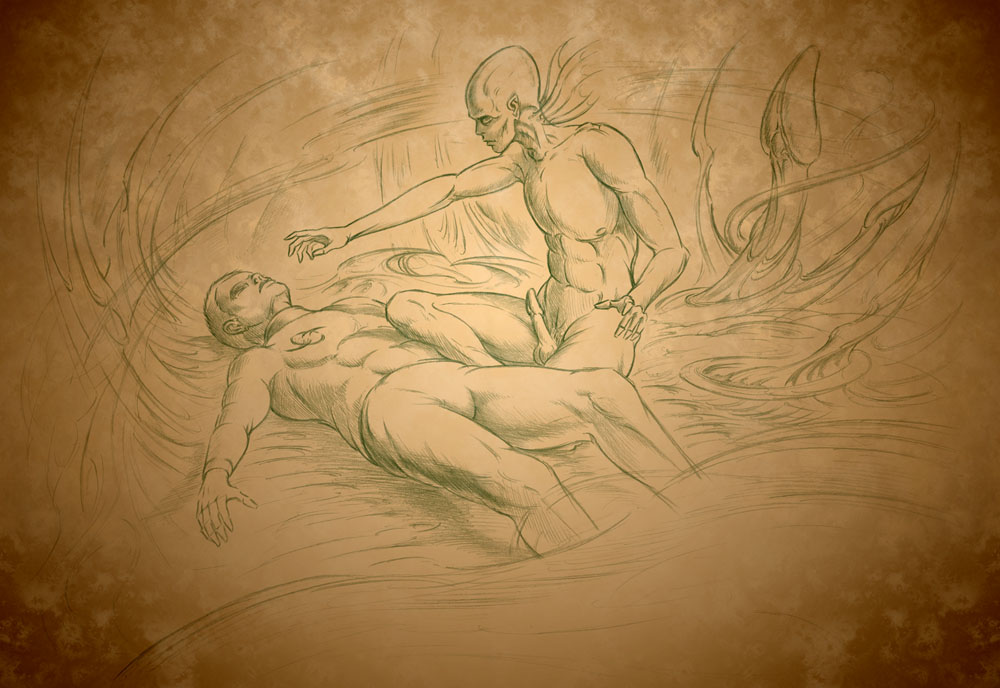
Various members of the Outer Alliance are either posting fiction, or reviewing something or otherwise attempting to fill that declaration of intent. For my part I decided today to do a sketch based on my favourite chapter of The Ticket that Exploded by William Burroughs, the sequence entitled the black fruit which Burroughs wrote with Michael Portman. Ticket was the first Burroughs book I read at the age of 16 or so, having discovered a copy in a local library, and it really felt like something exploding in the head. For a start, the text is some of his least accommodating for an average reader, although I was already familiar enough with literary experiment to cope with that. Far more electrifying was seeing familiar scenarios from science fiction and fantasy infused with a raw and relentless gay sexuality of endless erections and spurting cocks. The black fruit begins with a science fiction scene of lost astronauts encountering alien fishboys intent on having sex; it then progresses through a series of descriptions which read like a pornographic rewriting of similar scenes from HP Lovecraft or Clark Ashton Smith. In the opening pages of Ticket, Burroughs describes his book as “science fiction” but this was like no sf I’d read; I started to wish there was more like it. There are flashes of similar stuff in The Soft Machine (including an idea borrowed from Henry Kuttner) and elsewhere, and Cities of the Red Night is pretty much a full-on fantasy in its second half, but I’d still like to read more about the fishboys…

fishboy

Fishboy and Astronaut (detail).

So here’s an explicitly erotic sketch based on the black fruit (click the picture for the full thing). This should have been a lot better but I’m out of practice drawing at the moment and I didn’t give myself enough time. The scene doesn’t really match the book either, and the astronaut figure is pretty crappy. Feeble excuses aside, Burroughs’ rotting swamp gardens with their marble statues of copulating boys deserve better. And where his fiction leads, I’m still hoping that more writers will follow, not by copying his obsessions but by being as fearless and honest in mining their own.

Previously on { feuilleton }
William S Burroughs: A Man Within
The art of NoBeast

William S Burroughs: A Man Within

ticket.jpg

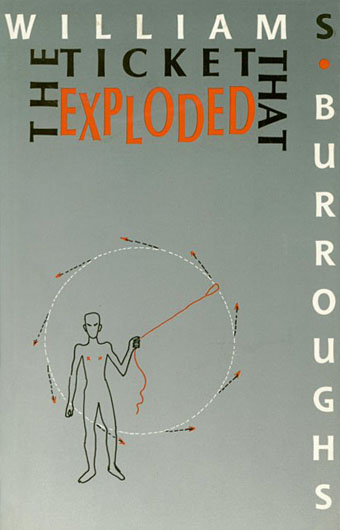
The Ticket that Exploded. Cover design by Thomi Wroblowski for a John Calder edition, 1985.

William S Burroughs: A Man Within is a feature-length documentary by Yony Leyser, and is, so the makers say, the first posthumous documentary about the always essential writer. Howard Brookner’s 1983 film, Burroughs, is probably definitive where the biography is concerned since Brookner was fortunate to get most of the key surviving Beats, family members, and allies while they were still around. Leyser’s trailer looks interesting, however (I’m hoping the film isn’t merely a parade of celebrities and soundbites), and it’s things like this which pass on the message of Burroughs’ continued importance to a new generation.

The film features never before seen footage of William S. Burroughs, as well as exclusive interviews with his closest friends and colleagues including John Waters, Genesis P-Orridge, Laurie Anderson, Peter Weller, David Cronenberg, Iggy Pop, Gus Van Sant, Sonic Youth, Anne Waldman, George Condo, Hal Willner, James Grauerholz, Amiri Baraka, Jello Biafra, V. Vale, David Ohle, Wayne Propst, Dr. William Ayers, Diane DiPrima, Donovan, Dean Ripa (the world’s largest poisonous snake collector), and many others, with narration by actor Peter Weller, and soundtrack by Sonic Youth. 

Release is slated for later this year. Meanwhile, there’s another trailer on YouTube for a Burroughs’-inspired short, The Japanese Sandman, based on WSB’s quest for the drug yage in the jungles of Panama. For an explanation of the title, consult the Reality Studio.

Elsewhere on { feuilleton }
The William Burroughs archive

Nicoletto Giganti’s naked duellists

fencers.jpg

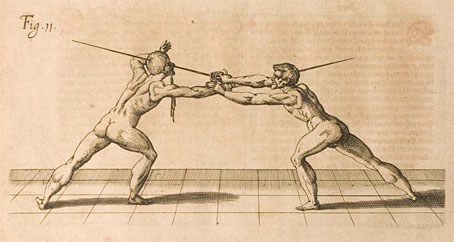
This is something you don’t generally see in swashbuckling films, a duellist being stabbed through the eye. To judge by the plates in Nicoletto Giganti’s sword-fighting manual it seems to have been a very common form of attack; duels with bare blades were a serious business. For some reason most of the combatants in these pictures also have bare bodies, possibly to better display the positioning of their limbs.

I found this 1644 book by accident last year while searching for something completely unrelated then forgot to bookmark the page. Good job, then, that the indispensable Mr Peacay at BibliOdyssey had come across the same pages. He also found plates from an older book dealing with different forms of hand combat.

Elsewhere on { feuilleton }
The men with swords archive
The etching and engraving archive

Previously on { feuilleton }
Battle of the Naked Men

Forbidden Colours

mishima1.jpg

Wilhelm von Gloeden‘s version of the Flandrin pose as it appears on the cover of a 1989 Gallimard edition of Forbidden Colours by Yukio Mishima. I included this photograph in the very first posting which examines the recurrence of Flandrin’s Jeune Homme Assis au Bord de la Mer but this is the first time I’ve seen it used on a book cover. The French twist the title into “forbidden loves” and in so doing lose Mishima’s punning subtlety.

mishima2.jpg

The Ballad To a Severed Little Finger (1966).

Searching around earlier turned up a nice collection of poster works by the great Japanese collage artist, Tadanori Yokoo. One of these from 1966 is dedicated to Mishima, while the one above shows actor Ken Takakura in one of his many yakuza roles. Yokoo regarded Mishima as a major influence and further cemented the relationship by making an appearance in Paul Schrader’s 1985 film, Mishima: A Life in Four Chapters. By convoluted coincidence, Schrader received his start in Hollywood ten years earlier with a co-written screenplay, The Yakuza, which Sidney Pollack directed. Ken Takakura reprised his gangster persona in that film, along with Robert Mitchum. It’s a good piece of neo-noir, worth seeking out.

For more Tadanori Yokoo, see some of the recent posts by Will at A Journey Round My Skull.

Elsewhere on { feuilleton }
The recurrent pose archive

Previously on { feuilleton }
The art of Goh Mishima, 1924–1989
The art of Hideki Koh
Mishima’s Rite of Love and Death
Secret Lives of the Samurai
Guido Reni’s Saint Sebastian
The art of Sadao Hasegawa, 1945–1999
The art of Takato Yamamoto