William S Burroughs: A Man Within

ticket.jpg

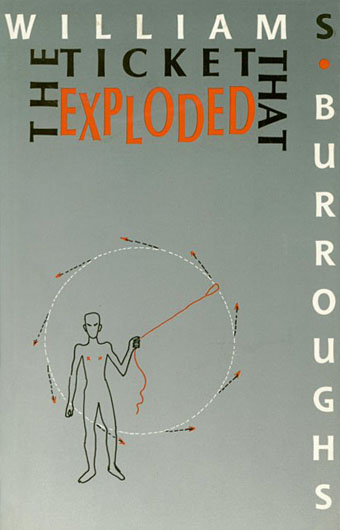
The Ticket that Exploded. Cover design by Thomi Wroblowski for a John Calder edition, 1985.

William S Burroughs: A Man Within is a feature-length documentary by Yony Leyser, and is, so the makers say, the first posthumous documentary about the always essential writer. Howard Brookner’s 1983 film, Burroughs, is probably definitive where the biography is concerned since Brookner was fortunate to get most of the key surviving Beats, family members, and allies while they were still around. Leyser’s trailer looks interesting, however (I’m hoping the film isn’t merely a parade of celebrities and soundbites), and it’s things like this which pass on the message of Burroughs’ continued importance to a new generation.

The film features never before seen footage of William S. Burroughs, as well as exclusive interviews with his closest friends and colleagues including John Waters, Genesis P-Orridge, Laurie Anderson, Peter Weller, David Cronenberg, Iggy Pop, Gus Van Sant, Sonic Youth, Anne Waldman, George Condo, Hal Willner, James Grauerholz, Amiri Baraka, Jello Biafra, V. Vale, David Ohle, Wayne Propst, Dr. William Ayers, Diane DiPrima, Donovan, Dean Ripa (the world’s largest poisonous snake collector), and many others, with narration by actor Peter Weller, and soundtrack by Sonic Youth. 

Release is slated for later this year. Meanwhile, there’s another trailer on YouTube for a Burroughs’-inspired short, The Japanese Sandman, based on WSB’s quest for the drug yage in the jungles of Panama. For an explanation of the title, consult the Reality Studio.

Elsewhere on { feuilleton }
The William Burroughs archive

Nicoletto Giganti’s naked duellists

fencers.jpg

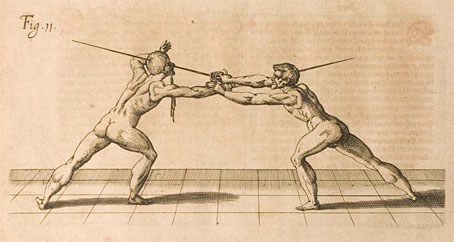
This is something you don’t generally see in swashbuckling films, a duellist being stabbed through the eye. To judge by the plates in Nicoletto Giganti’s sword-fighting manual it seems to have been a very common form of attack; duels with bare blades were a serious business. For some reason most of the combatants in these pictures also have bare bodies, possibly to better display the positioning of their limbs.

I found this 1644 book by accident last year while searching for something completely unrelated then forgot to bookmark the page. Good job, then, that the indispensable Mr Peacay at BibliOdyssey had come across the same pages. He also found plates from an older book dealing with different forms of hand combat.

Elsewhere on { feuilleton }
The men with swords archive
The etching and engraving archive

Previously on { feuilleton }
Battle of the Naked Men

Forbidden Colours

mishima1.jpg

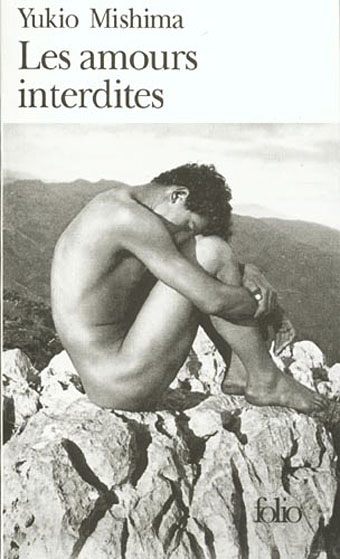
Wilhelm von Gloeden‘s version of the Flandrin pose as it appears on the cover of a 1989 Gallimard edition of Forbidden Colours by Yukio Mishima. I included this photograph in the very first posting which examines the recurrence of Flandrin’s Jeune Homme Assis au Bord de la Mer but this is the first time I’ve seen it used on a book cover. The French twist the title into “forbidden loves” and in so doing lose Mishima’s punning subtlety.

mishima2.jpg

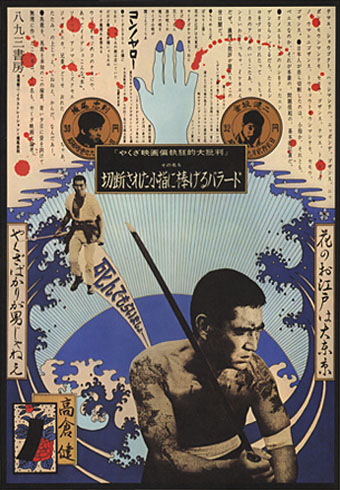
The Ballad To a Severed Little Finger (1966).

Searching around earlier turned up a nice collection of poster works by the great Japanese collage artist, Tadanori Yokoo. One of these from 1966 is dedicated to Mishima, while the one above shows actor Ken Takakura in one of his many yakuza roles. Yokoo regarded Mishima as a major influence and further cemented the relationship by making an appearance in Paul Schrader’s 1985 film, Mishima: A Life in Four Chapters. By convoluted coincidence, Schrader received his start in Hollywood ten years earlier with a co-written screenplay, The Yakuza, which Sidney Pollack directed. Ken Takakura reprised his gangster persona in that film, along with Robert Mitchum. It’s a good piece of neo-noir, worth seeking out.

For more Tadanori Yokoo, see some of the recent posts by Will at A Journey Round My Skull.

Elsewhere on { feuilleton }
The recurrent pose archive

Previously on { feuilleton }
The art of Goh Mishima, 1924–1989
The art of Hideki Koh
Mishima’s Rite of Love and Death
Secret Lives of the Samurai
Guido Reni’s Saint Sebastian
The art of Sadao Hasegawa, 1945–1999
The art of Takato Yamamoto

L’Androgyne

seon.jpg

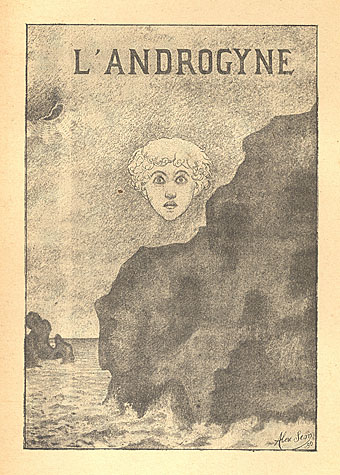
L’Androgyne by Alexandre Séon (1890).

Related to yesterday’s post, I’ve been re-reading various books this week for details of the most curious character associated with the French Symbolist movement, novelist and occultist Joséphin Péladan (1859–1918), also known as Sâr Peladan, a Babylonian title he bestowed upon himself as more befitting his adopted role as Rosicrucian mystic. Péladan’s writings and occult art theories spurred many of the painters who banded together as part of his Salon de la Rose+Croix, a kind of anti-salon intended to stand in opposition to what the Sâr saw as the drab realism of the Impressionists and the staid historicism of academic painters. One gets the impression reading about Péladan that he was probably a rather preposterous figure—his obsession with androgyny caused him to change his forename from Joseph to Joséphin yet he kept his length of bristling beard. But, like Oscar Wilde in London, his presence in the pool of fin de siècle art creates considerable ripples. Alexandre Séon, whose frontispiece above was created for Péladan’s semi-autobiographical essay, L’Androgyne, was particularly devoted to him, as was Carlos Schwabe. Séon’s picture depicts “the androgyne Samas, stupefied by the sexual enigma”, a character with whom Péladan fully identified as he describes his youth and its apparent state of androgynous grace.

mitchenko.jpg

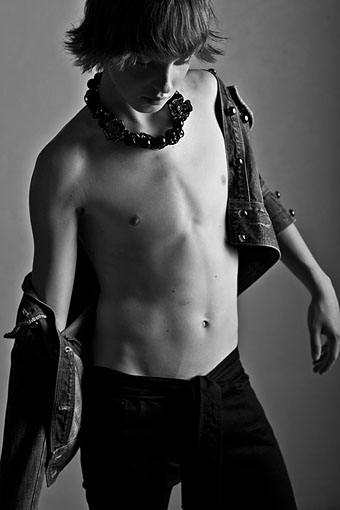
One doesn’t need a Rosicrucian salon today for examples of creative androgyny, of course, all you have to do is go to Flickr where you’ll find creatures such as the boy above from Roman Mitchenko’s photostream. The photos there are at the fashion end of the spectrum; for more of an amateur or semi-professional perspective there are groups like the Androgyny pool, and the Mommy, I want to be androgynous! pool, the latter featuring many striking boyish girls and girlish boys.

Previously on { feuilleton }
Arthur Tress’s Hermaphrodite
Carlos Schwabe’s Fleurs du Mal
Czanara’s Hermaphrodite Angel

The art of Goh Mishima, 1924–1989

goh_mishima.jpg

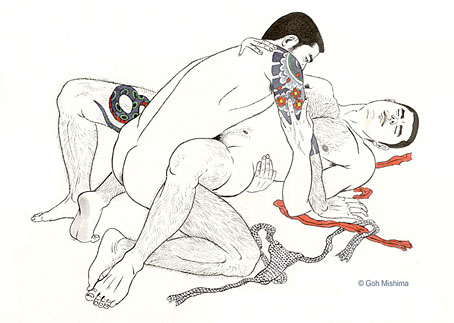
Untitled.

The gay artists archive is currently receiving more than twice as many visits as the rest of these pages so here’s a new addition to what is, it should be stressed, only a personal selection, not a definitive catalogue.

Goh Mishima (born Tsuyoshi Yoshida) specialised in what everyone seems to call “Yakazuza porn” although many of his men have fewer tattoos than genuine Japanese gangsters. Given the Japanese predilection for exploring every fetish imaginable someone had to cover this area. His name, of course, alludes to writer Yukio Mishima and there’s a lot about his work that Mishima would have enjoyed. The Tom of Finland Foundation has a small selection of works and there’s also an exhibition of originals running this month at the Gramercy Gallery. Their site is blighted by pointless Flash bollocks, however; go here instead for further pictures. (Dead link: try the Leslie Lohman Museum or this page at Japanese Gay Art instead.)

Note: The Tom of Finland Foundation biography page says Goh Mishima died three days before Emperor Hirohito in “1988”. Since Hirohito actually died in 1989 that’s the date I’ve listed here.

Elsewhere on { feuilleton }
The gay artists archive

Previously on { feuilleton }
The art of Hideki Koh
Mishima’s Rite of Love and Death
Secret Lives of the Samurai
Guido Reni’s Saint Sebastian
The art of Sadao Hasegawa, 1945–1999
The art of Takato Yamamoto