Muto: The Exterface Manifesto

muto1.jpg

In which French photographers Exterface extend their particular brand of erotic styling into the world of online publications. Muto is a typically high-quality production (requires registration with Issuu), the theme this time being the hothouse of the 1970s when the word “clone” was as much associated with gay bars as with the products of science fiction. What was once a visual cliché now seems fresh (and hot!) amid the clichés (twinks and bears) which took its place. With retromania one of the buzzwords du jour there’s no reason why erotic photography shouldn’t get in on the act, is there?

Via Homotography.

Elsewhere on { feuilleton }
The gay artists archive

Previously on { feuilleton }
Let’s get physical: Bruce of Los Angeles and Tom of Finland
Exterface

Weekend links 64

magritte.jpg

The Sixteenth of September (1956) by René Magritte.

To Magritte admirers, The Sixteenth of September is a deceptively realistic work painted in 1956, one of a series in which the artist plays tricks with light and time of day. It shows a crescent moon impossibly shining through the dark mass of a tree, against a dawn sky.

To [Marc] Bolan fans, the painting has an entirely different significance: 16 September 1977 was the date the singer was returning home in the small hours from a night out, in a Mini driven by his girlfriend Gloria Jones. […] Fans say the tree in the painting closely resembles the sycamore the car crashed into, and the moon was at the same phase on 16 September 1977. (more)

• New Yorkers finally got a successful vote for gay marriage making New York state the sixth and largest in the US giving full marriage rights to its gay citizens. One of America’s conservative journals, National Review, made the striking point that forty years ago New York was in the vanguard of gay liberation while Spain under Franco was a dictatorship with no gay rights at all. No one then would have bet on Spain beating New York to gay marriage rights as it did in 2005. Allow me to note that we still only have civil unions here in the UK.

• Related: Queer Beacon: LGBT spaces in New York City by Kian Goh, and at Scientific American: The Intelligent Homosexual’s Guide to Natural Selection and Evolution, with a Key to Many Complicating Factors by Jeremy Yoder.

• A pair of intrepid photographers breach the midnight security at St Paul’s Cathedral to bring back photos of the building rooftop. Related (and looking like a good location for a British equivalent of Stalker), photos of the disused Thorpe Marsh Power Station, Yorkshire.

• Mixtape of the month: the ATP I’ll Be Your Mirror collection by Portishead, a great blend of rock, rap and electronic odds-and-ends. Also a dash of Alan Moore & Stephen O’Malley.

Eddie Campbell is blogging again. Welcome back to the madhouse, Eddie. His smart and witty daughter, Hayley Campbell, continues to file regular bulletins from her London bunker.

• Your Tumblrs this week: Fuck Yeah Ken Russell and Fuck Yeah Powell & Pressburger.

Robot Flâneur: Exploring Google Street View.

Paris Visages by Marco Gervasio.

• “Push the button, Max!

Written On The Forehead (2011) by PJ Harvey.

Weekend links 63

solaris.jpg

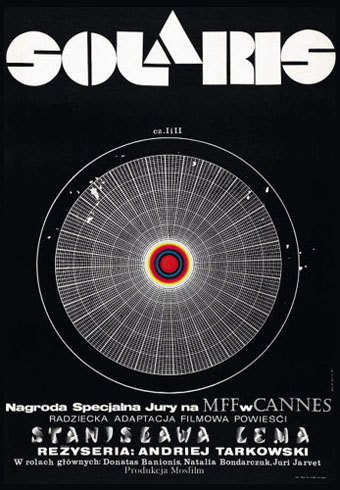
Polish poster by Andrzej Bertrandt for Andrei Tarkovsky’s 1972 film of Solaris.

• Stanisław Lem’s Solaris receives its first ever direct English translation by Bill Johnston (only on Audible for the moment), all previous editions having been sourced from a poor French translation. An all-too-common state of affairs for non-English fiction where bad or bowdlerised translations persist for years.

• Now that Minnesota politician Michelle Bachmann is running for US president it’s a good time to examine her views when (theoretically) her actions could one day impact on us all. The Daily Beast gathered together some of her worst pronouncements, including the following about gay people: “It’s a very sad life. It’s part of Satan, I think, to say that this is gay.” Her husband describes his attempts to counsel (ie: cure) gay teenagers with the words “Barbarians need to be educated.” It’s no surprise that both these people find confirmation of their views in the usual narrow interpretation of Christian doctrine. Not all American Christians are this ignorant or offensive, of course. The Heartland Proclamation calls for “an end to all religious and civil discrimination against any person based on sexual orientation and gender identity and expression”.

Journalist Andrew Sullivan in 2003 proposed a label for people like Bachmann: “I have a new term for those on the fringes of the religious right who have used the Gospels to perpetuate their own aspirations for power, control and oppression: Christianists. They are as anathema to true Christians as the Islamists are to true Islam.” It’s a term that ought to have more widespread use.
solaris-czech.jpg

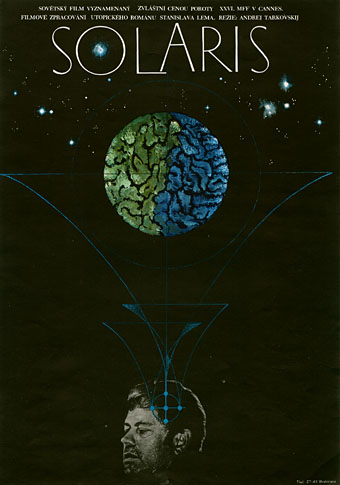
Czech poster for Solaris. No designer credited.

• Probing the secrets of psilocybin: “Scientists at the Johns Hopkins University School of Medicine have zeroed in on the dose levels of the ‘sacred mushroom’ chemical capable of yielding positive, life-changing experiences, while minimizing the chance of transient negative reactions in screened volunteers under supportive, carefully monitored conditions.”

• Rick Poynor relates a visit to the Frederic Marès Museum, Barcelona, home to the 50,000 objects Marès collected over his lifetime. Further details of the collection can be found at the museum website.

In her 1969 essay “The Pornographic Imagination,” [Susan] Sontag insisted that Story of O could be correctly defined as “authentic” literature. She compared the ratio of first-rate pornography to trashy books within the genre to “another somewhat shady subgenre with a few first-rate books to its credit, science fiction.” She also maintained that like science fiction, pornography was aimed at “disorientation, at psychic dislocation.”

If so, that aim is far more interesting than what most generic “mainstream” novels set out to do. No one could describe O as predictable or sentimental. Its vision was dark and unrelenting; everything about it was extreme. Sontag also compared sexual obsession (as expressed by Réage) with religious obsession: two sides of the same coin.

Carmela Ciuraru on the story of The Story of O by Pauline Réage.

• “No hay banda! There is no band. It is all an illusion.” David Lynch will be opening a Club Silencio in Paris (Montmartre, of course). Facebook pages here and here.

• Sad to say that Chateau Thombeau is now closed but Thom has begun a more personal journal here.

• Picture galleries of the Vorticists at the Tate here and here. Related: Into the Vortex.

• Illuminated Persian pages from 1604 at BibliOdyssey.

• Tape drawings by Chris Hosmer.

• Miles Davis and co. at the Isle of Wight Festival, 1970: part 1 | part 2 | part 3 | part 4

Hello, sailor

bossert.jpg

Homotography goes nautical again this week, sporting shots of model Lukas Bossert in a session by Mustafa Sabbagh. I’m not sure whether these have any purpose beyond showing off Mr Bossert’s physique but we don’t really need any other reason, do we? Homotography has bigger pics should you require them.

Incidentally, fashion photography is now the only place you regularly see photos of anyone smoking, whether posing or otherwise. With the march of prohibition, the cigarette-as-style-fixture seems to have shifted to become a vague signifier of rebellion. The fashion world loves its rebel iconography so I can see this trend continuing for some time, or at least until the habit starts to generate the inevitable complaints.

Previously on { feuilleton }
Querelle again
Sailors
Mikel Marton
Exterface

Weekend links 62

pavlishin.jpg

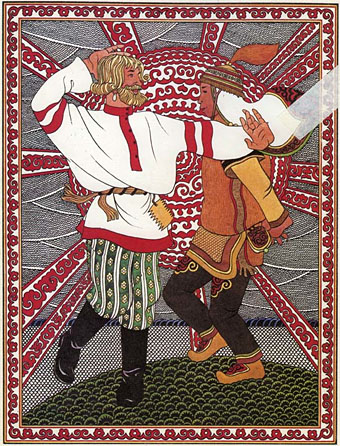
A plate from Tales of the Amur by Dmitry Nagishkin, a 1975 edition illustrated by Gennady Pavlishin.

• The week in Surrealism: Opera of the surreal gives Dalí an encore: Yo, Dalí, a previously unperformed work by Xavier Benguerel, receives its premier in Madrid. Meanwhile Tate Liverpool’s summer exhibition, René Magritte: The Pleasure Principle, is profiled here. “René Magritte has inspired more book covers than any other visual artist,” says James Hall.

If Rimbaud anticipated the Surrealists by decades, Ashbery is said to have gone beyond them and defied even their rules and logic. Yet though nearly 150 years have intervened since Rimbaud’s first declaration of independence, many readers in our own age, too, still prefer a coherence of imagery, a sameness of tone, a readable sequential message, even, ultimately, what amounts to a prose narrative broken into lines.

Lydia Davis on Rimbaud’s Wise Music.

Umberto Eco’s glimpse into the art of the novel | Return to Wonderland: an essay on Lewis Carroll’s world by Alberto Manguel | Heavy sentences by Joseph Epstein: On How to Write a Sentence and How to Read One, by Stanley Fish.

And then there’s the mystery of what happened to him for those four months in London when we have no trace of him. Rimbaud mentions Scarborough in “Promontory” and talks about “Hotels, the circular façades of the Royal and the Grand in Scarborough or Brooklyn.” Since there’s that missing period in England, people say he must have gone to Scarborough, and have even checked hotel registers for that period, but as far as I know nobody has ever found anything. Someone even checked railway and train schedules in order to pin him to this real place. I seem to remember a French writer admitting that Rimbaud was never in Brooklyn, but kind of wishfully thinking that he might have been. Which is very funny. “Rimbaud in Brooklyn”: there’s a project for someone.

A Refutation of Common Sense, John Ashberry on translating Rimbaud.

Robert Jeffrey posts a video of his nine-year-old self giving Madge a run for her money in 1991. As Boy Culture puts it: “Anyone who feebly clings to the belief that gay can be prayed away should take a look at this and give up already…” Amen.

• The mathematics of Yog-Sothoth: Richard Elwes on Exotic spheres, or why 4-dimensional space is a crazy place.

For I Will Consider My Cat Jeoffry by Christopher Smart (1722–1771).

Lesbian pulp fiction, 1935–1978 and Faber 20th century classics.

As The Crow Flies, a new album from The Advisory Circle.

New World Transparent Specimens by Iori Tomita.

79 versions of Gershon Kingley’s Popcorn.

Minor Man (1981) by The League of Gentlemen.