Gore Vidal, 1925–2012

vidal.jpg

You could spend all day picking out choice quotes. So much is still pertinent.

From ‘Women’s Liberation: Feminism and Its Discontents’:

Those who have been treated cruelly will treat others cruelly. This seems to be a fact of our condition. The Patriarchs have every reason to be fearful of woman’s revenge should she achieve equality. He is also faced with the nightmare (for him) of being used as a sexual object or, worse, being ignored (the menacing cloud in the middle distance is presently no larger than a vibrator). He is fighting back on every front.

Take pornography. Though female nudes have been usually acceptable in our Puritan culture, until recently the male nude was unacceptable to the Patriarchs. After all, the male—any male—is a stand-in for God, and God wears a suit at all times, or at least jockey shorts. Now, thanks to randy Lilith, the male can be shown entirely nude but, say the American censors, never with an erection. The holy of holies, the totem of our race, the symbol of the Patriarchs’ victory over the Great Mother, must be respected. Also, as psychologists point out, though women are not as prone to stimulus through looking at pictures as men (is this innate or the result of conditioning?), they are more excited by pictures of the male erect than of the male at ease. And excitement of course is bad for them, gives them ideas, makes them insatiable; even the ancient Greeks, though freer in sexual matters than we, took marriage seriously. As a result, only unmarried girls could watch naked young men play because young girls ought to be able to look over a field which married women had better not know about.

Today we are witnessing the breakup of patterns thousands of years old. The patriarchal response is predictable: if man on top of woman has been the pattern for all our known history, it must be right. This of course was the same argument he made when the institution of slavery was challenged. After all, slavery was quite as old an institution as marriage. With the rejection of the idea of ownership of one person by another at the time of our Civil War, Women’s Lib truly began. If you could not own a black man, you could not own a woman either. So the war began. Needless to say, the forces of reaction are very much in the saddle (in every sense), and women must fight for their equality in a system which wants to keep them in manageable family groups. buying consumer goods. raising future consumers, until the end of time—or the world’s raw resources, which is rather closer at hand.

The New York Review of Books, July 22, 1971

From ‘Pink Triangle and Yellow Star’:

Although our mental therapists and writers for the better journals usually agree that those who prefer same-sex sex are not exactly criminals […] or sinful or, officially, sick in the head, they must be, somehow, evil or inadequate or dangerous. The Roman Empire fell, didn’t it? because of the fags?

Our therapists, journalists, and clergy are seldom very learned. They seem not to realize that most military societies on the rise tend to encourage same-sex activities for reasons that should be obvious to anyone who has not grown up ass-backward, as most Americans have. In the centuries of Rome’s great military and political success, there was no differentiation between same-sexers and other-sexers; there was also a lot of crossing back and forth of the sort that those Americans who do enjoy inhabiting category-gay or category-straight find hard to deal with. Of the first twelve Roman emperors, only one was exclusively heterosexual. Since these twelve men were pretty tough cookies, rigorously trained as warriors, perhaps our sexual categories and stereotypes are—can it really be?—false. It was not until the sixth century of the empire that same-sex sex was proscribed by church and state. By then, of course, the barbarians were within the gates and the glory had fled.

Today, American evangelical Christians are busy trying to impose on the population at large their superstitions about sex and the sexes and the creation of the world. Given enough turbulence in the land, these natural fascists can be counted on to assist some sort of authoritarian—but never, never totalitarian—political movement. Divines from Santa Clara to Falls Church are particularly fearful of what they describe as the gay liberation movement’s attempt to gain “special rights and privileges” when all that same-sexers want is to be included, which they are not by law and custom, within the framework of the Fourteenth Amendment.

The Nation, November 14, 1981

Previously on { feuilleton }
Gore Vidal on American tolerance

Weekend links 119

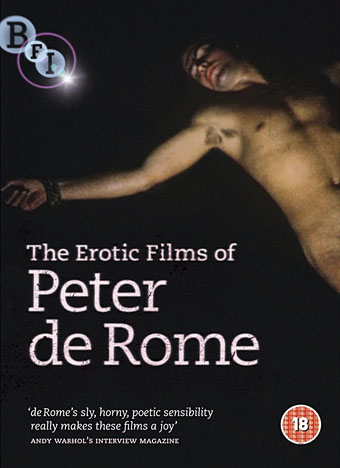
peterderome.jpg

The BFI’s recent DVD release of Peter de Rome’s gay porn films has been mentioned here a couple of times already but I only bought a copy this week. It’s a remarkable release for a number of reasons, not least for showing how much attitudes towards pornography in Britain have changed in recent years. De Rome’s films are explicit enough to ensure that in the 1970s and 1980s anyone caught selling them in the UK might have been imprisoned. That you can now buy them uncut from a high street shop on a disc packaged with the usual care by the British Film Institute means another small part of our iniquitous past has gone for good. Among the extras there’s a documentary with the 88-year-old director discussing his work. This week he talked to BUTT magazine who also have one of his shorter films from the DVD, Hot Pants, on their site.

• “Reading this book, it is hard not to feel that the largest mental health problem – the really crazy thing – is society’s attitude to drugs in general and LSD in particular…” Phil Baker reviews Albion Dreaming: A Popular History of LSD in Britain by Andy Roberts.

• “Loved by aristocrats and immortalized in literature, Denham Fouts remains virtually unknown in his own hometown.” Richard Wall on The World’s Most Expensive Male Prostitute.

The very etiology of rabies is mythic: once the bite heals and the virus has traveled to the brain, “the wound will usually return, as if by magic, with some odd sensation occurring at the site.” Then there’s the fact that no definitive diagnosis can be made without taking a biopsy of the sick animal’s brain, leaving only one gory solution: decapitation.

Rabies is horror’s muse. In almost all iterations of the genre, those we most trust suddenly turn strange: a boyfriend morphs into a wolf at midnight, a fiancé turns out to be harboring a mad first wife in the attic, a friend is bit by a zombie and goes berserk.

Alice Gregory reviews Rabid: A Cultural History of the World’s Most Diabolical Virus by Bill Wasik and Monica Murphy.

• The Horror of Philosophy: Erik Davis talks to Eugene Thacker about Lovecraft, medieval mysticism, and thinking the world-without-us.

Eagle Scouts Returning Our Badges: A Tumblr for those protesting the current anti-gay stance of the Boy Scouts of America.

• His Father’s Best Translator: Lila Azam Zanganeh on the late Dmitri Nabokov.

Les Liaisons dangereuses: illustrations by Alastair (Hans Henning Voigt).

• Andrea Scrima looks at Robert Walser’s Der Spaziergang (The Walk).

10 Great Places to Meet Lesbians If You Have a Time Machine.

• Jesse Bering in Scientific American asks “Is Your Child Gay?

As Above, So Below (1981) by Tom Tom Club | Genius Of Love (1981) by Tom Tom Club | Mea Culpa (1981) by Brian Eno & David Byrne.

Greek games

ganymede.jpg

Ganymede from an Attic red-figure bell-krater, ca. 500–490 BC.

And ye Megarians, at Nisæa dwelling,
Expert at rowing, mariners excelling,
Be happy ever! for with honours due
Th’ Athenian Diocles, to friendship true
Ye celebrate. With the first blush of spring
The youth surround his tomb: there who shall bring
The sweetest kiss, whose lip is purest found,
Back to his mother goes with garlands crowned.
Nice touch the arbiter must have indeed,
And must, methinks, the blue-eyed Ganymede
Invoke with many prayers—a mouth to own
True to the touch of lips, as Lydian stone
To proof of gold—which test will instant show
The pure or base, as money changers know.

Theocritus, Idyll XII, translated by Edward Carpenter.

One Ancient Greek tradition yet to be revived by the International Olympic Committee is the Diocleia, an annual contest held in the Dorian city of Megara. William Smith’s A Dictionary of Greek and Roman Antiquities (1882) gives a brief explanation:

DIOCLEIA, a festival celebrated by the Megarians in honour of an ancient Athenian hero, Diocles, around whose grave young men assembled on the occasion, and amused themselves with gymnastic and other contests. We read that he who gave the sweetest kiss obtained the prize, consisting of a garland of flowers. (Theocrit. Idyll. xii. 27, &c.) The Scholiast on Theocritus (l. c.) relates the origin of this festival as follows – Diocles, an Athenian exile, fled to Megara, where he found a youth with whom he fell in love. In some battle, while protecting the object of his love with his shield, he was slain. The Megarians honoured the gallant lover with a tomb, raised him to the rank of a hero, and in commemoration of his faithful attachment, instituted the festival of the Diocleia.

So the Diocleia was primarily a same-sex kissing contest, a detail that 19th century accounts do their best to skirt around, as they tended to do when faced with the unavoidable yet unacceptable sexual proclivities of the Ancient World. Here’s another account from a typewritten thesis by Ernest Leslie Highbarger, Chapters in the History and Civilization of Ancient Megara (1923):

Diocles
In his honor public games, the Diocleia, were celebrated. These were as important at Megara as were the Pythia and Eleusinia elsewhere. According to Megarian belief, Diocles was a Megarian ruler of Eleusis. But the Alexandrine tradition claimed that he was an Athenian who had fled to Megara for some cause and had become a hero after dying in defense of a boy friend. […] These Diocleia were held at the beginning of spring. The prize is said to have been a crown of flowers and was presented to the boy who gave the sweetest kiss. Boeckh and Reinganum, however, maintain that we must not limit such a contest to kissing but must extend it to contests in general such as the ones in which Diocles was victorious. But if we are to judge by the elegies of Theognis, boy-love was as common at Megara as in other parts of Greece and the osculatory contest at the games may have constituted no insignificant part.

Edward Carpenter, on the other hand, being a pioneering activist for gay rights, regarded these festivals as one of the many valuable precedents that might be used to argue a defence for same-sex relations:

Further [Bethe] suggests that the competition which yearly took place among the youths at the tomb of the great hero and lover, Diocles, in Megara – and which is known to us through Theocritus (Idyll xii.) – had a similar origin; and represented the survival of actual betrothals which once were celebrated there, as at a holy place. There is certainly something very grand about this whole conception and manifestation of the Uranian love among the Dorians. The wonderful stories – treasured in the hearts of the Greek peoples for centuries – of heroic bravery and mutual devotion inspired by it; the high seriousness with which it was cultivated both as a political safeguard and as a means of the education of youth, the religious sanction and dedication to the gods, and withal the absolute recognition of its human and passional origin, cannot fail to make us feel that here was a great people with a unique message for the world. Certainly we shall never in modern times understand this love until we realise this quality of it and its immense capabilities.

Intermediate Types among Primitive Folk (1914)

Dorian: Yes, the word is the origin of Dorian Gray’s first name, and Oscar Wilde was fully aware of its referring to proscribed passions. He was sufficiently well-acquainted with Greek poetry to pen a poem of his own to Theocritus so would have been very familiar with the Idylls and their paean to the Diocleia.

Previously on { feuilleton }
Achilles by Barry JC Purves

Weekend links 118

owczarek.jpg

The Garden of Urban Delights (2010) by Marcin Owczarek.

His protagonists are misfits: alienated, implicitly gay, longing for love, frequently hard to be around, always fixated on small pleasures that compensate for an essential feeling of not belonging. […] His patroness Edith Sitwell termed him “that rare being, a born writer.” William Burroughs dedicated The Place of Dead Roads to him, declaring Welch “certainly the writer who most directly influenced my work.” John Waters has called In Youth is Pleasure “so precious, so beyond gay, so deliciously subversive, [it] is enough to make illiteracy a worse social crime than hunger.”

Sadie Stein on Denton Welch, a writer I’m embarrassed about still not having read. Edith Sitwell and William Burroughs had a famously disputatious correspondence in the pages of the TLS over The Naked Lunch. An appreciation of Welch’s work was one of the few things they had in common.

• Don’t mention guitars: Robert Hampson on acousmatic music, the curse of Loop and the rebirth of Main.

• No Straight Lines: A Collection Of Queer Comics part one, part two, part three. A history by Justin Hall.

Pieces Of Gold by The Aikiu: shots from gay porn videos repurposed via some smart editing.

• RIP İlhan Mimaroğlu, electroacoustic composer. Ubuweb has a selection of his recordings.

“A good ground rule for writing in any genre is: start with a form, then undermine its confidence in itself,” he says. “Ask what it’s afraid of, what it’s trying to hide – then write that.” For Harrison, the most satisfying writers are “at odds with their cultural context. They’re trying to fit in and failing, or they’re trying to remove themselves and failing. The attempt to resolve the conflict is an angle – a frame or a context – in itself.”

The Guardian’s A Life in Writing profiles M. John Harrison. His new novel, Empty Space, was published on Thursday. There’s also this recent video interview with Arc magazine.

• Stephen Usery interviews editor Russ Kick about The Graphic Canon: Volume One.

At home with Prince Zaleski, the “most decadent and imperial detective in fiction”.

• A Visit with Magritte: photographs by Duane Michals.

Loitering airships could dispense drones on demand.

• Creating a Forever Object: Ian Schon’s Pen Project.

• A Tumblr for the late, lamented Arthur Magazine.

• “Few cities can boast a railway line for the dead.”

The Lost Tapes by Can: An Oral History.

Space Reflex (1963) by Dick Hyman & Mary Mayo | Space Is Deep (1972) by Hawkwind | Space Is The Place (1973) by Sun Ra | Space Moment (1995) by Stereolab | Space Pong (2006) by T++

Un Chant d’Amour (nouveau)

chant.jpg

A brief homage by Sam Scott Schiavo to Genet’s masterwork of homoerotic cinema Un Chant d’Amour (1950). Genet’s film works so well, and is so closely tied to his artistic obsessions, it’s difficult to approach but it’s good to see it still wields an influence. For comparison the original film can be watched at Ubuweb.

Previously on { feuilleton }
Jean Genet… ‘The Courtesy of Objects’
Querelle again
Saint Genet
Emil Cadoo
Exterface
Penguin Labyrinths and the Thief’s Journal
Un Chant D’Amour by Jean Genet