Weekend links 539

earle.jpg

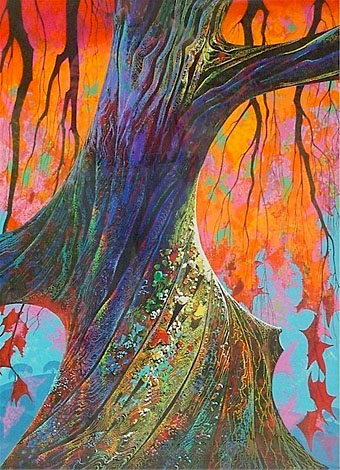
Fire, Red and Gold (1990) by Eyvind Earle.

Roger Penrose won a Nobel Prize recently for his work in physics. I read one of his books a few years ago, and was intimidated by the “simple” equations, but I always like to hear his ideas. This 2017 article by Philip Ball is an illuminating overview of Penrose’s life and work.

• At Dangerous Minds: Joe Banks on the incidents that led to Lemmy’s dismissal from Hawkwind in 1975, an extract from Hawkwind: Days of the Underground. The book is available from Strange Attractor in Europe and via MIT Press in the USA.

• “Not married but willing to be!”: men in love (with each other) from the 1850s on. It’s always advisable to take photos like these with a pinch of salt but several of the examples are unavoidably what they appear to be.

Most of all, this resolutely collaborative production stood against the vanity and careerism of individual authorship; Breton called it the first attempt to “adapt a moral attitude, and the only one possible, to a writing process.” The text itself is peppered with readymade phrases, advertising slogans, twisted proverbs, and pastiches of such admired predecessors as Rimbaud, Apollinaire, and Lautréamont, whose pluralistic credo, “Poetry must be made by all. Not by one,” anticipates the sampling aesthetic by a century. But the intensity was draining, and as the book moves toward its final pages and the writing becomes increasingly frenetic, you can almost feel the burnout taking hold. After eight days, fearing for his and Soupault’s sanity, Breton terminated the experiment.

Mark Polizzotti reviews a new translation by Charlotte Mandell of The Magnetic Fields by André Breton and Philippe Soupault

• The hide that binds: Mike Jay reviews Dark Archives: A Librarian’s Investigation into the Science and History of Books Bound in Human Skin by Megan Rosenbloom.

• “A photographer ventures deeper into Chernobyl than any before him.” Pictures from Chernobyl: A Stalker’s Guide by Darmon Richter.

John Van Stan’s reading of Frankenstein by Mary Shelley uses my illustrations (with my permission) for each of its chapters.

Susan Jamison, one of the artists in The Art of the Occult by S. Elizabeth, talks to the latter about her work.

William Hope Hodgson: The Secret Index. A collection of Hodgson-related posts at Greydogtales.

Gee Vaucher talks to Savage Pencil about her cover art for anarchist punk band, Crass.

Weird, wacky and utterly wonderful: the world’s greatest unsung museums.

Tom Cardamone chooses the best books about Oscar Wilde.

• At Dennis Cooper’s: Jean-Pierre Melville Day.

You by The Bug ft. Dis Fig.

Magnetic Dwarf Reptile (1978) by Chrome | Magnetic Fields, Part 1 (1981) by Jean-Michel Jarre | Magnetic North (1998) by Skyray

Weekend links 538

greenaway.jpg

The Elf Ring by Kate Greenaway.

• “Is it possible that the Victorian fairy tradition, beneath its innocent exterior, operated as a conduit for a hidden tradition of psychedelic knowledge?” Just in time for the British mushroom season, Mike Jay explores the connections between psychedelic mushrooms, folklore and fairy tales.

• “This second coming of Prince’s greatest album is the immaculate execution of a flawed conception: the belief that you can never have too much of a good thing.” Simon Reynolds on Prince and the expanded, multi-disc reissue of Sign O’ The Times.

• “An extraordinary stash of more than 400 erotic drawings by Duncan Grant that was long thought to have been destroyed has come to light, secretly passed down over decades from friend to friend and lover to lover.” Mark Brown on a trove of gay erotica.

• New art exhibitions: Wessel + O’Connor celebrates 35 years of homoerotic exhibitionism with 35 works by different artists; “masks a must”. And New Framing at Museum More includes a great painting by Jan Ouwersloot of trams manoeuvring at night.

• There is no Prog, only Zeuhl: A guide to one of rock’s most imaginative subgenres by Jim Allen. I recommend the Weidorje album.

The Power (Of Their Knowledge), another preview of the forthcoming album by Cabaret Voltaire (or Richard Kirk solo).

• RIP Eddie Van Halen. Annie Zaleski selects 10 of his best songs (really 9 plus an instrumental…).

• At Dennis Cooper’s: Spotlight on…Leonora Carrington The Hearing Trumpet (1976).

• Mix of the week: Autumn and Wise (The Fall) by The Ephemeral Man.

Abandoned Isle of Wight

Dark Side Of The Mushroom (1967) by Chocolate Watch Band | Mushroom (1971) by Can | Growing Mushrooms Of Potency (2011) by Expo ’70

Weekend links 536

peake.jpg

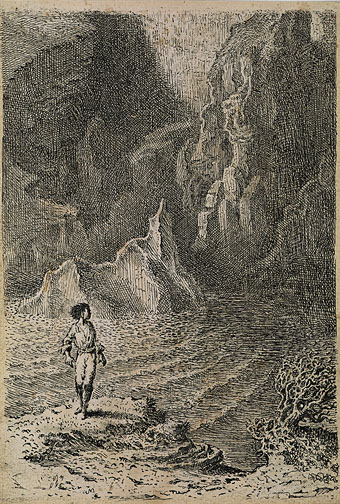
Jim Hawkins in Treasure Island. An illustration by Mervyn Peake, 1949.

• “Since it was 1967 when I became a teenager, I suspected that the Now would stir together rock ’n’ roll bands and mod girls and cigarettes and bearded poets and sunglasses and Italian movie stars and pointy shoes and spies.” Luc Sante on hs youthful search for The Now.

• “…in response to listener requests to play ‘more music like This Heat’, [John] Peel responded that he couldn’t because ‘nobody else sounds like them’.” Alexis Petridis on the mighty This Heat, the band who tried to change everything.

• “While I hesitate to deploy the overused and near-devalued word shamanic here, it does smell right. Or rite.” Ian Penman on the polychromatic delirium of Parliament and Funkadelic in 1970.

Anyway, we knew this new culture was there, we knew this phenomenon was occurring, centered in the Haight-Ashbury, so after this event, we dramaturges sat together and tried to think it out. What is this, in terms of breaking down the fourth wall? How is this a historical follow-through for Antonin Artaud on one hand and Bertrolt Brecht on the other? How did these two come together in this? What do you call this, when you provoke riots and use the audience as members of the cast? When you can stage events that brings the audience on the stage—but there is no formal stage? But it’s a theatricalized event…? It’s all new. So I called it ‘guerrilla theater.’ And Ronnie heard that phrase, and wrote an essay about doing Left provocative theater. That wasn’t what I saw. I saw it as being deeper than that. And I began writing plays that now were for sure plays except that a lot of the dialogue was spontaneously derived from the performers—we had some really great performers at the Mime Troupe at the time, I’d say there were at least a dozen good performers, and a couple who were really brilliant. Anyways, put these people together, I gave them a context, and we began improvising dialogue.

Peter Berg of the San Francisco Diggers talking to Jay Babcock for the sixth installment of Jay’s verbal history of the hippie anarchists

• “I love improvisation. I still do. For me it’s the way I like to be acting, you see.” RIP Michael Lonsdale, talking in 2015 about Jacques Rivette’s Out 1.

• “Would you find this bookstore beautiful or terrifying? Or both,” asks Jonny Diamond.

Yukino Ohmura uses stationery store stickers to create dazzling nightscapes.

• At Spine: Penguin Books celebrates 85 years with original artworks.

Strange Selectors by Various Artists on Werra Foxma Records.

Daisy Dunn on the gentle genius of Mervyn Peake.

• This Heat: Rimp Ramp Romp (1977) | Repeat (1979) | Makeshift Swahili (1981)

Ron Cobb, 1937–2020

cobb02.jpg

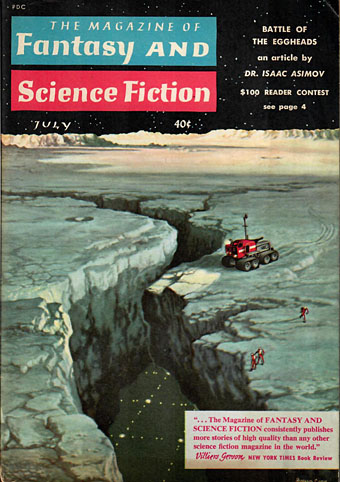
The Magazine of Fantasy and Science Fiction, July 1959.

The death of American illustrator/cartoonist/designer Ron Cobb was announced yesterday. All the obituaries are concentrating on the designs he produced for Hollywood feature films so here’s an alternative view of a long and varied career.

cobb01.jpg

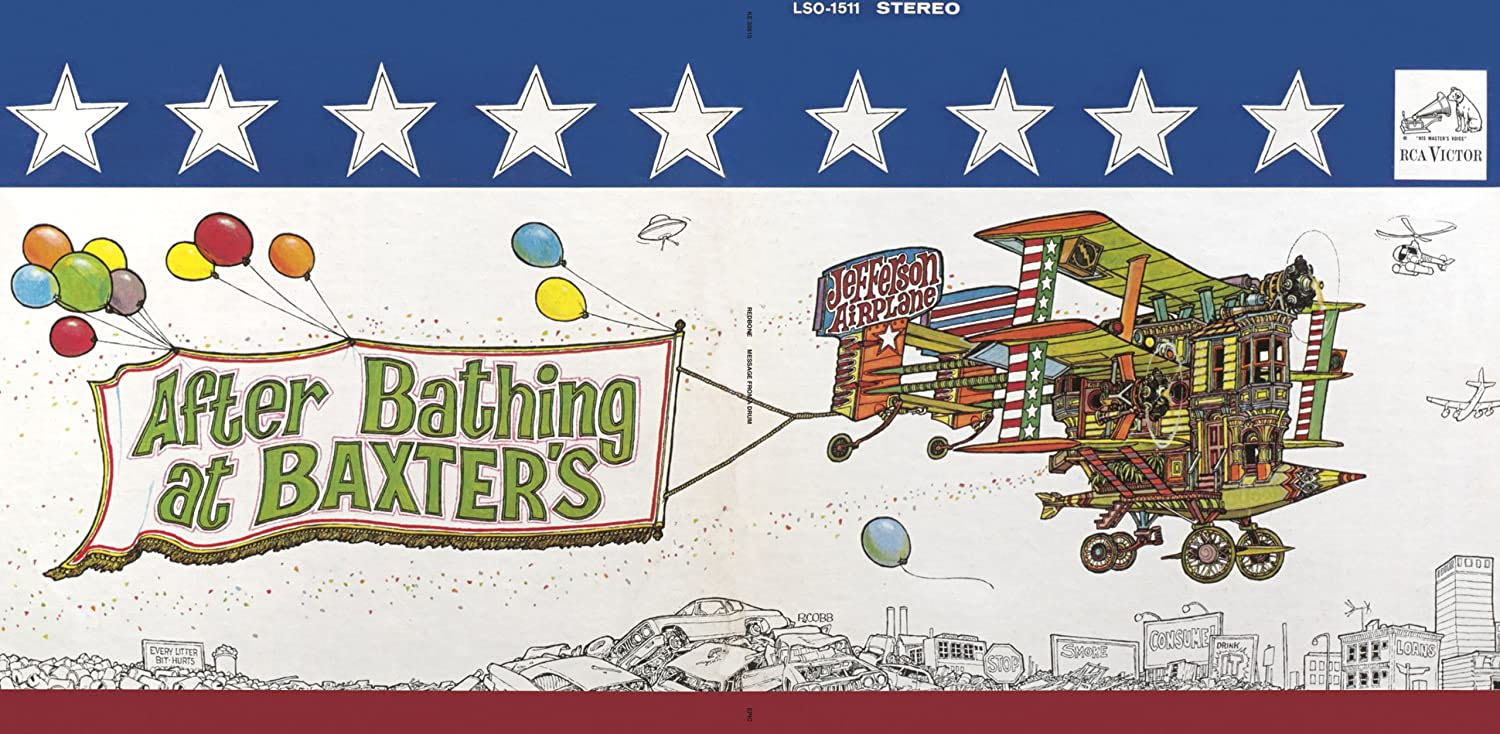
After Bathing At Baxter’s (1967) by Jefferson Airplane.

Cobb’s first album cover is his most famous, and probably his most familiar work outside his film designs, but there were a few more, some of which may be seen below. The San-Francisco-house-as-aircraft always reminds me of the car/plane hybrid piloted by Professor Pat Pending in the Wacky Races cartoons.

cobb04.jpg

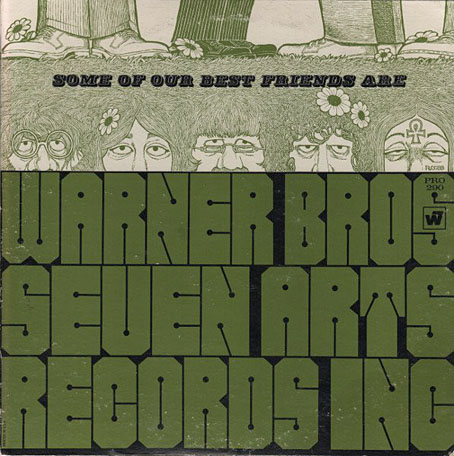
Some Of Our Best Friends Are (1968) by Various Artists.

cobb10.jpg

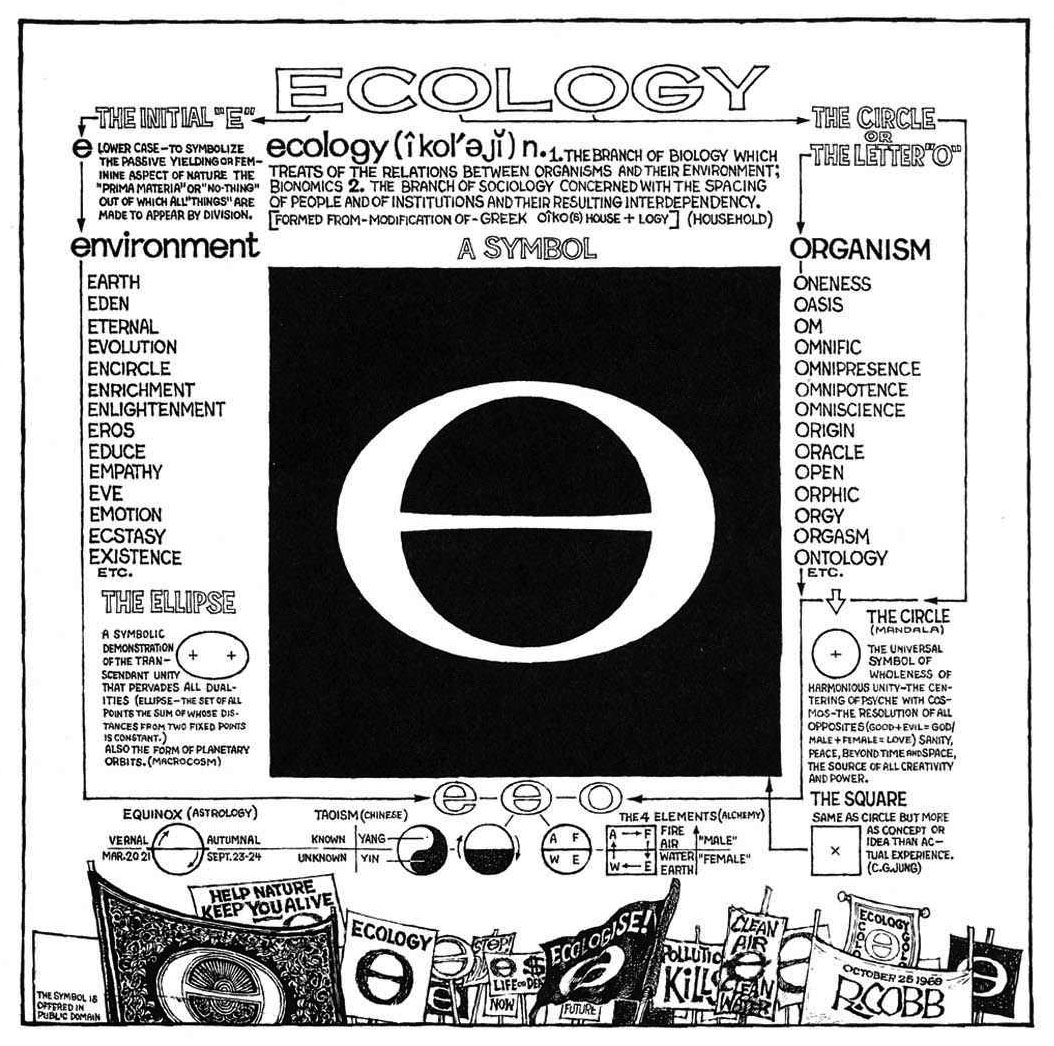
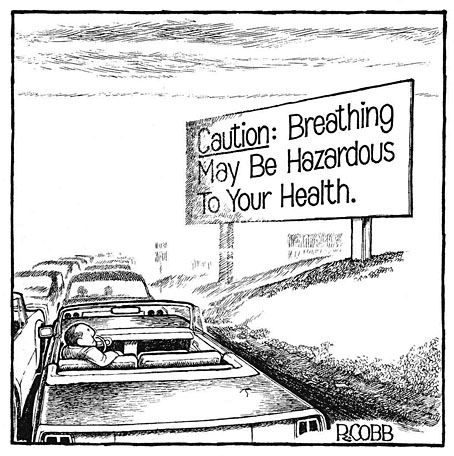
Ecology symbol, October 1969.

Cobb’s copyright-free design for an ecology symbol was published in the Los Angeles Free Press in November, 1969. The “Freep” also ran Cobb’s cartoons, some of which were later collected in The Cobb Book (1975). Satire has a tendency to date very quickly but many of Cobb’s barbs are still relevant today.

cobb07.jpg

Undated cartoon.

cobb05.jpg

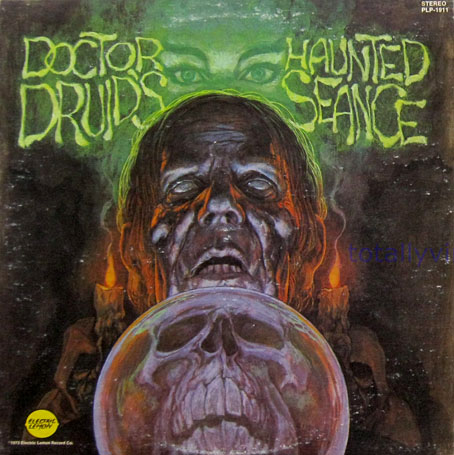
Doctor Druid’s Haunted Seance (1973).

Continue reading “Ron Cobb, 1937–2020”

Weekend links 535

beardsley.jpg

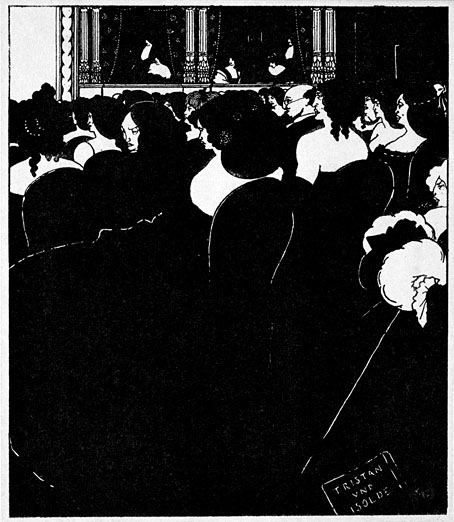
The Wagnerites (1894) by Aubrey Beardsley.

• “Part of my problem with influence is that the concept is too univocal; most of us are impacted by many others during our lifetimes, but often in oblique ways. So many of the most interesting bits of cultural transmission happen nonlinearly, via large groups of people, and in zigzag mutations. Assigning influence can also have the unintentional effect of stripping artists of their own originality and vision.” Geeta Dayal reviewing Wagnerism by Alex Ross.

• “Buñuel stubbornly refused to have any group affiliation whatsoever. Even though critics always tried to categorize him, he never wanted to explain the hidden meanings of any of his films and often denied that there were any.” Matt Hanson on the surreal banality of Luis Buñuel’s The Exterminating Angel.

• Next month Soul Jazz release the fourth multi-disc compilation in their Deutsche Elektronische Musik series devoted to German music from the 1970s and 80s. The third collection was the weakest of the lot so I wasn’t expecting another but this one looks like it may be better.

James Balmont chooses the five best films by Kiyoshi Kurosawa, who he calls “cinema’s master of horror”. I’ve yet to see any of these so I can’t say whether the label is warranted or not.

• At Wormwoodiana: Mark Valentine in a two-part post here and here charts the emergence of an under-examined sub-genre, the metaphysical thriller.

• Power Spots: 13 artists choose favourite pieces of music by Jon Hassell. A surprising amount of interest in his first album, Vernal Equinox.

• At Spine: George Orwell’s Animal Farm receives new cover designs for its 75th anniversary.

• “Pierre Guyotat’s work is more relevant now than ever,” says Donatien Grau.

• Mix of the week: FACT mix 775 by Sarah Davachi.

May 24th by Matthew Cardinal.

• Ry Cooder with Jon Hassell & Jim Keltner: Video Drive-By (1993) | Goose And Lucky (1993) | Totally Boxed In (1993)