Weekend links 574

vyletal09.jpg

Poster for Beauty and the Beast (1978) by Josef Vyletal.

• Next month, Second Run release Juraj Herz’s 1978 adaptation of Beauty and the Beast on region-free blu-ray. I watched this last year on a Czech DVD so it’s good to hear it’s being given an upgrade. Herz’s film is a distinctly sinister take on the familiar tale, with a bird-headed Beast that’s closer to Max Ernst than anything you’ll find in illustrations for Perrault’s stories.

• “In a coincidence so unlikely it almost seems, well, magical, the girls traced illustrations from a book of folklore that also contained a short story by Sir Arthur Conan Doyle himself, a reflection of a reflection of a reflection.” Audrey Wollen on the Cottingley fairy photographs. Related: The Coming of the Fairies by Arthur Conan Doyle.

• “[Mark E. Smith], with his love of Stockhausen, HP Lovecraft, and (bizarrely) the sitcom Keeping Up Appearances, becomes a reverse coder, an apostle of avant pulp, a ‘paperback shaman’.” Sukhdev Sandhu reviews Excavate! The Wonderful and Frightening World of the Fall, edited by Tessa Norton and Bob Stanley.

• “Found photos of men in love from 1850–1950“. Maybe. As before, I’m always cautious about imposing a narrative on old photographs.

• Mixes of the week: A mix for The Wire by Pamela Z, and a dose of post-punk esoterica by Moin for XLR8R.

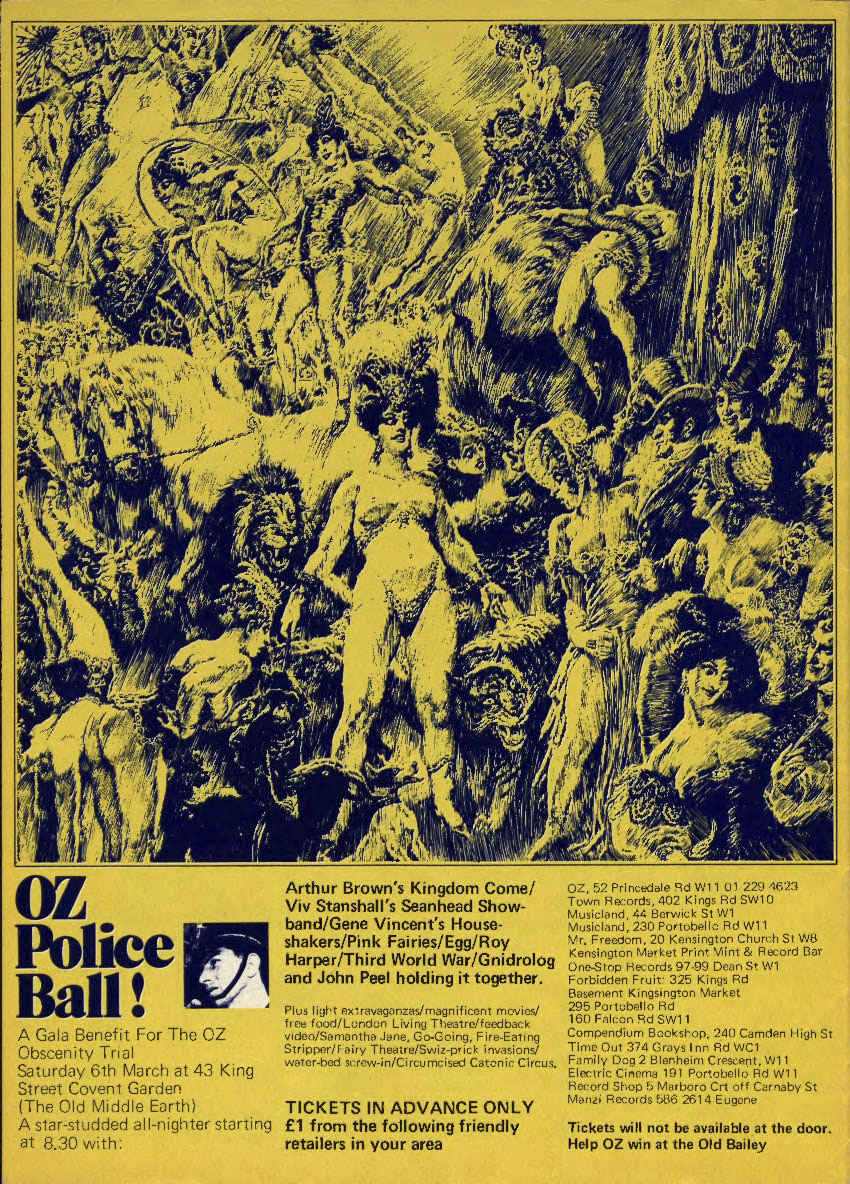
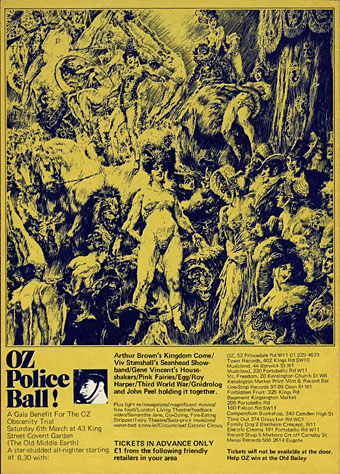
DJ Food takes another dive into back issues of International Times in search of ads for London’s Middle Earth club.

• At The Smart Set: Colin Fleming watches John Bowen’s drama of pastoral horror, Robin Redbreast.

• At Dennis Cooper’s: Heavily plotted non-linear structures whose velocity lacks narrative drive.

Ryan Gilbey attempts to rank Robert Altman’s features into a list of 20 best.

• Still Farther South: Poe and Pym’s Suggestive Symmetries by John Tresch.

• New music: At One Point by Scorn.

Visionist‘s favourite albums.

The Beast (1956) by Milt Buckner | Leggo Beast (1978) by Gregory Isaac’s All Stars | This Beast (1983) by Tuxedomoon

Paul Delvaux ou les Femmes Défendues

delvaux1.jpg

Henri Storck’s short film from 1971 is mostly an overview of Paul Delvaux’s irreducibly mysterious paintings but the first 7 minutes are invaluable for the views they give of the artist at work. I’m always interested in the technical details of painting but these are seldom mentioned in art books which tend to be more concerned with discussions of meaning and artistic intent. So here we see Delvaux sketching, then leafing through a collection of preliminary studies before finally dabbing at a figure on a large canvas in his skull-filled studio.

delvaux2.jpg

The rest of the film is taken up with shots that roam over many of the artist’s earlier paintings. I don’t have any books about Delvaux so there are more of his pictures here than I’ve seen in one place, all of them displaying the familiar nocturnal enigmas: somnambulist nudes, trains, moonlight, Classical architecture and so on. The voiceovers, including that of the artist, are in unsubtitled French but the film is available with subtitles as part of a DVD collection of films about Belgian artists and cultural figures directed by Storck and others. One for the shopping list.

Previously on { feuilleton }
Raoul Servais: Courts-Métrages
The mystery of trams
Temptations
Papillons de Nuit, a film by Raoul Servais
Paul Delvaux: The Sleepwalker of Saint-Idesbald
Ballard and the painters
Taxandria, or Raoul Servais meets Paul Delvaux

Weekend links 571

valck.jpg

Habit d’Astrologue (c. 1700) by Gerard Valck.

• “The Appointed Cloud begins with the high-pitched, keening sound of many bagpipes noisily playing at once—and then the music slowly coalesces, approaching a peaceful, tranquil hum. This gives way to fast-paced repetitive pulses, reminiscent of the minimalist works of composers such as Terry Riley and Philip Glass. Then the bagpipes join in once more, in a ferocious swarm of energy.” Geeta Dayal on the music of Yoshi Wada.

• “How can we conceive of the time of climate change, the time of planetary death? The House on the Borderland tried to conceive of exactly this a century ago. Yes, the narrator’s acts are fruitless. He gets haplessly carted about the universe to witness the end of time, which never really ends, is always at the edge, nearing an asymptote, on the borderland.” Namwali Serpell journeys through space and time with William Hope Hodgson.

• The Bureau of Lost Culture: DJ Food hosts a podcast discussion with Tony Bennett, founder and publisher of Knockabout Comics.

• Mixes of the week: Isolated Mix 111 (plus interview) by Ian Boddy, and a Wire mix (plus interview) by Teresa Winter.

• Fantastic visions and unknown worlds: Edwin Pouncey on Van Der Graaf Generator’s sleeve art.

• At Spoon & Tamago: Sculptor Kenichi Nakaya reconfigures ubiquitous Japanese rural crafts.

• My Bloody Valentine’s Kevin Shields: “We wanted to sound like a band killing their songs.”

• At Wormwoodiana: More earth mysteries are explored in Northern Earth magazine.

• New music: Black Horses Of The Sun by Dave Bessell.

The Exotica Project: One Hundred Dreamland 45s

• At Dennis Cooper’s: Hans Richter Day.

Mdou Moctar‘s favourite music.

Earth Floor (1985) by Michael Brook | Earth Tribe (1993) by Transglobal Underground | Earth Lights (2012) by Belbury Poly

Weekend links 570

griffin.jpg

Rick Griffin’s comic-style poster for The Quicksilver Messenger Service at the Avalon Ballroom, October 1967.

• “Like ‘perversion,’ the word ‘script’ has a special meaning for Escoffier, who devotes most of the book’s attention to films featuring sex between men, and treats pornography as a vast screen on which all of our fantasies are projected.” Steve Susoyev reviews Sex, Society, and the Making of Pornography by Jeffrey Escoffier.

• “The themes reflect Griffin’s core obsessions: sex, death, Christ, flesh, liquids, goofy japes, and lysergic gnosis. Man from Utopia is an opus, one that Griffin felt strongly enough about to eschew the usual pulp, printing the cover on good full-color card stock.” Erik Davis on Rick Griffin and a comic book like no other.

Strange Things Among Us, a summer exhibition at The College of Psychic Studies, London, will include among its exhibits a room of art by Austin Osman Spare.

She delighted in the fact that after The Sadeian Woman, she ended up on the mailing lists of both pro- and antiporn groups, though no one (alas) ever sent her any actual porn. She aligns more naturally in retrospect with Madonna—potent, fiercely individualistic, disruptive, and self-invented. Carter’s evolved philosophical position on gender was a variation on Stoicism. Gender roles were “behavioural modes,” a construct (“Baby is hermaphrodite!”), and there was weakness in allowing oneself to be beholden to (let alone enslaved by) a construct. Above all, women should have total sexual agency and also their own money. “I became a feminist,” she wrote in a postcard to Susannah Clapp, “when I realised I could have been having all this instead of being married.”

Minna Zallman Proctor on the life and work of raucous fabulist Angela Carter

• New music: Chapter 4 by the Moritz Von Oswald Trio with Heinrich Köbberling & Laurel Halo, and Synth Vehicles For Guitar by Michael C. Sharp.

• DJ Food searched the back issues of International Times to find a handful of adverts for London’s legendary UFO Club.

• At Wormwoodiana: Mark Valentine explores Hy Brasil, a novel by Margaret Elphinstone.

• Remembering Tom of Finland through stories of those who knew him.

• What I’m Aiming For: Peggy Seeger’s favourite music.

• At Dennis Cooper’s: The Light Show (1965–1971).

• Mix of the week: Haze by The Ephemeral Man.

• A Strange Light From The East (1967) by Tuesday’s Children | Strange Things Are Happening (1968) by Rings & Things | Strange Walking Man (1969) by Mandrake Paddle Steamer

Max Ernst by Peter Schamoni

me1.jpg

The English version of Peter Schamoni’s feature-length documentary from 1991 has finally reached YouTube. I think copyright reasons may have prevented it from doing so in the past in which case the usual caveats apply: if it’s of interest then watch it while you have the opportunity, it may not be there for long. The German version of the film has a longer title, Max Ernst: Mein Vagabundieren—Meine Unruhe, which auto-translates to “my vagabondingmy restlessness”, a reference to Ernst’s peripatetic life as well as to his artistic wanderings.

me2.jpg

I mentioned in the previous post my having spent some time last year watching a number of documentaries about Surrealism. This was one of them, and it’s the film about Max Ernst. Films about Salvador Dalí are plentiful but other Surrealist artists are lucky if they receive a single worthwhile appraisal. Peter Schamoni had filmed Ernst in 1966 for a short, Maximiliana oder die widerrechtliche Ausübung der Astronomie, so was already sympathetic to the artist’s work. Max Ernst resembles one of the BBC’s classic Arena documentaries in being a biographical account threaded with documentary material and pictures of significant artworks. Detail is supplied by actors reading from writings by Ernst, Dorothea Tanning and others.

me3.jpg

There’s a lot of interview footage here, mostly from TV appearances in later life, in which Ernst’s intelligent conversation makes a striking contrast to Dalí’s bluster and evasions. Schamoni interleaves the historical footage with shots of the various locations of Ernst’s wanderings: the south of France, New York City, California, Arizona, Paris. Several of the Dalí documentaries note the degree to which the coastal landscape of Cadaqués informed Dalí’s painting; Schamoni makes a similar comparison between Ernst’s American paintings and the desert landscapes of Arizona. It’s good to see some of the Microbes that he painted while he was there, a series of tiny landscape pictures that books about Ernst don’t always mention, let alone reproduce.

Previously on { feuilleton }
The nightingale echo
Max Ernst’s favourites
Viewing View
Max Ernst album covers
Maximiliana oder die widerrechtliche Ausübung der Astronomie
Max and Dorothea
Dreams That Money Can Buy
La femme 100 têtes by Eric Duvivier