
How the West was written | Dario Argento and his work for Once Upon a Time in the West.
Category: {film}
Film
Scorsese: my friendship with Michael Powell
Scorsese: my friendship with Michael Powell | Marty, Michael and the splendour of The Red Shoes.
Kenneth Anger on DVD again
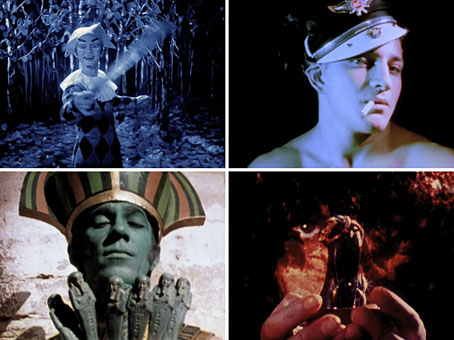
Nearly two years after their American release, and not a moment too soon, the films which comprise Kenneth Anger‘s superb Magick Lantern Cycle turn up at last in the UK. Good to see these being produced by the BFI, their previous collections of shorts by the Brothers Quay and Jan Švankmajer are distinguished by quality transfers, great packaging and very thorough documentation. Surprising, then, that the box art of the BFI set is rather naff-looking compared to the Fantoma releases. On the plus side, those of us in Region 2 receive the additional extra of an Anger documentary by Elio Gelminis. The BFI is also making these films available for the first time on Blu-ray. Now I’m hoping they might get round to doing a decent job with all the films of Sergei Parajanov, especially that cult favourite of mine, Shadows of Our Forgotten Ancestors.
Renowned as the author of the scandalous best-selling book Hollywood Babylon, Kenneth Anger is a legend in this own time. The mythology that has grown around him has many sources, from his involvement with the occult, astrology and the pop world of Mick Jagger, Marianne Faithfull and Jimmy Page, to the announcement of his own death in the pages of the Village Voice, and the destruction, loss and banning of his films. At the heart of all this mythology is a filmmaker of prodigious talent, whose skill and imagination create films of great visual force, influencing filmmakers such as Martin Scorsese, David Lynch and RW Fassbinder.
Disc one:
* Fireworks (1947)
* Puce Moment (1949)
* Rabbit’s Moon (1950/1971, the rarely seen 16mins version)
* Eaux d’Artifice (1953)
* Inauguration of the Pleasure Dome (1954)
* Scorpio Rising (1964)
* Kustom Kar Kommandos (1965)
* Invocation of My Demon Brother (1969)
* Rabbit’s Moon (1979 version)
* Lucifer Rising (1981)Disc two:
* Anger Me (2006) – Elio Gelminis documentary on Kenneth AngerExtras
* Newly recorded commentaries by Kenneth Anger
* The Man We Want to Hang (2002) – Anger’s film on the paintings of Aleister Crowley
Previously on { feuilleton }
• Mouse Heaven by Kenneth Anger
• The Man We Want to Hang by Kenneth Anger
• Relighting the Magick Lantern
• Jan Švankmajer: The Complete Short Films
• Kenneth Anger on DVD…finally
• The Brothers Quay on DVD
Tunnel 228
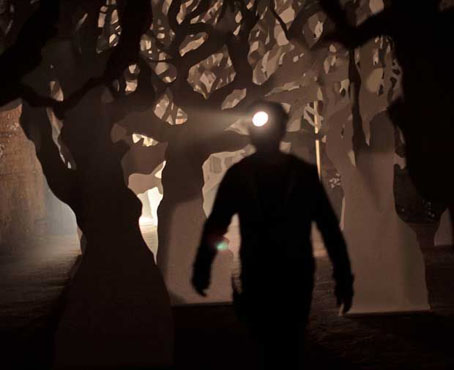
Lightning & Kinglyface’s paper forest; photo by Jeff Moore.
Tunnel 228 is a collaboration between Kevin Spacey in his position as artistic director of the Old Vic Theatre, and experimental theatre company Punchdrunk staging an art installation/performance work in tunnels beneath Waterloo, London. Mention of the magic word “Metropolis” (in its Fritz Lang context) caught my attention, the network of tunnels being filled in part by the sounds of clanking machinery. Visitors get to explore the paper forest shown above and may also see:
…tiny models of people in hidden nooks…a gilded statue of two fighting angels…spooky dummies of masked workers by artist Mark Jenkins, and bizarre still scenes, including a woman slumped over a melting table, by Polly Morgan.
The show runs from May 8th for fifteen days and is free but already seems to be fully booked going by the frustrated comments on this page. The rest of us will have to be intrigued by photos and hope that events such as this inspire artists and theatre groups elsewhere.
• Tunnel vision of underground art | Guardian feature.
Previously on { feuilleton }
• Polly Morgan, fine art taxidermist
• Metropolis posters
Alice in Wonderland by Jonathan Miller
I said, “Girl, you drank a lot of Drink Me,
But you ain’t in a Wonderland
You know I might-a be there to greet you, child,
When your trippin’ ship touches sand.”Donovan, The Trip (1966)
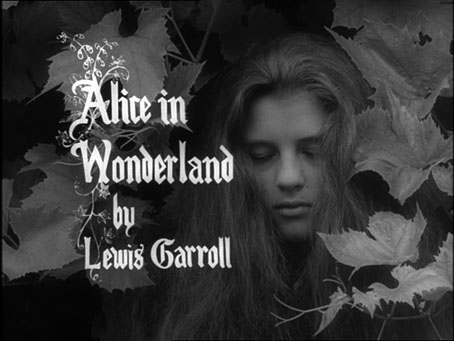
Most of the key texts of the psychedelic period tend to be either non-fiction—Aldous Huxley’s Doors of Perception, Timothy Leary’s The Psychedelic Experience—or spiritual works such as The Tibetan Book of the Dead, the volume upon which Leary’s book is based and which subsequently provided John Lennon with lines for Tomorrow Never Knows. The key fictional work of the era has to be Lewis Carroll’s Alice in Wonderland, a fact that would no doubt have surprised the book’s legions of enthusiastic Victorian readers, never mind its author. Grace Slick created the definitive Alice song with White Rabbit in 1965, written while she was with the Great Society but only recorded properly in 1967 after she’d joined Jefferson Airplane. But Alice’s adventures run a rich seam of Victorian whimsy through the music of 1966 to ’69, especially among the British bands whose lyrics tend to be far more childish and frivolous than their American counterparts. Donovan probably got there first among the Brits with The Trip on his Sunshine Superman album. Among the profusion of later references can be found one-off singles such as Alice in Wonderland (1967) by the Dave Heenan Set (who recorded songs for the Barbarella soundtrack as The Glitterhouse) and Jabberwock/Which Dreamed It? (1968) by Boeing Duveen & The Beautiful Soup, a band whose songwriter is better known today as Hank Wangford.