Vickers Airship Catalogue

vickers1.jpg

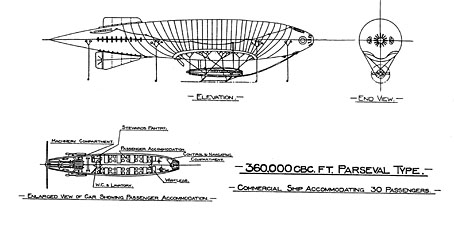
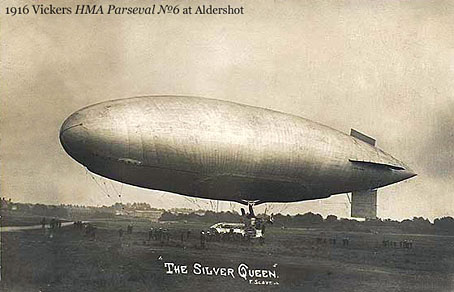
Just the thing for when you need to build your own… From a page of plans at Forgotten Futures. The photo of the Vickers Parseval craft is from this early aviation archive.

vickers2.jpg

Meanwhile, my good friend Ed alerted me to a documentary film which will be released in March this year. Farewell is directed by Ditteke Mensink and uses archive footage to tell the story of Lady Grace Drummond-Hay, the only female passenger on the first journey around the world of the Graf Zeppelin in 1929.

The voyage took 21 days and started off in New York. Via Friedrichshafen in Germany, across Siberia to Tokyo, across the Pacific Ocean to Los Angeles, the airship finally arrived back in New York greeted by much cheering and a ticker tape parade. During the adventurous trip the printing presses were working overtime, as it was followed closely and covered extensively. The voyage was a symbol of both technological progress and the improved relationship between two great nations: the United States and Germany. The outside world is unaware of the passionate love affair between Grace, a young widow, and Karl, a married man.

More at the film’s page here which includes a trailer. Looks fascinating, I’d love to see it.

Previously on { feuilleton }
The Air Ship
Dirigibles
La route d’Armilia by Schuiten & Peeters
The Airship Destroyer
Zeppelin vs. Pterodactyls

Burroughs: The Movie

burroughs.jpg

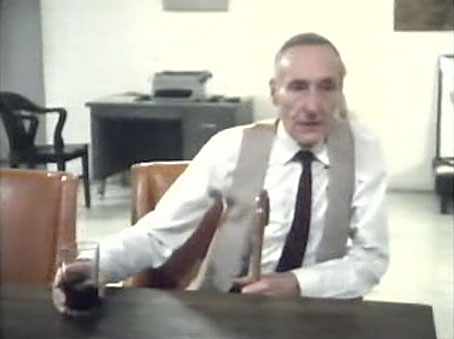
The author at home in his Bunker.

When I was writing last August about Yony Leyser’s new Burroughs documentary William S Burroughs: A Man Within I mentioned Howard Brookner’s 1983 film, Burroughs, a 90-minute study of the writer’s life and work that as a film biography remains definitive. Brookner was fortunate to capture all the surviving Beats (including Ginsberg and Gysin) and also family members like Burroughs’ son, William Jr. (who died shortly after filming), and his brother, Mortimer. If you’re interested in Burroughs and have never seen Brookner’s film it’s essential viewing, so it’s good news that Ubuweb has turned up a blurry copy (which they’ve titled Burroughs The Movie) taken from the BBC’s Arena screening shown after the writer’s death in 1997. As I recall, the beginning is slightly re-edited to make it an obituary piece but the rest of the film is complete.

Update: Ubuweb no longer hosts the film now that a reissue has been announced. The links have been removed here as a result.

Elsewhere on { feuilleton }
The William Burroughs archive

Peter Edwards times two

edwards1.jpg

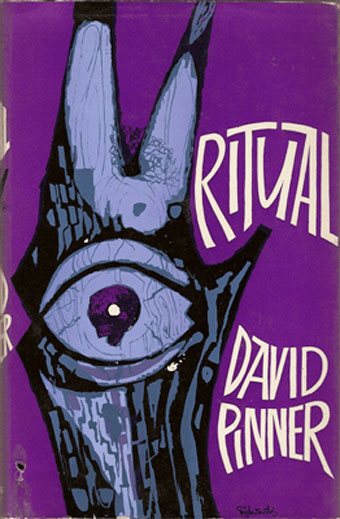
Sometimes it pays to have an unusual name… Ritual is a 1967 novel by David Pinner which has been claimed on many occasions to be the original source for the story which Anthony Shaffer wrote as The Wicker Man. An illustrator named Peter Edwards was responsible for the cover graphic and possibly the hand-drawn type as well. Searching for more of his work turned up this elegant cover for an Everyman title (at this rather tasty illustration blog) but little else.

edwards2.jpg

Metatron’s Cube.

There is, however, a younger Peter Edwards who also happens to be an illustrator with a website here and an example of his work above. Are the two related, perhaps? In addition to this pair there’s a third Peter Edwards who paints portraits. Pity the poor artist trying to carve a niche for his or herself among a host of similarly-named contemporaries.

Elsewhere on { feuilleton }
The book covers archive
The illustrators archive

Previously on { feuilleton }
The music of The Wicker Man

Roger Dean: artist and designer

Kieran at Sci-Fi-O-Rama was in touch recently asking me to contribute a paragraph about a favourite Roger Dean picture for this feature about the artist. The following splurge of polemic was the result, something I’d been intending to write for a while. Since so many words would have overwhelmed the other contributions it’s being presented here while Kieran’s post has a variety of shorter appreciations and further examples of Dean’s art and design.

dean1.jpg

Pathways (1973). A slightly reworked version of the original painting.

“Science fiction is unfortunate in having a most unsatisfactory framework of existence—it’s considered literary kitsch. I believe it should be the mainstream of literature because all the books that have become important down the generations of civilisation have been books about ideas. Superficially, science fiction would seem to offer the most scope for idea content, but the promise is unfulfilled. Good ideas and good writing rarely coincide. All too often the medium is used for entertainment alone and its potential beyond this should be obvious to everyone. I don’t just mean in the sense of fantasy technology. The potential for anticipating human evolution is there and perhaps the means to bring it about and definitely the means to bring about a social evolution.”

Roger Dean, interviewed in Visions of the Future (1976).

If popularity is often a curse as well as a blessing, it’s been Roger Dean‘s curse to see his work dismissed along with many other products of a decade—the 1970s—with more than its share of cultural heroes and villains. Music journalists in Britain have for years given the impression that the arrival of the Sex Pistols in 1976 swept away all that preceded them, in particular bands such as Yes whose album covers had helped raise the visibility of Dean’s art to an international level. This is not only a lazy assumption, it’s also wrong. When Yes released Going For the One in 1977 it was their first studio album in three years, yet despite the punk explosion it went to no. 1 in the UK album charts, while a rare single release from the band made the UK top ten. Yes were playing sell-out tours in Europe and the US in 1977 and 78, as were Pink Floyd whose The Wall was massively popular worldwide in 1979. Punk didn’t sweep prog away, what happened with its advent was that progressive rock and everything associated with it—Roger Dean’s art included—became critically disreputable almost overnight, such that no music journalist would dare say anything good about it. That disrepute has persisted for thirty years despite a lasting and indelible influence. This is an old argument but some facts often need restating anew. *
dean6.jpg

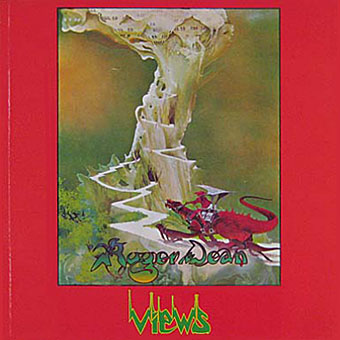
Views (1975).

I was 13 in September 1975 when Roger Dean’s first collection of his illustration and design work, Views, was published. At that time, I hadn’t heard any of the music to which his paintings and drawings were attached, and I didn’t even see a copy of the book until February 1976 when I happened to be in London on a school trip and found a big pile of what I guess was the second edition in Foyle’s book shop. This appeared at exactly the right moment. I wasn’t listening to the music but I was reading a lot of science fiction, and was starting to notice and imitate the work of various paperback artists. I recognised many of the pictures in Views from the covers displayed in the window of our local record shop, Cobweb, whose shopping-bag logo was a cowled magician figure à la Dean or Rodney Matthews. It’s difficult to say what struck me about Dean’s work at the time since you rarely articulate your preferences at that age. I think I liked the consistency of vision and the invention which blended the organic and mechanical, the architecture which looked at once ancient and futuristic, and the flat landscapes which put lone pine trees into rocky terrain familiar from Japanese and Chinese prints. For a teenager his style was also relatively easy to imitate if you forgot about basic things such as imagination and finesse, and I spent a year producing a lot of badly-drawn reptiles posed against lurid watercolour skies.

Continue reading “Roger Dean: artist and designer”

Queer Noise in Manchester

queer_noise.jpg

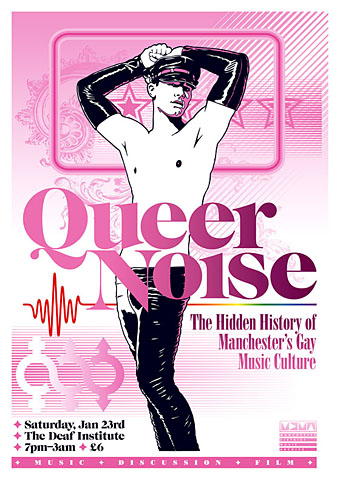
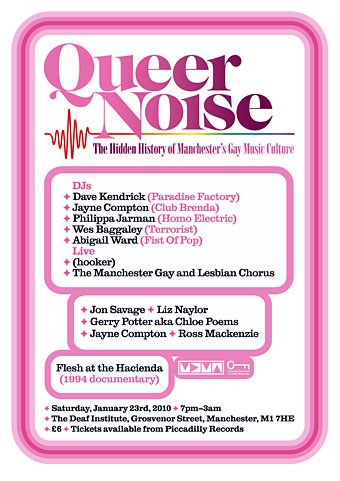
A reminder that the Manchester District Music Archive‘s Queer Noise event (for which I designed posters and flyers) takes place this Saturday.

Join us on Saturday 23rd January 2010 at The Deaf Institute for a one-off celebration of gay music in Manchester.

The line-up includes:
DJs: Dave Kendrick (Paradise Factory) • Jayne Compton (Club Brenda) • Philippa Jarman (Aytoun/Homo Electric) • Wes Baggaley (Terrorist)

Live Music: (hooker) • The Manchester Lesbian and Gay Chorus

Discussion: Jon Savage • Dave Kendrick • Liz Naylor • Jayne Compton • Gerry Potter aka Chloe Poems

Tickets are £6 are now available from Piccadilly Records.

ONLINE EXHIBITION
We will follow this event with an online exhibition scheduled for March 2010, curated by Jon Savage. If you have any flyers, posters, photos, footage or info relating to gay music in Manchester from the 1940s onwards, do get in touch at: info@mdmarchive.co.uk

queer2.jpg

Previously on { feuilleton }
Queer Noise and the Wolf Girl