Mind the doors!

andreev1.jpg

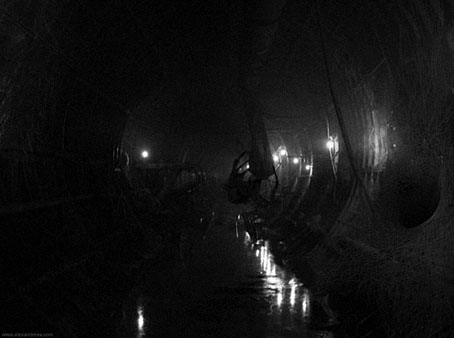
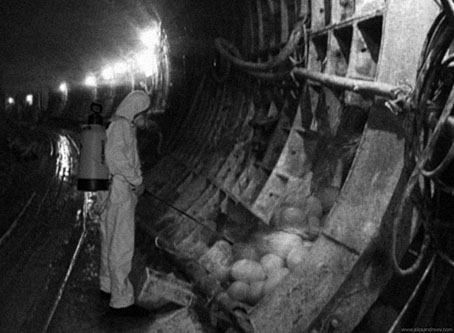
Russian artist Alexey Andreev populates the Moscow Metro with eldritch weirdness in a photo-collage series he calls Metronomicon. A couple of these pieces remind me of Clive Barker’s throat-grabbing story, The Midnight Meat Train, which was filmed a couple of years ago. For an earlier cinematic example of the horror inherent in underground transport systems there’s Gary Sherman’s Death Line, or Raw Meat as it was fatuously rebranded for the US, a very effective low-budget film from 1972. Fantastic Voyages reviews it here.

Andreev tip via MetaFilter.

andreev2.jpg

Previously on { feuilleton }
Subterrania
Tunnel 228

The Thief of Bagdad

thief2.jpg

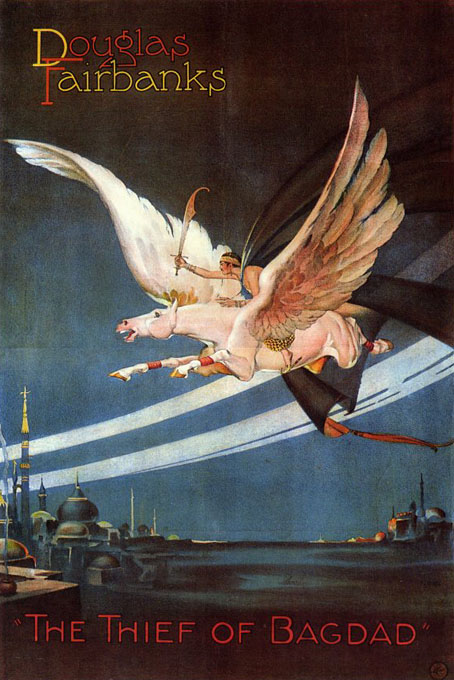
It’s the poster for the 1924 film version we’re concerning ourselves with here, not the more popular 1940 adaptation directed by Michael Powell. Both films are great but I have a special affection for Raoul Walsh’s silent version and this poster design has long been a favourite for the way it manages to condense the film’s blend of storybook graphics and Art Deco exotica. I’d wondered for years who was responsible for this design; according to various poster sites it’s the work of the film’s art director Anton Grot (1884–1974). This is one of several variations (there another here and one here) and there’s also a less interesting design which is far more typical of the period.

I often recommend the 1924 Thief of Bagdad as an introduction to silent cinema, especially if you can find a decent print. Fairbanks’ production had William Cameron Menzies as production designer and his sets are enormous Arabian Nights confections replete with minarets, onion domes and filigree screens like something from an Edmund Dulac illustration. Fairbanks gives a tremendously athletic performance and the marvellous Anna May Wong plays a Mongolian slave girl. There’s a lengthy description of the film’s production here while you can find a copy of the entire film at the Internet Archive although it really ought to be seen in a version which isn’t blighted by a company logo throughout.

Previously on { feuilleton }
More Arabian Nights
Edward William Lane’s Arabian Nights Entertainments
Alla Nazimova’s Salomé
Metropolis posters

The Epigenesis by Melechesh

epigenesis.jpg

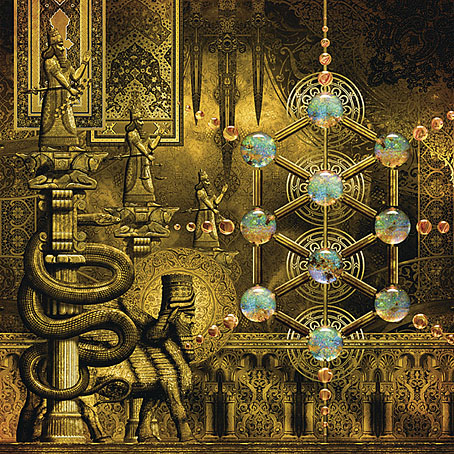
This new piece of work, a cover illustration for metal band Melechesh, was still in progress only a month ago but the album in question, The Epigenesis, has been announced so I can post it here. This follows a design I produced for an earlier Melechesh album, Emissaries, in 2006, both of which refer to the Sumerian mythology which powers the band’s music. There’s some vague Parajanov influence in this piece which isn’t the kind of thing that usually extends to the metal world but Sergei Parajanov’s films were one of the reference points the band offered. The suspended carpets at the top left are the most obvious allusion to the director but for the composition as a whole I also had in mind the tableaux scenes he creates in The Colour of Pomegranates and other films.

The Epigenesis will be released on the Nuclear Blast label on October 1st, 2010.

Elsewhere on { feuilleton }
The album covers archive

Previously on { feuilleton }
Short films by Sergei Parajanov
New things for October

Weekend links 24

early.jpg

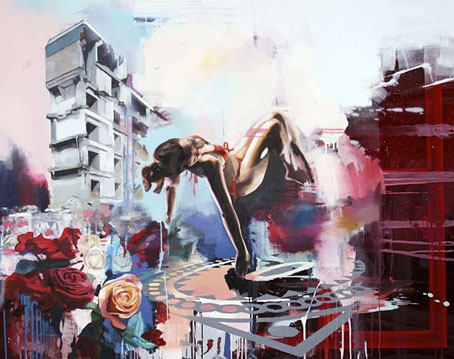
Delta-Wing (2009) by Chloe Early.

• “Feted British authors are limited, arrogant and self-satisfied, says leading academic”. Stating the bleeding obvious but it still needs to be said, apparently, especially when the announcement of the Booker list this year caused the usual confusion when Amis Jr. and McEwan weren’t included, as though the mere existence of their novels makes them prize-worthy. And as someone pointed out, the word “male” is missing from that headline.

Hero of Comic-Book World Gets Real: Alan Moore again, in the NYT this time. Related: a review of Unearthing live.

• Announcing The Hanky Code by Brian Borland & Stephen S Mills, a 40-poem book to be published next year by Lethe Press. For an explanation of the Hanky Code there’s this, and there’s also an iPhone app.

Folk—the ‘music of the people’—is now hip again, says (who else?) Rob Young who can also be heard on the archived podcast here. Related: the folk roots of Bagpuss. Related to the latter: The Mouse Mill.

zvorykin.jpg

An endpiece from The Firebird and other Russian Fairy Tales by Boris Zvorykin.

‘Yes’ to Catastrophe: Roger Dean, Prog and SF. A lengthy and thoughtful analysis of Roger Dean’s early work.

Into the Media Web, the enormous Michael Moorcock book which I designed, is officially published this week.

Cassette playa: in praise of tapes. I’ve complained about tapes in the past but people continue to find them useful. Some technologies die harder than others.

Boy BANG Boy: “Quiet moments made suddenly very loud with the attitude and opinion of what it means to be a young male in an impossibly diverse world.” An exhibition opening at Eastgallery, London, on August 5th.

Empty your heart of its mortal dream: Alfred Kubin’s extraordinary novel, The Other Side.

Ghostly and Boym Partners devise a new way to deliver digital music.

Besti-mix #27: a great selection by producer Adrian Sherwood.

Agnostics are troublemakers. Amen to that.

• RIP Harry Beckett.

Acousmata.

Let Us Go In To The House Of The Lord by Pharoah Sanders (live, 1971): Part 1 | Part 2

The Lady Is Dead and The Irrepressibles

lady1.jpg

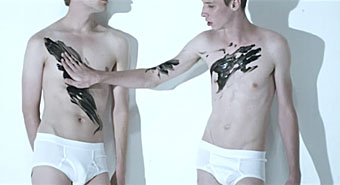
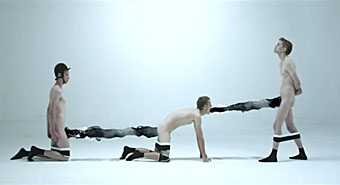
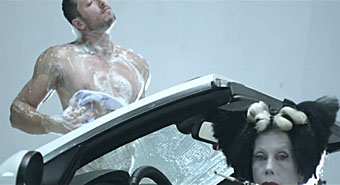
The lady may be dead but the art here is very much alive. The second great video of the week comes via the always essential Homotography, a short piece by director Roy Raz whose film features a pair of tattooed lesbians, a tennis match involving meat (or something), boys stripping out of their underwear to indulge in some peculiar—and for all we know, metaphysical—sexual congress, an elderly lady dancing round a piano, and a gang of luscious hunks who soap a car before sponging down their own bodies.

lady2.jpg

Do we have to worry about What It All Means? Of course we don’t, although the usual crowd of bewildered YouTube commenters struggle with comprehension like medieval rustics attempting to decipher so many signs and wonders. Think of it as the kind of thing Wes Anderson might create if someone dosed him with psychotropic chemicals that also turned him gay.

lady3.jpg

More important for me is the utterly fantastic song which Roy Raz uses, a number entitled In This Shirt by a ten-piece British group, The Irrepressibles, whose name I recognised but whose music I hadn’t heard until this. Lead singer Jamie McDermott’s voice is very reminiscent of Antony Hegarty which is no bad thing, although McDermott is probably weary of the comparison. Our musical culture would be greatly improved by more people taking their lead from Antony. The Irrepressibles’ site has a Soundcloud page where you can hear other songs from their recent Mirror, Mirror album, the CD of which is now on my shopping list. They also have a couple of videos showing their live performances which look rather spectacular. 2010 is turning out to be a good year for British music; when that music comes with cute guys attached it’s an added bonus.

lady4.jpg

Update: Roy Raz’s film is now also on Vimeo with other of his works.