Weekend links 664

warburton.jpg

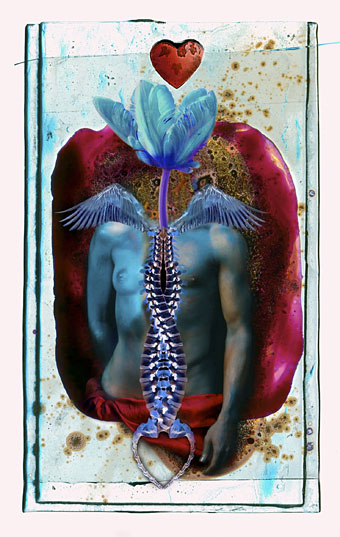
Caduceus: Tarot Card Study – Love by Holly Warburton.

• The week in stage magic: Ken Carbone, writing about playing cards and graphic design, points the way to an hour of Ricky Jay demonstrating his miraculous abilities with a pack of cards. Elsewhere, Erik Ofgang asks “Who was Mr. Electrico, the sideshow magician who inspired Ray Bradbury—then vanished?”

The 1980 Floor Show – Uncut / Unedited: 8 Hours of David Bowie in Ziggy Stardust guise performing for American TV cameras at The Marquee, London, in October 1973. That’s more Bowie than most people would want—there’s a lot of repetition—but it’s good to know things like this can still surface.

• “A supernova has gone out,” says David Grundy about the late Wayne Shorter. Also this: “Sci-fi fan Shorter suggested the title to [Weather Report’s] second album I Sing The Body Electric, taken from Walt Whitman via Ray Bradbury.”

• “We need to get away from thinking of ourselves as machines… That metaphor is getting in the way of understanding living, wild cognition.” A long read by Amanda Gefter about the secret life of plants, and “4E” cognitive science.

• “…why take a soft approach to safety when you can scare the sensible into the next generation with some of the most effective horror shorts of all time?” Ryan Finnegan on the notorious PIFs (public information films) of the 1970s.

• “I am increasingly of the Lynchian mindset of ‘never explain’…” Lynda E. Rucker talking to Steven Duffy about her latest story collection, Now It’s Dark.

• James Balmont presents a brief introduction to the mind-altering cinema of Sogo Ishii.

• At Spoon & Tamago: Hidari: An epic wooden puppet samurai stop-motion film.

• Old music: Musique De Notre Temps (1976) by Éliane Radigue.

• Steven Heller’s font of the month is Juma.

Body Electric (1982) by The Sisters Of Mercy | Super-Electric (1991) by Stereolab | Electric Garden (Deep Jazz In The Garden Mix) (2013) by Juan Atkins & Moritz von Oswald
Weekend links 662

mika.jpg

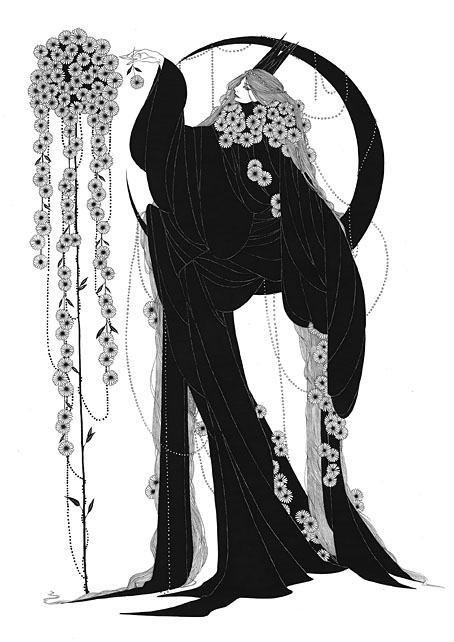
Pierrot le Fleur by Marina Mika.

• I’ve been saying for years that Andrzej Żuławski’s On the Silver Globe should be given a proper blu-ray release, and that’s what Region B viewers will receive soon courtesy of Eureka. Andrzej Żuławski: Three Films will be released in May, a set that comprises the director’s unfinished SF film, his debut feature, The Third Part of the Night (1971)—which I still haven’t seen—and also The Devil (1972), which I have seen but only as a poor copy that’s been circulating via illicit channels for many years.

• “The album’s 18-minute, multi-section standout Jenny Ondioline acquired a crucial role. It became the first track I’d play whenever I boarded a train, slipped on my headphones, and settled in beside an anonymous rail rider.” Hayden Merrick on travelling across the USA to the sounds of Transient Random-Noise Bursts With Announcements by Stereolab.

• At Aquarium Drunkard: E. Hehr explores musical exotica via Technicolor Paradise: Rhum Rhapsodies & Other Exotic Delights, “…a compilation that touches upon the noir side of exotica, far more gritty and raw compared to the lavish production on the esteemed exotica albums from Capitol and Liberty.” I own this collection. It’s a good one.

“My own experience,” Leda muses “tells me that more love goes into the thought of homosexuality than the practice.” Other gays are neither radical heroes nor the pathetic, self-hating fairies of, say, Mart Crowley’s Boys in the Band. This frankness makes Love, Leda a singular work; a contemporary portrait of working-class gay London in the years running up to decriminalisation that neither flatters nor sensationalises. In doing so, Hyatt transforms gay sex and love from an abject taboo to a deeply human intimacy.

Huw Lemmey on Love, Leda by Mark Hyatt, a candid tale of gay life in the Britain of the 1960s

• “It became something like a ritual, an exhumation of long-unheard music reanimated as glacial drones and ghostly symphonic movements—the sound of the cathedral transmuted into an enveloping shadow of pulsation, echo and glitch.” Orgelwerk by Ted Reichman.

Max Richter answers 50 questions. Sleep, Richter’s 8-hour ambient epic, is still my favourite among his compositions that I’ve heard to date: 8 CDs and a blu-ray disc from Deutsche Grammophon.

• RIP Alastair Brotchie, publisher of books at Atlas Press, and biographer of Alfred Jarry. Also a commenter here on one occasion when he corrected an erroneous photograph caption.

• A trailer for Suzume, a new feature film by Makoto Shinkai. Related: A Gathering of Cats.

• The story behind Jack Pierson’s homoerotic new photo book.

• The Strange World of…Phew.

Why Do I Still Sleep (1983) by Popol Vuh | Sleep I (1995) by Paul Schütze | The Dreamer Is Still Asleep (1999) by Coil

Švankmajer’s Decalogue

svankmajer3.jpg

Natural History (1973) by Jan Švankmajer.

A Jan Švankmajer interview I was reading recently contained two references to something he called his “Decalogue” but no detail as to what this might be. The mystery was explained in a footnote: “Decalogue” is a collection of ten artistic principles that Švankmajer wrote for a film magazine, Vertigo, in 2006. Given the low circulation of these kinds of journals I expected the piece to be unavailable but the magazine has a website which reproduces the full text here.

Despite the title, these aren’t really Ten Commandments, they’re more statements of Švankmajer’s artistic philosophy, and as such won’t be suitable for everyone, or for every purpose when they’re so heavily oriented towards animated film. All the same, I like to see things like this even if I don’t agree with them; sometimes finding a principle you disagree with is a way of confirming or reinforcing the value of its opposite. In other cases you may find a condensation of a vague impulse which becomes easier to recall when set into words. A good example of the latter is the well-known instruction from Eno & Schmidt’s Oblique Strategies (which also has a quasi-religious tone:) “Honour your error as a hidden intention”. I seldom follow this one but I keep it in mind. As Švankmajer says at the end of his piece, rules like these are also made to be broken.

Previously on { feuilleton }
The Magic Art of Jan Švankmajer
Švankmajer’s cats
Jan Švankmajer: The Animator of Prague
Jan Švankmajer, Director
Don Juan, a film by Jan Švankmajer
The Pendulum, the Pit and Hope
Two sides of Liška

The Magic Art of Jan Švankmajer

svankmajer1.jpg

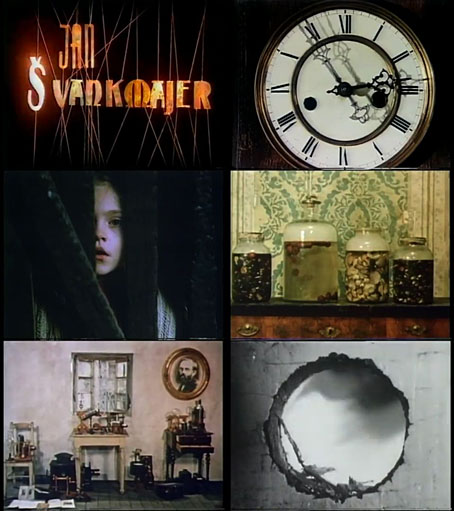
Three years ago I binged on all the Jan Švankmajer feature films after buying the box of blu-rays released by the director’s Athanor company. Once I’d worked my way through that lot, and rewatched the BFI collection of Švankmajer’s short films, I went through all the documentaries I’ve managed to accumulate, including this two-part BBC study which I taped when it was first broadcast in 1992. It’s likely that Švankmajer’s approach to film and to Surrealism no longer requires the kind of introduction that seemed necessary in the 1990s, but for those who do need such a thing this is a good place to start.

svankmajer2.jpg

Ben Fox’s documentary was made to coincide with an exhibition of Švankmajer’s films and artworks being shown at an animation festival in Cardiff. The two installments examine a different aspect of Švankmajer’s cinematic works: “Memories of Mysterious Beings” concerns the films that deal with childhood dreams and fears, while “The Naming of Demons” concentrates on his use of Surrealism as a tool for satire or social critique. In between lengthy extracts from the films the camera prowls around some of the director’s artworks while an actor reads statements Švankmajer has made about his interests and intentions. This last feature isn’t something I enjoy very much, not when the actor’s nasal delivery is so different from Švankmajer’s own voice. It’s a common ploy in documentaries, having someone impersonate an interviewee to avoid using subtitles, but it’s one I find distracting when done like this.

eva.jpg

Eva liked statues.

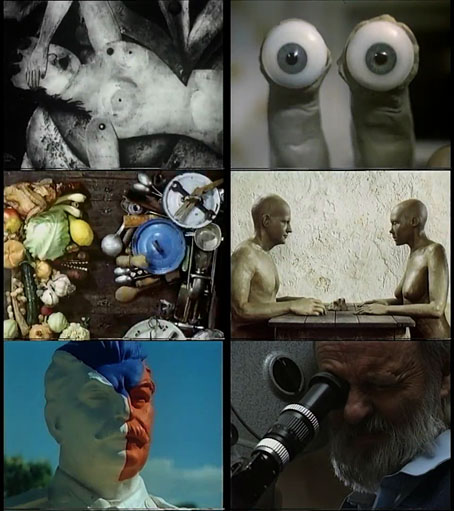
At this point I would have directed your attention once again to Jan Švankmajer, Director, a documentary about Czech cinema which featured the man himself talking at length about his activities in the 1960s, but this has now been removed from YouTube. In its place, however, there’s a more recent upload, Les Chimères des Švankmajer, an 80-minute documentary for French TV by Bertrand Schmitt and Michel Leclerc which is included among the extras on the BFI’s collection of Švankmajer’s short films. The only trouble here is that the YT copy has no subtitles, you’ll need to be a French speaker to understand the voice-overs which run throughout. This is one of the best of all the Švankmajer documentaries since it shows the range of activities conducted by Švankmajer and his late wife, Eva Švankmajerová, as artists and foremost members of the Prague Surrealist Group; film-making, as Švankmajer has often stressed in interviews, was only one outlet for his creativity. (It was also one he was forbidden to practice for several years when the Communist authorities took exception to his work.) In addition to seeing the Švankmajers preparing an exhibition of their creations, Schmidt and Leclerc show us something of their home outside Prague, an artwork in itself that combines the sculpture park and Wunderkammer. Eva Švankmajerová was the creator of many of those sculptures, a celebrated artist in her own right whose contribution to her husband’s films has often been overlooked.

Elsewhere on { feuilleton }
The Surrealism archive

Previously on { feuilleton }
Švankmajer’s cats
Jan Švankmajer: The Animator of Prague
Jan Švankmajer, Director
Don Juan, a film by Jan Švankmajer
The Pendulum, the Pit and Hope
Two sides of Liška

Weekend links 657

foxx.jpg

• Cover art for a new album by John Foxx which will be released on CD in March. This catches my attention for being based on Walter Benjamin’s compendious collection of esoterica, with the music being solo piano pieces. If the latter are anything like the albums Foxx recorded 20 years ago with Harold Budd then this is all very promising. Is the cover design by Jonathan Barnbrook? The typography and formal treatment of the photo suggest as much.

• “The new game was not providing access to everything but finding out how many expensively licensed properties you could cull from your service before people started to question how much they were paying a month.” Sam Thielman on the sudden unavailability of hundreds of classic Warner Brothers cartoons. Regarding his comment about the unplayability of Internet Archive videos: you download them and put them on a USB drive.

Frost Flowers on the Windows (1899) is a book that documents “the extraordinary power of windowpane frost to take ‘ice photographs’, images capable of expressing the ‘vital qualities’ of life forms close to the glass,” according to its author, Albert Alberg.

• New music: ev THe norTH, “a sound journey through the winter of the far north” by Lorenz Weber. (The encoding of the album title won’t display properly on this page.)

• RIP Yukihiro Takahashi, singer, songwriter and drummer with the fabulous Yellow Magic Orchestra. The space-disco video for YMO’s Rydeen never gets old.

• “I want an indescribable feeling”: composer Kali Malone on her search for the sublime.

• Old music: Roundtrip by Don Cherry & Jean Schwarz, a live performance in Paris, 1977.

• At Spoon & Tamago: Glass artist Genki Sudo crafts tentacle earbuds.

• At Unquiet Things: The Incandescent Otherworlds of Gervasio Gallardo.

• At Dennis Cooper’s: Acid Westerns Day.

Arcade (1987) by Chris & Cosey | The White Arcades (1988) by Harold Budd | Arcade (2018) by Philip Jeck