Finch posters

finch.jpg

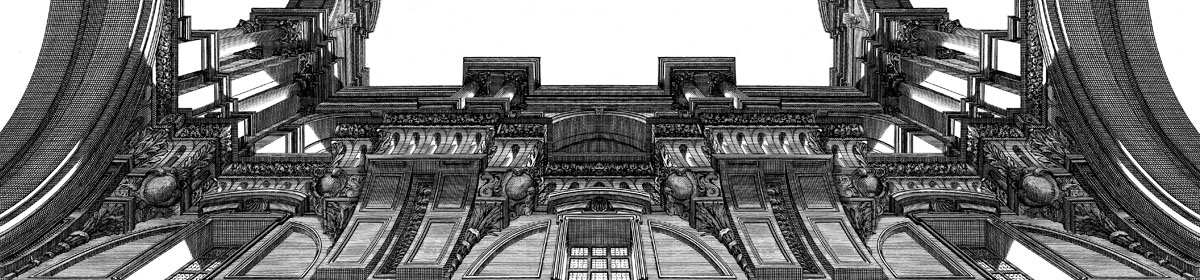
I won’t say this is by popular demand but after persistent requests for posters of my cover art for Jeff VanderMeer’s latest novel, Finch, I’ve opened a new CafePress shop selling exactly that. The largest of these is 58.38cm x 82.55 (22.984″ x 32.5″) which should be big enough for most appetites. There’s also a smaller size 35.03cm x 49.53 (13.7904″ x 19.5″) and I’ve added some cards and postcards.

In Finch, mysterious underground inhabitants known as the gray caps have reconquered the failed fantasy state Ambergris and put it under martial law. They have disbanded House Hoegbotton and are controlling the human inhabitants with strange addictive drugs, internment in camps, and random acts of terror. The rebel resistance is scattered, and the gray caps are using human labor to build two strange towers. Against this backdrop, John Finch, who lives alone with a cat and a lizard, must solve an impossible double murder for his gray cap masters while trying to make contact with the rebels. Nothing is as it seems as Finch and his disintegrating partner Wyte negotiate their way through a landscape of spies, rebels, and deception. Trapped by his job and the city, Finch is about to come face to face with a series of mysteries that will change him and Ambergris forever.

Jeff is currently promoting Finch on his latest book tour, details of which can be found here.

Previously on { feuilleton }
Finch

Virtual Alice

alice.jpg

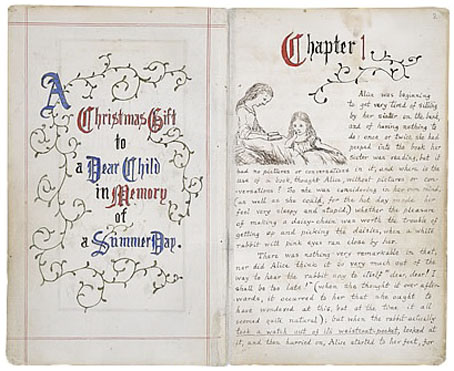
No, I didn’t go searching for this, I had my fill of Alice’s Adventures in Wonderland last month. The British Library website is a lot more amenable than it used to be for the casual browser, and one of its newer sections is a small collection of what they call virtual books which enable you to leaf through some of their exclusive volumes. The pages above are from the original handwritten manuscript, Alice’s Adventures Under Ground, from which the printed book was later adapted. I have this in a small facsimile edition so I don’t need a web version, and the illustrations are often reprinted, but this web copy allows you to see the work in its entirety. They also reproduce the text and have an audio facility. I went through my copy a couple of times whilst working on the calendar in order to see how Dodgson depicted some of his scenes. A few of his conceptions differ from the famous Tenniel illustrations, not least his drawing of Alice herself who closely resembles the real Alice Liddell.

Previously on { feuilleton }
Psychedelic Wonderland: the 2010 calendar
Charles Robinson’s Alice’s Adventures in Wonderland
Humpty Dumpty variations
Alice in Wonderland by Jonathan Miller
The Illustrators of Alice

The Evil Orchid Bookplate Contest

bookplate1.jpg

Bookplate by Denis Kostromitin.

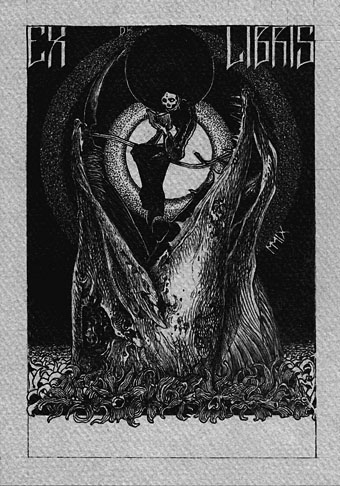
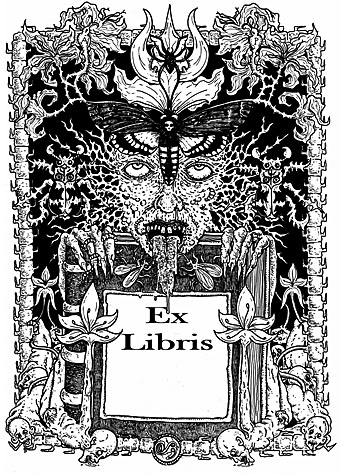
Following the recent postings of covers and illustrations from Der Orchideengarten, Will at A Journey Round My Skull posts the results of his Evil Orchid Bookplate Contest which encouraged illustrators to create an Orchideengarten-styled bookplate design. You can see the winner and many other splendid entries on his pages. I fully intended to do something for this then got sidetracked by work on the Alice in Wonderland calendar but I’ve picked out a couple of the (inevitably) black-and-white pieces which I thought stood out. The death’s-head moth on @ndy paciorek’s picture below makes a convenient link with yesterday’s post.

Meanwhile, there’s further Orchideengarten goodness over at Arthur Magazine.

bookplate2.jpg

Bookplate by @ndy paciorek.

Elsewhere on { feuilleton }
The illustrators archive

Previously on { feuilleton }
Der Orchideengarten illustrated
David Becket’s bookplates
Der Orchideengarten

Der Orchideengarten illustrated

orchid_01.jpg

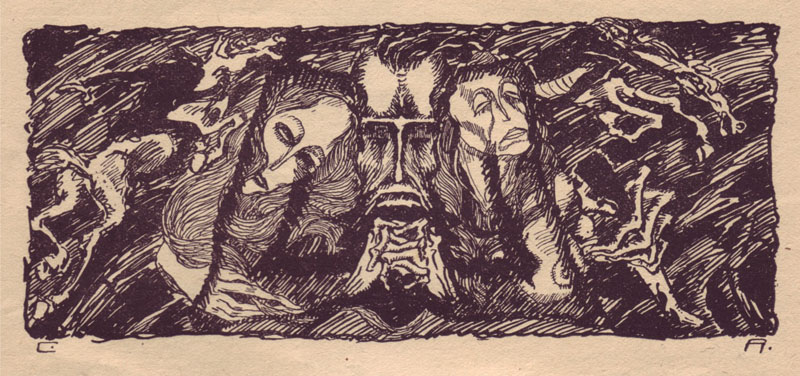
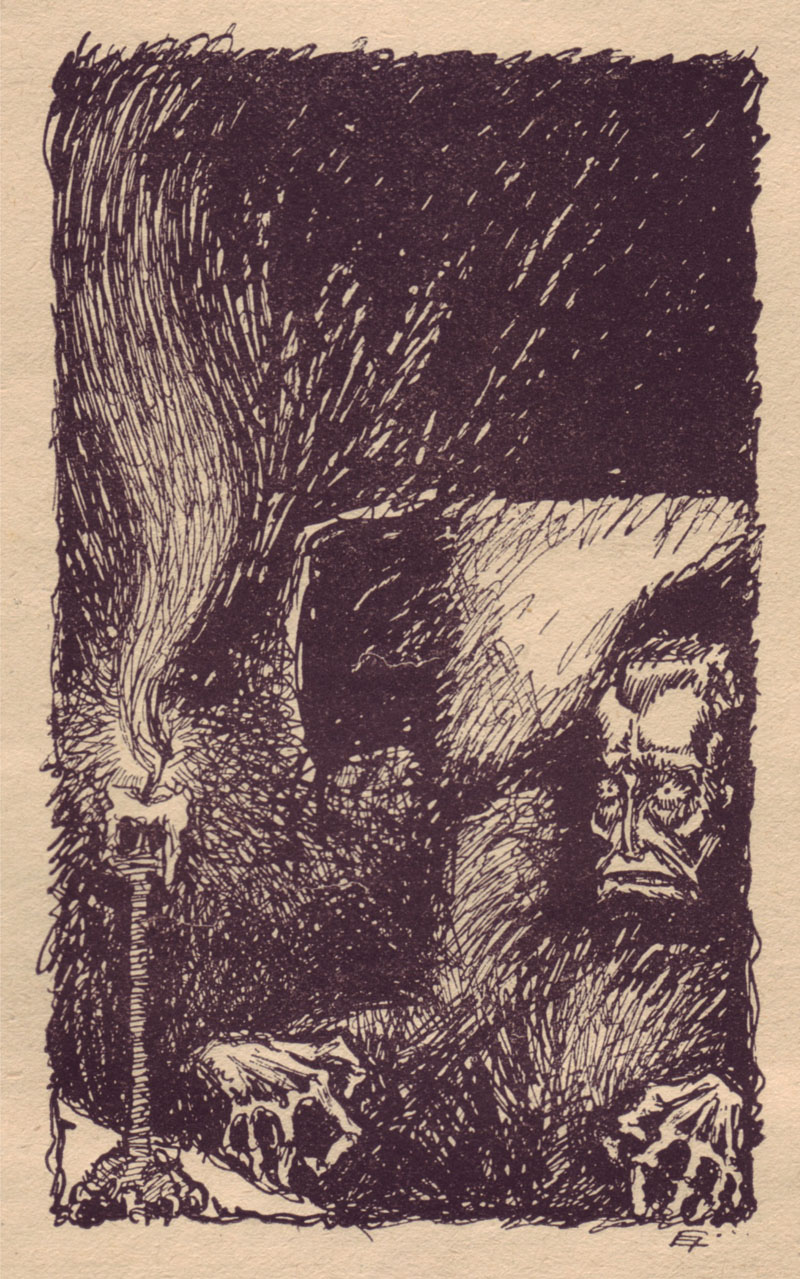
Halloween approaches and as a precursor it’s a great pleasure to be able to post a selection of interior illustrations from Der Orchideengarten, courtesy of Will at A Journey Round My Skull. Der Orchideengarten was a German magazine of weird fiction which ran for 51 issues from 1919 to 1921 and whose existence today is rarely acknowledged despite being credited as the world’s first fantasy magazine. Information is scarce and these scans come from Will’s own copies which is why I’ve posted fifteen more below the fold; you can’t see this stuff anywhere else. A Journey Round My Skull featured some covers and a different set of interior illustrations earlier this year, and there should be a new post complementing this one with more of the magazine’s stunning cover designs.

orchid_02.jpg

What strikes me about these black-and-white drawings is how different they are in tone to the pulp magazines which followed shortly after in America and elsewhere. They’re at once far more adult and frequently more original than the Gothic clichés which padded out Weird Tales and lesser titles for many years. Some are almost Expressionist in style, while the Wild Hunt series below shows a distinct Goya influence. I’d love to know how the written content matches the illustrations; I suspect there’s the same difference of atmosphere and emphasis to American weird fiction as there is in the drawings.

Update: Will’s new post is Watering the Toxic Garden which will be followed on Thursday by the results of his Evil Orchid Bookplate Contest.

Click on any of these pictures for a larger version.

Continue reading “Der Orchideengarten illustrated”

Through the Wonderwall

wonderwall1.jpg

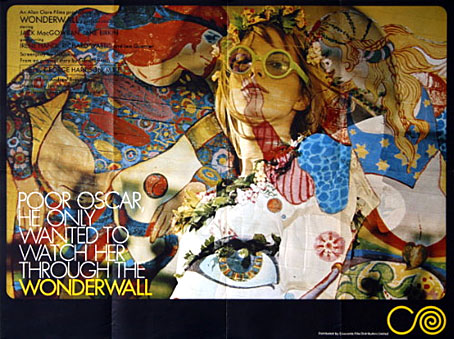
It’s taken me years but the recent obsession with UK psychedelia led me to finally watch Joe Massot’s piece of cinematic fluff from 1968, Wonderwall, a film distinguished primarily for its score by George Harrison (with Ringo Starr and Eric Clapton playing pseudonymously), and its title which was swiped years later by a bunch of Rutles-imitators from Manchester. The story is so slight it would have barely sustained an hour-long TV film: absent-minded scientist (Jack MacGowran) becomes intrigued by his glamorous neighbour (Jane Birkin playing “Penny Lane”; yeah, right…) and knocks holes in the walls of his flat in order to scrutinise her modelling, partying and frequent undressing. Unlike Blow Up (1966, and also featuring Jane Birkin) and the later Performance (1970), both of which attempted to accurately pin down some of the modish aspects of the period, this is a very kitsch piece. That wouldn’t be so bad if it was entertaining kitsch like, say, Smashing Time (1967), but Massott has to resort to scenes of limp comedy and some rather dull dream sequences in order to pad the thing out. Between the handful of actual dialogue scenes there’s a lot of gloating over Ms Birkin’s flesh which no doubt satisfied one half of the audience but by today’s standards is hardly thrilling. Iain Quarrier plays Penny’s duplicitous boyfriend (with a fake Liverpool accent) in his last screen role before he quit acting. Quarrier and MacGowran had appeared together in two of Roman Polanski’s British films, Cul-de-sac (1966) and Dance of the Vampires (1967). In the latter, MacGowran again plays an absent-minded scientist while Quarrier is cinema’s first (?) gay vampire.
wonderwall2.jpg

An interjection from The Fool.

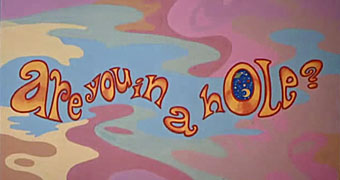
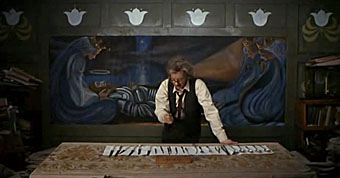
Of chief interest for me in Wonderwall was the decor and title card decorations by Dutch psychedelic collective, The Fool (who also appear in the party scene), famous for their earlier Beatles associations including the inner sleeve for Sgt Pepper and designs for the short-lived Apple Boutique in London’s Baker Street. I was also curious about the distinctive decor of MacGowran’s flat which contrasts with the psychedelia next door, all dark green walls embellished with Victorian murals and a Tennyson poem—very fittingly a piece called The Daydream—which circles the room.
wonderwall4.jpg

The professor prepares to attack the wall.

This was particularly interesting in that it made another connection between the psychedelic era and Victorian arts movements, especially from the Aesthetic/Arts & Crafts end of things, but it wasn’t at all obvious whether the connection was an intentional part of the film’s production design or an accident of location and budgetary convenience. Aside from the old-fashioned appearance of MacGowran’s rooms there seemed no reason why his otherwise cultureless character would have any interest in decorating his living space in this way.
wonderwall3.jpg

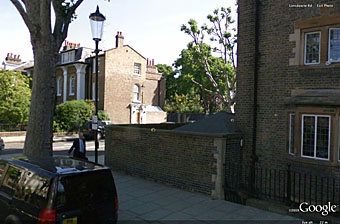
The street corner then…

google1.jpg

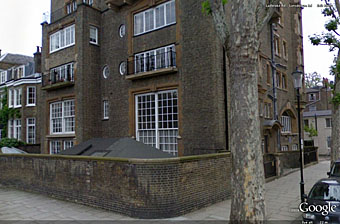
…and now.

google2.jpg

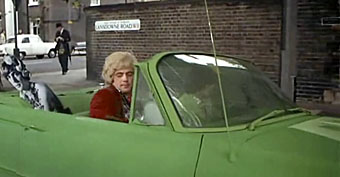
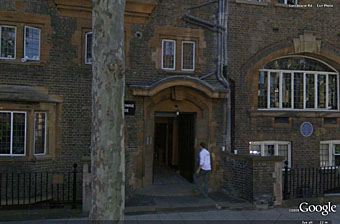
The building itself is equally distinctive and an exterior shot conveniently shows a street sign placing the location in Lansdowne House, a Victorian apartment block on the corner of Lansdowne Road and Ladbroke Road in the Notting Hill/Holland Park area of London.
google3.jpg

Lansdowne House.

What did the building look like today, I wondered? Google Earth proves indispensable at times like this and it was easy to find, in a street which looks more cramped than it does in the film. The presence of a blue plaque on the wall proved intriguing, a sign that the place once had famous residents. Googling for that revealed this photo which was a real surprise: Lansdowne House at one time contained studios for artists who included Charles Ricketts and Charles Shannon, a gay couple and leading lights of London’s fin de siècle art scene (also friends of Oscar Wilde), and another artist, James Pryde, who with William Nicholson worked as The Beggarstaffs. So my suspicion about the Arts & Crafts decor was correct, which means that MacGowran’s flat may have been decorated that way originally and remained untouched since the 1890s. I haven’t seen Rhino’s special edition of Wonderwall which contained additional information about the making of the film, so have no idea whether the history of the building is mentioned there. If anyone does know, please leave a comment. For now I’m quite happy to have stumbled upon another minor link between two of my favourite art decades.

For more visuals, this page has a host of screen grabs from the film as well as some gif animations, all of which manage to make Wonderwall seem more interesting than it is when you’re watching it.

Previously on { feuilleton }
Charles Ricketts’ Hero and Leander
Images by Robert Altman