Illustrating Hyperborea

hyperborea00.jpg

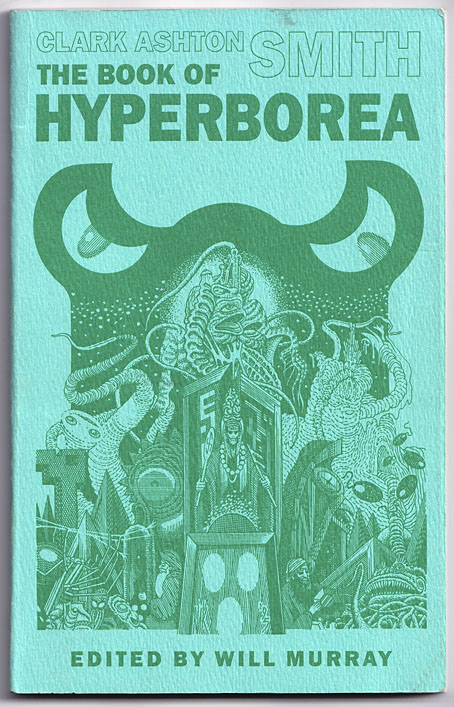
The Book of Hyperborea (1996). Cover art by Robert H. Knox.

“My Hyperborean tales, it seems to me, with their primordial, prehuman and sometimes premundane background and figures, are the closest to the Cthulhu Mythos, but most of them are written in a vein of grotesque humor that differentiates them vastly.” — Clark Ashton Smith

Since re-reading Clark Ashton Smith’s The Tale of Satampra Zeiros I’ve been revisiting more of Smith’s stories set in the lost world of Hyperborea. And having put together a post some years ago that gathered all the original illustrations for Smith’s Zothique cycle, I thought I’d try and do the same for another of his story series. As I noted in the earlier post, we’re fortunate today that it’s so easy to see illustrations that in the past would have been impossible to find unless you owned (or had access to) a huge collection of pulp magazines. Pulp illustrations aren’t always very good—in the case of the early issues of Weird Tales, they’re frequently amateurish—but those that illustrate new fiction for the first time are historically important if nothing else.
pennington1.jpg

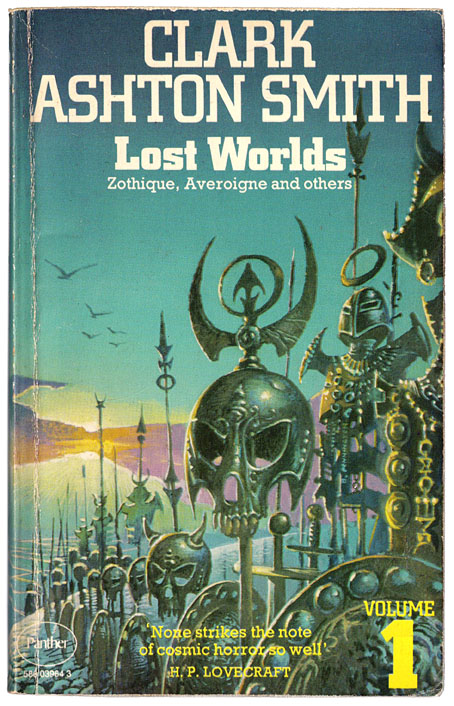
Lost Worlds: Volume 1 (1974). Cover art by Bruce Pennington. Lost Worlds was a single-volume collection published by Arkham House (USA) and Neville Spearman (UK). The Panther paperback covers by Bruce Pennington could easily be used on other books but these were the first Smith volumes I owned.  

The first Hyperborea stories were among Smith’s earliest prose fantasies, owing something to Lord Dunsany on the one hand (HP Lovecraft detected a Dunsanian quality), and the writers of antiquity on the other, the name “Hyperborea” (“Behind the North Wind”) being borrowed from the Greeks. The northern location is about the only feature of the continent that the Greek writers would recognise, Smith’s world being a temperate pre-Ice Age realm of mountains and verdant jungles. Dinosaurs and megafauna share the lands with human inhabitants for whom sorcery is a common practice. As with Zothique, the cycle was an influential one. Lin Carter in the introduction to his Ballantine collection, Hyperborea (1971), suggests that the name of the continent might have prompted Robert E. Howard to set his Conan stories in “the Hyborean Age”. This could be the case: Howard and Smith were writing for the same publications, and the first Conan story was published in Weird Tales shortly after The Tale of Satampra Zeiros; but Howard was also reading the Greeks as well. A more substantial influence may be found in Fritz Leiber’s Nehwon, a world in which aspects of Hyperborea and Zothique are combined. Sword and sorcery begins “behind the North Wind”, in other words, although there’s very little sword-play in Smith’s fiction, that was Leiber and Howard’s department.
pennington2.jpg

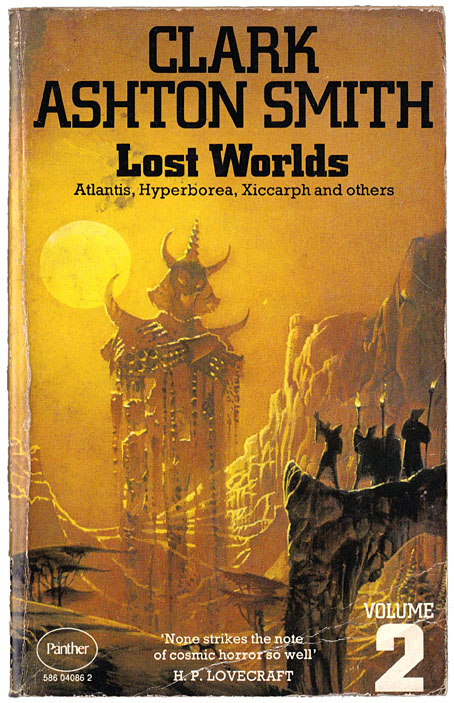
Lost Worlds: Volume 2 (1974). Cover art by Bruce Pennington.

The original Hyperborea illustrations are fewer than those for Zothique. As with the later cycle, several of the stories are unillustrated, while others were given lacklustre artwork. In the earlier post I followed the story order chosen by Lin Carter which attempted to contrive an internal chronology for the cycle. Carter did the same with his Hyperborea collection so I’ve followed his example once again. Later collections, like Will Murray’s Book of Hyperborea, tend to order the stories by publication date.
hyperborea01.jpg

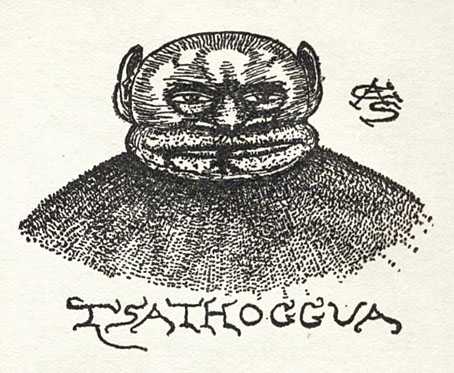
The Seven Geases, Weird Tales, October 1934.

An illustration of Tsathoggua by Smith himself. The toad-god turns up in person in this story.
hyperborea02.jpg

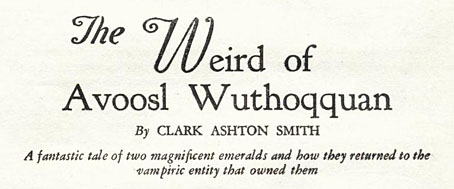
The Weird of Avoosl Wuthoqquan, Weird Tales, June 1932.

Continue reading “Illustrating Hyperborea”

Weekend links 808

kometen.jpg

Comets from Meyers Konversationslexikon (1885–90).

• At The Daily Heller: Steven Heller reviews A Life in Ink, a new monograph about the art of Ralph Steadman. Heller is full of praise for Steadman, and discusses commissioning his work for The New York Times. But in his bewilderment at Steadman’s lack of a knighthood he seems unaware of the degree to which state honours are frequently refused by Britons, especially those who position themselves in opposition to the established order. Americans are obsessed with awards and “halls of fame”, and appear to regard Britain’s state honours as something like the Oscars with a royal seal, rather than what JG Ballard once described as “a Ruritanian charade that helps to prop up the top-heavy monarchy.” If Steadman has deliberately shunned the honours list he’d be joining a venerable company.

• “In mid-19th century Italy, two eccentric aristocrats set forth on parallel projects: constructing ostentatious castles in a Moorish Revival style. Iván Moure Pazos tours the psychedelic chambers of Rochetta Mattei, optimised for electrohomeopathic healing, and Castello di Sammezzano, an immersive, orientalist fever dream.”

• New music: Ithaqua by Cryo Chamber Collaboration is this year’s installment in the Lovecraft-themed album series (previously) from Cryo Chamber. Also this week: Analog 2025 by Various Artists; and Flux (music for a performance by still still / Marta & Kim) by Rutger Zuydervelt and Lucija Gregov.

For all their bravura and maximalism, Powell and Pressburger understood the power of leaving things out, building into their films chasms that the mind must leap, gaps that the imagination must fill. Like Joan Webster, we discover that we don’t want things to be made too easy. We want to catch our own fish rather than have them delivered, to swim in the ocean rather than in a pool.

Imogen Sara Smith on I Know Where I’m Going, one of the films from Michael Powell and Emeric Pressburger’s golden decade, the 1940s

• Among the new titles at Standard Ebooks, the home of free, high-quality, public-domain texts: In the Days of the Comet by HG Wells.

• At the BFI: David Parkinson selects 10 great Sherlock Holmes films and TV adaptations.

• Winning entries for the Capture The Atlas Northern Lights Photographer of the Year.

• Books and original drawings by Austin Osman Spare on sale at Gerrish Fine Art.

• At Unquiet Things: The art of Chie Yoshii.

Kohoutek-Kometenmelodie (1973) by Kraftwerk | Cometary Wailing (1981) by Bernard Xolotl | Kometenmelodie Part 1 (1994) by 300,000 VK

Eric Pape’s Arabian Nights

pape01.jpg

Eric Pape (1870–1938) was an American artist and illustrator who shouldn’t be confused with his contemporary Frank C. Papé, a Briton who was also a popular illustrator. Pape was more of a fine artist—he studied in Paris under Jean-Léon Gérôme—whose magazine illustrations are of that type that favoured realistic scenes using posed models. The illustrations in The Arabian Nights Tales of Wonder and Magnificence (1923) differ enough from his paintings to be taken for the work of another artist, the book being a substantial volume which Pape fills with many full-page ink drawings replete with stippling and detail.

pape02.jpg

The stories are a retelling by Padraic Colum with an eye to maintaining the flavour of the original (or older) texts. Books like this were aimed at a young readership but Colum begins with an introduction that describes the origin of the tales, and also weighs the pros and cons of the translations by Lane and Burton. In the stories he avoids simplifying the names of the more popular characters, so we have the six voyages of “El-Sindibad of the Sea”, and the tale of “Ala-ed-din” and his wonderful lamp. These gestures of fidelity are matched by Pape’s vignettes, many of are borrowed from Arabian or Persian sources. Pape had spent two years living and working in Egypt—his painting of the Sphinx by moonlight was a product of this period—a factor which may explain why he was offered the commission.

pape03.jpg

The pictures I’ve selected are mostly the full-page pieces which I’ve adjusted slightly to remove the grey tone of the paper. This copy of the book is a reprint from 1945, a period when print standards suffered from wartime restrictions. Older printings may be better.

pape04.jpg

pape05.jpg

Continue reading “Eric Pape’s Arabian Nights”

The art of Jean-Michel Nicollet

nicollet12.jpg

French artist Jean-Michel Nicollet isn’t really known as a comic artist but one of his strips appeared in the Métal Hurlant Lovecraft special in September, 1978, and was reprinted in the Heavy Metal Lovecraft special a year later. Nicollet’s three-page story, H.P.L., is a slight thing which you can read below but his paintings present more of the atmosphere of Lovecraft’s fictional worlds than many of the other strips in those issues, including the equally slight contribution from Moebius. Prior to this, Métal Hurlant had been using some of Nicollet’s paintings for cover art, as a result of which one of the same illustrations appeared on the cover of the very first issue of Heavy Metal magazine in 1977. The winged Lovecraft from his comic strip turned up again on the cover of a Robert Bloch story collection for French publisher Nouvelles Éditions Oswald (NéO) in 1980.

nicollet09.jpg

Nicollet seems to have retired now from cover work but during the 1970s and 80s he was a very prolific illustrator, especially for NéO. NooSFere has a gallery of his covers which are mostly for reprints of early 20th-century horror, fantasy and adventure tales, also a few detective stories. He seems to have enjoyed illustrating classic detective fiction (photos show him posing with a large Holmesian pipe) so there may well be more covers which aren’t included in the NooSFere list.

nicollet11.jpg

The selections I’ve chosen here match my own preferences for cosmic horror and weird fiction, and represent another attempt to look further afield for this type of illustration. French cover design can be unsympathetic to cover illustration, crowding the paintings with poor type choices and purposeless graphics. The uniform layouts of NéO treat the artwork with more respect.

nicollet13.jpg

nicollet14.jpg

Continue reading “The art of Jean-Michel Nicollet”

Weekend links 796

wright

Academy by Lamplight (1770) by Joseph Wright of Derby.

• “He recounts, for example, the death of the custom of ‘Stephening’ in Drayton Beauchamp, Buckinghamshire, where ‘all the inhabitants used to go on St. Stephen’s Day to the Rectory, and eat as much bread and cheese, and drink as much ale as they chose, at the expense of the Rector’. Stephening was discontinued by the Rector, as the event ‘gave rise to so much rioting’.” Ross MacFarlane on A Collection of Old English Customs, and Curious Bequests and Charities (1842).

• “He should be known as a film music revolutionary”: Milos Hroch on revitalising the legacy of Czech composer Zdeněk Liška.

• At The Wire: Read an extract from Ian Thompson’s Synths, Sax And Situationists: The French Musical Underground 1968-1978.

Wright’s choice of subject matter was not only contemporary, but bordered on the heretical. In his candlelight paintings of the orrery, the air pump and the alchemist at work, he not only employed dramatic lighting and plunging shadows to heighten the drama, but the scenes themselves dealt in mortality and the insignificance of man in relation to the natural world, as well as suggesting that the scientist was now usurping the divine creator.

Charlotte Mullins on the chiaroscuro paintings of Joseph Wright of Derby

• New music: Daylight Daylight by Steve Gunn; Hard Ware by Patrick Cowley; WhiteOut by Lawrence English.

• At Spoon & Tamago: GAKUponi: A self-sustaining loop of fish and plants that hangs on the wall.

• Mix of the week: DreamScenes – September 2025 at Ambientblog.

• At the BFI: Anton Bitel chooses 10 great German horror films.

• At Unquiet Things: A conversation with Benz and Chang.

• RIP Robert Redford.

The Fish (Schindleria Praematurus) (1972) by Yes | Fish Culture (1980) by Marc Barreca | Filter Fish (1995) by Leftfield