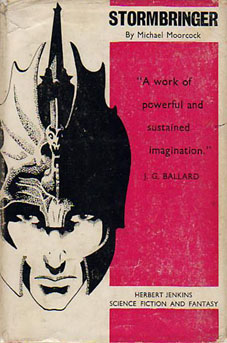
Jim Cawthorn, 1929–2008

cawthorn1.jpg

“Jim Cawthorn and I have been inseparable for over twenty-five years, sometimes to the point where I can’t remember which came first—the drawing or the story. It is his drawings of my characters which remain for me the most accurate, both in detail and in atmosphere. His interpretations in strip form will always be, for me, the best.” Michael Moorcock.

Jim Cawthorn—illustrator, comic artist and fantasy historian—died this week. Cawthorn was the first illustrator employed by Savoy Books and one of the key factors in drawing me to their doors in the early 1980s. His illustrations made their books special and his comics adaptation of Moorcock’s The Jewel in the Skull was a big influence on my early black and white work.

Mike Moorcock, Dave Britton and I seem to be in a minority in regarding Cawthorn as one of the finest fantasy illustrators of his generation. His carefully stipled drawings of the late Fifties and early Sixties are all miniature masterpieces and I don’t care how many artists attempt lavish paintings of Moorcock’s Elric character, for me the definitive representation remains the drawing used on the cover of the first edition of Stormbringer in 1965. Cawthorn was Moorcock’s illustrator of choice for many years and was involved with the Moorcock-edited run of New Worlds right from the start with his cover illustrating Ballard’s Equinox story. He also provided reviews for New Worlds, and his critical faculties were demonstrated to the full in 1987 with Fantasy: The 100 Best Books, an overview of the genre credited to Cawthorn and Moorcock for which Cawthorn himself wrote most of the entries.

I wrote in more detail about Cawthorn’s work for the Savoy site several years ago. For an overview of his career and influences, there’s Dave Britton’s interview from 1979.

Update: some extra pictures added.
cawthorn2.jpg

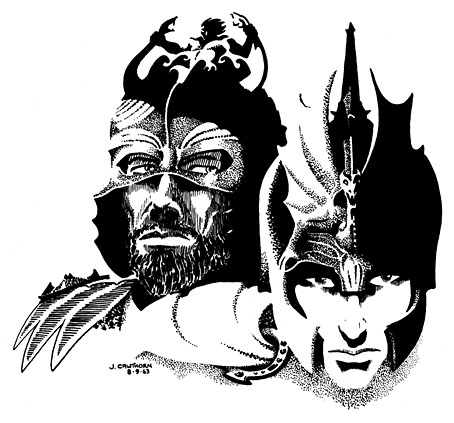
Jagreen Lern and Elric (1963).
Continue reading “Jim Cawthorn, 1929–2008”

The art of Mati Klarwein, 1932–2002

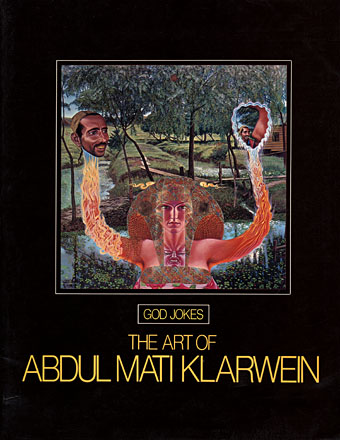
godjokes.jpg

If book collecting is frequently a waiting game, some waiting periods can be longer than others. In the case of Mati Klarwein’s God Jokes, my patience and hope have sustained themselves for 28 years until I finally acquired a copy this Thursday afternoon. God Jokes was the second book of Mati Klarwein’s work, published by Harmony Books, New York, in 1976, a slim catalogue-style collection of his paintings, some of which were featured in the early issues of Omni magazine. In 1979 and 1980 God Jokes turned up in a chain of UK remainder shops and for a while it seemed like everyone I knew owned a copy which possibly explains my unaccountable decision to avoid buying one myself. As the years passed and I became increasingly enamoured with Mati Klarwein’s work I came to regret that decision, not least because the book seemed to disappear completely. Copies have turned up since on Abe.com but at bizarrely inflated prices (£50 for a 56-page art book?!). I paid £4.99; patience sometimes pays off.

abraxas.jpg

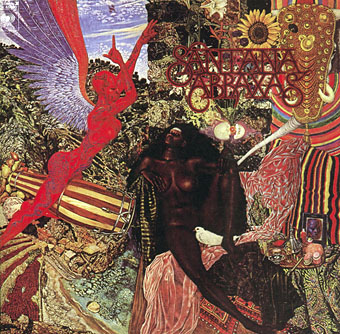
Abraxas by Santana.

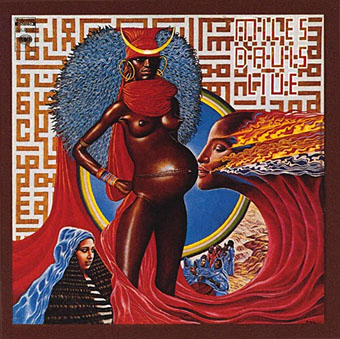
Mati Klarwein’s work has been most visible via the album sleeves of the Sixties and Seventies which borrowed his pictures for their covers. Chief among these is one of the best Santana albums, Abraxas (1970), which used his stunning 1961 painting The Annunciation (and a lettering design by Robert Venosa), and one of all-time favourite albums, the Miles Davis masterpiece Bitches Brew (1970). Miles Davis was a great Klarwein enthusiast for a while and commissioned new work for his Live-Evil album in 1971.

davis.jpg

Live-Evil by Miles Davis.

It’s not necessary to go into detail describing Mati Klarwein’s work when you can go to the web gallery maintained by his family and feast your eyes there. Klarwein is one of the few 20th century artists to have taken Salvador Dalí’s photo-realist painting style and make of it something unique to himself; his work is always immediately recognisable. That this work is still known mainly for its illustrative connections tells you more about the iniquities of the art world than it does about the value of the paintings as works of art.

maarifa.jpg

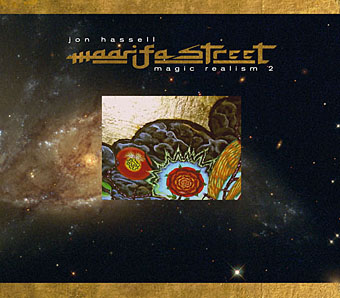
The most curious thing about having to wait so long to find a copy of God Jokes was that I ended up working with a picture of Mati Klarwein’s three years before I found the book; I would have expected to find the book one day but the latter eventuality was far less predictable. In 2005 Jon Hassell asked me to design his new CD, Maarifa Street, and Jon was keen to use a tiny video detail he made of a huge and incredible Klarwein painting, Crucifixion (1963–65). The detail is the rectangle in the centre of the cover, juxtaposed against some Hubble galaxies: the very small against the very large. We used the painting itself and further details inside the digipak. Jon was another of those who used Klarwein’s art for his album sleeves (for Earthquake Island, Dream Theory in Malaya and Aka-Darbari-Java/Magic Realism) and the two men became great friends as a result.

crucifixion.jpg

Crucifixion by Mati Klarwein.

Jon Hassell writes about Bitches Brew—and Mati Klarwein’s sleeve art—here. His site also includes a 1998 Mati Klarwein interview from The Wire in which the painter discusses his life and work. If you want a copy of God Jokes for yourself, be prepared to wait…or pay over the odds.

Elsewhere on { feuilleton }
The fantastic art archive

Elsewhere on { feuilleton }
The album covers archive

Previously on { feuilleton }
Ballantine Adult Fantasy covers
Visions and the art of Nick Hyde
The poster art of Marian Zazeela

The art of Pierre Clayette, 1930–2005

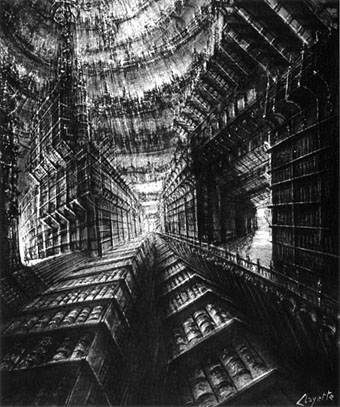
clayette1.jpg

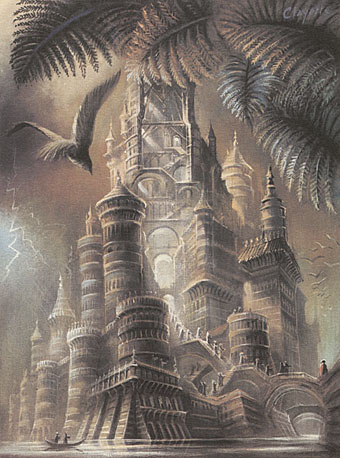
The Library of Babel (no date).

Another French artist who specialised in fantastic architecture, Pierre Clayette’s work came to my attention via the picture above which illustrates a Borges story. This leads me to wonder once again what it is about French and Belgian artists which attracts them more than others to this type of imagery.

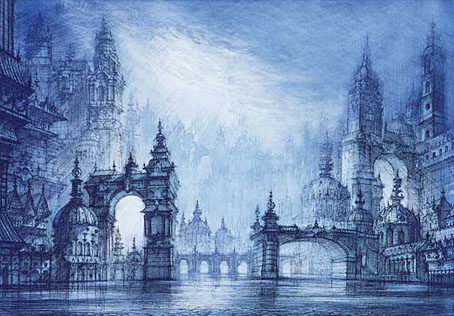
clayette2.jpg

Whatever the reason, there isn’t a great deal of Clayette’s work online and biographical details are few. This page (the source of the untitled picture above) reveals that he worked as an illustrator for Planète magazine, the journal of “fantastic realism” founded by Jacques Bergier and Louis Pauwels in the early Sixties. Some readers may know that pair as the authors of a { feuilleton } cult volume, The Morning of the Magicians (1960), whose vertiginous blend of speculative and weird fiction, occultism and futurology Planète was intended to continue.

clayette3.jpg

Clayette also worked as a theatre designer and book illustrator. Le Chateau (above) is an illustration from Songes de Pierres, a 1984 portfolio depicting scenes from Pierres by Roger Caillois. That writer has his own significant Borges connection, being responsible for introducing Borges’ work to France via his editorship of the UNESCO journal, Diogenes. (Pauwels and Bergier later published Borges in Planète.)

Finally, there’s a less extravagant Flickr collection of some Clayette covers for Penguin Shakespeare editions. All of which only scratches the surface of what was evidently a prolific career; I’ll look forward to more examples of his work coming to light.

Elsewhere on { feuilleton }
The fantastic art archive
The illustrators archive

Previously on { feuilleton }
The art of Michiko Hoshino
The art of Erik Desmazières
The art of Gérard Trignac
The Absolute Elsewhere

The Corpus Clock

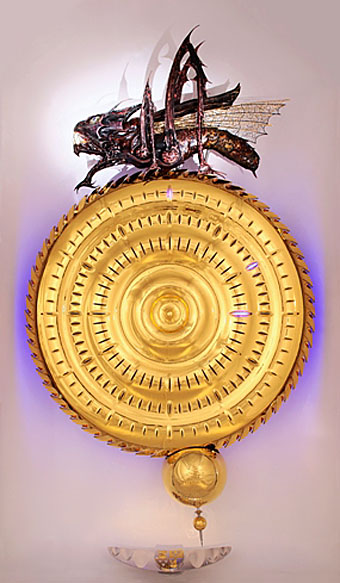
corpus_clock.jpg

This splendid clock is unveiled by Professor Stephen Hawking later today at Corpus Christi College in Cambridge. If it hadn’t cost a million pounds to develop I’d probably be demanding that someone find me one for Christmas. The mechanical monster perched at the top is explained by its creator:

“It is terrifying, it is meant to be,” said John C Taylor, the creator and funder of an extraordinary new clock to be unveiled tomorrow by Stephen Hawking at Corpus Christi College in Cambridge. “Basically I view time as not on your side. He’ll eat up every minute of your life, and as soon as one has gone he’s salivating for the next. It’s not a bad thing to remind students of. I never felt like this until I woke up on my 70th birthday, and was stricken at the thought of how much I still wanted to do, and how little time remained.”

Unfortunately there are few decent pictures to be had of the device but the Telegraph has an article which describes its “grasshopper escapement”, while the Guardian goes one better with a video of the clock in action.

Update: Longer video at the university site with Dr Taylor explaining the clock in detail.

Previously on { feuilleton }
Gold robots
The art of Sergei Aparin
The art of Almacan
The sculpture of Christopher Conte
The Bowes Swan

Frazetta: Painting with Fire

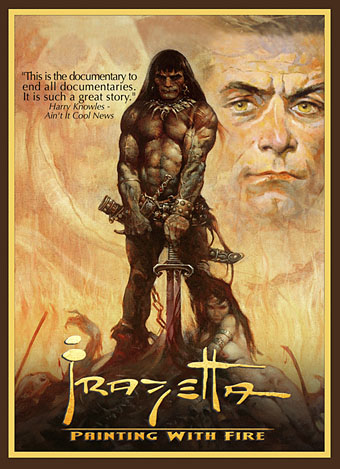
itunes_frazetta.jpg

Continuing from yesterday’s post, Berni Wrightson appears in this 2003 documentary about the great fantasy artist Frank Frazetta. (And Frazetta is another artist who acknowledges a debt to Roy G Krenkel.) I saw this when it first appeared on video and it’s essential viewing for anyone interested in Frazetta’s work. Stephanie Bruder wrote this week to inform me that the film is now available through iTunes (US store only, for now; UK release is being arranged).

For the last half century, Frank Frazetta has dominated the fantasy art world with his visceral images of savage warriors, curvaceous princesses, and fantastical creatures set in the most lavish landscapes. In this critically acclaimed documentary, we journey to a place where up until now, only the privileged have been. For the first time on film, the reclusive Frazetta reveals to us details of his astonishing life, including how he learned to draw left handed at the age of 70 after suffering a debilitating stroke. Dozens of other professionals candidly weigh in on Frank’s career, including comic legends Berni Wrightson, Dave Stevens, William Stout, Neal Adams, Al Williamson, Forrest Ackerman and film directors Ralph Bakshi and John Milius.  Also appearing are rocker Glenn Danzig, actress Bo Derek and fantasy artists Brom, Simon Bisley, and Joe Jusko. Mirroring the dramatic nature of his work, this film utilizes visual effects and a breathtaking orchestral score to create astonishing results. Painting With Fire tells of a life, the spark of an artist, and what Frazetta means to future inspirations. Frank Frazetta is not just a pop phenomenon, but a creative artist destined for a serious place in art history.

Frazetta’s official site is here, this unofficial site has a great selection of his paintings and his influence in some of my own work was recounted here.

Previously on { feuilleton }
Men with snakes
My pastiches
Fantastic art from Pan Books