Weekend links 33

andrews1.jpg

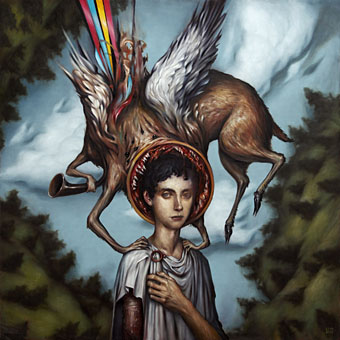
Blue Sky Noise (2010) by Esao Andrews.

Franz Xaver Messerschmidt is the first exhibition in the United States devoted exclusively to the 18th-century sculptor. Related: an earlier post about the artist’s work.

• How are the team behind War Horse planning to follow up their smash hit? With a gay love story performed by puppets. Related: Achilles (1995) by Barry JC Purves.

• More great posts at A Journey Round My Skull: Czechoslovakian Expose VI and Black Cradle of Bright Life, fifteen works by the Macedonian artist Vangel Naumovski (1924–2006).

Top 10 Anti-Gay Activists Caught Being Gay. Related: “Fuck your feelings,” in which columnist Dan Savage gets righteously impatient when a correspondent complains. As Savage says, people who use their faith as a stick to beat gay people contribute to an atmosphere of intolerance in which kids are bullied for being gay (or appearing to be), or transgender, or merely different, and kill themselves as a result. Over the past couple of weeks there’s been an upsurge of US media attention to the most recent suicides; Savage inaugurated the It Gets Better project in order to help. Also related: God Loves Poetry.
andrews2.jpg

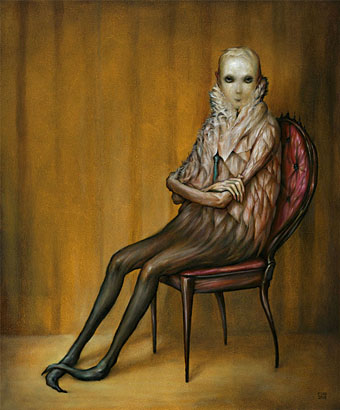
Meigh (2010) by Esao Andrews.

Antony Hegarty enthuses about Shoot Yer Load, one of the scurrilous 12″ singles released by my Savoy colleagues in the 1980s. Antony and the Johnsons have a new album out, Swanlights, on Secretly Canadian.

When the future of music was a rainbow hued parabola: book designer John Gall collects old synthesizer manuals.

Fantastic Memories (1944) by Maurice Sandoz, illustrated by Salvador Dalí.

Urban optometry: life as a London crane operator at BLDGBLOG.

• Today is 10/10/10 which means it’s Powers of Ten Day.

These New Puritans: a band like no other.

Art Nouveau: a virtual exhibition.

Diaghilev: Lord of the dance.

Flaming Telepaths (1974) by Blue Öyster Cult; Flaming Telepaths (2005) by Espers.

Diaghilev’s World of Art

miriskusstva1.jpg

Cover by Evgeny Lanceray for Prospectus of the Magazine, 1901.

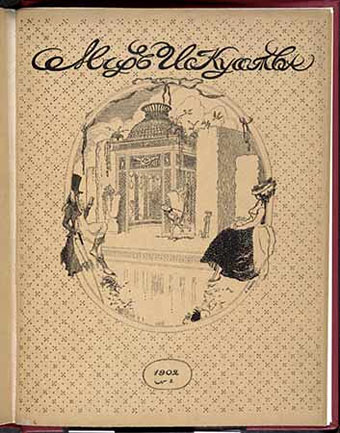
Previous posts here have concerned fin de siècle art magazines like The Savoy, Pan and Jugend; yesterday we had Sergei Diaghilev so it seems fitting to mention Diaghilev’s own magazine, Mir Iskusstva (World of Art), founded in 1899 with similar intentions to the European magazines which were highlighting developments in art beyond the academic sphere. Mir Iskusstva was also the name of the Russian art group who used the magazine as their forum, and a number of the artists involved in the movement, notably Léon Bakst, Ivan Bilibin and Nicholas Roerich, went on to work for Diaghilev at the Ballets Russes.

miriskusstva2.jpg

Cover by Léon Bakst for Mir iskusstva #8 (1902).

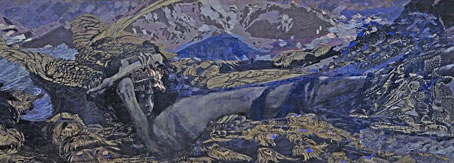
I find this later development especially fascinating since it positions the magazine as a precursor to the groundbreaking works which followed rather than being—as so many periodicals were and still are—a publication which had its moment of glory then faded from view. Of the works shown here, Vrubel’s Symbolist Demon, one of several painted by the artist, was featured in a 1903 edition of the magazine, whilst the Bakst painting, depicting the destruction of Atlantis, shows a Symbolist side to an artist who later became far better known for his Ballets Russes costume designs.

vrubel.jpg

Demon (1902) by Mikhail Vrubel.

Unlike the other magazines mentioned above, I’ve yet to come across a cache of whole editions of Mir Iskusstva (and I’m still waiting for Ver Sacrum to turn up somewhere). This page has an overview of the Russian art movement and its journal, while this page has a selection of works by the artists involved. For more of Vrubel’s work, Wikimedia Commons has the best collection of the artist’s paintings and sculpture.

bakst.jpg

Terror Antiquus (1908) by Léon Bakst.

Previously on { feuilleton }
Diaghilev and the Ballets Russes
Pamela Colman Smith’s Russian Ballet
The art of Ivan Bilibin, 1876–1942
Magic carpet ride
Le Sacre du Printemps
Images of Nijinsky

Diaghilev and the Ballets Russes

diaghilev1.jpg

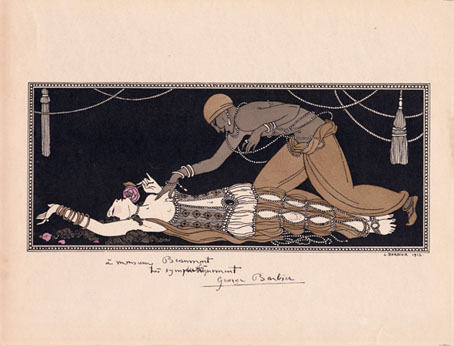
Ida Rubinstein as Zobeide and Vaslav Nijinsky as the Golden Slave in Schéhérazade (1913) by George Barbier.

Another great exhibition at the V&A, London, Diaghilev and the Ballets Russes gathers a wealth of costumes, stage designs, photographs and ephemera—including some of Stravinsky’s manuscripts—to present a history of the legendary ballet company and their visionary impresario. For those who can’t get to London the museum website shows some of the items which will be on display, and there’s also a blog about the installing of the exhibition. The enormous frontcloth from 1924 based on Picasso’s Two Women Running on the Beach received a flurry of attention in the press here but my own attention was caught by the picture of Natalia Goncharova‘s even more enormous backcloth for The Firebird. The exhibition runs to January 9, 2011.

diaghilev2.jpg

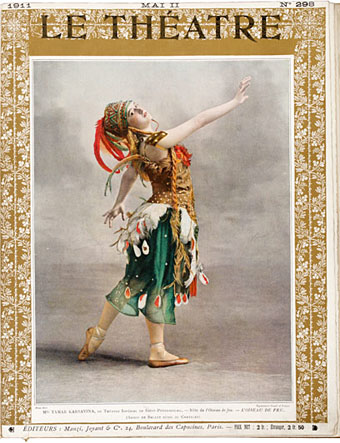
Cover of Le Théatre showing Tamara Karsavina in costume as the Firebird, May 1911.

While we’re on the subject, a new biography of the impresario, Diaghilev: A Life by Sjeng Scheijen, was reviewed last week in the New York Times:

Diaghilev loved beautiful young men, and at a time when the fashion in ballet was to exchange patronage for sex, his company provided a bounty. Scheijen dexterously plays his sources against one another to examine the erotic and professional dynamics between Diaghilev and his stars.

For a fictional (and necessarily heterosexual) account of those erotic and professional dynamics, I recommend Michael Powell & Emeric Pressburger’s The Red Shoes (1948) which not only has a central character based on Diaghilev but includes among the cast of real dancers Léonide Massine, dancer and principal choreographer of the Ballets Russes from 1915 to 1921.

See also:
Russian Ballet History | An archive and documentary site.

Previously on { feuilleton }
Pamela Colman Smith’s Russian Ballet
The art of Ivan Bilibin, 1876–1942
Jack Cardiff, 1914–2009
Magic carpet ride
Le Sacre du Printemps
Images of Nijinsky

Several Salomés

fowler.jpg

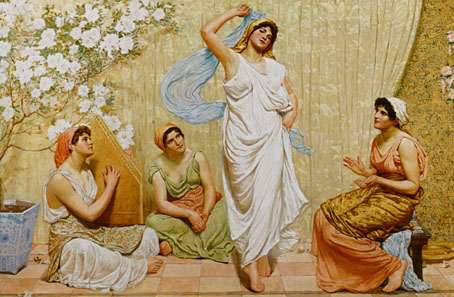
The Dance of Salomé (1885) by Robert Fowler.

There’s always more to find… Unfortunately, Robert Fowler’s academic tableaux is a prime example of bad Victorian art: carefully modelled but overlit, dull and lifeless. And worst of all for the subject at hand: deeply unerotic. We’re supposed to believe that this woman wrapped in a bedsheet would exude enough eros to drive her father to lustful recklessness. This was the bloodless “good taste” against which Oscar Wilde and the Aesthetes set themselves.

moreau.jpg

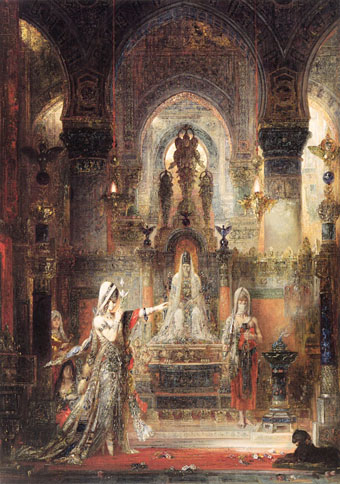
Salomé Dancing before Herod (1876) by Gustave Moreau.

Wilde’s idea of Salomé can be seen here in one of Gustave Moreau‘s many paintings on the theme. Wilde would have preferred Moreau’s paintings, or something similar, to adorn his published play but he ended up with Aubrey Beardsley instead. You only have to compare Beardsley’s Stomach Dance with Fowler’s painting to see why Aubrey’s art made such a dramatic impression in the 1890s.

pell.jpg

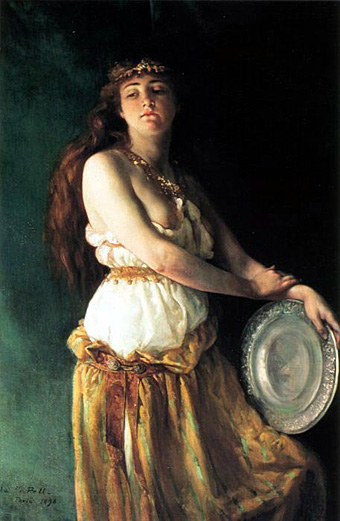
Salomé (1890) by Ella Ferris Pell.

Ella Ferris Pell’s painting isn’t the only portrait of Salomé by a female artist of this period but it’s the one which Bram Dijkstra chose as the cover image for his excellent study Idols of Perversity: Fantasies of Feminine Evil in Fin-de-Siècle Culture (1986). Of this work Dijkstra writes:

In Pell’s painting a number of the most characteristic turn-of-the-century attributes of the biblical temptress are absent. She does not glare at us with a look of crazed sexual hunger; she does not have the wan, vampire features of the serpentine dancer; nor does she show herself to be a tubercular adolescent … Pell’s Salomé, a real life-woman, independent, confident, and assertive, was far more threatening, far more a visual declaration of defiance against the canons of male dominance than any of the celebrated viragoes and vampires created by turn-of-the-century intellectuals could ever have been. Such a woman could not be disposed of in as cavalier a fashion as the evil women in man’s mind. Her indomitable reality was this feminist Salomé’s most formidable weapon, far more dangerous than any imaginary decapitating sword.

henri.jpg

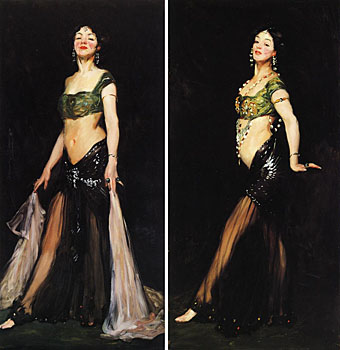
Salomé (1909), two paintings by Robert Henri.

Finally, there’s this pair of paintings by American artist Robert Henri whose work resembles John Singer Sargent’s in its shadowed backgrounds and light brushstrokes. Salomé was no longer a perennial theme by this point but Maud Allan’s improvised dance performance, Vision of Salomé, was proving enormously popular at the time Henri painted these pictures which may explain his choice of subject. There’s little in the rest of his oeuvre along similar lines.

Elsewhere on { feuilleton }
The Salomé archive

Weekend links 29

dancer.jpg

A Folies Bergère dancer, c. 1909.

Six Novels in Woodcuts: The Library of America publishes a boxed set of Lynd Ward’s works: Gods’ Man, Madman’s Drum, Wild Pilgrimage, Prelude to a Million Years, Song Without Words and Vertigo.

• RIP ace graphic designer Raymond Hawkey. Related: Raymond Hawkey: An eye for detail, and Hawkey’s James Bond cover designs from the mid-60s.

The Record: Contemporary Art and Vinyl, an exhibition at Duke University, North Carolina, features work by 41 artists from around the world, from the 1960s to the present, using vinyl records as subject or medium.

decaris.jpg

The Île de la Cité, a steel engraving by Albert Decaris (1950).

Fred Tomaselli will have a new exhibition of his work at the Brooklyn Museum next month.

Socialist Monuments in Bulgaria photographed by Linda Ferrari.

• What would Howard think of the Mythos Art Dildo?

Space is Process, a film about Olafur Eliasson.

Thurston Moore’s Indie Books.

Chris Colfer in a leather bar.

Ephemeral New York.

• Chrome! Helios Creed’s YouTube channel.