Weekend links 588

br.jpg

Gerry Barney’s logo for British Rail. A page from the British Rail Corporate Identity Manual (1965).

• RIP Russ Kick, writer, editor, and founder of many websites/blogs such as Rare Erotica, Books Are People Too and (notoriously) the several iterations of The Memory Hole, a space dedicated to keeping visible information that successive US governments would have preferred to remain unseen. I’d known Russ remotely for many years, initially as a reviewer of the Savoy comics in Outposts. Savoy Books later helped find him a publisher for Psychotropedia: A Guide to Publications on the Periphery, a wide-ranging overview of alternative/underground print culture in the late 1990s. In 2004 his information activism gave him a fleeting taste of world-wide attention when he forced the Bush administration to make public the photos of flag-draped coffins returning from Iraq. The scandal put his name on the front pages of newspapers that should have been finding those photos for themselves instead of cheerleading the war. A run of books for Disinformation presented his archival researches for the general reader, then in 2012 he edited The Graphic Canon, a massive three-volume collection of comics and illustrations based on classic works of literature. I was among the many contributors to the latter with an adaptation of The Picture of Dorian Gray, and would have worked on the follow-up collection of crime stories if I hadn’t been busy with other things. I had hoped that we might work together again in the future.

• “‘The new mainstream has attempted to erase the innovations of the avant-garde from jazz history,’ the film declares.” Geeta Dayal reviews Fire Music, a documentary about the jazz innovations of the 1960s.

• I don’t have the hardware to play this but Sable is a new computer game from Raw Fury whose design owes much to the desert landscapes seen in comics by Moebius.

• New/old music: Stealing Sheep and The Radiophonic Workshop reimagine the score for René Laloux’s animated science-fiction film La Planète Sauvage.

• At Spine: Savannah Cordova on how to perfect your book cover’s typography. Having recently designed an all-type cover design this is timely.

• Mixes of the week: Isolatedmix 113 by Sunju Hargun, XLR8R Podcast 714 by Soela, and Holograficzne Widmo ze Bart De Paepe by David Colohan.

• “If it ain’t broke, don’t fix it.” Gerry Barney, designer of the British Rail logo, doesn’t like the green reworking of his design.

• Scottish lord goes blood simple: a teaser for The Tragedy of Macbeth by Joel Cohen and some bloke called William Shakespeare.

• “It’s unmanageable.” Ellen Peirson-Hagger on how the vinyl industry reached breaking point.

Macbeth (1973) by John Cale | Rail (1994) by Main | Logotone (2013) by Steve Moore
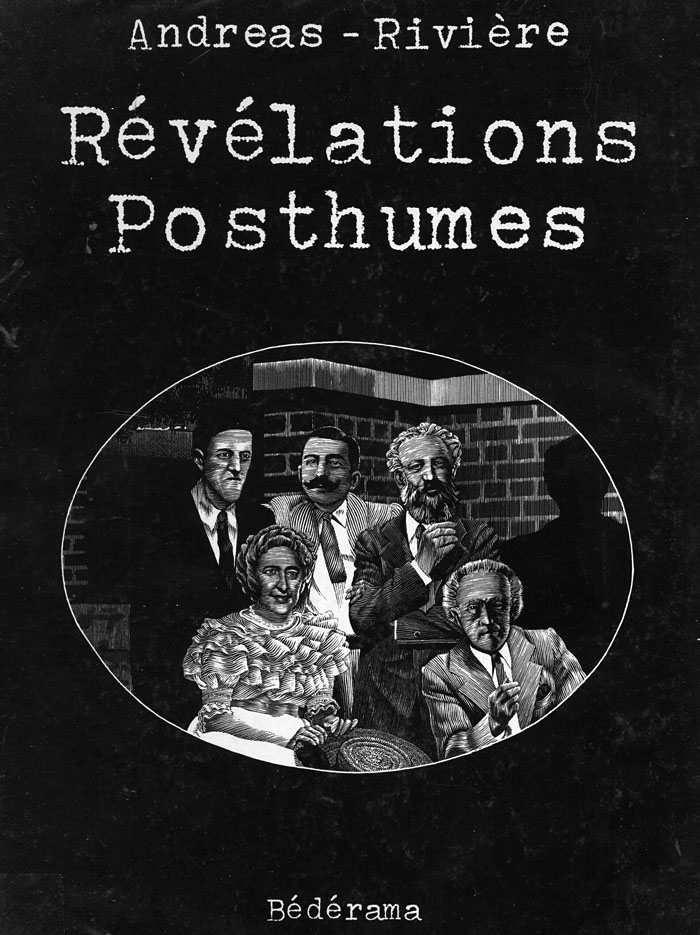
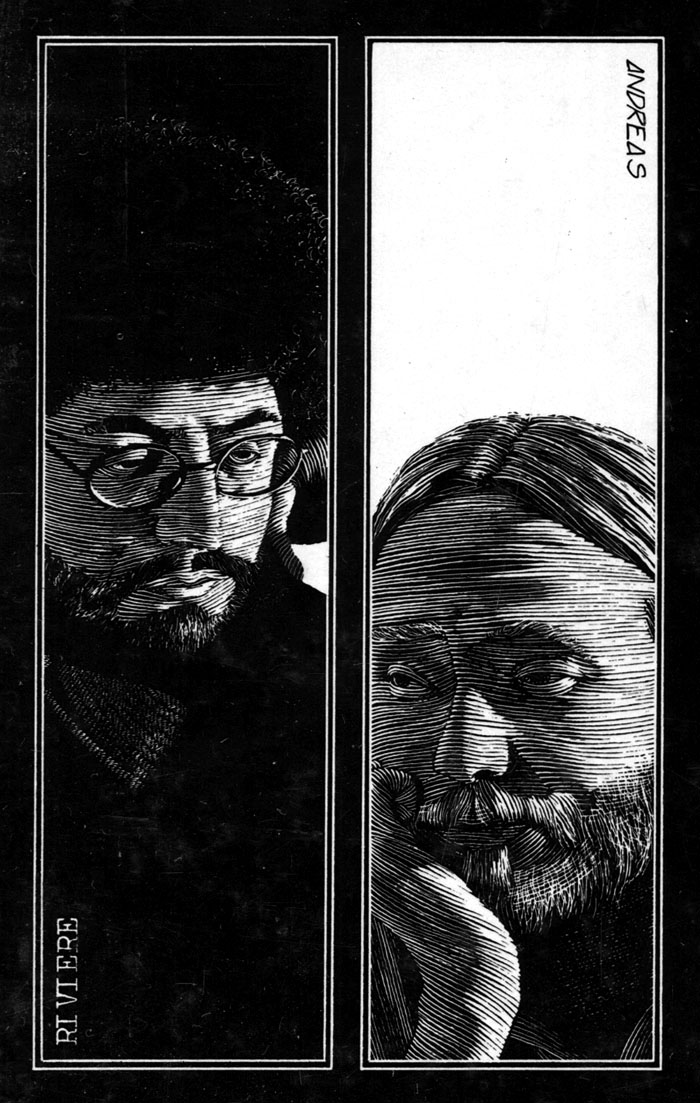
Révélations Posthumes by Rivière and Andreas

revelations1.jpg

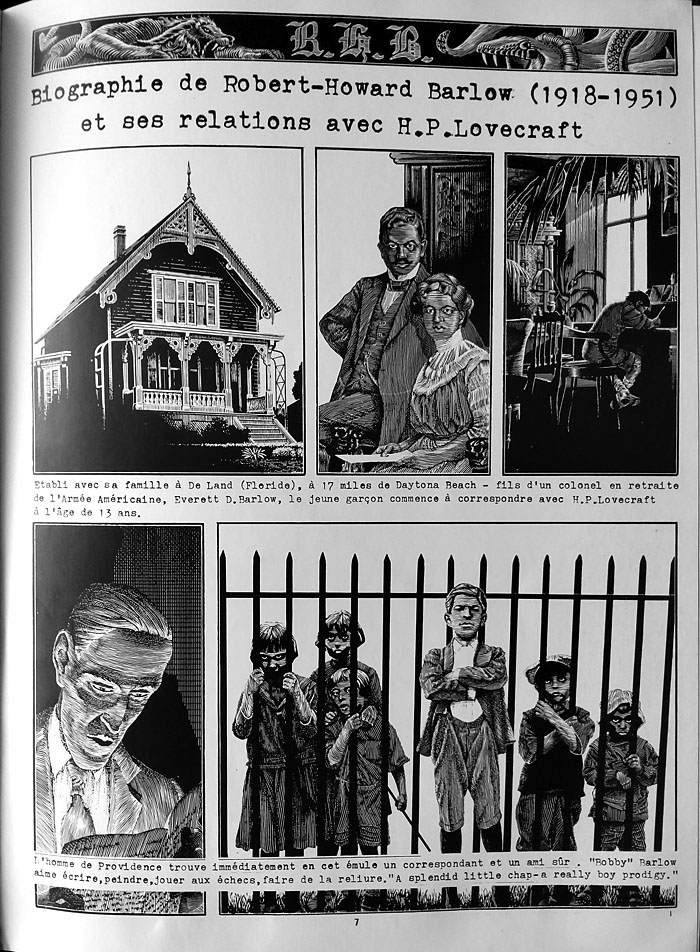
Le livre est arrivé. Révélations Posthumes, written by François Rivière and illustrated by Andreas (Martens), turned out to be better than I expected: 58 pages of very sharp black-and-white illustration on coated paper, and in the hardcover album format which has long been my favourite mode of presentation for comic books. The quality of the printing has made me realise that the reprint of RHB in The Cosmical Horror of HP Lovecraft (see this post) had blacked in many of the fine lines of Andreas’s scraperboard drawings, resulting in darker panels with diminished detail. Here you see the story as it was drawn, and—more importantly—with all of its pages present. The reprint of La Femme de Cire du Musée Spitzner (The Spitzner Museum’s Wax Woman) fared much better in Escape magazine.

revelations2.jpg

Auteur et artiste.

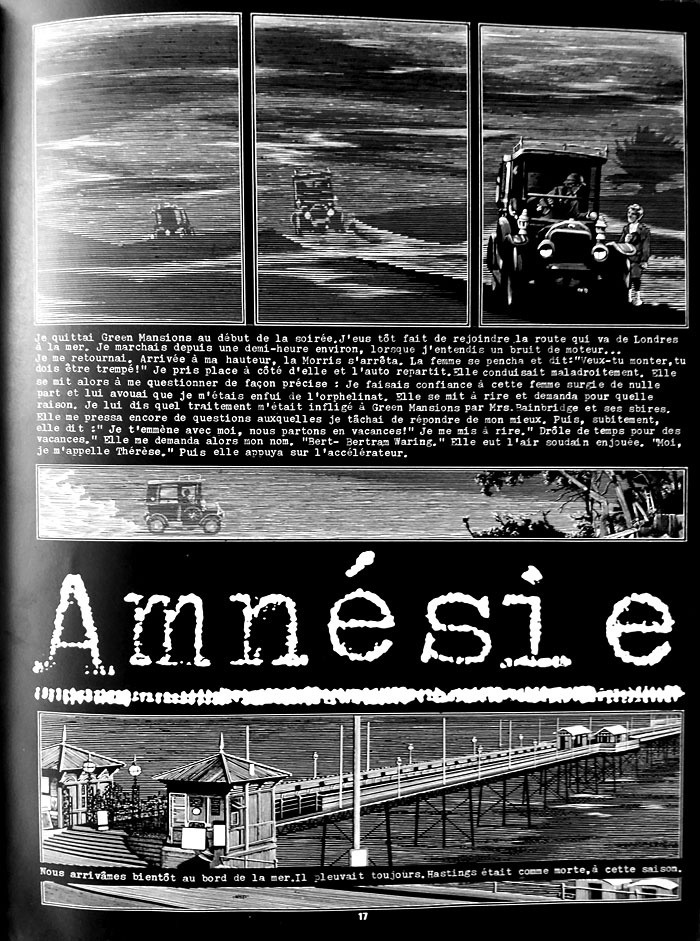
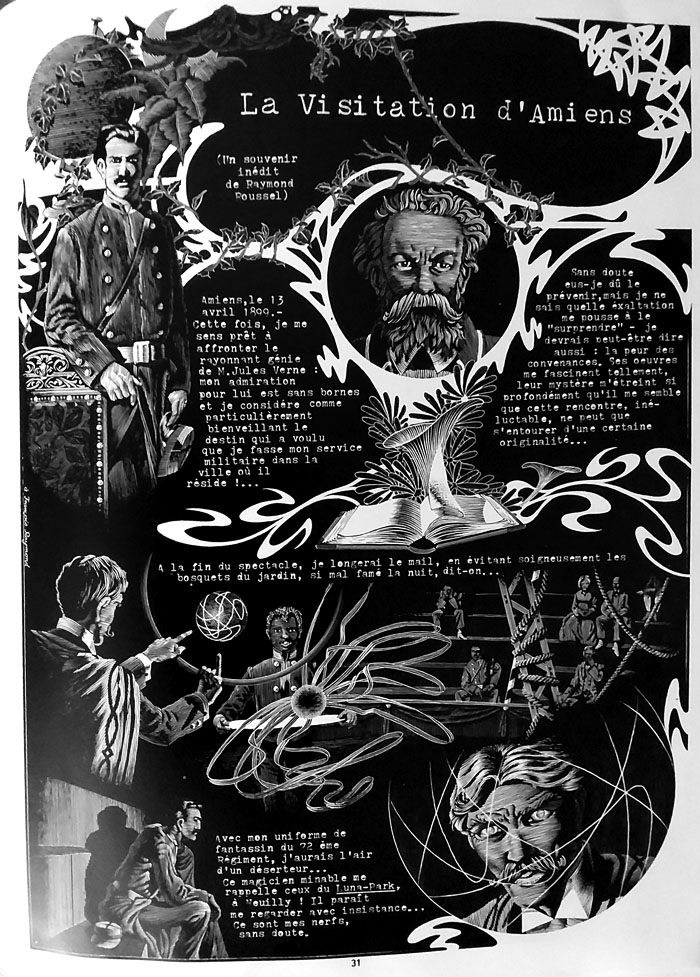
The other three stories in this collection are all new to me. Amnésie concerns the strange disappearance of Agatha Christie in December 1926, an event which has been the source of much unresolved speculation (Monsieur Rivière is apparently a great Christie enthusiast); La Visitation d’Amiens recounts a meeting in 1899 between the young Raymond Roussel when he was posted to Amiens during his military service, and the aging Jules Verne, whose fantastic inventions would influence Roussel’s 1914 novel, Locus Solus; Le Crime de la Mosquée is set in Rochefort-sur-Mer in 1936, and concerns a young Englishman, Alfred J. Nobbs, visiting the home of the late Pierre Loti, another writer whose works inspired Raymond Roussel. Writers dominate this book, which no doubt explains the choice of typewritten captions.

revelations3.jpg

The introduction by Pierre-Jean Rémy suggests that all the stories are combinations of fact and fiction, but the Lovecraft and Robert H. Barlow story seems to be based in full on Barlow’s biography, while the Spitzner Museum story concerns a Belgian painter, Pol Delmotte, who doesn’t appear to exist at all outside these pages. (“Delmotte” is very probably based on Paul Delvaux but the events of the story would have prevented him being named as such. Thanks to Paul R. for the comments noting this.) Whatever the case—and it’s impossible for me to really tell when my French is so poor—the artwork is superb. The very similar look of the Barlow and Spitzner stories, all elongated panels and the occasional half-toned photograph, had led me to expect a similar form for the other stories but Andreas varies his layouts from story to story. Amnésie adds a black background to the pages, while La Visitation d’Amiens removes most of the panel borders to create a series of floating vignettes, Art Nouveau flourishes and other decoration. Le Crime de la Mosquée differs from the rest by filling each page with a landscape-ratio composition, a rare thing in comics. The backgrounds of the last few pages present a series of architectural interiors whose meticulous rendering rivals the engravers of the 19th century for veracity and detail. The book as a whole shows Andreas to be a master of the scraperboard technique but this volume also seems to comprise the totality of his work in the medium. His later books contain a great quantity of exceptional art but the pen-and-ink style he uses is often sketchier and more stylised, inevitably so given the pressures of comic-book production. I’m tempted to hope that Titan might one day produce a English translation of this book but they’d be more likely to do the Rork saga or the rest of the Cromwell Stone series first, and there are many volumes of those. Révélations Posthumes has at least been reprinted several times since 1980 so it’s easy to find.

revelations4.jpg

revelations5.jpg

Continue reading “Révélations Posthumes by Rivière and Andreas”

Andreas, HPL and RHB

andreas1.jpg

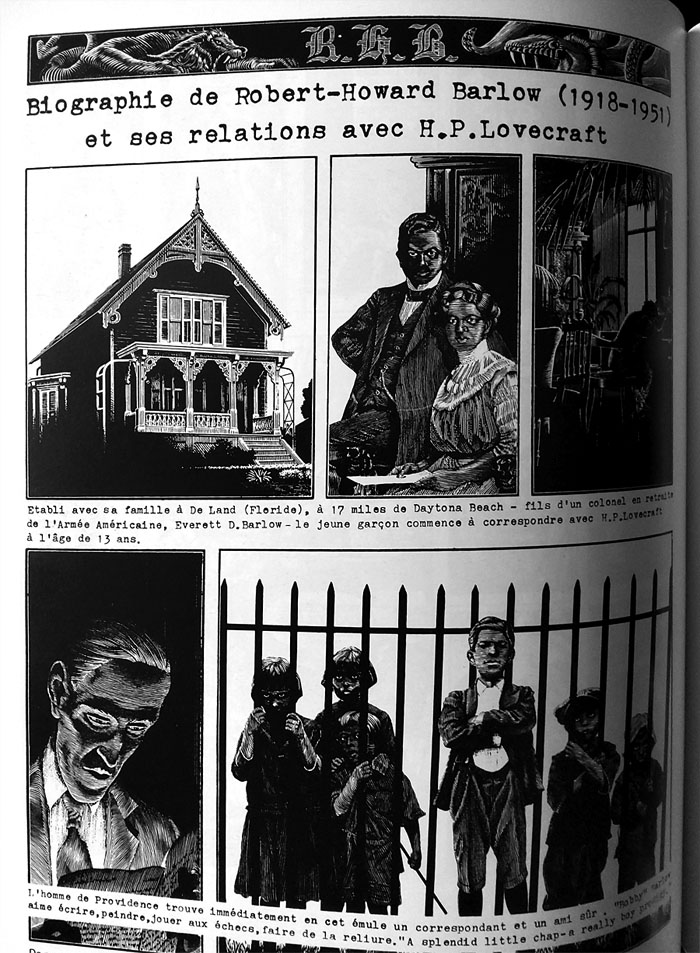
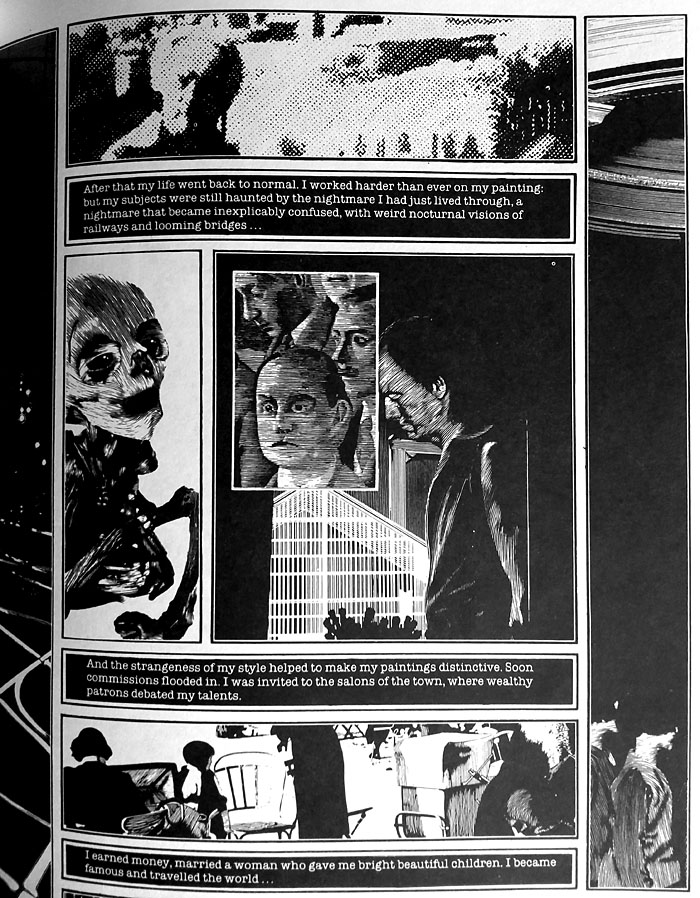
Mention of Robert H. Barlow last week reminded me of a comic strip which is an unusual addition to the world of Lovecraft-related art. RHB, written by François Rivière and illustrated by Andreas (Martens), was published in a French magazine, À Suivre, in 1978. I discovered the story when it was reprinted in The Cosmical Horror of HP Lovecraft (1991), an Italian volume that was the first substantial collection in book form of Lovecraftian comic strips and illustrations. Andreas and Rivière’s strip is a short biographical sketch of Robert H. Barlow’s equally short life which focuses on his connections to HP Lovecraft but doesn’t attempt any spurious fictionalisation. A few of the pages were posted at Deep Cuts in June of this year, together with a translation of the French text. The post there notes something that hadn’t occurred to me before, that Rivière would have taken most of his information about Barlow from L. Sprague de Camp’s Lovecraft biography. The post also made me realise that the Cosmical Horror reprint is missing its last two pages, so after 30 years I finally discover that the panel sequence showing a falling cat (seen earlier being dropped from a height by the young Barlow) has a happy conclusion that also ends the strip itself.

andreas4.jpg

The Spitzner Museum’s Wax Woman.

Andreas has been a favourite comic artist of mine for many years, thanks in part to strips like RHB with its combination of unorthodox page layouts, scraperboard drawings (scratchboard, if you’re American) and the occasional use of enlarged half-toned photos. The scraperboard technique can be a laborious one for a comic artist, especially when applied in a photo-realist manner, which may explain why Andreas has used a more stylised pen-and-ink rendering for many of his own books, the drawings of which often resemble the engraving-like illustrations of Franklin Booth. The only other Andreas strip I’ve seen to date that uses scraperboard is The Spitzner Museum’s Wax Woman, another collaboration with Rivière which relates the ill-fated encounters of a Belgian painter with the woman of the title. The story received its first English printing in issue 17 of Escape magazine in 1989, and its appearance there made Andreas an artist to look out for in the future. The museum tale and the Barlow story were collected with several similar pieces in a book collection, Révélations Posthumes, in 1980. I’d really like to see this even though my French is très pauvre:

Avec ce livre, vous découvrirez d’étonnantes révélations posthumes concernant la vie fulgurante d’un ami et confident de Lovecraft, l’étrange aventure survenue en 1926, à Hastings, à un orphelin et une mystérieuse Thérèse Neele. La rencontre d’un soldat nommé Raymond Roussel et de Jules Vernes, à Amiens. Les origines du talent morbide d’un peintre belge fasciné par les figures de cire du Musée Spitzner. L’avatar maléfique joué à un malheureux jeune Anglais par Pierre Loti en sa maison de Rochefort-sur-Mer.

andreas2.jpg

Rork.

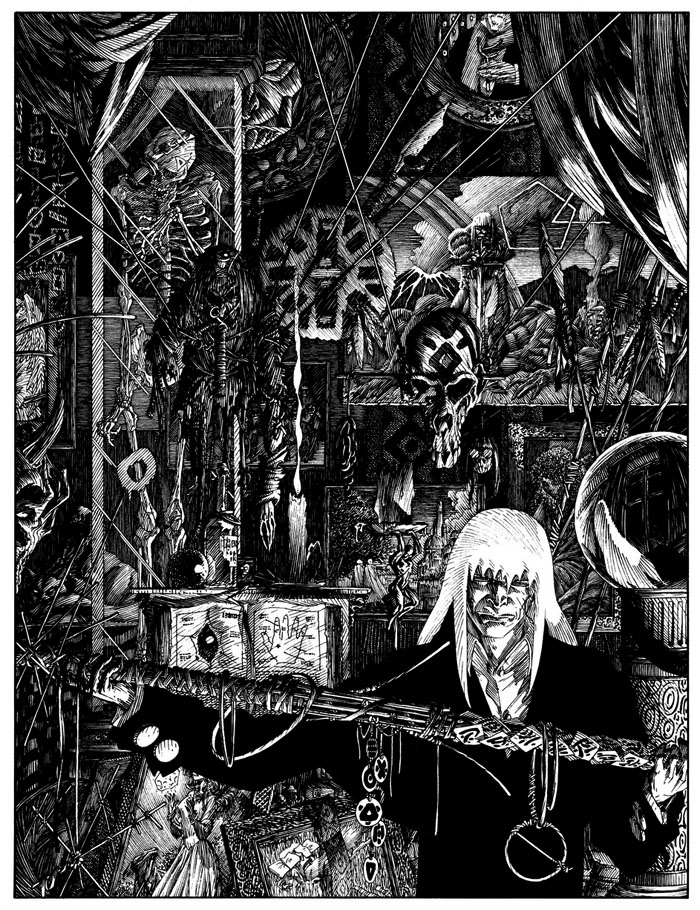
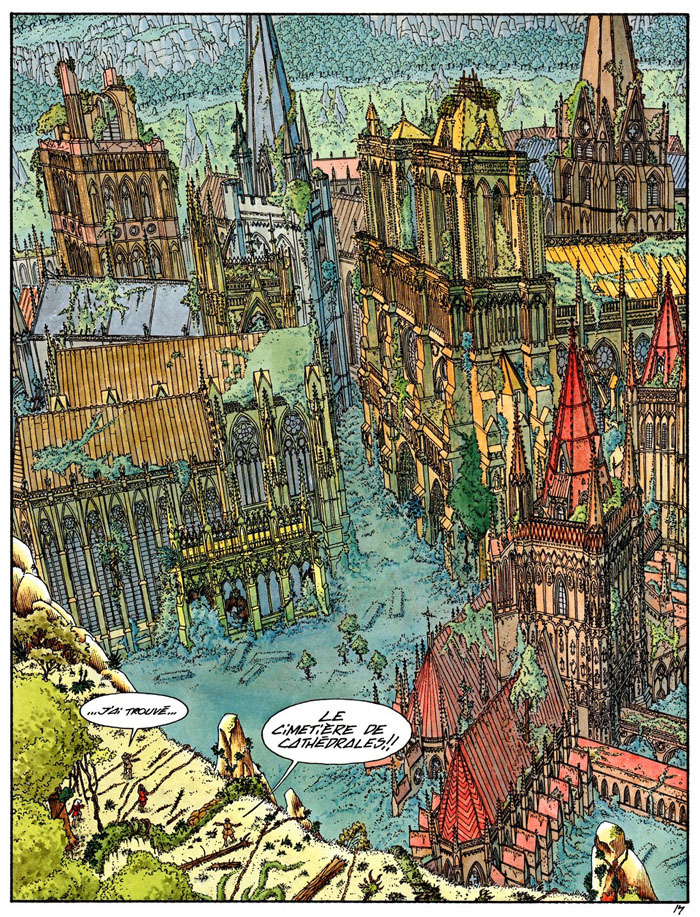
Révélations Posthumes seems to have been a one-off for Andreas. His subsequent, self-written books are more commercial fare, being a succession of weird adventure stories which follow the exploits of eccentric characters such as Cromwell Stone (an occult detective), the ageless, enigmatic Rork (a white-haired magus and occult detective), Capricorne (an astrologer and occult detective), and so on. As with Philippe Druillet, Lovecraft is never far away: the first episode of Cromwell Stone opens with an epigraph from HPL’s Supernatural Horror in Literature, while elsewhere inexplicable leviathan entities lurk in parallel dimensions, and architectural anomalies abound. The Rork series is especially enjoyable, like Doctor Strange without the superhero histrionics, featuring wildly audacious storylines such as Le Cimetière de cathédrales (1988), in which a graveyard for cathedrals is discovered in the Amazonian jungle.

andreas3.jpg

The fantasies of Andreas, like those of François Schuiten, might be more familiar to Anglophone readers if his works had been translated more often (or, in the case of RHB, translated at all). Dark Horse ran English versions of stories by Andreas and Schuiten in their Cheval Noir anthology series in the 1990s, and also published English reprints of the Rork and Cromwell Stone books but, as with the translated editions of Schuiten, these are now hard to find. More recently, Titan Books has published a new English edition of the first Cromwell Stone book but I’ve not seen any indication that they’ll be following this with more of the same. (I’ve also not seen the book itself so can’t vouch for the quality of the translation. Titan’s recent Druillet reprints have been riddled with textual errors. Beware.) Rather than wait for translations that might never arrive, the better option would be to improve my French reading skills. Writing this post has prompted me to order a secondhand copy of Révélations Posthumes. I’m looking forward to seeing what else it contains.

Elsewhere on { feuilleton }
The Lovecraft archive

Previously on { feuilleton }
Lovecraft: Démons et Merveilles
The art of François Schuiten
The art of Andreas Martens

Weekend links 578

luttich.jpg

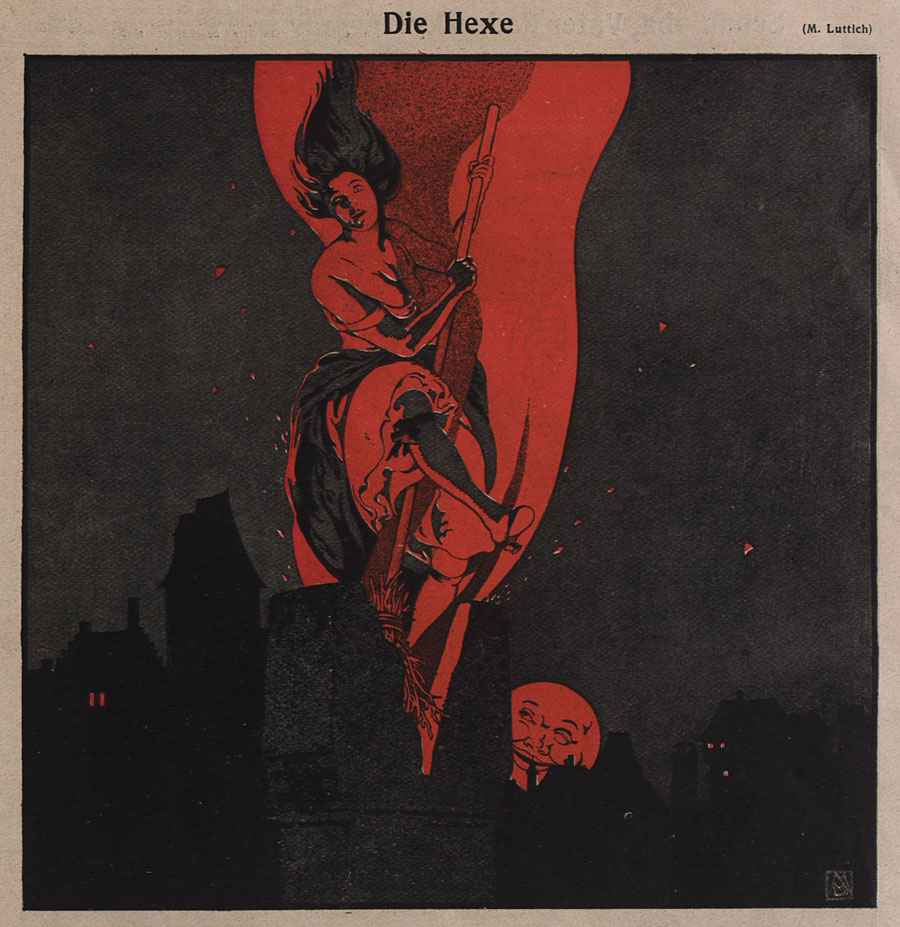
The Witch (1920) by Mila von Luttich for Die Muskete.

• “One thing that used to annoy Geff in particular—I don’t think Sleazy cared so much—was that the gay press hardly ever paid any attention to Coil. It really was the cliché of, if you’re making disco bunny or house music then you might get covered in the gay press, but if you’re not doing something that appeals to that rather superficial aesthetic, which was the hallmark of the gay scene, they didn’t even deign to glance at you.” Stephen Thrower talking to Mark Pilkington about Love’s Secret Domain by Coil, and touching on an issue that I’ve never seen referred to outside the occasional Coil interview. Coil’s sexuality was self-evident from their first release in 1984 but they always seemed to be too dark and too weird for the gay press, and for the NME according to this interview.

• “Gorey collected all sorts of objects at local flea markets and garage sales—books, of course, though also cheese graters, doorknobs, silverware, crosses, tassels, telephone insulators, keys, orbs—but he especially loved animal figurines and stuffed animals.” Casey Cep on Edward Gorey’s toys.

• Last week it was a giant cat opposite Shinjuku station; this week at Spoon & Tamago there’s a giant head floating over Tokyo.

DJ Food delves through more copies of The East Village Other to find art by underground comix artists (and Winsor McCay).

• New music: My Sailor Boy by Shirley Collins, and Vulva Caelestis by Hawthonn.

• “€4.55m Marquis de Sade manuscript acquired for French nation.”

• At Dangerous Minds: The Voluptuous Folk Music of Karen Black.

• At Greydogtales: Montague in Buntlebury.

Aaron Dilloway‘s favourite music.

Toys (1968) by Herbie Hancock | Joy Of A Toy (1968) by The Soft Machine | Broken Toys (1971) by Broken Toys

Return to Pepperland

ys1.jpg

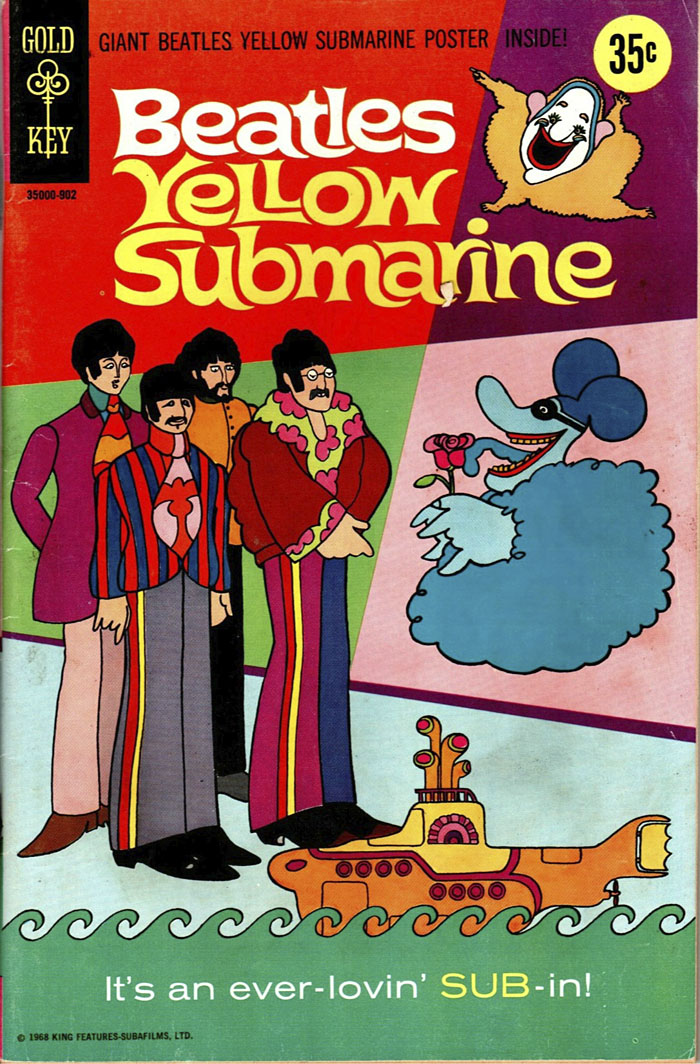
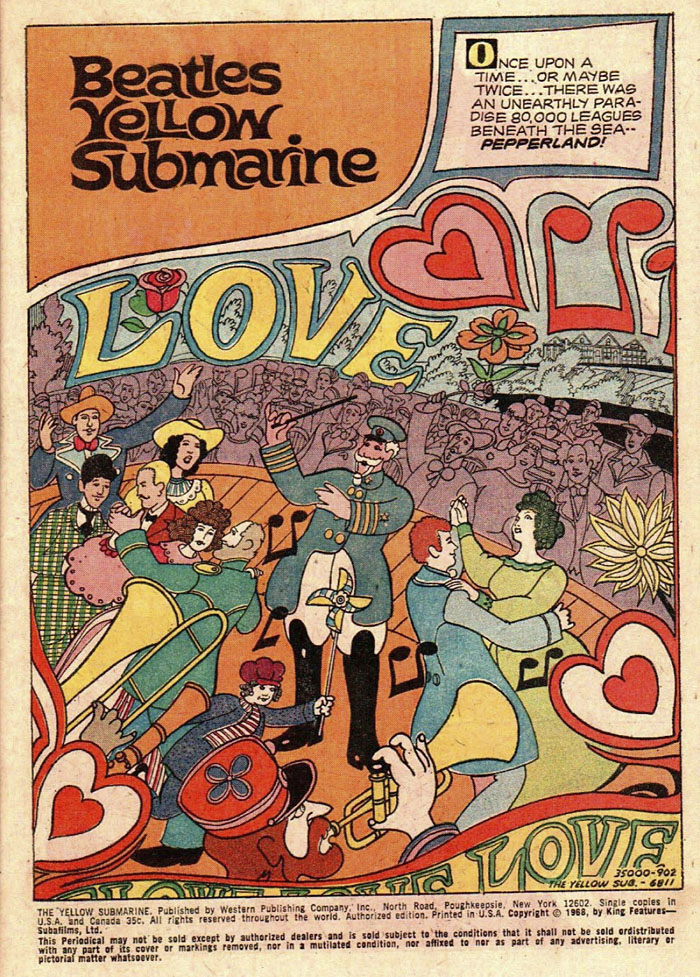
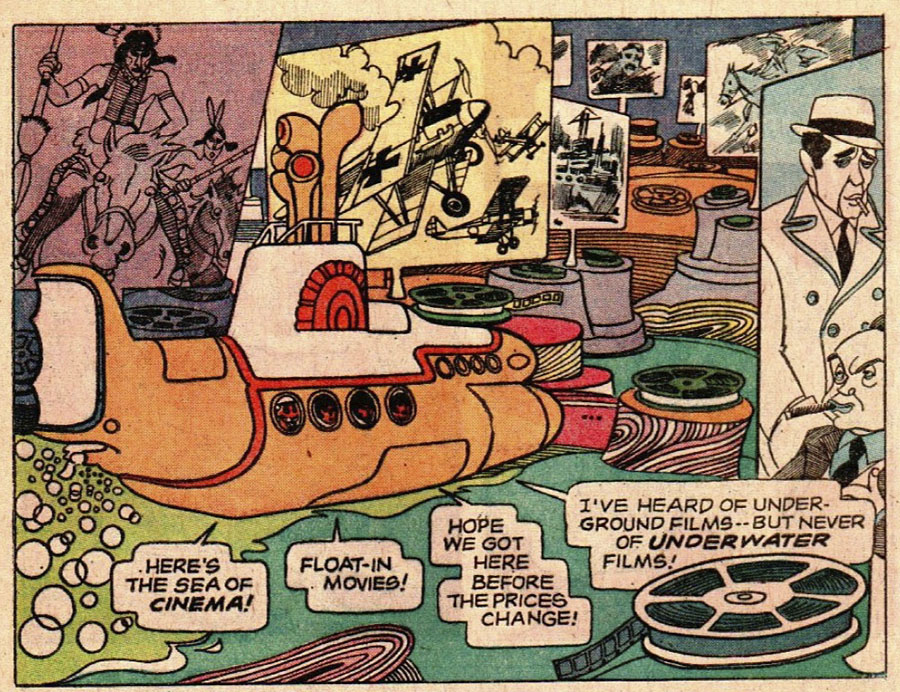
Another candidate for the small list of comics drawn in the groovy style (or a diluted version of the same), the first comic-book adaptation of Yellow Submarine was a single 64-page issue published by Gold Key in February 1969. Low-quality copies have been circulating for years on fan sites but there’s now a copy available here with the pages scanned at a higher resolution. Whatever the quality, the cheap paper doesn’t help the artwork, but for a cash-in this isn’t a bad adaptation. The background details don’t always keep up with Heinz Edelmann’s invention but artist José Delbo maintains the character style of the animation throughout, while the script by Paul S. Newman pads out the missing song sequences with additional japes and bad puns. I’ve seen claims that the story is based on an early draft of the film script but can’t say whether this is true or not. There are a few notable deviations from the film, however, such as additional seas—The Sea of Consumer Products, The Sea of Cinema—and an extra character, Rita the Meter Maid, who looks nothing like a British traffic warden of the 1960s.

ys3.jpg

The last time I mentioned this comic I also referred to a more recent adaptation by Bill Morrison which had been commissioned, partly drawn then inexplicably cancelled. Morrison’s pages were superior to the Gold Key adaptation in their design and their fidelity to the animation style of the film so it’s good to see that the various licence-holders have allowed him to complete his work. The book was published by Titan for Yellow Submarine‘s 50th anniversary in 2018.

ys3.jpg

Previously on { feuilleton }
The groovy look
The South Bank Show: The Making of Sgt Pepper
The Sea of Monsters
Tomorrow Never Knows
Yellow Submarine comic books
A splendid time is guaranteed for all
Heinz Edelmann
Please Mr. Postman
All you need is…