Les Murailles de Samaris by Schuiten & Peeters

map.jpg

The Obscure World.

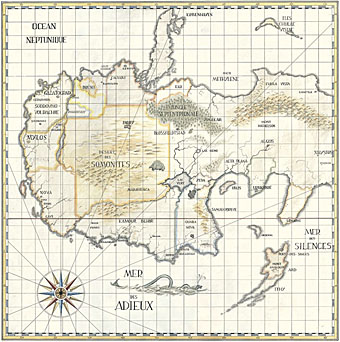
Les Murailles de Samaris (1983) by François Schuiten and Benoît Peeters is the first of the stories which explores the world of Les Cités Obscures, a “counter-Earth” on the opposite side of our Sun with a continent of separate city-states, each with their own distinct architectural style. Having discovered these stories first in their French editions it wasn’t immediately apparent how much the Obscure World was supposed to be connected to our own; a number of the books contain references to people or places in our world, while the city of Brüsel, subject of the book of that name, is a kind of parallel Brussels. The counter-Earth explanation isn’t given in the early books but seems to have evolved later, as does Schuiten and Peeters’ introduction of portals between the worlds which imply a two-way leakage of influence. Writer and artist encourage readers of the series to suggest or “discover” new portals to the Obscure World.
samaris1.jpg

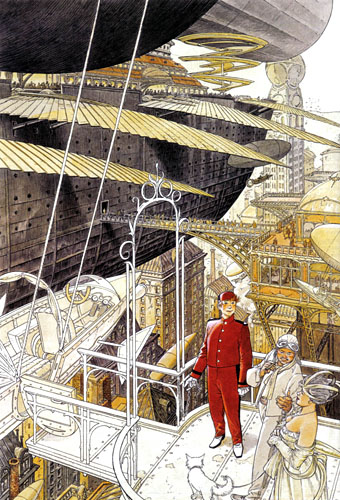
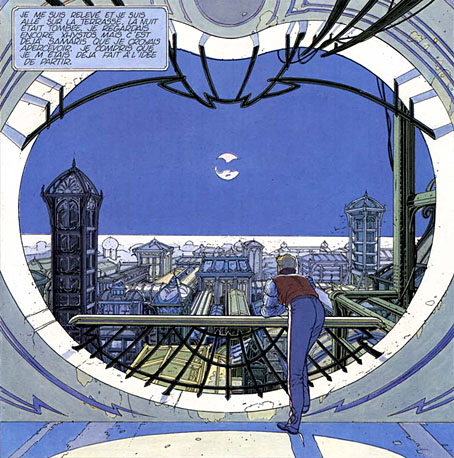
A view over Xhystos.

The distant city of Samaris is the mysterious destination of Les Murailles de Samaris (The Walls of Samaris). The story begins in the city of Xhystos whose style is fully Art Nouveau in a manner reminiscent of the celebrated Belgian architect Victor Horta, if Horta had been allowed to design a city where every building is decorated with wrought-iron curves and glass-canopied roofs, and where trams go by on elevated roads several storeys high. The narrator, Franz, is informed by the city authorities that he’s been chosen to go on a perilous mission to discover whether rumours about the nature of Samaris are true or not. Previous explorers have failed to return so Franz’s friends and girlfriend regard his acceptance of the mission as suicidal. What follows is a journey by steam train out of the city into a surrounding zone of lawless ruins, then a journey by “altiplane” and “aerophele”, the latter being a kind of multi-winged sand yacht.

Continue reading “Les Murailles de Samaris by Schuiten & Peeters”
The art of François Schuiten

schuiten1.jpg

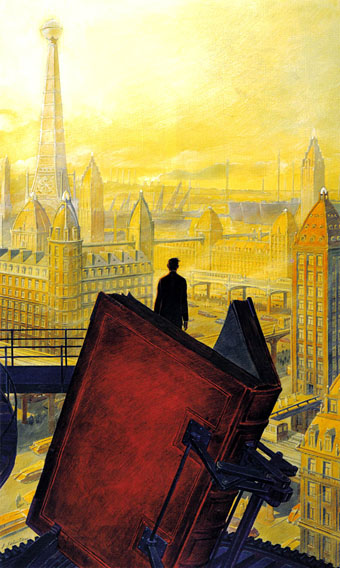
Paris au XXieme Siecle by Jules Verne (1994).

Following a comment I made last week in the post about the Temples of Future Religions by François Garas I’ve decided it’s time to give some proper attention to one of my favourite comic artists, François Schuiten, a Belgian whose obsession with imaginary architecture resembles the earlier endeavours of Garas and others. Schuiten’s parents were both architects which perhaps explains his predilection. In addition to a large body of comics work, he’s produced designs for film—notably Taxandria by Raoul Servais—Belgian stamps, and a steampunk makeover for the Arts et Métiers station of the Paris Métro. In 1994 he created cover designs and a series of illustrations for the publication of Jules Verne’s rediscovered manuscript, Paris au XXieme Siecle.

schuiten2.jpg

Cover for Spirou (2000).

I first encountered Schuiten’s work in a 1980 issue of Heavy Metal magazine which was reprinting translated stories from the French Métal Hurlant along with original work. Schuiten’s story, The Cutter of the Fog, was an erotic and futuristic tale of a small community and the obsession of the local “fog-cutter”. François’s brother Luc wrote the piece and it bears some similarity with JG Ballard’s Vermilion Sands story, The Cloud Sculptors of Coral D. Unusually for Schuiten, the architecture was downplayed in this one although the small homes with their geodesic roofs are like extrapolations of architectural plans from one of the Whole Earth Catalogues.

The next time I saw his work was several years later when artist Bryan Talbot showed me some of the comic albums he’d brought back from a European convention. Among these there were several of the Cités Obscures books that Schuiten had been creating during the Eighties and Nineties with writer Benoît Peeters. These knocked me out with their apparently effortless creation of an imaginary world comprised of several city states, each with their own unique architectural style, and a wealth of retro-future technology, from dirigibles of all shapes and sizes to ornithopters and huge motorised unicycles. One of the many things I liked about European comic artists, and something which made me favour their work over their American counterparts, was the creation of richly detailed imaginary universes with inhabitants one could expect to meet in our world, not facile superheroes or vigilantes. Schuiten went further than his contemporaries by making the architecture meticulously believable and foregrounding its design to an extent that in some of the Cités Obscures stories architecture itself is the subject.

Continue reading “The art of François Schuiten”

The Columbus Monument

columbus.jpg

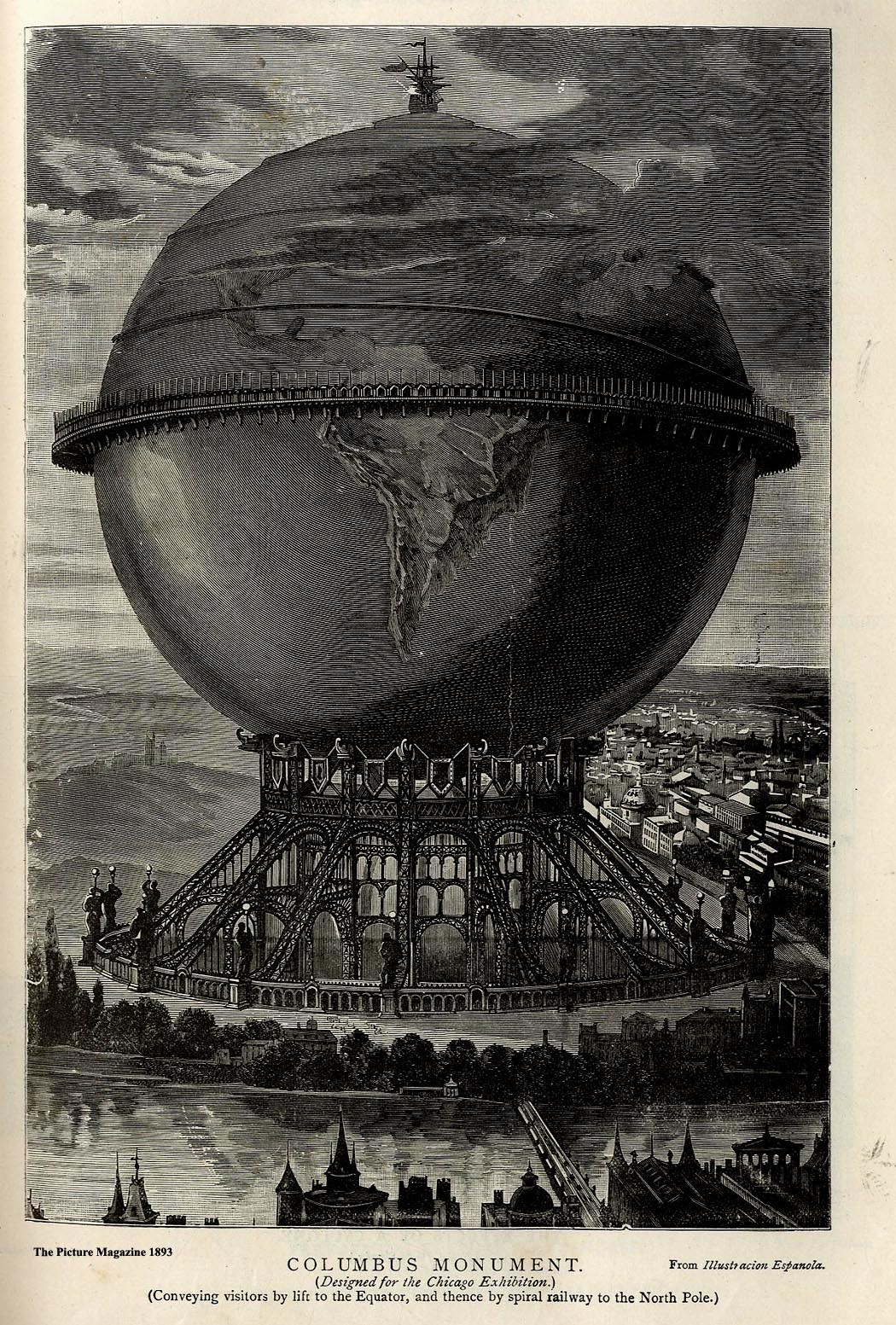
You can always rely on expositions and world’s fairs for architectural extravagance. This monster globe was an unrealised proposition for the 1893 World’s Columbian Exposition in Chicago and would have required potential visitors to be conveyed “by lift to the Equator, and thence by spiral railway to the North Pole.” What Columbus’s ship is doing perched at the top of the world is anyone’s guess. I’ve not been able to discover who was responsible for this; Erik Larson’s book about the fair (and the career of serial killer HH Holmes), The Devil in the White City, doesn’t mention the monument in its index.

Previously on { feuilleton }
• Exposition Universelle publications
• Exposition cornucopia
• Return to the Exposition Universelle
• The Palais Lumineux
• Louis Bonnier’s exposition dreams
• Exposition Universelle, 1900
• The Palais du Trocadéro
• The Evanescent City

The art of Peter Randall-Page

randall-page1.jpg

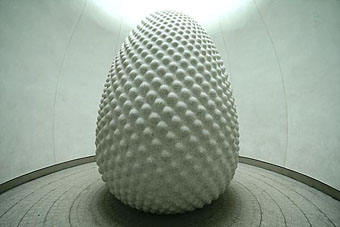
Seed (2007).

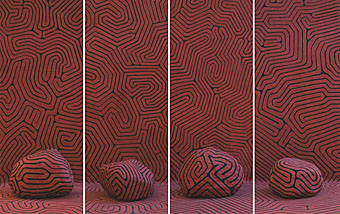
It was my intention to post something about Peter Randall-Page’s sculptures earlier this year but never got round to it, so the opening of an exhibition of his work at the Yorkshire Sculpture Park this month provides the perfect opportunity. The park’s website has details of the works on view while the artist’s own site has a detailed catalogue of his career. I hadn’t realised until I looked at his list of works that he was responsible for my favourite of Manchester’s small collection of public fountains, the St Ann’s Fountain in St Ann’s Square.

Update: A photo gallery of the works on display.

randall-page2.jpg

Rocks in my Bed (2005).

Previously on { feuilleton }
• The art of Arnaldo Pomodoro
• Sculptural collage: Eduardo Paolozzi
• The art of Igor Mitoraj

Exposition Universelle publications

exposition1.jpg

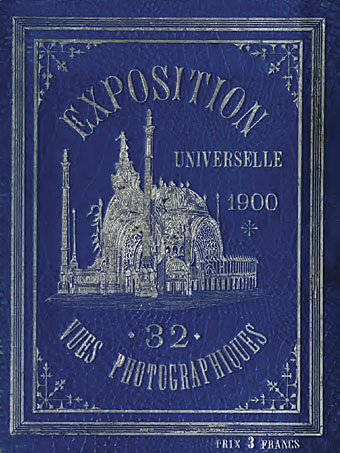
More Exposition Universelle fetishism. The Internet Archive has a small collection of documents from the Paris exposition, not all of them of interest but these two are worth a look for their pictures at least. Exposition universelle, 1900; 32 vues photographiques (above) features various views of the exposition exhibits although they’re made somewhat redundant by the Brooklyn Museum’s Flickr set of tinted photos.

exposition2.jpg

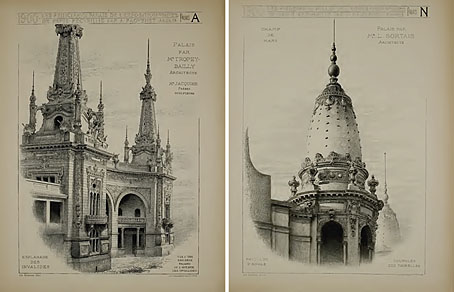
Of more interest is Les principaux palais de l’Exposition universelle de Paris with its details of the extravagant architectural confections on display. And for a look at a visitors’ guide there’s Paris Exposition, 1900: guide pratique du visiteur de Paris et de l’exposition from Hachette & Cie, still going strong today and now the UK’s largest publisher.

Previously on { feuilleton }
• Exposition cornucopia
• Return to the Exposition Universelle
• The Palais Lumineux
• Louis Bonnier’s exposition dreams
• Exposition Universelle, 1900
• The Palais du Trocadéro
• The Evanescent City