Weekend links 271

flyhead.jpg

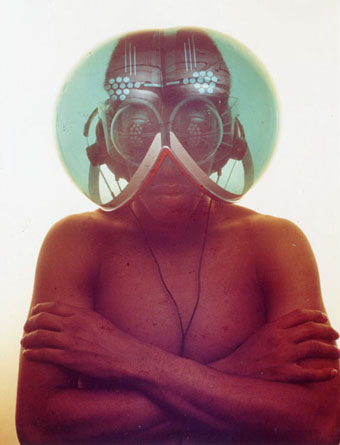
Environment Transformer/Flyhead Helmet by Haus-Rucker-Co (1968). From Hippie Modernism at the Walker Art Center, Minneapolis.

• From 2006: Weird Tales: The Strange Life of HP Lovecraft. Geoff Ward examines Lovecraft’s life and work for BBC Radio 3 with contributions from Neil Gaiman, ST Joshi, Kelly Link, China Miéville and Peter Straub. Meanwhile, Ned Beauman wonders whether Ford Madox Ford is “as scary as Lovecraft”.

• Alexei German’s years-in-the-making feature film, Hard to be a God (previously), receives a UK release this week. Paul Duane reports on an overwhelming viewing experience, while Nigel Andrews says it “may be the greatest film since the millennium began”.

• Mixes of the week: Adventures In Sound And Music, 30 July 2015, hosted by Joseph Stannard, and RCMIX9 by worriedaboutsatan.

As Nabokov insisted, “Literature is invention. Fiction is fiction. To call a story a true story is an insult to both art and truth.” The genre thrives because its deceptions are liberating. For Wood, the thrill of reading fiction is intimately connected with the awareness that fiction constitutes “an utterly free space, where anything might be thought, anything uttered.” The excitement comes when, as readers, we’re allowed to participate in this freedom and experience the fiction imaginatively, without being required to believe that it is true.

Joanna Scott on The Virtues of Difficult Fiction

• “Writing used to be a solitary profession. How did it become so interminably social?” asks Meghan Tifft.

• The original, real-life dystopian cityscape of Kowloon Walled City, and the artwork it inspired.

• The Long, Lonely Walk: Nick Ripatrazone on hallways in horror films.

• New cover designs for the Essentials range from Penguin Books.

• Lemi Ghariokwu: “How I designed Fela Kuti’s album covers”.

• “Do CDs sound better than vinyl?” asks Chris Kornelis.

• Magic Fly (1977) by Space | Human Fly (1978) by The Cramps | I Am The Fly (1978) by Wire
Invisible Cities: Miscellanea

cities01.jpg

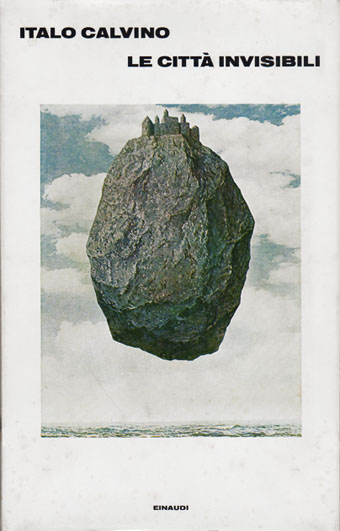
Cover art: The Castle in the Pyrenees (1961) by René Magritte.

A final post for this week devoted to Italo Calvino’s Invisible Cities, and it occurs to me that “Miscellanea” could easily be the name of one of Marco Polo’s cities.

One thing that’s become apparent over the past few days is that this subject is a very popular one with artists, especially in Italy. This is understandable but it also means you could probably fill another week of posts pursuing further illustrations and homages. Rather than belabour things I’m ending with a few of the more notable derivations including some cover designs. The Einaudi volume above was the first printing in Italy in 1972.

cities03.jpg

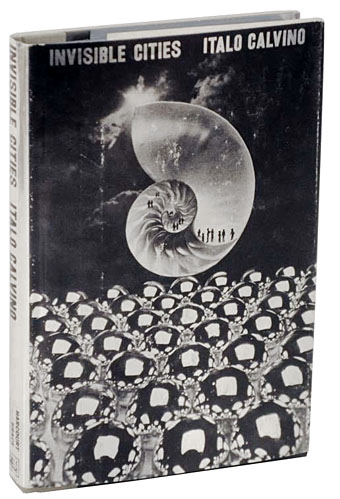
Cover design by Arnold Skolnick.

And this was the first American edition from Harcourt, Brace and Jovanovich in 1974. The cover is printed in silver foil which makes the book a particularly desirable item. This might explain why it’s also rather expensive today.

cities04.jpg

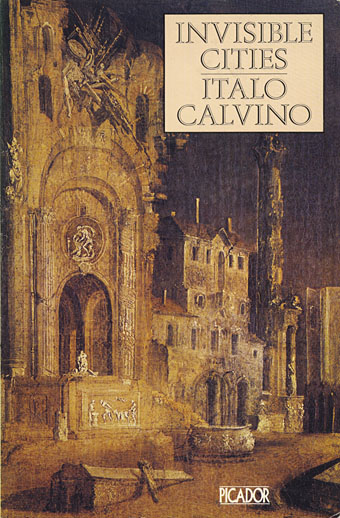
Cover art: Martyrdom of a Saint by Monsù Desiderio.

The 1979 Picador edition is one of two paperback editions I own. The enigmatic “Monsù Desiderio” has a confused identity (see this post), and specialised in curious architectural paintings so this is an apt choice.

Continue reading “Invisible Cities: Miscellanea”

Seeing Calvino: Invisible Cities

seeing1.jpg

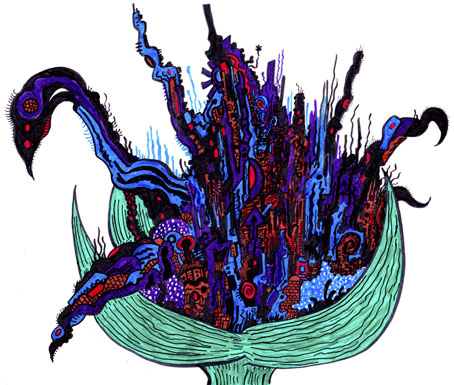
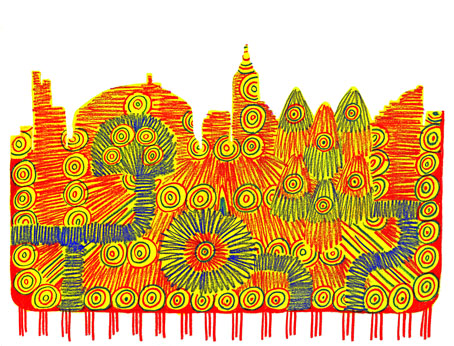
Continuous Cities 4: Cecilia by Leighton Connor.

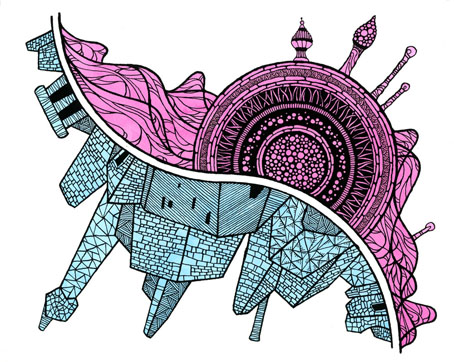
Seeing Calvino is the most recent of the illustration projects featured this week, a group effort by three artists—Leighton Connor, Matt Kish and Joe Kuth—dedicated to picturing all 55 of the Invisible Cities. Matt Kish has been mentioned here before since he and I were among the many artists adapting literary works for The Graphic Canon (2012), a huge three-volume endeavour edited by Russ Kick. (Matt chose Moby-Dick while I worked on the rather less daunting Picture of Dorian Gray.) The depictions for Seeing Calvino are bold, vivid, and almost abstract at times. The trio completed their Invisible Cities project in April this year but there’s a promise on their Tumblr to commence work on an adaptation of Calvino’s astronomical fantasia, Cosmicomics.

seeing2.jpg

Thin Cities 4: Sophronia by Matt Kish.

seeing3.jpg

Cities and the Sky 1: Eudoxia by Joe Kuth.

Elsewhere on { feuilleton }
• The illustrators archive

Previously on { feuilleton }
• Gérard Trignac’s Invisible Cities
• Colleen Corradi Brannigan’s Invisible Cities
• Le Città In/visibili
• Mikhail Viesel’s Invisible Cities
• Bookmark: Italo Calvino
• Crossed destinies revisted
• Crossed destinies: when the Quays met Calvino
• Tressants: the Calvino Hotel

Gérard Trignac’s Invisible Cities

trignac09.jpg

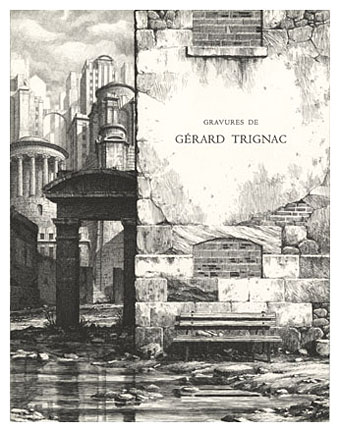
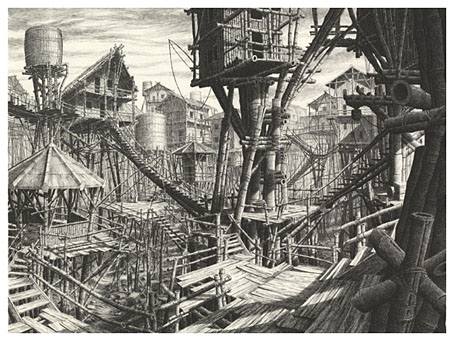
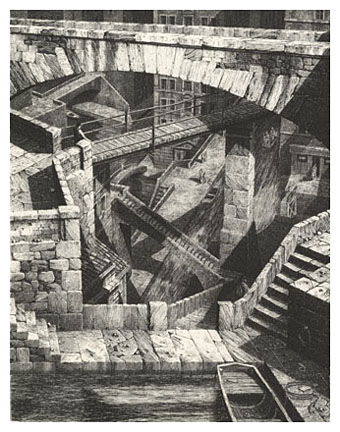
I wrote a short appreciation of French artist Gérard Trignac back in 2006, and he’s been mentioned a few times since, so it would be remiss of me to not include his etchings in this week’s illustration series. Trignac is a favourite of mine among the current crop of French etchers and engravers for his superb renderings of fantastic architecture. Most of this work is from his own imagination but he’s also illustrated Borges (The Immortal) and Calvino, producing plates for expensive limited volumes. Les Villes Invisibles was published in 1993 by Les Amis du Livre, Paris, in an edition of 200. The combination of a small print run with a series of ten etchings makes this a costly volume; the cheapest edition on Abe.com just now is going for €1500.

Scarcity aside, these are marvellous depictions of Calvino’s cities, as detailed and meticulous as any of Trignac’s other works. One thing that becomes apparent when you start looking at illustrations of Calvino’s novel is that artists tend to pick the same few cities. So in Trignac’s case we have more views of Armilla, Octavia, Zenobia and so on. All of these may be seen at Trignac’s website, while one of the expensive volumes is for sale here. For those who can’t afford the latter I recommend Les Portes du Silence (2004), a collection of Trignac’s work that includes all the plates for Les Villes Invisibles, the Borges’ illustrations, and much more besides.

trignac03.jpg

Thin Cities 2: Zenobia.

trignac02.jpg

Trading Cities 5: Esmeralda.

Continue reading “Gérard Trignac’s Invisible Cities”

Colleen Corradi Brannigan’s Invisible Cities

ccb1.jpg

Cities and Memory 5: Maurilia.

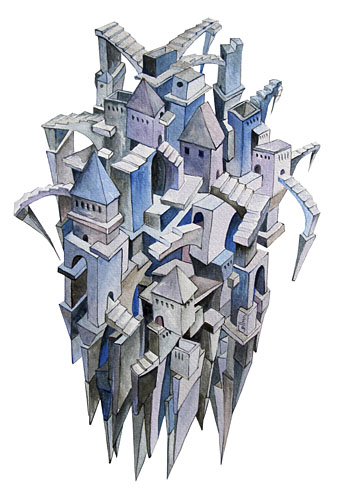
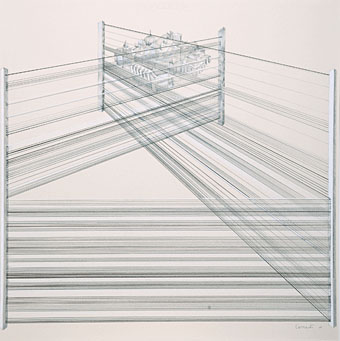
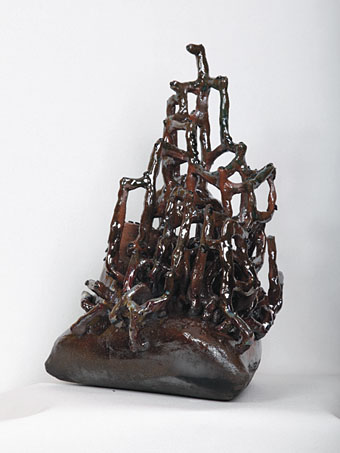
Colleen Corradi Brannigan’s multimedia project was linked here back in 2011 when news of her endeavours reached a number of high-profile websites. These artworks are another attempt to depict all of Italo Calvino’s cities, this time using a range of media that includes sculpture. I like the variety of this series; some of the depictions approach the more rigorous perspectives of MC Escher while others are as loose as Expressionist paintings. The website also includes extracts from Calvino’s descriptions.

ccb2.jpg

Trading Cities 4: Ersilia.

ccb3.jpg

Thin Cities 3: Armilla.

Continue reading “Colleen Corradi Brannigan’s Invisible Cities”